COMPANY PROFILE / SPACE INDUSTRY
Astrobotic Technology
A privately held lunar lander builder that investigated its failed first mission and, in 2026, moved on to its next Moon missions under a U.S. listed parent
Astrobotic Technology, of Pittsburgh, builds landers that carry cargo (payloads) to the Moon. Its first lander, Peregrine, launched in January 2024 but could not land because of a propulsion anomaly. The company published the cause, found by an investigation that included outside experts, and in 2026 it announced two new NASA lunar missions and became a wholly owned subsidiary of the U.S. listed company Voyager Technologies the same month. This profile sets out what role the company plays in space, what it has committed, who it works with and what it is aiming for, using only primary sources from the company, NASA and SEC filings.
- Astrobotic Technology in 30 seconds, and where it stands in the space industry
- The logo and how the name is written
- Where the company sits in the space industry
- Scale
- Resources committed to space
- What it has done so far
- What comes next
- What the company is aiming for in space
- Map of partnerships in the space industry
- Technologies, products and services
- The risks this company carries
- Glossary / References / Claim-to-source audit
1. Astrobotic Technology in 30 seconds, and where it stands in the space industry
Subsidiary of Voyager Technologies100% acquisition closed on 10 July 2026. The parent trades as NYSE: VOYG
November 2026 or laterNASA calls it "Moon Base II". Not yet confirmed
Companies in the space industry are easiest to understand when sorted into four kinds: those that launch rockets, those that go to the Moon or space stations, those that run satellites and services in orbit, and those that build spacecraft parts and systems (Fig. 1 below). Astrobotic Technology is one that goes to the Moon: it builds landers that carry cargo to the Moon, and equipment for power and mobility on the surface. The biggest caution in reading this company is that a company that had been private and had not published its finances became a subsidiary of a listed company in July 2026 Sourced. As a result, we could not confirm the company's stand-alone revenue, profit or headcount from the primary sources we read. What the parent did disclose in SEC filings are the terms of the purchase (price and contingent consideration), and from these we can read how the company is positioned. The name "Astrobotic" is still used on the company's website, but the company says it will now also operate as "Voyager Lunar Systems".
2. The logo and how the name is written

The logo is the company's trademark. We have not recreated it with generated images; we placed the image taken from the official website as img/astrobotic_logo.svg (the original is white lettering, so it sits on a dark navy background).
Note on naming: the legal entity is Astrobotic Technology, Inc., and according to the company's announcement of 13 July 2026 it will also operate under the name "Voyager Lunar Systems" as the lunar business unit of its parent, Voyager Technologies. This article mainly uses "Astrobotic", the name used on the company's website and in most of its material, and distinguishes the two where needed.
Official site: https://www.astrobotic.com/3. Where the company sits in the space industry
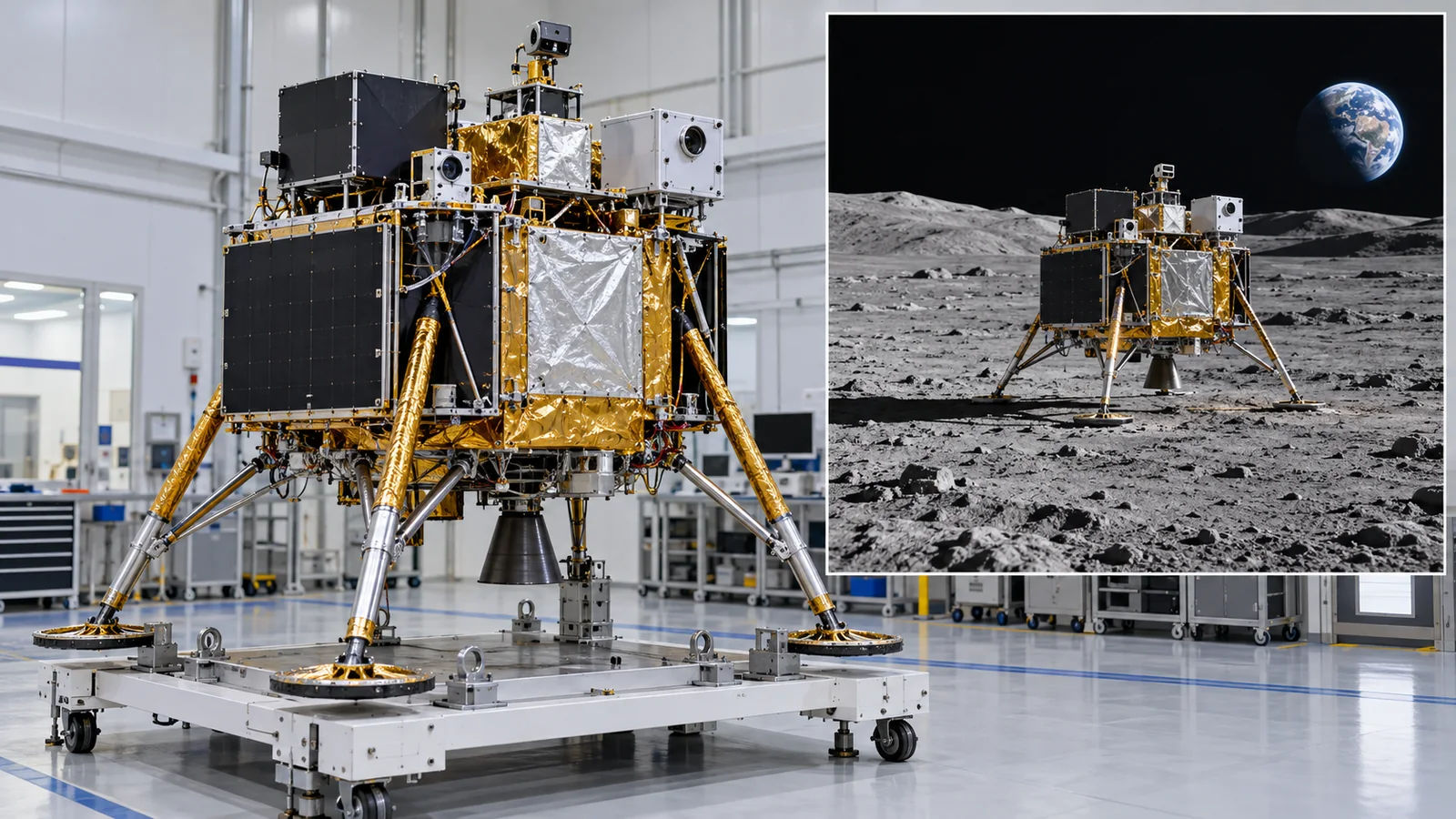
First, two terms. A lander is a spacecraft that descends slowly to the surface of the Moon or another body and sets down. A payload is the "cargo" that a rocket or lander carries: experiment equipment, rovers, instruments from companies. Astrobotic builds the lander and delivers other organisations' payloads to the Moon, in effect a courier service to the Moon. It has two lunar landers: the small Peregrine and the medium-class Griffin.
The Moon has no air, so a parachute is useless. A lander must slow itself using engine thrust alone and set down at a chosen spot. Before that, the engine and fuel tanks must keep working correctly through the days of flight from Earth to the Moon. Astrobotic's first lander, Peregrine, ran into a fuel-system valve problem at the very start of that flight (section 6) Sourced. For the technical details of landers, see our explainers on lunar exploration and Artemis, and on rocket engines and propellants.
4. Scale
The company is privately held, and we could not confirm its stand-alone revenue, profit or headcount in either company material or the parent's filings Not yet confirmed. What we could confirm is the terms the parent, Voyager Technologies, disclosed for the purchase (Form 10-Q filed with the U.S. SEC on 4 August 2026).
| Item (US$ million) | Amount | Explanation |
|---|---|---|
| Ceiling on the purchase price (total) | 300.0 | Base consideration 162.2, assumed debt 9.0 and contingent consideration 128.8 (undiscounted), combined |
| Base consideration and debt, paid at closing (10 July 2026) | 96.1 (cash) plus shares | Together with 2,024,880 Class A common shares of the parent |
| Contingent consideration deemed "earned" | 69.5 | At the time of the 10-Q. To be paid in a mix of cash and shares |
| Remaining contingent consideration | - | Open until 31 March 2028. Varies with what is achieved |
The amounts above are terms of the purchase, not Astrobotic Technology's revenue or valuation. "Contingent consideration" is an amount paid only if later targets (milestones) are met, and is not paid if they are not Not yet confirmed. The parent also says it has not yet completed the allocation of the purchase price (the valuation of assets and liabilities acquired) and plans to report it in its 10-Q for the third quarter of 2026. The only statement of scale the company makes about itself is its claim to have secured more than US$600 million in NASA and Department of Defense contracts in total (company announcement of 2 June 2026; no breakdown could be confirmed). This article gives no valuation or investment judgement.
5. Resources committed to space
The table shows whether primary sources confirm four things: people, money, outside investments and acquisitions, and contracts with public bodies.
| Type of resource | What could be confirmed | Status |
|---|---|---|
| People | Headcount is not disclosed. Sites: the headquarters in Pittsburgh (spacecraft assembly, a clean room, and the mission control centre) and a propulsion and test facility in Mojave, California | Not disclosed (the sites are Sourced) |
| Money: R&D and capital spending | We could not confirm stand-alone amounts from the primary sources we read. The parent says it intends to accelerate investment in Astrobotic's programmes (lunar and reusable rockets) | Could not confirm |
| Money: funding | We could not confirm details of the company's own fundraising. From July 2026 it obtains funds under its parent | Sourced (details: could not confirm) |
| Outside investments, acquisitions, joint ventures, disposals | The company became the party acquired (the parent, Voyager, took 100% on 10 July 2026). We could not confirm any acquisitions, joint ventures or investments by the company itself. Astrolab (the FLIP rover), Mission Control Space Services (Canada, a joint CubeRover mission) and ESA are payload customers or joint-mission partners | Sourced (investments: could not confirm) |
| Contracts and links with public bodies | NASA CLPS (Peregrine Mission One, Griffin Mission One, and the two Peregrine missions announced on 30 June 2026). Use of NASA technology (NDL, a navigation Doppler lidar developed at NASA Langley). NASA ended the VIPER project in July 2024. The company says it has secured over US$600 million in NASA and Department of Defense contracts in total. We cannot separate award value, ceiling and amounts paid, so individual amounts are not given | Sourced |
| University and research links | ESA (carrying LandCam-X) and the Canadian company Mission Control Space Services (BEACON). We could not confirm details of university links | Sourced (universities: could not confirm) |
Status of main vehicles, missions and products (checked 17 October 2026)
| Vehicle or mission | Type | Main specifications (company's stated values) | Record | Stage and date | Source |
|---|---|---|---|---|---|
| Peregrine Mission One | Small lunar lander | About 120 kg of payloads (company website). This flight carried 21 payloads (company statement) | Launched on 8 January 2024 on the first flight of United Launch Alliance's Vulcan rocket. A propulsion anomaly prevented a lunar landing. It operated for 10 days 14 hours, and made a controlled re-entry over the South Pacific on 18 January 2024 | Achieved (no lunar landing) | Ref. 1, 5, 10 |
| Griffin Mission One (NASA name "Moon Base II") | Medium lunar lander | About 625 kg of payloads (company website). Landing site Nobile Crater (lunar south pole). 10 payloads (NASA, ESA, commercial) | Unveiled on 15 June 2026. Shipped in July to NASA's Jet Propulsion Laboratory (JPL) in California for environmental testing | In testing (launch targeted for November 2026 or later; Not yet confirmed) | Ref. 3, 6, 10, 12 |
| Peregrine-2 and Peregrine-3 | Small lunar landers (NASA contracts) | Three NASA payloads per mission (radiation measurement, observation of exhaust effects, a laser reflector). Landing site near the Gruithuisen Domes | None yet | Contract stage (launch planned for 2028; Not yet confirmed) | Ref. 5, 6 |
| CubeRover | Small lunar rover | A small vehicle in standardised sizes (company description) | To be used in the BEACON mission aboard Griffin-1 | Development and test (Not yet confirmed) | Ref. 3, 12 |
| LunaGrid | Lunar surface power service | A concept to generate power with vertical solar arrays (VSAT) and distribute it by wireless chargers and tethered CubeRovers. The company says it is designed to survive the lunar night (down to about -220 degrees C) | None yet | Concept and development (Not yet confirmed) | Ref. 4, 11 |
| Xodiac | Reusable rocket lander for ground testing | Over 600 flights (company statement) | Used to test landing systems | In operation (achieved) | Ref. 13 |
6. What it has done so far
| When | What happened | Meaning |
|---|---|---|
| 2007 | Company founded (company statement) | - |
| July 2019 | The propulsion feed system was contracted to an outside vendor through competitive selection (post-mission report) | Part of Peregrine's propulsion system was outsourced |
| Early 2022 | After technical and supply-chain problems at the vendor, the company ended the vendor contract and decided to complete the feed system in-house | A switch to in-house work to keep the schedule |
| April to November 2022 | While assembling the feed system, the valves that control helium pressure (PCVs) repeatedly failed in testing. In August the company switched to valves from another supplier | The background to the later anomaly, as laid out in the post-mission report's timeline |
| 8 January 2024 | Launched Peregrine Mission One. During pressurisation soon afterwards the propulsion system had an anomaly, and it could not land on the Moon | The flight did not end in a lunar landing |
| 18 January 2024 | Controlled re-entry (over the South Pacific) | On 13 January, in consultation with NASA, the company decided to end the mission so as not to add debris |
| 17 July 2024 | NASA announced it would discontinue VIPER, a rover to search for ice on the Moon. The reasons given were cost increases, delays and the risk of further cost growth. Griffin Mission One continues within its NASA contract | VIPER had been planned to fly on Griffin. NASA said the Griffin launch had also slipped to a similar time |
| August 2024 | Published the post-mission report. A review board of 34 experts, chaired by an outside investigator, concluded that the cause was a mechanical failure of the helium pressure control valve PCV2 (loss of seal) | The company made the cause and the preventive measures public |
| April 2026 | Integrated the navigation Doppler lidar (NDL), developed by NASA, into Griffin-1 | Strengthens measurement of speed and altitude on landing |
| 2 June 2026 | Announced an agreement to be acquired by Voyager Technologies | From private company to subsidiary of a listed company |
| 15 June 2026 | Unveiled Griffin-1 (NASA staff visited) | The stage of final assembly |
| 30 June 2026 | The company announced two NASA Moon Base lunar missions (Peregrine-2 and -3) | A new award after the earlier failure |
| 10 July 2026 | Voyager Technologies completed the acquisition (SEC filing) | It now also operates as "Voyager Lunar Systems" |
A rocket's fuel tanks are kept at pressure by pushing from the inside with helium, a light gas. The valve that lets helium flow or stops it is the PCV. According to the report, PCV2 lost its ability to close tightly (its seal), so helium kept flowing into the oxidizer tank, which suddenly reached a high pressure and ruptured Sourced. The review board writes that it confirmed in a ground-test replication that a threaded joint inside the valve had loosened and that the O-ring that seals it had been damaged. To avoid one valve failure losing the whole mission, future landers will use several valves of different designs. The investigation also explains, in a timeline, the decisions made when the feed system was moved from an outside vendor to in-house work, and why replacing the valve would have meant repeating completed acceptance tests.
7. What comes next
The company writes that, after Griffin-1 launches, it will operate the mission from its Pittsburgh mission control centre, through the transit to the Moon, the landing and payload operations after touchdown Sourced. These timings are the company's targets and can change with test results and the availability of launch vehicles Not yet confirmed.
None of the following is firmly stated in the primary sources we read Not yet confirmed.
The Griffin-1 launch date (day and month), and any company announcement newer than 13 July 2026 / the launch dates of Peregrine-2 and -3 / the latest contract value of Griffin-1 and the full list of payloads, which has changed since August 2024 / the company's stand-alone revenue, headcount and R&D expense / any flight plan for LunaGrid. Dates and amounts in news coverage or on third-party sites cannot be confirmed from primary sources and are not used here.
8. What the company is aiming for in space
This section includes points the company does not state directly. We set them out as inferences that can be read from primary sources, with the basis for each.
| What can be read | Primary basis | Status |
|---|---|---|
| The aim is to move from "one-off deliveries" to a base that keeps running on the Moon (carrying, power, mobility) | The company presents lunar landers, rovers, lunar surface power (LunaGrid) and reusable rockets as one business. The parent calls this a "lunar platform" | Sourced (company description) |
| It expects funding constraints to ease under Voyager | The company and the parent say they will "accelerate investment" and give "scale, resources and long-term commitment" | Inference |
| NASA's lunar programme (Moon Base) policy is the largest external factor | The company describes NASA's new procurement (CS-8) as targeting up to 30 lunar landings from 2027. As the VIPER cancellation shows, NASA policy changes feed straight into contracts | Sourced |
| The second Peregrine award may not be unrelated to having identified and published the cause of the failure and set out corrective measures | We could not find a primary source in which NASA states its reasons for selection. The company published the cause and corrective measures in its post-mission report | Inference |
The 2024 post-mission report sets out, in a timeline, the decisions that led up to the failure of PCV2. They include moving the feed system in-house after vendor problems, changing the valve supplier, and the fact that PCV2 sat deep inside the vehicle so that replacing it would have meant repeating completed acceptance tests, so the company recognised the risk and decided to fly as it was Sourced. To avoid repeating such a decision, the company says it has added quality-management staff, placed its own staff at suppliers, and made critical parts redundant with several valves of different designs. From this we read that the openness has become a base of trust with customers such as NASA, helping it win the next contracts Not yet confirmed.
9. Map of partnerships in the space industry
10. Technologies, products and services
| Category | Content (company's description) | Status |
|---|---|---|
| Lander: Peregrine | A small lunar lander. About 120 kg of payloads, with payload operations for one lunar day (192 hours). Landing precision about 100 m. Base prices on the company's website are US$1.2 million per kg to the surface and US$300 thousand per kg to lunar orbit (company's stated values; they differ by contract) | Sourced (company's stated values) |
| Lander: Griffin | A medium-class lunar lander. About 625 kg of payloads. The company says it has five times Peregrine's carrying capacity and can take rovers the size of a compact car. Prices are US$1.2 million per kg to the surface and US$300 thousand per kg to lunar orbit (company website) | Sourced (company's stated values). First flight: Not yet confirmed |
| Sensors for safe landing | In addition to terrain relative navigation (TRN: working out position by looking at the terrain) and hazard detection, it has integrated the navigation Doppler lidar (NDL) developed at NASA's Langley Research Center. Using laser pulses and the Doppler effect, it measures how fast the vehicle is moving relative to the ground and how high it is | Sourced |
| Rover: CubeRover | A small lunar rover that uses commercial off-the-shelf parts. The company describes it as "CubeSats for the lunar surface" | Sourced (flight: Not yet confirmed) |
| Lunar surface power: LunaGrid | A concept for selling power "by the watt" on the lunar surface. Vertical solar arrays (VSAT) generate power, which is distributed by wireless chargers and tethered CubeRovers. Designed to survive the lunar night (down to about -220 degrees C). Under development with NASA's Space Technology Mission Directorate. The company's website says "as early as 2026", but we could not confirm a flight plan from the primary sources we read | Not yet confirmed |
| Propulsion and test | A propulsion and test facility in Mojave, California. Landing systems are tested on Xodiac, a reusable rocket lander for ground testing. The company says it has "over 600 flights" | Sourced |
| MoonBox | A service of small capsules in which individuals and groups can send keepsakes to the Moon | Sourced (company website) |
The Peregrine findings teach a lot from the point of view of materials and parts Sourced. The failed valve showed loosening of a threaded joint under vibration and damage to the O-ring (a rubber-like sealing part). A spacecraft is shaken and shocked hard at launch. That makes thread locking, the material and compression of O-rings, and leak testing after vibration important. The company reports that in a ground test, giving a spare valve qualification-level shock and vibration and repeated pressure cycles produced a leak rate about the same as in flight. It also says that, going forward, it will test valves at the component level for the same kind of sealing flaw, and use several valves of different designs. This is an example of tying choices such as "cheap but weak against vibration" or "expensive but proven" to the design of vehicle reliability (for the materials, see our explainers on the space environment and its effects on materials, on how to read space-materials evaluations, and on rocket engines and propellants).
11. The risks this company carries
| Risk | Content | Status |
|---|---|---|
| No lunar landing yet | The first vehicle, Peregrine, did not land on the Moon. The next one, Griffin-1, will be the company's first real attempt at a lunar landing | Sourced |
| Schedule slips | The August 2024 report said Griffin Mission One would launch "by the end of 2025"; the company's announcement of July 2026 says "November 2026 or later". The VIPER cancellation also had the Griffin delay in its background | Sourced |
| Parts supply and quality | The cause on the first vehicle was the failure of a valve whose supplier had been changed. The company says it will prevent a repeat by measures such as placing its staff at suppliers | Sourced |
| Dependence on NASA policy | The core contracts are NASA's CLPS. NASA ended VIPER in 2024 and in 2026 is moving ahead with Moon Base orders (CS-8). A change of policy feeds straight into contracts | Sourced |
| Finances not visible | It was private, and from July 2026 it is a subsidiary, so its stand-alone revenue, profit and headcount are not published | Sourced |
| Integration after the acquisition | The parent says it has not yet completed the allocation of the purchase price. Changes to how the business is run under new management cannot be confirmed at present | Inference (the difficulty of integration is a general point) |
| Contingent consideration | Part of the purchase price depends on achieving targets by the end of March 2028. Achieving them could influence management priorities | Inference |
| Export control and regulation | Spacecraft bound for the Moon are subject to export controls (ITAR and EAR), the FAA, the FCC and others. Launch licensing and frequency procedures can affect schedules (a general point; we could not confirm company-specific statements) | Inference |
12. Glossary
- Lander
- A spacecraft that makes a soft landing (sets down gently) on the Moon or another body.
- Payload
- The cargo a spacecraft carries, such as experiment equipment or rovers.
- CLPS
- Commercial Lunar Payload Services. A NASA programme that buys delivery of cargo to the Moon from commercial landers.
- Moon Base
- NASA's 2026 plan to build a permanent presence on the lunar surface. Company announcements use names such as "Moon Base II".
- Task order
- An individual order for a single mission, issued within the CLPS framework.
- PCV
- Pressure control valve. A valve that lets helium flow to adjust the pressure in fuel tanks.
- Oxidizer
- A liquid containing oxygen that is needed to burn the fuel. It is kept in a separate tank from the fuel.
- Re-entry
- A spacecraft's return into Earth's atmosphere.
- TRN
- Terrain relative navigation. Working out position by looking at the terrain.
- NDL
- Navigation Doppler lidar. A sensor that measures speed and altitude with a laser and the Doppler effect.
- CubeRover
- A small rover in standardised sizes developed by the company.
- VSAT
- Vertical Solar Array Technology. Solar arrays stood upright so they can generate power even in the Moon's low sunlight.
- Contingent consideration
- The part of an acquisition price paid only if targets set after the purchase are met.
- 10-Q / 8-K
- Quarterly and current reports filed with the U.S. SEC.
13. References
- Astrobotic Technology PEREGRINE: MISSION 1 Post-Mission Report (August 2024). The launch, the propulsion anomaly, the review board's analysis, the timeline and the forward actions. https://www.astrobotic.com/wp-content/uploads/2024/08/PM1_Post-Mission-Report_Website.pdf
- NASA NASA Ends VIPER Project, Continues Moon Exploration (17 July 2024, RELEASE24-094). The reasons for ending VIPER and the continuation of Griffin Mission One. https://www.nasa.gov/news-release/nasa-ends-viper-project-continues-moon-exploration/
- Astrobotic Technology Press release "Griffin-1 Lunar Lander Unveiled Ahead of Environmental Testing" (15 June 2026). The unveiling of Griffin-1, its payloads, environmental testing and launch plan. https://www.astrobotic.com/griffin-1-lunar-lander-unveiled-ahead-of-environmental-testing/
- Astrobotic Technology Press release "Astrobotic to Join Voyager Technologies, Accelerating America's Moon Base" (2 June 2026). The acquisition agreement and the company's own description (founding year, contract total). https://www.astrobotic.com/astrobotic-to-join-voyager-technologies-accelerating-americas-moon-base/
- Astrobotic Technology Press release "Astrobotic Awarded 2 NASA Contracts for CLPS Moon Base Missions" (30 June 2026). The awards for Peregrine-2 and -3, their payloads, and Peregrine-1's 21 payloads. https://www.astrobotic.com/astrobotic-awarded-2-nasa-contracts-for-clps-moon-base-missions/
- Astrobotic Technology / Voyager Technologies Press release "Voyager awarded $298M NASA contract under completed Astrobotic acquisition" (13 July 2026). Completion of the acquisition, operation as "Voyager Lunar Systems", and the target time for Griffin Mission One. https://www.astrobotic.com/voyager-awarded-298m-nasa-contract-under-completed-astrobotic-acquisition/
- Voyager Technologies, Inc. Form 10-Q for the quarterly period ended June 30, 2026 (filed with the U.S. SEC on 4 August 2026). The terms of the Astrobotic acquisition, its closing date and the contingent consideration. https://www.sec.gov/Archives/edgar/data/1788060/000162828026052292/voyg-20260630.htm
- Voyager Technologies, Inc. Form 8-K (filed 4 June 2026, Item 3.02). The merger agreement and how the share consideration works. https://www.sec.gov/Archives/edgar/data/1788060/000162828026040850/voyg-20260601.htm
- Astrobotic Technology Blog "NDL Integrated with Griffin-1" (30 April 2026). The integration of the navigation Doppler lidar and the sensors for safe landing. https://www.astrobotic.com/ndl-integrated-with-griffin-1/
- Astrobotic Technology Official website, "Landers" page. The carrying capacity and base prices of Peregrine and Griffin. https://www.astrobotic.com/lunar-delivery/landers/
- Astrobotic Technology Official website, "Lunar Surface Power (LunaGrid)" page. https://www.astrobotic.com/lunar-delivery/lunar-surface-power/
- Astrobotic Technology Official website, "Manifest: What's On Board" page. Griffin-1's landing site and payloads. https://www.astrobotic.com/lunar-delivery/manifest/
- Astrobotic Technology Official website (source of the logo; introduction of Xodiac and others). https://www.astrobotic.com/
14. Claim-to-source audit
| Claim in the text | Status | Source |
|---|---|---|
| Founded 2007, over US$600 million in NASA and Department of Defense contracts (company statement), locations of headquarters and facilities | Sourced (company statement) | Reference 4 https://www.astrobotic.com/astrobotic-to-join-voyager-technologies-accelerating-americas-moon-base/ |
| Acquisition by Voyager Technologies (agreement 1 June 2026, closed 10 July), price and contingent consideration, and that the purchase price allocation is not yet complete | Sourced | Reference 7 https://www.sec.gov/Archives/edgar/data/1788060/000162828026052292/voyg-20260630.htm |
| The merger agreement and how the share consideration works | Sourced | Reference 8 https://www.sec.gov/Archives/edgar/data/1788060/000162828026040850/voyg-20260601.htm |
| Operation as "Voyager Lunar Systems", the Griffin Mission One target (November 2026 or later), 10 payloads, the description of NASA's CS-8 | Sourced (company statement) | Reference 6 https://www.astrobotic.com/voyager-awarded-298m-nasa-contract-under-completed-astrobotic-acquisition/ |
| Peregrine Mission One's launch, anomaly, days of operation, re-entry, distance, the review board's analysis, the timeline and the corrective measures | Sourced | Reference 1 https://www.astrobotic.com/wp-content/uploads/2024/08/PM1_Post-Mission-Report_Website.pdf |
| Peregrine-1 carried 21 payloads; the awards for Peregrine-2 and -3 and their payloads | Sourced (company statement) | Reference 5 https://www.astrobotic.com/astrobotic-awarded-2-nasa-contracts-for-clps-moon-base-missions/ |
| NASA ended VIPER (17 July 2024) and Griffin Mission One continues | Sourced | Reference 2 https://www.nasa.gov/news-release/nasa-ends-viper-project-continues-moon-exploration/ |
| The unveiling of Griffin-1, its payloads (BEACON, LandCam-X, FLIP), environmental testing | Sourced | Reference 3 https://www.astrobotic.com/griffin-1-lunar-lander-unveiled-ahead-of-environmental-testing/ |
| Griffin-1's landing site (Nobile Crater) and its list of payloads | Sourced | Reference 12 https://www.astrobotic.com/lunar-delivery/manifest/ |
| The carrying capacity and base prices of Peregrine and Griffin | Sourced (company's stated values) | Reference 10 https://www.astrobotic.com/lunar-delivery/landers/ |
| The integration of NDL, TRN and hazard detection | Sourced | Reference 9 https://www.astrobotic.com/ndl-integrated-with-griffin-1/ |
| The LunaGrid concept (VSAT, wireless charging, designed to survive the lunar night) | Not yet confirmed | Reference 11 https://www.astrobotic.com/lunar-delivery/lunar-surface-power/ |
| Xodiac's flight record (over 600) | Sourced (company statement) | Reference 13 https://www.astrobotic.com/ |
| The four company types in Fig. 1 | Our calculation | Our own arrangement (companies shown are examples from this series) |
| The Griffin-1 launch date (day and month), Peregrine-2 and -3 launch dates, any LunaGrid flight plan, any company announcement newer than 13 July 2026 | Not yet confirmed | Outlook: not firmly stated in the primary sources we read. Dates from news reports are not used |
| Stand-alone revenue, headcount, R&D expense and fundraising | Not yet confirmed | Outlook: we could not find them in company material or filings. We do not claim they are absent or small |
| Contract values for Griffin-1 and for each of Peregrine-2 and -3 | Not yet confirmed | Outlook: the primary sources we read do not let us separate award value, ceiling and amounts paid, so we do not give them |
| The reading of the aims under Voyager (a lunar platform, eased funding constraints) | Inference | Our own interpretation (basis: References 4 and 6) |
| The reading of the link between the second Peregrine award and publishing the cause of the failure | Inference | Our own interpretation (NASA's reasons for selection could not be confirmed) |
| Risks from post-acquisition integration, contingent consideration, and export control and regulation | Inference | Our own interpretation (general points) |
Last updated: 17 October 2026 / Troy Technical
The figures in this article are based on Astrobotic Technology's official material, NASA's official announcements and filings made by Voyager Technologies, Inc. with the U.S. SEC. We have not used market-research estimates or figures that appear only in press coverage. Passages marked "Inference" are our reading of primary information, not statements by the company. Purchase terms are given only as the parent disclosed them, and no valuation or investment judgement is made.