COMPANY PROFILE / SPACE INDUSTRY
Astroscale
A company that has flown close to real space junk, and now seeks repeat orders for life extension, refuelling and removal
Astroscale is a Tokyo company in the business of "in-orbit services": going up to retired satellites and space debris to inspect, capture, refuel and more. In 2024 the company says its ADRAS-J satellite flew around a real piece of debris, an upper stage of a Japanese H-IIA rocket, at about 50 m, and in the end closed to about 15 m (including the company's claim to be the first private company to do so). Its revenue is still small, however, and it continues to report operating losses. This profile sets out what role the company plays in space, what it has committed, who it works with and what it is aiming for, using only its securities report and its latest disclosure material.
- Astroscale in 30 seconds, and where it stands in the space industry
- The logo and how the name is written
- Where the company sits in the space industry
- Scale
- Resources committed to space
- What it has done so far
- What comes next
- What the company is aiming for in space
- Map of partnerships in the space industry
- Technologies, products and services
- The risks this company carries
- Glossary / References / Claim-to-source audit
1. Astroscale in 30 seconds, and where it stands in the space industry
ADRAS-J (2024)A debris-removal technology demonstration, and approach and observation of real debris
within the year to April 2027A refuelling demonstration for the U.S. Space Force (company plan). Not yet confirmed
Companies in the space industry are easiest to understand when sorted into four kinds: those that launch rockets, those that go to the Moon or space stations, those that run satellites and services in orbit, and those that build spacecraft parts and systems (Fig. 1 below). Astroscale is one that runs satellites and services in orbit: it designs and builds its own satellites, has rocket companies launch them, and then serves customers' satellites or debris in space. Its securities report organises the business into five in-orbit services (inspection, life extension and refuelling, repair and upgrade, removal of existing debris, and end-of-life removal) and says that by 2030 it plans to launch multiple missions in three of them (inspection, life extension and refuelling, and debris removal) Sourced. However, revenue still comes mainly from development and demonstration contracts with government bodies, and the company says that "winning repeat orders is essential for the business to turn profitable" (October 2026 business briefing material).
2. The logo and how the name is written

The logo is the company's trademark. We have not recreated it with generated images; we placed the logo used in the header of the official website as img/astroscale_logo.svg (it is single-colour, so we show it in white on a dark navy background).
Note on naming: the listed holding company is Astroscale Holdings Inc., a separate legal entity from its Japanese operating company, Astroscale Japan (kabushiki gaisha Astroscale). The UK business is Astroscale Ltd, the U.S. business is Astroscale U.S. Inc., and the French business is Astroscale France SAS. Unless stated otherwise, "Astroscale" in this article means the whole group.
Official site: https://www.astroscale.com/3. Where the company sits in the space industry
First, three terms. Debris (space debris) is "space junk": retired satellites, rocket upper stages and fragments of them. It moves at 7 to 8 km per second, so even a fragment a few millimetres across can do serious damage to a satellite. Low Earth orbit (LEO) is the orbit at altitudes up to 2,000 km, and geostationary orbit (GEO) is the orbit at about 36,000 km where a satellite appears fixed in the sky. A servicer is the spacecraft (the capture vehicle) that approaches another satellite or debris to serve it.
Citing ESA (the European Space Agency), the securities report says that in June 2026 there were about 54,000 trackable pieces of debris 10 cm or larger, about 1.2 million including pieces of a few centimetres, and about 15,800 working satellites Sourced (ESA figures quoted by the company). Cars and aircraft have systems for inspection, repair and scrapping, but satellites have long been "single-use", and broken ones stay in orbit. Astroscale is trying to make this "aftercare for space" a business. For the technical details of debris, see our explainer on in-orbit servicing and space debris. The securities report also contains an estimate of the in-orbit services market from a research firm; this article does not use research-firm estimates, so we do not adopt it.
4. Scale
As a listed company, its scale can be checked in statutory filings Sourced. The fiscal year runs from May to April; figures are consolidated under International Financial Reporting Standards (IFRS), in thousands of yen.
| Measure (¥ thousand) | Year to April 2024 | Year to April 2025 | Year to April 2026 |
|---|---|---|---|
| Revenue | 2,852,561 | 2,456,956 | 5,940,615 |
| Operating loss | Not tallied in this article | (18,755,004) | (9,975,386) |
| Loss before tax | (9,219,842) | (21,550,288) | (6,695,854) |
| Loss attributable to owners of the parent | (9,181,329) | (21,551,603) | (7,114,985) |
| Total assets | 24,990,809 | 33,625,291 | 32,121,830 |
| Cash and cash equivalents (period end) | 14,196,227 | 21,300,864 | 10,021,823 |
| Cash flow from operating activities | (12,822,877) | (12,250,750) | (12,485,991) |
| Employees | 494 | 577 | 593 |
In the year to April 2026 revenue more than doubled, but the operating loss was about ¥9.98 billion, so the company is not yet profitable. The company explains that its losses continue because it is "engaged in R&D of satellites and space equipment that need large up-front investment and long development periods" Sourced. "Project revenue" (revenue plus government subsidy income tied to projects, a company-defined reference figure; ¥11,506,710 thousand in the year to April 2026) is not an IFRS measure, and the company itself notes that it should not be treated as a substitute for other measures. The company also writes that the smaller operating loss in the year to April 2026 is mainly because it began to capitalise (book as an asset, instead of expensing) the manufacturing cost of its life-extension satellite LEXI-P. A smaller loss does not necessarily mean that the business itself has become more profitable.
5. Resources committed to space
The table shows whether primary sources confirm four things: people, money, outside investments and acquisitions, and contracts with public bodies.
| Type of resource | What could be confirmed | Status |
|---|---|---|
| People | 593 consolidated (30 April 2026): engineering 158 in Japan and 279 overseas; shared functions 71 in Japan and 85 overseas. Engineers are about 70% of staff. Sites in Japan (the Tokyo headquarters and a ground station in Yokohama), the UK, the U.S., France and Israel | Sourced |
| Money: R&D expense | ¥7,533,569 thousand in the year to April 2026. Of this, ¥6,892,872 thousand is for subsidised government projects (APS-R, ISSA-J1, REFLEX-J and others) and ¥257,970 thousand is up-front development before any order. The costs of subsidised projects are matched by government subsidy income recorded separately in revenue | Sourced |
| Money: capital spending | ¥7,054,716 thousand in the year to April 2026 (including intangible assets). Mainly the U.S. subsidiary's life-extension satellite LEXI-P (procuring and building the satellite bus, capture mechanism, thrusters and so on) | Sourced |
| Money: funding | ¥10,985 million from an overseas share offering in May 2025 (estimated net proceeds ¥10,660 million). ¥30,600 million in May 2026 from euro-yen convertible bonds with share acquisition rights, a third-party allotment and related issues. Financing cash flow in the year to April 2026 was an inflow of ¥7,236,403 thousand | Sourced |
| Outside investments, acquisitions, joint ventures, disposals | In June 2020 the Israeli subsidiary took over the life-extension business of Effective Space Solutions R&D Ltd. Subsidiaries were set up (UK 2017, U.S. 2019, Israel 2020, France 2023). We could not confirm any investments in partners from the primary sources we read | Sourced (investments: could not confirm) |
| Contracts and links with public bodies | JAXA (Commercial Removal of Debris Demonstration, CRD2), the SBIR fund of Japan's Ministry of Education, Culture, Sports, Science and Technology (MEXT), the Japan Science and Technology Agency (JST) programme for economic-security technologies, JAXA's Space Strategy Fund, ESA, the UK Space Agency, France's CNES, NASA (its first direct contract, January 2026), the U.S. Space Force, Japan's Ministry of Defense and the UK Ministry of Defence, among others. Amounts are shown in the table below, separating total awards, orders already placed and expectations | Sourced |
| University and research links | Joint development of a "refuelling-port coupling system" with Honda R&D (REFLEX-J). We could not confirm joint research with universities from the primary sources we read | Sourced (universities: could not confirm) |
Main public funding and contracts (checked 17 October 2026. Amounts are from company material, using the company's exchange-rate assumptions of US$1 = ¥155, €1 = ¥180 and £1 = ¥205)
| Project | Content | Amount | Status |
|---|---|---|---|
| ADRAS-J (JAXA CRD2 Phase I) | Observation and inspection of real debris | ¥1.9 billion (total award, partly funded by the company) | Demonstration complete (March 2026) |
| ADRAS-J2 (JAXA CRD2 Phase II) | A demonstration to capture the same rocket upper stage and lower its orbit | About ¥12.0 billion (fully funded by the customer; contract period fiscal 2025 to 2029) | In development. Launch in the year to April 2028 (company plan; Not yet confirmed) |
| ELSA-M (ESA and Eutelsat OneWeb "Sunrise") | Removal of retired communications satellites (end-of-life removal service) | €31.6 million (phases 2 to 4 combined; phase 4 is €13.95 million; partly funded by the company) | In development and ground testing. Launch in the year to April 2028 (company plan) |
| ISSA-J1 (SBIR fund) | Observation and inspection of large satellites and similar | ¥12.0 billion in total (phase 2 is ¥6.5 billion; phase 3 is not yet contracted; in October 2026 the phase 2 contract amount rose by ¥249 million) | In development. Launch in fiscal 2027/28 (company plan) |
| REFLEX-J (JST and Space Strategy Fund) | Refuelling technology for cooperative satellites | ¥10.8 billion in total (first and second years contracted; third year onward is an expectation) | In development. Launch in fiscal 2030 (company plan) |
| CNES project (with Exotrail) | A demonstration of capturing OneWeb satellites with magnets and removing them | €13.2 million (about ¥2.3 billion) | Contracted from August 2026. Launch in fiscal 2029/30 (company plan) |
| CAT-IOD (UK) | The preparatory stage of an in-orbit debris-removal demonstration | Phase A is €0.59 million. The follow-on is €50 to 60 million (the company's estimate; not yet ordered) | Not yet confirmed |
| APS-R (U.S. Space Force) | A refuelling demonstration in geostationary orbit | We could not confirm the amount from the primary sources we read (the company describes it as partly funded by itself) | Launch planned within the year to April 2027 (Not yet confirmed) |
Some of the "totals" above include later phases not yet contracted and company estimates (ISSA-J1 phase 3, REFLEX-J from year three, the CAT-IOD follow-on). The company itself writes that expected amounts are not guaranteed orders. Japanese subsidies and funds can also change in amount after review. The company says it has also won orders from defence bodies, but this article does not cover military uses in detail.
Status of main vehicles, missions and products (checked 17 October 2026)
| Vehicle or mission | Type | Main specifications (company's stated values) | Record | Stage and date | Source |
|---|---|---|---|---|---|
| ELSA-d | Debris-removal technology demonstration satellite (end-of-life, EOL) | A pair of a capture vehicle and a simulated-debris client. Captures with magnets and a docking plate | Launched into a 550 km orbit in March 2021. Captured simulated debris in August 2021. Operated for over two years | Achieved (complete) | Ref. 1 |
| ADRAS-J | Debris observation and inspection demonstration satellite | Launched on Rocket Lab's Electron | Launched 18 February 2024. The target was the second stage of H-IIA rocket flight 15 (launched January 2009). Approached to about 50 m on 23 May 2024, flew around it in July, and approached to about 15 m on 30 November. Finished all demonstrations on 25 March 2026 and began lowering its orbit | Achieved (complete) | Ref. 1 |
| ELSA-M | End-of-life removal for satellite constellations (EOL) | Designed to remove several satellites. Captures with magnets | Completed the critical design review (CDR) in June 2025. A 2023 structural test found structural weaknesses in some parts and delayed development (company statement) | In development (launch planned in the year to April 2028; launch contract with Isar Aerospace's Spectrum; Not yet confirmed) | Ref. 1, 2 |
| ISSA-J1 | Observation and inspection satellite | To launch on India's PSLV under a contract with NewSpace India | None yet | In development (fiscal 2027/28; Not yet confirmed) | Ref. 1, 2, 3 |
| APS-R | Refuelling demonstration satellite | None given | In ground testing | Development and test (launch planned within the year to April 2027; Not yet confirmed) | Ref. 1, 2 |
| LEXI-P | First life-extension satellite (for commercial customers) | A capture mechanism that grips the circular structure (PAR) that connects a satellite to its rocket | In the final stage of working towards a contract with an expected customer. No contract signed | Development (launch planned in the year to April 2028; Not yet confirmed) | Ref. 1, 2 |
| Docking plate | A magnetic capture plate fitted to satellites | A magnetic plate with identification markers | 571 satellites carry them in orbit (including third-party plates, as of the filing date). All Eutelsat OneWeb satellites launched since December 2020 carry them. More than 1,000 satellites are expected to carry them in future | In operation (achieved) | Ref. 1 |
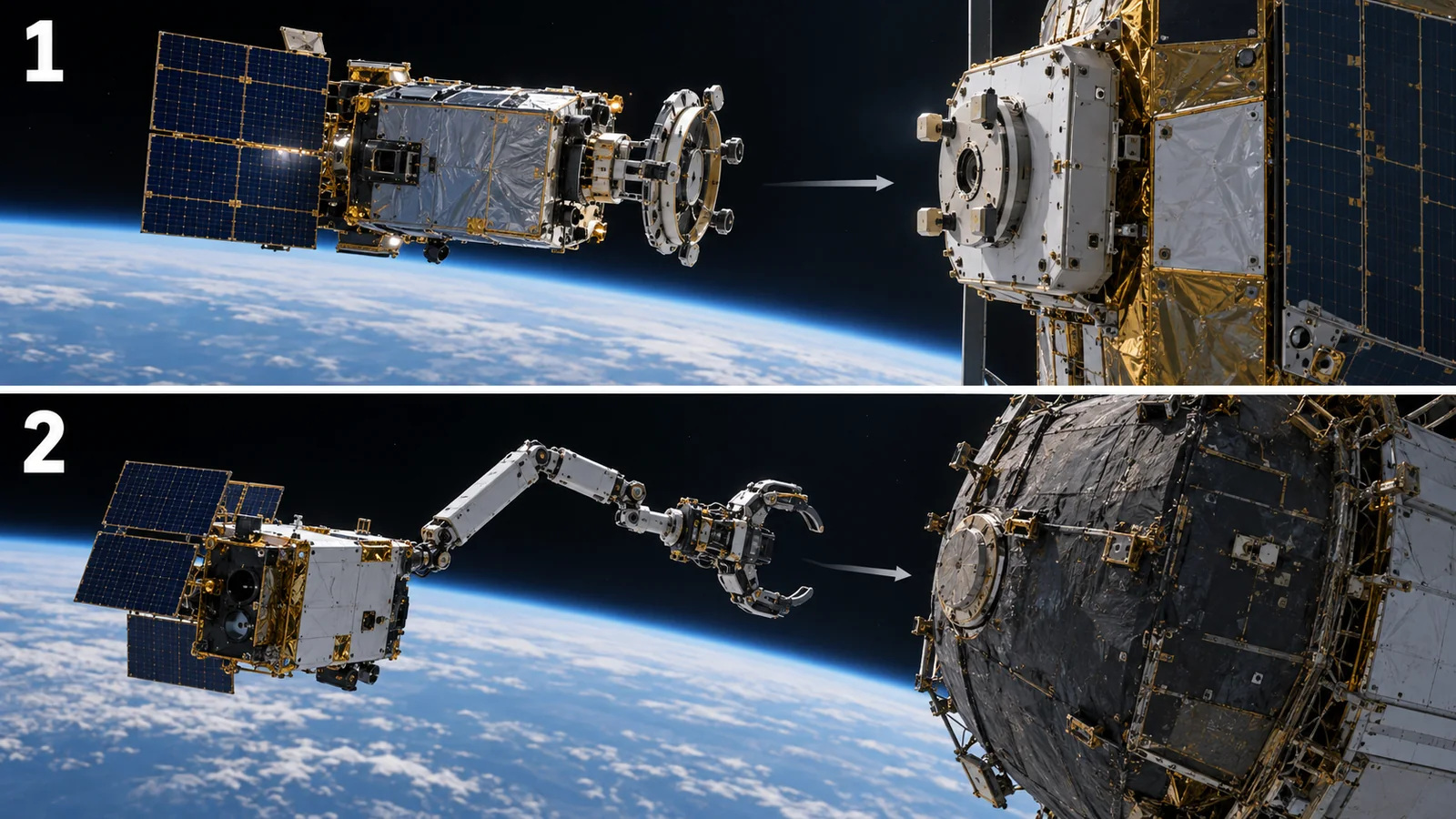
Astroscale uses two capture methods Sourced. The magnetic method works with a docking plate (a magnetic plate with identification markers) fitted to the satellite in advance, to which the servicer's magnet attaches. The arm method uses a robotic arm to grab debris that carries no plate. The company says the magnetic method lets the plate be a cheap part and lowers the difficulty of capture. The capture mechanism of the life-extension satellite LEXI is designed to grip the payload adapter ring (PAR), the structure where a satellite meets its rocket, and is described as light and able to take rings of various sizes. On materials and structure, the securities report records that in the ELSA-M structural test (April 2023) structural weaknesses were found in some parts, and that additional testing delayed development. A spacecraft structure must withstand the vibration and shock of launch, and the newer the mechanism's shape, the more likely a weak point is to appear only in testing. The company writes that it uses rules conforming to the aerospace quality-management standard AS/EN/JIS Q 9100 for quality assurance (for the technology, see our explainers on in-orbit servicing and space debris, spacecraft thermal control, and the space environment and its effects on materials).
6. What it has done so far
| When | What happened | Meaning |
|---|---|---|
| May 2013 | Founder Mitsunobu Okada started the company in Singapore. The company describes itself as the first private company aimed at removing debris | A company that started from debris removal |
| 2015 to 2019 | Subsidiaries were set up in Japan (2015) and the UK (2017). A holding company was set up in Tokyo in November 2018 and became the parent in the January 2019 reorganisation | Moving to a Tokyo-headquartered structure |
| June 2020 | The Israeli subsidiary took over a life-extension business | From low Earth orbit services to geostationary orbit services |
| March 2021 | Launched ELSA-d (after obtaining a UK Space Agency mission licence) | The first satellite to demonstrate the chain of debris-removal technologies |
| August 2021 | ELSA-d captured simulated debris | Demonstrated capture with magnets and a docking plate |
| 18 February 2024 | Launched ADRAS-J (Mahia Peninsula, New Zealand, on Rocket Lab's Electron) | Phase I of JAXA's CRD2 |
| 5 June 2024 | Listed on the Tokyo Stock Exchange Growth Market | A way to raise capital |
| May to November 2024 | ADRAS-J approached to about 50 m behind real debris, held position and orbited it, then made a final approach to about 15 m. The company says it also confirmed the automatic abort function that steers away to avoid a collision | The company claims a world first for a private company (a claim based on the company's own research) |
| August 2024 | Signed the ADRAS-J2 contract with JAXA (capture of debris and lowering its orbit) | From observation to capture |
| May 2025 | Raised ¥10,985 million in an overseas offering. Completed COSMIC phase 2 | - |
| June 2025 | Completed the ELSA-M critical design review (CDR) | - |
| January 2026 | Selected for a NASA study (in-orbit servicing for the Habitable Worlds Observatory). Its first direct contract with NASA | The start of direct dealings with a U.S. space-science agency |
| March 2026 | ADRAS-J finished all demonstrations and began lowering its orbit. Signed with Isar Aerospace for ELSA-M's launch | A milestone in the demonstrations |
| May 2026 | Raised ¥30,600 million from convertible bonds, a third-party allotment and related issues | Growth investment aimed at repeat orders |
| October 2026 | Disclosed an increase in the ISSA-J1 phase 2 contract amount (¥249 million). The same month's business briefing material records the follow-on mission of the UK debris-removal programme COSMIC as "lost" | One expected opportunity dropped out. The company says the expected total for government projects (about ¥61.0 billion) is unchanged regardless of COSMIC |
Debris does not announce its position and may be tumbling. So getting close at all is hard. ADRAS-J came in from far away, a little at a time (hundreds of metres, then about 50 m), and the company writes that it used "relative navigation", working out position by watching the debris's shape and orientation with an infrared camera Sourced. It also confirmed that the function that moves away automatically, the "abort", works. Finally it went round beneath the structure (the PAF), the mount between rocket and satellite that is assumed to be the capture point in the future ADRAS-J2, and closed to about 15 m. That is the "observation" part; the capture itself is planned for the next mission, ADRAS-J2.
7. What comes next
In its securities report the company writes that by 2030 it will launch multiple missions each in inspection, life extension and refuelling, and debris removal, and by 2035 will widen the business to parts replacement and repair Sourced. All of these are company plans and can change with development, testing, launch vehicles and contracts. ELSA-M, for example, has already been delayed once by structural test results Not yet confirmed.
None of the following is firmly stated in the primary sources we read Not yet confirmed.
The launch date (day and month) of each mission / the customer name and contract value for LEXI-P / the contract value of APS-R / the in-orbit results of ELSA-M and ADRAS-J2 / the latest detailed profit and loss of each subsidiary other than the Singapore entity. Dates and amounts in news coverage or on third-party sites cannot be confirmed from primary sources and are not used here.
8. What the company is aiming for in space
This section includes points the company does not state directly. We set them out as inferences that can be read from primary sources, with the basis for each.
| What can be read | Primary basis | Status |
|---|---|---|
| The aim is to move from one-off development and demonstration to a business that sells a small number of standard satellites (platforms) repeatedly | The October 2026 business briefing material calls ELSA-M, APS-R, LEXI and GRPO "platforms" and sets reuse of technology and better profitability through repeat orders as the goal | Sourced (company policy) |
| For now the business is strongly supported by government funding (subsidies, funds and development contracts) | Of project revenue of ¥11,506,710 thousand in the year to April 2026, government subsidy income was ¥5,566,095 thousand (about 48%) | Our calculation (the share is our division) |
| Life extension (LEXI) is the key to widening the base of commercial customers | The briefing material says that after the successful in-orbit demonstration of LEXI-P it aims to win orders for the second unit onward from more than 20 potential customers | Sourced (company policy) |
| The timing of profitability depends on improving the balance of subsidised projects from fiscal 2028 and on winning repeat orders | The briefing material says the partly funded subsidised projects are due to finish in fiscal 2027, and it expects profitable subsidised projects from fiscal 2028 | Inference |
The business briefing material (October 2026) sets out the company's path in three stages: "winning study projects", then "winning operational missions and demonstrating the technology in orbit", then "winning repeat-order projects". For the first two stages it writes that "revenue is limited" and "profitability is low (many one-off projects)" Sourced. From this we read that the company is now putting its resources first into making demonstrations succeed, so as to reach a state where customers will "buy the same satellite again" Not yet confirmed.
9. Map of partnerships in the space industry
10. Technologies, products and services
Astroscale's core is a technology for safely approaching non-cooperative objects (things that do not report their position and move freely): rendezvous and proximity operations (RPO). The company is developing five in-orbit services on this technology. The illustration below is our arrangement, based on the securities report's description, of the two capture methods used in debris removal.
View original SVG, values and sources
Illustration Magnetic and arm capture compared. We drew this from the company's securities report; it does not show the actual shape or size of any vehicle. ADRAS-J2 is at the planning stage Not yet confirmed.
| Category | Content (company's description) | Status |
|---|---|---|
| 1. Inspection (ISSA) | Approaching broken satellites or debris and observing them with cameras and similar. Used to analyse causes of failure and to gather information before debris removal. ADRAS-J (demonstration complete), ISSA-J1 (in development) | Sourced (ISSA-J1: Not yet confirmed) |
| 2. Life extension and refuelling (LEX) | Docking with a satellite that is running out of fuel, and using the servicer's fuel or refuelling it, to extend its operation. The company expects 20 to 30 geostationary satellites to retire each year. LEXI-P (in development), APS-R (a refuelling demonstration for the U.S. Space Force), REFLEX-J | Not yet confirmed |
| 3. Repair and upgrade | Using robotic technology to replace parts or raise the capability of satellites in operation. Study contracts from ESA and NASA were won (December 2025, January 2026) | Sourced (study stage; the service itself: Not yet confirmed) |
| 4. Removal of existing debris (ADR) | Capturing existing debris with an arm and lowering its orbit. The main customers are expected to be government bodies. ADRAS-J2, and the UK's COSMIC (the follow-on mission is recorded as lost in company material) | Not yet confirmed |
| 5. End-of-life removal (EOL) | Capturing failed satellites of constellations with magnets and removing them. ELSA-d (demonstration complete), ELSA-M (in development). It also supplies docking plates commercially | Sourced (ELSA-M: Not yet confirmed) |
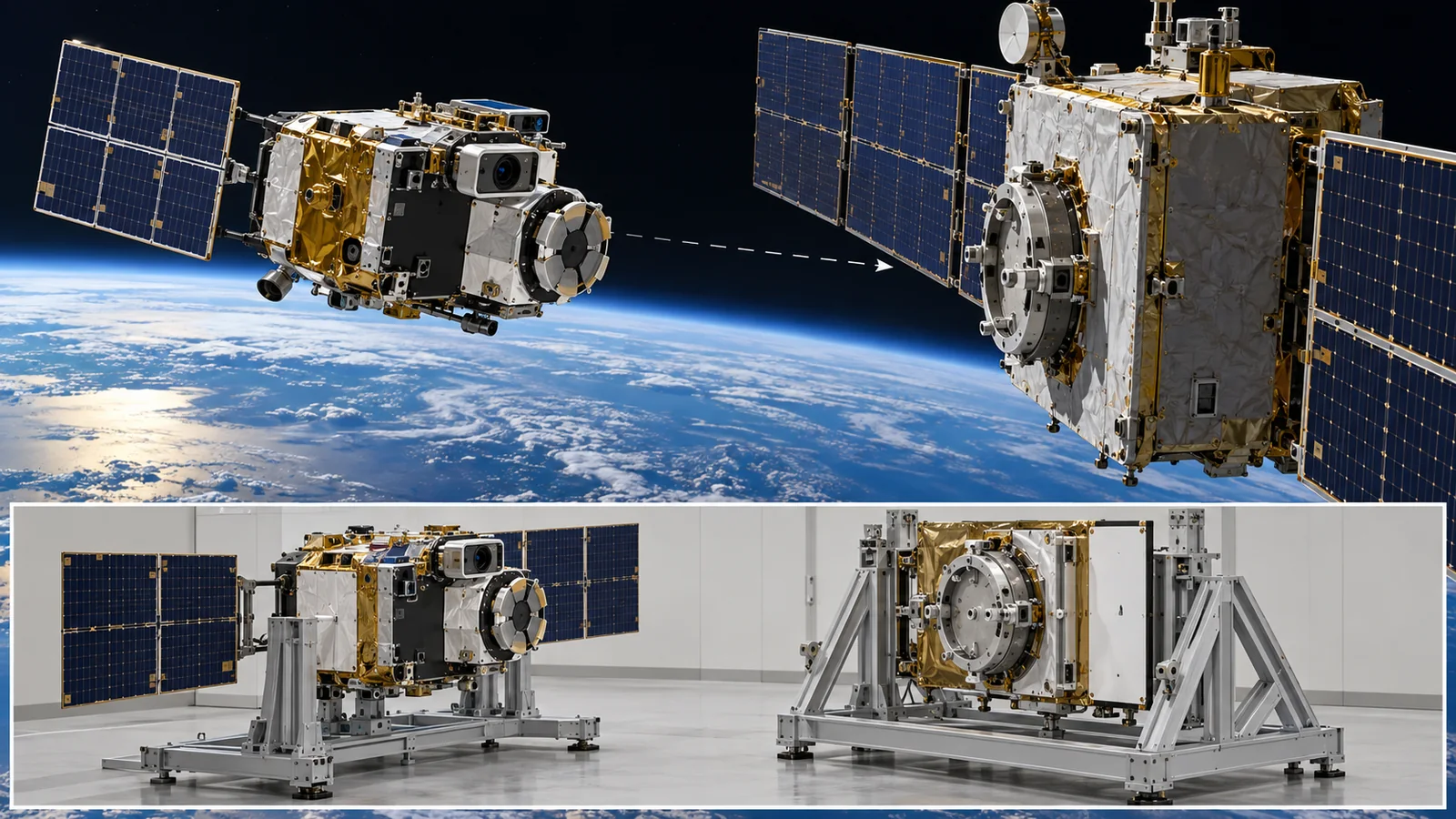
The securities report describes the docking plate as "a magnetic plate with identification markers fitted in advance" Sourced. With the plate on a satellite, it is said that a servicer can identify the target, estimate its motion, approach, capture and de-orbit it relatively easily, and keep removal cost down. A magnetic plate would be expected to be light, to need no power, and to be unlikely to fail (the company does not state the material, so this is our inference). On materials and parts, the points at issue would be as follows. Over the satellite's life the plate must keep its magnetism and its bond even under radiation, atomic oxygen and large temperature swings (this too is our inference; we could not find individual test results in the company's material. For the technology, see our explainers on in-orbit servicing and space debris and on the space environment and its effects on materials). Also, to keep the mechanism light, the LEXI capture mechanism is designed to grip a standard structure, the ring (PAR) where a satellite meets its rocket. The thinking is to fit a connection that is widely used in the industry, rather than design around each target's structure.
11. The risks this company carries
| Risk | Content | Status |
|---|---|---|
| Losses and the timing of profit | Operating losses continue (¥9,975,386 thousand in the year to April 2026). The company says "winning repeat orders is essential for profitability" and gives no date for profit | Sourced |
| Delays in development, testing and launch | ELSA-M was delayed when a 2023 structural test found weaknesses in some parts. Launches are outsourced to outside rocket companies, so the company also depends on their delays and orbit-insertion accuracy | Sourced |
| Whether demonstrations succeed | ELSA-M, LEXI-P, APS-R, ADRAS-J2 and others are at the stage of actually launching and demonstrating in orbit. The company rates the risk of technology development and demonstration as "likelihood: medium, impact: large" | Sourced |
| Whether repeat orders arrive | The company explains that many projects were one-off and low in profitability. The pipeline of expected projects is the company's own estimate, not guaranteed orders. The follow-on to the UK's COSMIC is recorded as lost | Sourced |
| Reliance on governments and subsidies | About 48% of project revenue is government subsidy income. Subsidies can change in amount with reviews and changes in the schemes | Sourced (the share is Our calculation) |
| How revenue is recognised | Many projects use the cost-recovery method (booking revenue only up to costs incurred), so profit is hard to see until completion. The company itself lists its revenue-recognition policy as a risk | Sourced |
| Exchange rates | Revenue and costs in yen move with exchange rates. The company rates exchange-rate risk as "likelihood: high" | Sourced |
| Dilution of shares | Share issues and the exercise of share acquisition rights can dilute the value per share. The company states a dilution of 13.28% from the May 2025 offering and a potential dilution of 10.59% from the May 2026 financing | Sourced |
| Whether the market opens up | The company lists as a risk that the in-orbit services market may not form and grow as expected | Sourced |
| Export control and regulation | Developing and building satellites in several countries requires complying with complex rules, including export controls. This can raise costs and delay schedules | Sourced |
12. Glossary
- In-orbit servicing
- Services performed in space on satellites or debris: observation, repair, refuelling, removal and so on.
- Debris (space debris)
- Space junk: retired satellites, rocket upper stages and fragments of them.
- Servicer
- The spacecraft that approaches another satellite or debris to serve it.
- RPO
- Rendezvous and proximity operations. Technology for safely approaching another object.
- Non-cooperative object
- An object that does not report its position and moves freely, such as debris.
- Low Earth orbit (LEO) / geostationary orbit (GEO)
- Orbits up to 2,000 km altitude / at about 36,000 km, where a satellite appears fixed in the sky.
- Docking plate
- A magnetic plate with identification markers, fitted to a satellite. Used for magnetic capture.
- PAR / PAF
- Payload adapter ring / payload attach fitting. Structures that connect a satellite to its rocket.
- Abort
- Moving away automatically to avoid a collision with the target.
- CRD2
- JAXA's Commercial Removal of Debris Demonstration.
- SBIR fund
- A Japanese fund that supports R&D by small businesses (here a theme in the space field run by MEXT).
- Project revenue
- A reference figure shown by the company: revenue plus government subsidy income.
- Cost-recovery method
- An accounting method that books revenue only up to the costs incurred.
- Securities Report (yuka shoken hokokusho)
- The annual statutory disclosure that listed companies in Japan file with the government. It is published through EDINET.
13. References
- Astroscale Holdings Inc. Securities Report for the 8th fiscal year (year to April 2026), filed with the Director-General of the Kanto Local Finance Bureau on 29 July 2026 (EDINET document ID S100YSZC; in Japanese). Business description, history, the five in-orbit services, ELSA-d and ADRAS-J, finances, R&D expense, capital spending, employees, risks. https://disclosure2dl.edinet-fsa.go.jp/searchdocument/pdf/S100YSZC.pdf
- Astroscale Holdings Inc. Business briefing material (October 2026) (16 October 2026; in Japanese). Launch plans for the missions, the order position, the list of contracts, financial strategy. https://contents.xj-storage.jp/xcontents/AS82438/d184e101/0d1e/4b40/9772/1f7c2f92fb77/140120261016552263.pdf
- Astroscale Holdings Inc. Timely disclosure "Notice of an increase in the contract amount for ISSA-J1 Mission Phase 2 at the Japanese consolidated subsidiary" (6 October 2026; in Japanese). https://contents.xj-storage.jp/xcontents/AS82438/bd10141b/a32d/47b2/b8bf/aeb825556e47/140120261006546468.pdf
- Astroscale Holdings Inc. IR library (the list of disclosure documents; in Japanese). https://www.astroscale.com/ja/ir/library
- Astroscale Official website (source of the logo). https://www.astroscale.com/en
14. Claim-to-source audit
| Claim in the text | Status | Source |
|---|---|---|
| Legal name, English name, head office, founding, listing date, subsidiary structure | Sourced | Reference 1 https://disclosure2dl.edinet-fsa.go.jp/searchdocument/pdf/S100YSZC.pdf |
| Revenue, losses, assets, cash, cash flows, employees (years to April 2024 to 2026) | Sourced | Reference 1 https://disclosure2dl.edinet-fsa.go.jp/searchdocument/pdf/S100YSZC.pdf |
| Project revenue of ¥11,506,710 thousand, subsidy income of ¥5,566,095 thousand, R&D expense, capital spending, orders received, funding | Sourced | Reference 1 https://disclosure2dl.edinet-fsa.go.jp/searchdocument/pdf/S100YSZC.pdf |
| The share of project revenue that is government subsidy income (about 48%) | Our calculation | Our own division (of Reference 1 figures) |
| The course of ELSA-d and ADRAS-J (dates, distances, target debris), the five in-orbit services, docking plates | Sourced | Reference 1 https://disclosure2dl.edinet-fsa.go.jp/searchdocument/pdf/S100YSZC.pdf |
| Launch plans and contract amounts for ELSA-M, ISSA-J1, APS-R, LEXI-P and ADRAS-J2; COSMIC recorded as lost | Sourced (plans: not yet confirmed) | Reference 2 https://contents.xj-storage.jp/xcontents/AS82438/d184e101/0d1e/4b40/9772/1f7c2f92fb77/140120261016552263.pdf |
| The increase in the ISSA-J1 phase 2 contract amount (¥249 million) | Sourced | Reference 3 https://contents.xj-storage.jp/xcontents/AS82438/bd10141b/a32d/47b2/b8bf/aeb825556e47/140120261006546468.pdf |
| The list of disclosures to October 2026 and where the securities report is | Sourced | Reference 4 https://www.astroscale.com/ja/ir/library |
| The four company types in Fig. 1 | Our calculation | Our own arrangement (companies shown are examples from this series) |
| The launch date (day and month) of each mission, the customer and contract value for LEXI-P, the contract value of APS-R, the in-orbit results of ELSA-M and ADRAS-J2 | Not yet confirmed | Outlook: not firmly stated in the primary sources we read. Figures from news reports are not used |
| The material of the docking plate and any materials test results | Not yet confirmed | Outlook: we could not find individual statements in the company's material |
| Whether any investments in partners or joint research with universities exist | Not yet confirmed | Outlook: we could not find them in the primary sources. We do not claim they do not exist |
| The reading of the aim to move to repeatedly selling standard satellites (platforms) | Inference | Our own interpretation (basis: Reference 2) |
| The reading that the timing of profit depends on subsidised projects from fiscal 2028 and on repeat orders | Inference | Our own interpretation (basis: Reference 2) |
| The reading that resources go first into making demonstrations succeed | Inference | Our own interpretation (from the briefing material's framing) |
Last updated: 17 October 2026 / Troy Technical
The figures in this article are based on the securities report that Astroscale Holdings Inc. filed with the Director-General of the Kanto Local Finance Bureau and on the company's official disclosure material. We have not used market-research estimates (such as the size of the in-orbit services market) or figures that appear only in press coverage. Passages marked "Inference" are our reading of primary information, not statements by the company. Military uses in detail, share prices, valuations and investment judgements are not discussed.