COMPANY PROFILE / SPACE INDUSTRY
Axiom Space
- A company that has flown four private astronaut missions and is building both the "after the ISS" space station and a lunar spacesuit
Axiom Space is a private company based in Houston, Texas. It has carried out four private astronaut missions to the International Space Station (ISS) between 2022 and 2025, and the fifth (Ax-5), contracted with NASA, is planned for no earlier than January 2027. At the same time it is developing Axiom Station, a commercial space station to take over after the ISS retires, and the AxEMU lunar spacesuit for NASA's Artemis programme. However, the launch of Axiom Station's first module is only planned for 2028, and the schedule has slipped from the company's first announcement in 2020 (a target of the second half of 2024). This article uses primary sources only, namely the company's official announcements, what they say about contracts with NASA, and public SEC data, and keeps what could be confirmed separate from what is still open.
- Axiom Space in 30 seconds, and where it sits in the space industry
- Logo and how the name is written
- Where the company sits in the space industry
- Company size
- Resources committed to the space industry
- Track record so far
- Plans
- What the company seems to be aiming for
- Partnership map in the space industry
- Technologies, products and services
- Risks the company faces
- Glossary / References / Claim-to-source audit
1. Axiom Space in 30 seconds, and where it sits in the space industry
Texas, USAIn June 2026 the company said its legal domicile also moved from Delaware to Texas
In-orbit services (secondary)Crewed flights, spacesuits, a space station, and computing in orbit
No. 5 from January 2027Ax-1 to Ax-4 in 2022 to 2025. Ax-5 is under a NASA order (January 2026)
for 2028A company plan. The first target in 2020 was the second half of 2024
more than US$525 millionIncludes both equity and debt. The split is not disclosed
Most space companies are strongest in either rockets or satellites. What sets Axiom Space apart is that it is working on three parts of keeping people in space at once: the flight, the place to live, and the clothing Sourced. (1) Flight: under NASA contracts it sends private astronauts to the ISS. (2) A place to live: it is building a commercial station for after the ISS. (3) Clothing: under NASA contracts it is developing spacesuits for the Moon and for orbit. It does not build rockets or crew capsules itself. Launch uses a SpaceX spacecraft (as stated on the official Ax-4 page), and the station's pressurised modules are manufactured by Thales Alenia Space. So Axiom Space is a company that provides the whole experience of staying in space, rather than a maker of the vehicles, which sets it apart from the other types.
2. Logo and how the name is written

A note on naming: the company name is Axiom Space, and the legal name is Axiom Space, Inc. (as shown in the footer of its website). "Axiom" is an English word for a self-evident truth. The station is called Axiom Station, the spacesuit AxEMU (Axiom Extravehicular Mobility Unit, a suit for spacewalks), and the missions Ax-1 to Ax-5. Note also that the filers on EDGAR whose names contain "Axiom Space" are third-party investment vehicles that invest in the company, not the company itself (Section 4).
Official site: https://www.axiomspace.com/ (the logo is the white version in the site header, recoloured to black so it can be read on a white background)3. Where the company sits in the space industry
Companies in the space industry are easiest to sort by the role they play in space, which gives four types. Axiom Space is mainly "Exploration, crewed and lunar", and secondarily "Satellites, in-orbit services and manufacturing" (computing in orbit, and places for research and manufacturing in space). It is easiest to think of it as a company that provides the places and equipment for people to work in space.
A private astronaut mission (PAM) is a short stay at the International Space Station (ISS) that a private organisation arranges for its astronauts with NASA's approval. A commercial space station is a station built and run by a company rather than a government. It is planned as a place to stay in low Earth orbit after the ISS retires, which is expected around 2030. An extravehicular activity (EVA) is work outside the spacecraft by an astronaut in a spacesuit. For the technology behind stations, see our explainers on the space environment and its effects on materials, on spacecraft thermal control, and on lunar exploration and Artemis.
4. Company size
Because the company is privately held, it has no obligation to publish revenue or profit on a regular basis. The table below sets out what could be confirmed from its website and public data Sourced.
| Item | What could be confirmed | Source |
|---|---|---|
| Founding and headquarters | Founded in 2016 (as stated in a company release). Headquartered in Houston. On 23 June 2026 it announced that it had moved its legal domicile from Delaware to Texas | Reference 6 |
| Leadership | CEO and President: Dr. Jonathan Cirtain. Founder and Executive Chairman: Kam Ghaffarian. CFO: Zach Gitomer (appointment announced July 2026) | References 8 and 14 |
| Employees | About 700 (company statement, June 2026). Most are in Texas | Reference 6 |
| Main facilities | An assembly, integration and test facility at the Houston Spaceport (at Ellington Airport) for the final assembly and integration of station modules (the company is an anchor tenant). A space station development facility, a spacesuit lab and a mission control room | References 6 and 23 |
| Revenue and profit | Not disclosed (no mention in official material; this article does not estimate it) | Could not be confirmed |
| Fundraising | Announced US$350 million (including both equity and debt) on 12 February 2026. On 4 June 2026 it announced a final close of more than US$525 million (company announcements) | References 7 and 8 |
| Listing status | Privately held. The filings on SEC EDGAR with "Axiom Space" in the name are Form D notices from third-party investment vehicles that invest in the company (for example one filed on 14 April 2026). No filing by the company itself could be confirmed | Reference 25 |
The fundraising figures are amounts the company announced. They are not revenue, and they are not a measure of what the company is worth. The split between equity and debt, the amounts by investor and the company's valuation are not disclosed. The Form D notices on EDGAR belong to third-party investment vehicles. The one filed on 14 April 2026, for example, is a notice for a small vehicle with a total offering of US$500,000, US$444,500 sold and one investor, so it does not show the company's own fundraising. This article does not discuss share prices, valuations or investment decisions.
5. Resources committed to the space industry
Four angles are covered (people, money, outside investments and acquisitions, and contracts with public agencies), showing what could and could not be confirmed.
| Angle | What could be confirmed | Category |
|---|---|---|
| People | About 700 employees, centred on Houston, with wholly owned subsidiaries set up in Switzerland (Lucerne) and Japan. The Japanese entity was announced to start operating on 1 July 2026 under Dr. Koichi Wakata as Chief Technology Officer, Asia Pacific. Astronauts on staff include Peggy Whitson (Vice President of Human Spaceflight) and Michael López-Alegría (Chief Astronaut) | Sourced |
| Money | In 2026 it raised more than US$525 million at the final close (co-led by Type One Ventures and the Qatar Investment Authority; participants included 1789 Capital, 4iG, LuminArx and MUFG Bank). Spending on R&D and capital investment is not disclosed. A grant of up to US$5.5 million from the Texas Space Commission for developing orbital computing | Sourced (spending breakdown not confirmed) |
| Investments, acquisitions, joint ventures, divestments | No investments in or acquisitions of other companies appear in official material (could not be confirmed). Wholly owned subsidiaries were set up (Switzerland, Japan). On spacesuits it works with Prada, Oakley and Nokia | Could not be confirmed (investments and acquisitions) |
| Contracts and ties with public agencies | NASA: five private astronaut missions (Ax-1 to Ax-5); two spacesuit task orders (about US$228 million for the Artemis III lunar suit in 2022; for the ISS, an initial commitment of about US$5 million and a potential value of up to US$142 million in 2023); selection under NextSTEP-2 (2020). A memorandum of understanding with ESA (September 2026). Contract values are given in Section 6, with ceilings, committed amounts and payments kept apart | Sourced |
Status of main vehicles and products (checked 17 October 2026)
| Vehicle / product | Type | Main specifications (company's stated values, with conditions) | Track record | Stage |
|---|---|---|---|---|
| Private astronaut missions (Ax-1 to Ax-5) | Transport and stay of private astronauts at the ISS | Ax-5: launch arranged under NASA, from Kennedy Space Center, up to 14 days docked to the ISS. Crew not yet decided | 4 flights (April 2022 to July 2025). 14 astronauts flew, with more than 160 research activities | Ax-5 no earlier than January 2027 (plan) |
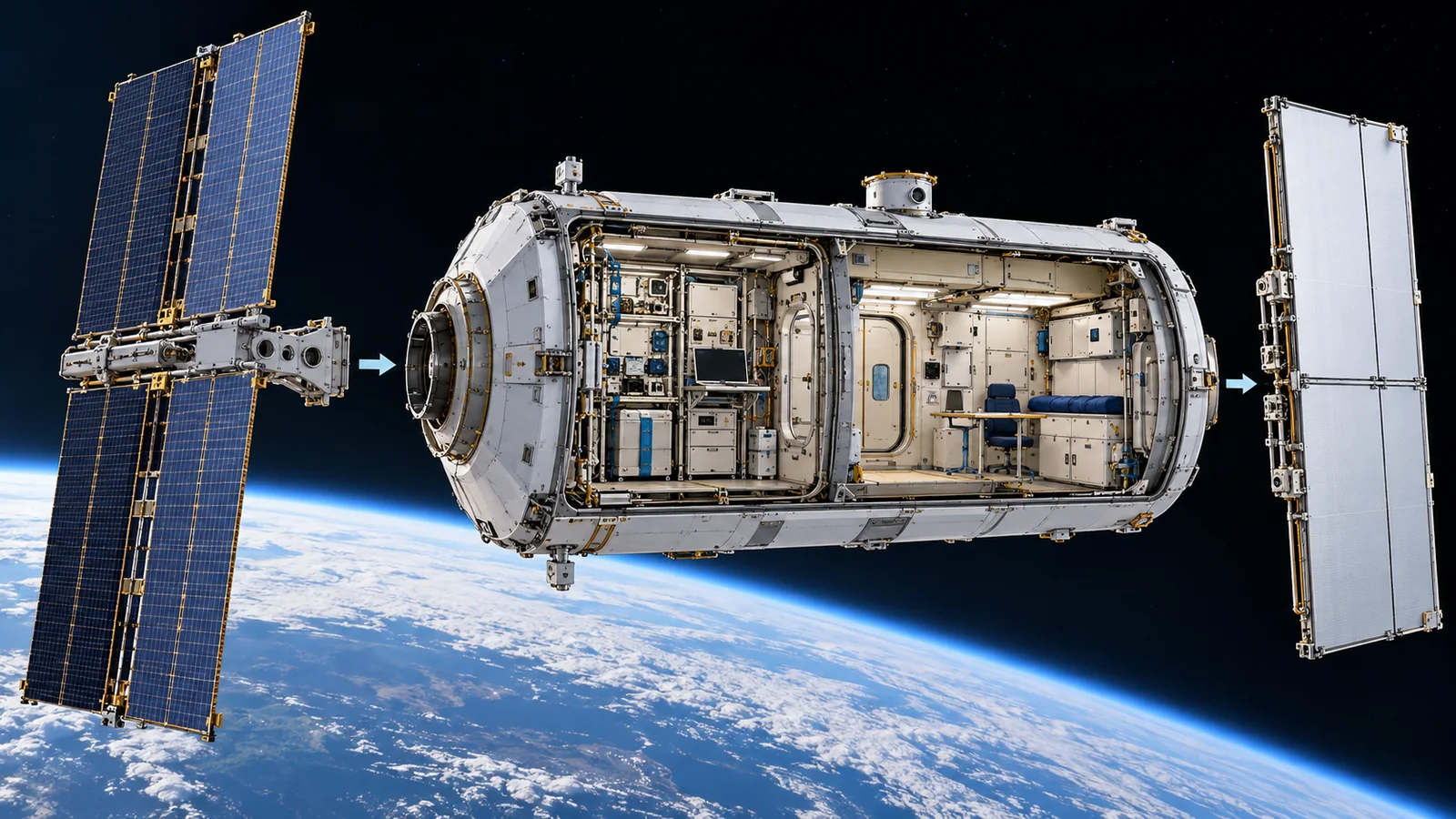
| Axiom Station | Commercial space station | First module planned to launch in 2028. Second module less than a year later. Together they form a free-flying station that can host four crew | No flight record in orbit. The first module is in final assembly (Turin, Italy) | In development |
| AxEMU | Spacesuit for the Moon and for orbit | A suit based on NASA's xEMU design. The inner cooling garment is for spacewalks of up to eight hours (company statement) | Crewed tests in NASA's Neutral Buoyancy Laboratory and an uncrewed thermal-vacuum test. More than 800 hours of crewed pressurised time (December 2025) | In development and testing. Use on the Moon depends on NASA's flight plans |
| Orbital computing (ARC) | Small computing units in orbit | ARC 1 and 2 ride on Kepler Communications' optical data-relay satellites. Optical links at 2.5 Gbps | Two units operating in orbit (October 2026) | Demonstration and early operation |
A spacesuit looks like clothing, but it is a device that combines a pressure vessel, joints, cooling and communications Sourced. Three features of materials and manufacturing can be read from Axiom Space's official material.
(1) A water-cooled "undergarment" on the inside. The Liquid Cooling and Ventilation Garment (LCVG) runs thin tubes over the body's main muscle groups and carries body heat away with cold water (for spacewalks of up to eight hours). The cooling circuit is doubled so a backup takes over if one loop fails. The company says it used Prada's engineered knitting and high-performance fibres so the garment can be worn repeatedly (June 2026).
(2) An outer fabric layer built to withstand heat and micrometeoroids. For the outer layer unveiled in 2024, the company says Prada helped with design and product development so that it could withstand the temperature extremes and micrometeoroid environment of the lunar south pole.
(3) Joints use a mix of "soft" and "hard" designs. The company says it uses both to widen the range of motion, and that the suit has features to cope with lunar dust. However, no durability or lifetime test results (numbers) could be confirmed in official material Not yet confirmed. For the effects of the space environment, see our explainer on the space environment and its effects on materials.
6. Track record so far
How the Axiom Station schedule has changed (from company announcements)
| Date | Event | What it means |
|---|---|---|
| 2016 | Company founded | Co-founders Kam Ghaffarian and Michael Suffredini (2020 announcement) |
| 27 January 2020 | Selected under NASA's NextSTEP-2 Appendix I, winning the right to attach a commercial module to the ISS Node 2 forward port | A first foothold for a commercial station. The first module was then targeted for the second half of 2024 |
| 15 July 2021 | Final contract with Thales Alenia Space for two pressurised modules for the station (EUR 110 million) | Module manufacturing outsourced to a European company. Launches were then planned for 2024 and 2025 |
| 8 April 2022 | Launched Ax-1; returned on 25 April | The first fully private astronaut mission to the ISS (the company describes it as a first) |
| 2022 | A task order of about US$228 million under NASA's xEVAS contract for a lunar spacesuit for Artemis III | Stated by the company as the task-order value (amounts paid could not be confirmed) |
| 21 May 2023 | Launched Ax-2; returned on 30 May | Included two Saudi Arabian astronauts |
| 10 July 2023 | A task order for an ISS spacesuit (initial commitment about US$5 million, potential value up to about US$142 million over four years) | The maximum is a ceiling, not a confirmed amount |
| 18 January 2024 | Launched Ax-3; returned on 9 February | Included Turkey's first astronaut (company statement) |
| 4 June 2024 | First integrated test for Artemis by NASA, SpaceX and Axiom Space (a simulation of the suit with the lander) | The company's description of the first such test of a suit with a lander |
| 25 June 2025 | Launched Ax-4; splashed down off California on 15 July | India, Poland and Hungary flew their first government astronauts to the ISS. An 18-day mission |
| 18 December 2025 | Published its year in review. It had revised the station assembly sequence, now "a two-module free-flying station no earlier than 2028" | The schedule was explained by the completed final welds of the first module and the docking adapter at 80% of design, among other points |
| 30 January 2026 | NASA signed the Ax-5 mission order (the fifth consecutive private astronaut mission award) | Planned to launch no earlier than January 2027 |
| 12 February and 4 June 2026 | Announced US$350 million of financing, and in June a final close of more than US$525 million | Includes both equity and debt (the split is not disclosed) |
| 14 May and 2 June 2026 | Announced wholly owned subsidiaries in Japan and in Switzerland | Footholds in Asia-Pacific and Europe |
| 26 May 2026 | Joined the team of Astrolab, one of the providers NASA selected for a crewed lunar rover | Responsible for suit integration and controls and displays (company statement). The release gives no contract value |
| 7 June 2026 | Unveiled the suit's inner layer (the cooling garment) with Prada | Joint development on materials and manufacturing |
| 10 September 2026 | Signed a memorandum of understanding with the European Space Agency (ESA) | To explore European use of low Earth orbit and cooperation on suit-based training |
| 5 and 6 October 2026 | Redwire won a contract for roll-out solar arrays for the second module. The company said two ARC orbital computing units are operating | A widening supply chain and a computing demonstration |
7. Plans
Everything below is a company plan or target, not an achieved fact Not yet confirmed.
The company has also announced the following (all plans).
| Item | Company's explanation | Category |
|---|---|---|
| Expanding the station | In future a fully independent four-module commercial station (no timing given) | Not yet confirmed |
| Orbital data centres | Add free-flying nodes and build a cloud-computing network in orbit. Putting nodes in orbit in 2026 was the plan | Not yet confirmed |
| Business in Japan and Europe | The Japanese entity is planned to start operating on 1 July 2026. The Swiss entity is planned to start in the summer of 2026 | Not yet confirmed |
| Use of its spacesuit in Europe | Within the memorandum, exploring use of the AxEMU at ESA's training facilities | Not yet confirmed |
None of the following appears in official material Not yet confirmed.
Whether a contract for Axiom Station is settled under NASA's commercial LEO destinations programme (in June 2026 the company wrote only that NASA is finalising the path to a commercial successor) / the reason for the Axiom Station delay / the value of each mission contract / revenue and profit / the equity and debt split of the fundraising / the Ax-5 crew and launch date / individual FAA or other licensing details. Press-reported valuations and order values are not used.
8. What the company seems to be aiming for
This section includes points the company has not stated directly. They are written as inferences that can be drawn from primary sources, with the basis given.
| What can be read | Primary-source basis | Category |
|---|---|---|
| It is aiming to be NASA's commercial successor to the ISS | In June 2026 it wrote that NASA is finalising the path to a commercial successor and that Axiom Space "sits at the center" of these markets, and it continues to build the station | Inference |
| Astronaut missions are a way to gain experience ahead of running a station | The Ax-5 announcement says insight from the four earlier missions benefits development of the next-generation station | Inference |
| It puts weight on an international business with government customers | The ESA memorandum, subsidiaries in Japan and Switzerland, and astronauts from India, Poland, Hungary and other countries flying with it | Inference |
| It wants one product line of spacesuits from the lunar surface to orbit to ground training | It describes a "single foundational architecture" for the ISS and lunar suits designed in parallel, and is exploring use at ESA's training facilities | Inference |
| It wants computing, research and manufacturing in orbit to become revenue lines for the station | The ARC orbital computing units, the data-centre prototype, and the research and manufacturing business pages | Inference |
In its July 2023 announcement of the ISS spacesuit task order, the company said it would modify its Artemis III lunar suit as the baseline design Sourced. The policy is to design the lunar suit and the orbital suit in parallel from the same basic design. From this, this article reads an aim to share the suit's development cost across several contracts and gather it into one product line. This is, however, an interpretation of a stated policy, and no document shows profitability Not yet confirmed.
9. Partnership map in the space industry
10. Technologies, products and services
What Axiom Space offers is what people need to stay in space: the flight, a place to live, clothing, and a place for research and computing Sourced.
| Technology or service | Company's explanation | In plain terms |
|---|---|---|
| Private astronaut missions | A stay of up to 14 days at the ISS with NASA's approval. Commanded by former NASA astronauts (Michael López-Alegría, Peggy Whitson) | Countries and companies can send their own astronauts to the ISS without a spacecraft of their own |
| Axiom Station | The first module has four crew quarters and research and manufacturing functions. Later additions are envisaged: an airlock, a second habitat, a research and manufacturing module and an observation window | A privately run place to stay in space that can be used after the ISS |
| AxEMU (spacesuit) | Based on NASA's xEMU design and made to fit a wider range of body sizes. Designed so it can be maintained in orbit | A suit for spacewalks that works on the Moon and at a space station |
| Liquid Cooling and Ventilation Garment (LCVG) | Tubes of cooling water run over the main muscle groups, with a doubled circuit. A flow of oxygen at the face washes out carbon dioxide | A cooling undergarment worn inside the spacesuit |
| Orbital computing (ARC) and orbital data centres | Computing and AI processing in orbit, with post-quantum cryptography. A prototype on the ISS (AxDCU-1) and two ARC units on Kepler's satellites | Process satellite data in space before sending it to the ground |
| Places for research and manufacturing | Offers microgravity research opportunities (diabetes, cancer, neurodegenerative disease and more). Set up a University Alliance | A place to do research, and eventually manufacturing, in the space environment |
For the first module of Axiom Station, the company says the final welds are complete and testing of the pressure vessel (the outer shell that holds the air) is under way (December 2025) Sourced. A pressurised module must withstand the internal air pressure, protect against micrometeoroids and tolerate the temperature swings of space. Manufacturing is outsourced to Thales Alenia Space, and the material (whether it is aluminium alloy), the welding method and the inspection method are not stated in the official material checked here. The solar arrays are planned to be Redwire's roll-out type (carried rolled up and unrolled in orbit). The module's size and mass, the launcher's limits and the reliability of the deployed arrays are the design constraints Not yet confirmed. For the basics of solar arrays, see our explainer on solar cells for space.
11. Risks the company faces
| Risk | Content | Category |
|---|---|---|
| Slipping station schedule | The first module's target moved from "the second half of 2024" in 2020 to "2028" as of October 2026. The reason for the delay could not be confirmed from primary sources | Sourced |
| No flight record in orbit | No station module has reached orbit, and the spacesuit has yet to be used on the Moon or in orbit | Sourced |
| Dependence on NASA's commercial station plans | In June 2026 the company wrote that NASA is finalising the path to a commercial successor. The status of any contract for Axiom Station could not be confirmed | Not yet confirmed |
| Lunar schedule | Which flight the suit will be used on (Artemis III or IV) is described differently from one announcement to another, and changes to NASA's flight plans could affect it | Not yet confirmed |
| Funding and debt | The money raised includes both equity and debt, and the split is not disclosed. Profitability of the business cannot be confirmed from outside | Not yet confirmed |
| Dependence on suppliers | It relies on Thales Alenia Space for module manufacturing, Redwire for solar arrays, and SpaceX and others for launch and transport | Sourced |
| Safety of crewed flight | The safety of private astronaut missions depends on NASA's reviews and on the providers of the launcher and spacecraft. No serious accident on the four flights appears in the official material checked here | Sourced (no mention) |
12. Glossary
- International Space Station (ISS)
- A low-Earth-orbit space station operated jointly by several countries. Retirement is planned around 2030.
- Low Earth orbit (LEO)
- An orbit a few hundred kilometres above the ground, where the ISS and others fly.
- Private astronaut mission (PAM)
- A programme in which a private organisation, with NASA's approval, sends astronauts for a short stay at the ISS.
- Commercial space station
- A space station built and run by a company. Planned as a place to stay after the ISS retires.
- AxEMU
- Axiom Extravehicular Mobility Unit, the company's spacesuit for spacewalks.
- xEVAS
- NASA's Extravehicular Activity Services contract. Work is ordered in several task orders, and the company states the maximum value for the whole contract (all companies and orders) as US$3.5 billion.
- Task order
- An order for a specific piece of work issued under a larger contract framework.
- NextSTEP-2
- A NASA solicitation framework set up to support private-sector space development.
- Pressurised module
- A room of a space station that holds air pressure and that people can enter.
- Airlock
- A pressure-adjusting chamber used to go in and out for spacewalks.
- LCVG
- Liquid Cooling and Ventilation Garment. A water-cooled, ventilated undergarment worn inside a spacesuit.
- Roll-out solar array (ROSA)
- A solar array that is launched rolled up and unrolled in orbit.
- NET
- No Earlier Than.
- Form D
- A notice that an issuer which raised money without a public offering files with the SEC in the United States.
13. References
- Axiom Space Human Spaceflight Missions (dates and crews of Ax-1 to Ax-5). Checked 17 October 2026. https://www.axiomspace.com/missions
- Axiom Space Axiom Mission 4 (overview, launch and splashdown dates, spacecraft). Checked 17 October 2026. https://www.axiomspace.com/missions/ax4
- Axiom Space NASA Selects Axiom Space for Fifth Private Astronaut Mission to International Space Station (30 January 2026). https://www.axiomspace.com/missions/ax5
- Axiom Space Axiom Station (module configuration, state of construction). Checked 17 October 2026. https://www.axiomspace.com/axiom-station
- Axiom Space The Next-Generation Spacesuit (description of AxEMU). Checked 17 October 2026. https://www.axiomspace.com/axiom-suit
- Axiom Space Axiom Space Redomiciles to Texas (23 June 2026). Employees, facilities, Texas Space Commission grant. https://www.axiomspace.com/release/axiom-space-redomiciles-to-texas
- Axiom Space Axiom Space Closed Oversubscribed Financing at $525M+ (4 June 2026). https://www.axiomspace.com/release/axiom-space-closes-oversubscribed-financing-at-525m
- Axiom Space Axiom Space Secures $350M in Financing to Accelerate Space Station, Spacesuit Development (12 February 2026). https://www.axiomspace.com/release/axiom-space-secures-350m-financing-to-accelerate-space-station-spacesuit-development
- Redwire / Axiom Space Redwire Awarded Follow-On Contract to Provide Roll-Out Solar Array Wings for Axiom Space's Second Space Station Module (5 October 2026). https://www.axiomspace.com/release/redwire-follow-on-contract-second-module
- Axiom Space Axiom Space, Kepler Ready Orbital Computing for Quantum Era (6 October 2026). https://www.axiomspace.com/release/axiom-space-kepler-ready-orbital-computing-for-quantum-era
- Axiom Space Axiom Space, European Space Agency Sign Memorandum of Understanding to Expand Europe's Access to Low-Earth Orbit (10 September 2026). https://www.axiomspace.com/release/axiom-space-european-space-agency-mou
- Axiom Space / Astrolab Astrolab Selected to Provide Lunar Rover Advancing Lunar Exploration (26 May 2026). https://www.axiomspace.com/release/astrolab-selected-to-provide-lunar-rover-advancing-lunar-exploration
- Axiom Space Axiom Space, Prada Unveil Inner Layer of Next-Gen Lunar Spacesuit (7 June 2026). https://www.axiomspace.com/release/axiom-space-prada-unveil-inner-layer-of-next-gen-lunar-spacesuit
- Axiom Space Axiom Space Builds Out Executive Team for Commercial Space Station Era Welcoming New CFO, CIO (15 July 2026). https://www.axiomspace.com/release/axiom-space-builds-out-executive-team-for-commercial-space-station-era-welcoming-new-cfo-cio
- Axiom Space 2025 Year in Review (18 December 2025). https://www.axiomspace.com/news/year-in-review-2025
- Axiom Space Axiom Space Awarded Contract to Pursue Spacesuit Development for International Space Station (10 July 2023). The two xEVAS task orders. https://www.axiomspace.com/news/eva-leo-contract
- Axiom Space Thales Alenia Space to provide the first two pressurized modules for Axiom Station (posted 17 August 2021; contract of 15 July 2021). https://www.axiomspace.com/news/thales-alenia-space-to-provide-the-first-two-pressurized-modules-for-axiom-station
- Axiom Space Axiom Space selected by NASA for access to International Space Station port (27 January 2020). https://www.axiomspace.com/news/axiom-selected-by-nasa-for-access-to-international-space-station-port
- Axiom Space Axiom Space to Establish Japan Subsidiary to Serve Growing Asia-Pacific Demand (14 May 2026). https://www.axiomspace.com/news/axiom-space-japan-subsidiary
- Axiom Space Axiom Space Establishes Swiss Subsidiary to Anchor European Engagement, Space Collaboration (2 June 2026). https://www.axiomspace.com/news/axiom-space-establishes-swiss-subsidiary
- Axiom Space Axiom Space, National Stem Cell Foundation, Saudi Space Agency Collaborate to Expand Study of Neurodegenerative Disease in Microgravity (14 October 2026). https://www.axiomspace.com/news/national-stem-cell-foundation-joins-with-axiom-space-and-the-saudi-space-agency-to-expand-study-of-neurodegenerative-disease-in-microgravity
- Axiom Space Axiom Space, ElevationSpace Sign Agreement to Assess High-Frequency Re-Entry and Recovery Services (30 October 2025). https://www.axiomspace.com/news/mou-elevationspace
- Axiom Space Axiom Space Clears Major Milestone as it Prepares to Connect Axiom Station to International Space Station (4 April 2025). https://www.axiomspace.com/news/axiom-space-clears-major-milestone-as-it-prepares-to-connect-axiom-station-to-international-space-station
- Axiom Space First Artemis III Integrated Test Complete (4 June 2024). https://www.axiomspace.com/news/first-artemis-iii-integrated-test-complete
- U.S. SEC Form D of Axiom Space PML SPV 1 LP (CIK 0001826762, a third-party investment vehicle investing in the company), filed 14 April 2026, accession number 0001826762-26-000002. https://www.sec.gov/Archives/edgar/data/1826762/000182676226000002/primary_doc.xml
- Axiom Space Official website home page (to check the company overview and logo). Checked 17 October 2026. https://www.axiomspace.com/
14. Claim-to-source audit
| Claim in the article | Category | Source |
|---|---|---|
| Launch and return dates and crews of Ax-1 to Ax-4; Ax-5 no earlier than January 2027 | Sourced | Reference 1 https://www.axiomspace.com/missions |
| Overview of Ax-4 (18 days, splashdown by a SpaceX spacecraft, first government astronauts of several countries) | Sourced | Reference 2 https://www.axiomspace.com/missions/ax4 |
| The Ax-5 mission order (30 January 2026, fifth consecutive, up to 14 days); 14 astronauts and more than 160 research activities over four flights | Sourced | Reference 3 https://www.axiomspace.com/missions/ax5 |
| Module configuration and state of construction of Axiom Station | Sourced | Reference 4 https://www.axiomspace.com/axiom-station |
| Description of AxEMU (design based on xEMU, maintainable in orbit) | Sourced | Reference 5 https://www.axiomspace.com/axiom-suit |
| The June 2026 change of legal domicile, about 700 employees, facilities, the Texas Space Commission grant (up to US$5.5 million) | Sourced | Reference 6 https://www.axiomspace.com/release/axiom-space-redomiciles-to-texas |
| The June 2026 final close (more than US$525 million) and the participation of MUFG Bank | Sourced | Reference 7 https://www.axiomspace.com/release/axiom-space-closes-oversubscribed-financing-at-525m |
| US$350 million in February 2026 (equity and debt), the investors that led it, the founder and executive chairman | Sourced | Reference 8 https://www.axiomspace.com/release/axiom-space-secures-350m-financing-to-accelerate-space-station-spacesuit-development |
| Redwire's ROSA for the second module; first module planned to launch in 2028; second less than a year later | Sourced | Reference 9 https://www.axiomspace.com/release/redwire-follow-on-contract-second-module |
| Orbital computing ARC (two units in orbit, 2.5 Gbps optical links) | Sourced | Reference 10 https://www.axiomspace.com/release/axiom-space-kepler-ready-orbital-computing-for-quantum-era |
| The memorandum of understanding with ESA (10 September 2026) | Sourced | Reference 11 https://www.axiomspace.com/release/axiom-space-european-space-agency-mou |
| Joining the Astrolab team selected as a crewed lunar rover provider (26 May 2026) | Sourced | Reference 12 https://www.axiomspace.com/release/astrolab-selected-to-provide-lunar-rover-advancing-lunar-exploration |
| The cooling garment (LCVG) with Prada, the 2024 outer layer, the mention of Artemis IV | Sourced | Reference 13 https://www.axiomspace.com/release/axiom-space-prada-unveil-inner-layer-of-next-gen-lunar-spacesuit |
| Appointment of the CFO (July 2026) | Sourced | Reference 14 https://www.axiomspace.com/release/axiom-space-builds-out-executive-team-for-commercial-space-station-era-welcoming-new-cfo-cio |
| The 2025 year in review (a two-module free-flying station no earlier than 2028, first module's final welds, AxEMU testing, start of Artemis III hardware production, ARC and AxDCU-1) | Sourced | Reference 15 https://www.axiomspace.com/news/year-in-review-2025 |
| The two xEVAS task orders (about US$228 million; initial about US$5 million and up to about US$142 million) and the stated maximum of US$3.5 billion for xEVAS as a whole | Sourced | Reference 16 https://www.axiomspace.com/news/eva-leo-contract |
| The EUR 110 million contract with Thales Alenia Space (launches then planned for 2024 and 2025) | Sourced | Reference 17 https://www.axiomspace.com/news/thales-alenia-space-to-provide-the-first-two-pressurized-modules-for-axiom-station |
| Selection under NextSTEP-2 Appendix I (27 January 2020; target of the second half of 2024) | Sourced | Reference 18 https://www.axiomspace.com/news/axiom-selected-by-nasa-for-access-to-international-space-station-port |
| The Japanese subsidiary (announced 14 May 2026, to start operating 1 July) | Sourced | Reference 19 https://www.axiomspace.com/news/axiom-space-japan-subsidiary |
| The Swiss subsidiary (announced 2 June 2026) | Sourced | Reference 20 https://www.axiomspace.com/news/axiom-space-establishes-swiss-subsidiary |
| Research cooperation with the Saudi Space Agency and others (14 October 2026) | Sourced | Reference 21 https://www.axiomspace.com/news/national-stem-cell-foundation-joins-with-axiom-space-and-the-saudi-space-agency-to-expand-study-of-neurodegenerative-disease-in-microgravity |
| The memorandum of understanding with ElevationSpace (30 October 2025) | Sourced | Reference 22 https://www.axiomspace.com/news/mou-elevationspace |
| The station operations simulation and the mission control room MCC-A | Sourced | Reference 23 https://www.axiomspace.com/news/axiom-space-clears-major-milestone-as-it-prepares-to-connect-axiom-station-to-international-space-station |
| The integrated test for Artemis (June 2024) | Sourced | Reference 24 https://www.axiomspace.com/news/first-artemis-iii-integrated-test-complete |
| The filing on EDGAR is a Form D of a third-party investment vehicle (total offering US$500,000, US$444,500 sold, one investor) | Sourced | Reference 25 https://www.sec.gov/Archives/edgar/data/1826762/000182676226000002/primary_doc.xml |
| Legal name and logo | Sourced | Reference 26 https://www.axiomspace.com/ |
| The four-type grouping and the position in Fig. 1, the calculation of the schedule slip (about four years) | Our calculation | This article's own arrangement. Company names are examples from companies in this series |
| Revenue, profit, the equity and debt split of the fundraising, valuation | Not yet confirmed | Not in official material. This article does not estimate them (our note) |
| The status of a contract under NASA's commercial LEO destinations programme, the reason for the station delay, the Ax-5 crew and schedule | Not yet confirmed | Not in the official material checked here. Press-reported information is not used (our note) |
| Station first module in 2028, the second less than a year later, Ax-5 no earlier than January 2027 | Not yet confirmed | Company plans, not achieved facts. Reference 9 https://www.axiomspace.com/release/redwire-follow-on-contract-second-module |
| It is aiming to be NASA's commercial successor to the ISS | Inference | This article's interpretation of the June 2026 announcement (our note) |
| Astronaut missions are a way to gain experience ahead of running a station | Inference | This article's interpretation of the Ax-5 announcement (our note) |
| It puts weight on an international business with government customers | Inference | This article's interpretation of the memoranda, subsidiaries and astronauts of several countries (our note) |
| It wants one product line of spacesuits from the lunar surface to orbit to ground training | Inference | This article's interpretation of the policy stated in July 2023 (our note) |
| It wants computing, research and manufacturing in orbit to become revenue lines for the station | Inference | This article's interpretation of the ARC and data-centre announcements (our note) |
Last updated 17 October 2026 / Troy Technical
The figures in this article are drawn from Axiom Space's official announcements and public filings with the U.S. Securities and Exchange Commission (SEC). No research-firm estimates or press-based figures have been used. All plans and dates are company targets, not achieved facts. Contract values are written with confirmed and maximum amounts kept apart. Passages marked "Inference" are this article's interpretation of primary sources, not statements made by the company.