COMPANY PROFILE / SPACE INDUSTRY
Blue Origin
A private company building the New Glenn rocket and the Blue Moon lander, for which 2026 became a year of accidents and rebuilding
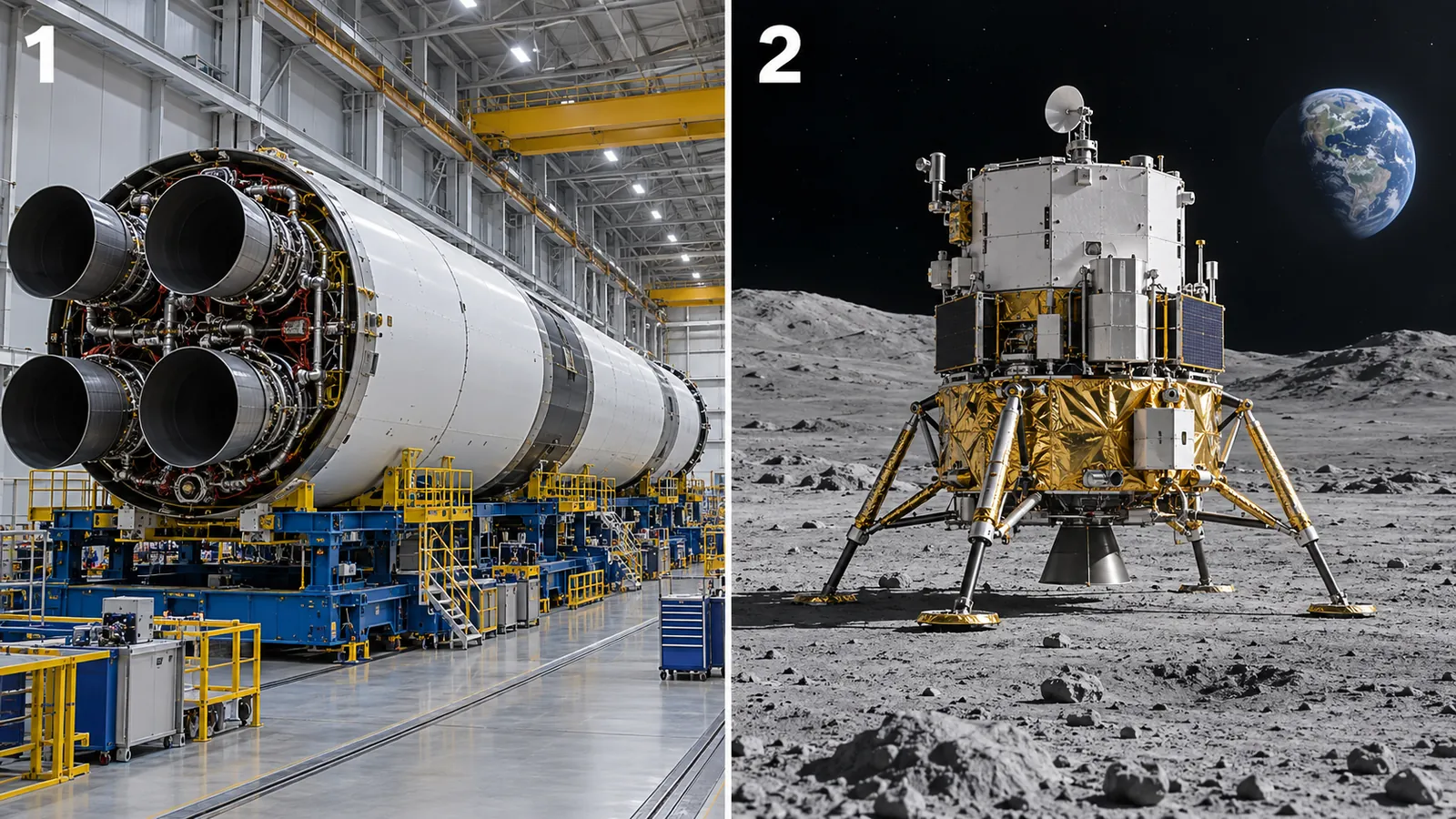
Blue Origin is a privately held U.S. company developing the reusable heavy-lift rocket New Glenn and the Blue Moon landers that will set cargo and astronauts down on the Moon. It launched New Glenn in January and November 2025, and in November it landed the first-stage booster on a ship at sea. In 2026, however, the third flight in April left a satellite in a lower orbit than planned, and a hotfire test on 28 May destroyed the rocket and badly damaged the launch pad. The company's target is to fly again by the end of 2026. Because it is private, its revenue, profit and other financials are not published, and no SEC filings could be found. This profile sets out what it builds, where it invests and what remains unconfirmed, using company announcements, public records from the FAA and NASA, and a customer's SEC filing. This field changes fast, so every vehicle and mission status carries its check date (17 October 2026).
- Blue Origin in 30 seconds, and where it stands in the space industry
- The logo and how the name is written
- Where the company sits in the space industry
- Scale (within what a private company discloses)
- Resources committed to space
- What it has done so far
- What comes next
- What the company is aiming for in space
- Map of partnerships in the space industry
- Technology, products and services
- The risks this company carries
- Glossary / References / Claim-to-source audit
1. Blue Origin in 30 seconds, and where it stands in the space industry
Lunar (secondary)It also works on the Blue Moon lander and the TeraWave satellite network. The classification is ours
What sets Blue Origin apart is that it is developing a rocket (New Glenn) and a lunar lander (Blue Moon) at the same time. New Glenn is also the ride that takes its landers to the Moon, so when the rocket stops, the lunar plans slip too Our calculation. In 2026, the April mishap on the third flight (the FAA required an investigation and closed it on 22 May) was followed on 28 May by a hotfire test in which the vehicle and launch pad were damaged Sourced. The company targets a return to flight by the end of 2026, but that is a target, not an achievement Not yet confirmed. When comparing it with other space companies, read the vehicle specifications and the flight record (and the outlook for resuming flights) separately.
2. The logo and how the name is written

A note on names: the company is Blue Origin, which it says means "Earth". New Glenn is the name of a rocket, named after John Glenn, the first American to orbit the Earth; it is not a company name. To avoid confusing company and vehicle names (New Shepard, New Glenn, Blue Moon, Blue Ring), this article keeps them apart.
Official site: https://www.blueorigin.com/3. Where the company sits in the space industry
4. Scale (within what a private company discloses)
Blue Origin is privately held, and a search of SEC EDGAR by company name found no matching company Sourced. As a result revenue, profit, funding raised and valuation could not be confirmed, and this article does not estimate them. The scale the company itself gives in announcements is as follows.
| Item | Content (company announcements) | Date |
|---|---|---|
| Staff in Florida | Over 5,000 (an announcement of 12 August 2026 said over 4,500). About 500 suppliers. More than 20 sites in Brevard and Orange Counties | 16 October 2026 |
| Investment in Florida | More than US$3 billion in facilities and infrastructure (company statement) | 16 October 2026 |
| Staff in Texas | Over 550. The launch site Launch Site One was established in 2006 | 8 October 2026 |
| Rocket factory | Rocket Park in Florida has 1.37 million square feet. A US$330 million expansion for the upper-stage (second-stage) factory is due to finish in summer 2027 | 16 October 2026 |
| New factory (Texas) | A new manufacturing campus, "Constellation Park" (1.3 million square feet), in Hutto, Texas. More than 2,000 jobs over the next 10 years. The announcement gives no investment amount | 8 October 2026 |
Headcounts and investment figures are company announcements, not audited numbers. A company-wide headcount and any split across the space businesses could not be confirmed.
The scale of flying can be seen on the company's "Missions" page. The company says New Shepard (a crewed suborbital rocket) flew 38 times and carried 98 people above the Karman line, and on 30 January 2026 it announced a pause of at least two years Sourced. New Glenn has flown three times: 16 January 2025 (the first flight), 13 November 2025 (the second) and 19 April 2026 (the third).
5. Resources committed to space
The table below shows whether the four resource points (people, money, outside investments and acquisitions, and contracts with public bodies) could be confirmed in public documents.
| Type of resource | Content | Type |
|---|---|---|
| People | Over 5,000 in Florida and over 550 in Texas (company announcements). A company-wide headcount and a split by business could not be confirmed | Sourced |
| Money: facilities | More than US$3 billion in Florida facilities and infrastructure. More than US$1 billion to rebuild its first launch site, LC-36 (the company says it was completed in 2021). US$330 million to expand the upper-stage factory | Sourced |
| Money: funding and finances | The source of funds, revenue and profit are not disclosed. No SEC filings could be found | Could not be confirmed |
| Outside investments and acquisitions | No investment, acquisition, joint venture or divestment appears in the official sources checked | Could not be confirmed |
| Public contracts: NASA (lunar lander) | The Human Landing System (HLS) contract (May 2023) is worth about US$3.1 billion. As of December 2025 it had risen less than 1% (about US$13 million) from the original (NASA Office of Inspector General). The initial NextSTEP-2 award in May 2020 was over US$480 million | Sourced |
| Public contracts: NASA (others) | The second Commercial Lunar Payload Services (CLPS) delivery, of the VIPER rover, is a contract worth up to US$190 million (September 2025). The company says NASA selected it in September 2026 to develop and deliver the Mars Telecommunications Orbiter (MTO); the announcement gives no amount. An agreement with NASA to use a test stand at Stennis Space Center (July 2026) | Sourced |
| Public contracts: U.S. Space Force and others | The company says it is working with the U.S. Space Force on certifying New Glenn for National Security Space Launch (NSSL) and on a jointly built customer integration facility at Cape Canaveral. No contract amount could be confirmed | Sourced |
| University and research links | In September 2026 the company announced an expanded public-private partnership with the Air Force Research Laboratory on propulsion technology. Its content and value could not be confirmed | Sourced |
The table below lists the main vehicles and their status as far as company and public sources show (checked 17 October 2026). Performance values are the company's stated values, and vehicles with different conditions are not ranked against each other.
| Vehicle | Type and main specifications (company's stated values) | Record or stage | Date | Source |
|---|---|---|---|---|
| New Glenn (7x2) | Two-stage reusable rocket, 98 m tall. First stage has seven BE-4 engines. Over 13 t to geostationary transfer orbit and 45 t to low Earth orbit (company's stated values; see the company page for conditions). First stage designed for at least 25 reuses | Three flights (16 January 2025, 13 November 2025, 19 April 2026). The vehicle was lost in a hotfire test on 28 May 2026. Return to flight is a company target for the end of 2026 | 17 October 2026 | Reference 1, 3, 8 https://www.blueorigin.com/new-glenn https://www.blueorigin.com/missions https://www.blueorigin.com/news/new-glenn-return-to-flight |
| New Glenn 9x4 | The next, larger version. Nine engines on the first stage, four on the second. Nearly 400 ft tall. 70 t to low Earth orbit and 20 t to trans-lunar injection (company's stated values) | In development. Its operating pad, LC-36B, is under construction | 12 August 2026 | Reference 2, 20 https://www.blueorigin.com/new-glenn/9x4 https://www.blueorigin.com/news/returning-launch-complex-36-to-two-pads |
| Blue Moon MK1 | A single-launch cargo lander. One BE-7 engine (liquid hydrogen and liquid oxygen). Up to 3 t on the 7x2 | Testing finished (NASA thermal-vacuum tests, May 2026). The first MK1, Endurance (MK1-101), has not flown. No date could be confirmed | 4 May 2026 | Reference 13, 14 https://www.nasa.gov/missions/artemis/blue-origin-moon-lander-completes-testing-at-nasa-vacuum-chamber/ https://www.blueorigin.com/blue-moon/mark-1 |
| Blue Moon MK2 | A crewed version for four astronauts and a cargo version carrying up to 30 t (company's stated values) | In development, for NASA's Artemis V. NASA's inspector general expects further delay to the critical design review (CDR) | 10 March 2026 | Reference 11, 14 https://oig.nasa.gov/wp-content/uploads/2026/03/final-report-ig-26-004-nasas-management-of-the-human-landing-system-contracts.pdf https://www.blueorigin.com/blue-moon/mark-1 |
| New Shepard | A crewed suborbital rocket (reusable) | 38 flights, 98 people carried. Paused from 30 January 2026 for at least two years | 30 January 2026 | Reference 3, 17 https://www.blueorigin.com/missions https://www.blueorigin.com/news/new-shepard-to-pause-flights |
"In development" and "Testing finished" do not mean flight or operation is assured. All performance values are the company's stated values and are not necessarily measured or third-party-certified figures.
The FAA said that its investigation, led by the company, found the direct cause of the April 2026 mishap on New Glenn's third flight to be a cryogenic leak that froze a hydraulic line and led to a thrust anomaly during the second-stage engine burn Sourced. "Cryogenic" means fuels such as liquid oxygen and liquid hydrogen that are handled at hundreds of degrees below zero. When such a liquid leaks, nearby lines and parts can freeze, and metals and rubbers can lose their normal properties. This bears directly on how materials are chosen and how pipes and seals are designed Not yet confirmed (our own explanation).
A second example is the anomaly in the 28 May hotfire test. On 5 August the company said it began at the main oxygen valve of a BE-4 engine, as confirmed by inspection of recovered hardware. It plans small modifications to the valve that can be retrofitted to existing engines Sourced. In an engine that handles oxygen and fuel at high pressure, the design of a small part such as a valve can decide the safety of the whole vehicle.
On reuse, the company's design goal is at least 25 flights for the first stage. The second stage is expendable; only the first stage is reused. For how space environments affect materials and how reusable rockets work, see our explainers on reusable rockets, rocket engines and propellants, and liquid hydrogen.
6. What it has done so far
Flight results and accidents are listed as far as company and FAA announcements go. Causes are limited to what the authorities and the company have published; this article does not speculate.
| When | What happened | Meaning |
|---|---|---|
| 2006 | Established the launch site Launch Site One in Texas (company statement) | Base for New Shepard flights |
| May 2020 | In the initial NextSTEP-2 award (design of a crewed landing system), Blue Origin received over US$480 million (NASA Office of Inspector General) | Starting point of the lunar-lander work |
| 12 September 2022 | The booster was lost on the uncrewed New Shepard flight NS-23. The capsule separated and landed safely. The FAA closed its investigation on 27 September 2023, citing structural failure of an engine nozzle, and required 21 corrective actions | Accident response ahead of crewed flights |
| May 2023 | NASA awarded Blue Origin the Human Landing System contract (for Artemis V, about US$3.1 billion) (NASA Office of Inspector General) | Full-scale lander development |
| 16 January 2025 | First flight of New Glenn (NG-1). It reached orbit (NASA Office of Inspector General). The FAA required a mishap investigation and closed it on 28 March 2025, saying the first stage could not restart its engines, so no reentry burn took place and the stage was lost. Seven corrective actions | Debut of a new rocket |
| 13 November 2025 | Second flight (NG-2). It put NASA's twin ESCAPADE Mars spacecraft into the planned loiter orbit and landed the first stage on the ship Jacklyn (company announcement) | A sea landing of a large reusable booster |
| 22 and 30 January 2026 | Flew New Shepard for the 38th time (NS-38). On 30 January it announced a pause of at least two years to focus resources on a crewed lunar capability | Resources shifted to the lunar plan |
| 19 April 2026 | Third flight (NG-3), carrying AST SpaceMobile's BlueBird 7 satellite. The FAA required an investigation, saying a mishap occurred in the second-stage flight sequence after a successful launch. AST SpaceMobile wrote in its SEC filing that the satellite was put in a lower orbit than planned and, because its thrusters cannot sustain it there, would be taken out of orbit | Satellite orbit insertion failed |
| 22 May 2026 | The FAA closed the NG-3 investigation. The direct cause was a cryogenic leak that froze a hydraulic line and caused a thrust anomaly in the second-stage burn. Nine corrective actions. The FAA will verify implementation before the next flight | Conditions for a return to flight set out |
| 28 May 2026 | An anomaly occurred in a hotfire test of the whole New Glenn vehicle at LC-36 in Florida, and the vehicle was lost. The company said all personnel were accounted for. The lightning tower, the transporter-erector and the hydraulic cylinders were lost | Loss of vehicle and pad equipment |
| 30 June 2026 | The company said it would not rebuild the pad as it was but would switch to a hybrid horizontal and vertical method (assemble the stages horizontally, then raise the rocket with a crane) and aim to fly again by the end of 2026 | Rebuild plan |
| 5 August 2026 | The company said the anomaly began at the main oxygen valve of a BE-4 engine. Improved valves were to be ready by the end of August | An account of the cause (investigation continues) |
Dates and content in the table were checked against FAA announcements, NASA documents, company announcements and AST SpaceMobile's filing. The FAA announcements page did not show the 28 May anomaly as a mishap investigation. A company account includes the company's own assessment, so read it together with what the authorities say.
7. What comes next
The items below are plans and targets, not achievements Not yet confirmed.
| Item | Content (company and authority statements) | Type |
|---|---|---|
| New Glenn return to flight | The company targets a return to flight by the end of 2026 and plans to switch LC-36A to a new method (assemble horizontally, raise with a crane). There is no guarantee | Not yet confirmed |
| LC-36B and 9x4 | LC-36B is under construction as the operating home of the 9x4. A vertical integration facility and a payload processing facility for the 9x4 are also under construction (company announcements, August and October 2026) | Not yet confirmed |
| Launch rate | The FAA's current licence (VOL 24-133) allows up to 12 launches a year at LC-36A. The company proposes 50; the FAA published a draft environmental assessment, with comments open until 30 October 2026 (a proposal stage). The company says it is building for multiple flights a week by the end of the decade | Not yet confirmed |
| Blue Moon MK1 | The first MK1, Endurance (MK1-101), is to carry two NASA instruments to the lunar south polar region; NASA said in May 2026 this would happen "this year". Because New Glenn cannot fly for now, no date could be confirmed | Not yet confirmed |
| NASA's VIPER rover | In September 2025 NASA awarded a CLPS contract (up to US$190 million) to deliver VIPER to the Moon's south pole on a second MK1 in late 2027. The delivery is an option that NASA decides to exercise after reviewing MK1's first flight and other results | Not yet confirmed |
| Crewed lander MK2 (Artemis V) | NASA's inspector general (March 2026) expected the critical design review (CDR) to slip to July 2026 and the uncrewed demonstration mission to come in February 2029. NASA has since announced changes to Artemis mission numbering and order, so the latest NASA announcements should be checked | Not yet confirmed |
| Mars Telecommunications Orbiter (MTO) | The company says NASA selected it in September 2026. The spacecraft is based on Blue Ring, with production sized for four a year (company). The announcement gives no launch date | Not yet confirmed |
| TeraWave and Quartz | TeraWave is a satellite network the company describes as offering up to 6 terabits per second (company's stated value), to be built at the new Texas factory. Quartz has three ground stations installed and tested, with nine sites planned by the end of 2026 (company). The start of TeraWave service could not be confirmed | Not yet confirmed |
| New Shepard | Paused for at least two years from 30 January 2026. No restart date could be confirmed | Not yet confirmed |
The following do not appear in the documents checked Not yet confirmed.
Revenue, profit, funding raised and valuation / a company-wide headcount / the landing result of New Glenn's first stage on its third flight / the launch date of the first MK1 (Endurance) / a fixed date for New Glenn's next flight / amounts for individual contracts such as MTO. Press-only figures such as "N launches in year X" or "US$N billion invested" are not used here.
8. What the company is aiming for in space
This section includes points the company does not state directly. They are inferences from what the primary sources show, given with their grounds.
| What can be read | Primary-source grounds | Type |
|---|---|---|
| It is putting the lunar business first | In January 2026 the company paused New Shepard for at least two years, saying it would redirect resources to accelerate its human lunar capabilities | Inference |
| It uses New Glenn as the ride for its own lunar and satellite businesses too | The company says New Glenn underpins its sustained human presence on the Moon, in-space resources, Blue Ring and LEO destinations. Both MK1 and MK2 launch on New Glenn | Sourced |
| It is trying to raise launch frequency by building facilities ahead of need | The company describes investment in factories, pads, integration facilities and landing ships. Its stated aim is multiple flights a week by the end of the decade | Inference |
| It is trying to make communications (TeraWave and Quartz) a third pillar | The October 2026 announcement of the new factory centres on making TeraWave and Quartz | Inference |
| The key to the lunar plan is New Glenn's reliability and MK2's technical challenges | NASA's inspector general (March 2026) cites cryogenic fluid management as a challenge and a design-review delay. The FAA investigated the NG-3 mishap | Sourced |
On 30 January 2026 the company gave its reason for pausing New Shepard as redirecting resources to accelerate its human lunar programme. New Shepard had flown 38 times and carried 98 people, and the company itself says it has "a multi-year customer backlog" Sourced. From a decision to stop a business that had demand in order to concentrate on the Moon, this article reads the company's priority as the lunar surface. The NG-3 mishap and the May loss of the vehicle that followed bore directly on New Glenn, the rocket that supports that priority Not yet confirmed.
9. Map of partnerships in the space industry
10. Technology, products and services
| Area | Main products | What the company's documents say |
|---|---|---|
| Launch | New Glenn (7x2, 9x4) | The first stage has seven BE-4 engines (640,000 lbf each at sea level; liquid oxygen and liquefied natural gas; oxygen-rich staged combustion). The second stage has two BE-3U engines (liquid hydrogen). A seven-metre fairing. The first stage lands on a ship at sea |
| Engines | BE-4, BE-3U, BE-7 | Two BE-4 engines also power the first stage of ULA's Vulcan (company statement). BE-7 is for the MK1 lander and uses liquid hydrogen and liquid oxygen |
| Lunar landers | Blue Moon MK1 and MK2 | MK1 is a cargo lander and MK2 a crewed and cargo lander. Plans include delivering lunar power towers (over 10 kilowatts) and rovers |
| Spacecraft | Blue Ring | A spacecraft combining solar-electric and chemical propulsion. The basis of the Mars Telecommunications Orbiter. Several are in production, sized for four a year (company) |
| Communications | TeraWave, Quartz | TeraWave is stated at up to 6 terabits per second (company's stated value). Quartz is a network of ground stations with 3.7 m antennas |
| Suborbital flight | New Shepard | 38 flights. Paused from 30 January 2026 |
Blue Origin favours engines that burn liquid hydrogen and liquid oxygen (the BE-3U on the second stage, the BE-7 on the lunar lander) Sourced. Liquid hydrogen gives high specific impulse (fuel efficiency) but is stored at extremely low temperatures, which makes the insulation, seals and thermal contraction of tanks and lines hard to design Not yet confirmed (our own explanation). That property is not unrelated to the cause of the mishap above (a cryogenic leak).
The MK1 page says that because the BE-7 runs on liquid hydrogen and liquid oxygen, it can take advantage of in-situ resource utilization (ISRU), making propellant from lunar ice (water). The company's "About" page also lists, as a long-term goal, making solar cells, power cables and oxygen from lunar dust (regolith) Not yet confirmed. These are company goals, not demonstrated facts. For how lunar resources are used, see our explainer on lunar resources and ISRU.
11. The risks this company carries
| Risk | Content | Type |
|---|---|---|
| A late return to flight | The vehicle and pad were lost in the 28 May 2026 hotfire test. The company targets a return by the end of 2026, but the investigation continues. LC-36A is being rebuilt, and no other operating pad could be confirmed | Sourced |
| Repeated accidents | The FAA required mishap investigations on the first flight (January 2025) and the third (April 2026). On the third, a customer's satellite was left in a lower orbit than planned and will be taken out of orbit (AST SpaceMobile says its insurance is expected to cover the cost) | Sourced |
| Lunar-lander delay | NASA's inspector general says the Artemis V lander has slipped at least eight months, from April 2028 to December 2028, and expects a further delay to the design review. It also points to challenges in cryogenic fluid management and in design margins (mass and propellant) | Sourced |
| Spacesuit interface | NASA's inspector general says the spacesuit connection changed, so the lander's airlock may need changes, which could add delay and cost | Sourced |
| Hard to verify from outside | Revenue, profit, funding and company-wide headcount are not disclosed, so there are few ways to check its financial health from outside | Sourced |
| A broad business | It is pursuing rockets, lunar landers, satellite communications, spacecraft and engine sales at once, which could spread resources thin | Inference |
| Licensing and environmental review | Raising the launch rate (12 to 50 a year) depends on the FAA's environmental review (draft stage) | Sourced |
12. Glossary
- New Glenn
- Blue Origin's large reusable rocket, named after astronaut John Glenn.
- 7x2 and 9x4
- New Glenn versions, named by engines on the first stage times engines on the second (7x2 means seven and two; 9x4 means nine and four).
- Blue Moon
- Blue Origin's lunar lander, in a cargo version (MK1) and a crewed and cargo version (MK2).
- HLS (Human Landing System)
- The lander that takes astronauts down to the Moon in NASA's Artemis programme.
- CLPS
- The NASA framework for commissioning private landers to deliver science instruments and other payloads to the Moon.
- Mishap
- The FAA's term for a launch accident or malfunction. The FAA requires investigation and confirmation of corrective actions.
- Cryogenic
- The temperature range, hundreds of degrees below zero, at which liquid oxygen and liquid hydrogen are handled.
- Hotfire
- A test in which a rocket is held on the ground and its engines are actually fired.
- ISRU
- In-situ resource utilization: using lunar or Martian ice and soil on the spot to make propellant and oxygen.
- NSSL
- The U.S. programme that buys national-security space launches from private companies.
13. References
- Blue Origin New Glenn (the company's stated vehicle specifications; checked 17 October 2026). https://www.blueorigin.com/new-glenn
- Blue Origin New Glenn 9x4 (stated specifications of the next, larger version; checked 17 October 2026). https://www.blueorigin.com/new-glenn/9x4
- Blue Origin Missions (list of New Shepard and New Glenn flights; checked 17 October 2026). https://www.blueorigin.com/missions
- Blue Origin New Glenn Launches NASA’s ESCAPADE, Lands Fully Reusable Booster (13 November 2025, second flight). https://www.blueorigin.com/news/new-glenn-launches-nasa-escapade-lands-fully-reusable-booster
- Blue Origin New Glenn Mission NG-3 (summary of the third flight, 19 April 2026). https://www.blueorigin.com/missions/ng-3
- U.S. Federal Aviation Administration (FAA) FAA General Statements (announcements opening and closing the mishap investigations of Blue Origin NG-1 and NG-3, January 2025 to May 2026). https://www.faa.gov/newsroom/statements/general-statements
- AST SpaceMobile Exhibit 99.1, "AST SpaceMobile Addresses Today’s Orbital Launch of BlueBird 7 on the New Glenn Launch Vehicle" (attached to a Form 8-K filed with the U.S. SEC on 20 April 2026). https://www.sec.gov/Archives/edgar/data/1780312/000149315226018012/ex99-1.htm
- Blue Origin New Glenn Return to Flight (a note from CEO Dave Limp, 30 June 2026). https://www.blueorigin.com/news/new-glenn-return-to-flight
- Blue Origin GS1-3 Hotfire Updates (progress on the anomaly in the 28 May 2026 hotfire test; updated 5 August 2026). https://www.blueorigin.com/news/gs1-3-hotfire-updates
- U.S. Federal Aviation Administration (FAA) Blue Origin New Glenn at Cape Canaveral Space Force Station Project (licence and environmental-review status; last updated 15 October 2026). https://www.faa.gov/space/stakeholderengagement/blue-origin-new-glenn
- NASA Office of Inspector General NASA’s Management of the Human Landing System Contracts (IG-26-004, 10 March 2026). Lander contract values, delays and the make-up of Blue Origin's team. https://oig.nasa.gov/wp-content/uploads/2026/03/final-report-ig-26-004-nasas-management-of-the-human-landing-system-contracts.pdf
- NASA NASA Selects Blue Origin to Deliver VIPER Rover to Moon’s South Pole (19 September 2025). https://www.nasa.gov/news-release/nasa-selects-blue-origin-to-deliver-viper-rover-to-moons-south-pole/
- NASA Blue Origin Moon Lander Completes Testing at NASA Vacuum Chamber (4 May 2026). https://www.nasa.gov/missions/artemis/blue-origin-moon-lander-completes-testing-at-nasa-vacuum-chamber/
- Blue Origin Blue Moon Mark 1 (stated specifications and planned missions of MK1; checked 17 October 2026). https://www.blueorigin.com/blue-moon/mark-1
- Blue Origin Building the Infrastructure for More Frequent Launches in Florida (16 October 2026). https://www.blueorigin.com/news/building-infrastructure-for-more-frequent-launches-in-florida
- Blue Origin Blue Origin Announces Constellation Park: New Texas Manufacturing Campus and 2,000 Advanced Jobs (8 October 2026). https://www.blueorigin.com/news/blue-origin-announces-new-texas-manufacturing-campus
- Blue Origin Blue Origin to Pause New Shepard Flights for No Less Than Two Years (30 January 2026). https://www.blueorigin.com/news/new-shepard-to-pause-flights
- Blue Origin Blue Origin and NASA Partner to Test New Glenn’s Upper Stage at Historic Stennis Space Center (24 July 2026). https://www.blueorigin.com/news/blue-origin-nasa-partner-to-test-new-glenn-at-stennis-space-center
- Blue Origin Blue Origin Selected by NASA to Help Build America’s Mars Telecommunications Network (2 September 2026). https://www.blueorigin.com/news/blue-origin-selected-by-nasa-to-help-build-mars-telecommunications-network
- Blue Origin Returning Launch Complex 36 to Two Pads: Blue Origin Begins Construction of LC-36B (12 August 2026). https://www.blueorigin.com/news/returning-launch-complex-36-to-two-pads
- Blue Origin About Blue Origin (the company's mission and goals; checked 17 October 2026). https://www.blueorigin.com/about-blue
- Blue Origin TeraWave Satellite Communications Network (checked 17 October 2026). https://www.blueorigin.com/terawave
- U.S. Federal Aviation Administration (FAA) FAA Closes Blue Origin Mishap Investigation (New Shepard NS-23, 27 September 2023). https://www.faa.gov/newsroom/faa-closes-blue-origin-mishap-investigation
- Blue Origin Official website (source of the logo; checked 17 October 2026). https://www.blueorigin.com/
- U.S. SEC EDGAR company-name search for "blue origin" (no matching company; checked 17 October 2026). https://www.sec.gov/cgi-bin/browse-edgar?company=blue+origin&owner=include&count=40&action=getcompany
14. Claim-to-source audit
| Claim in the text | Type | Source |
|---|---|---|
| Company name and location (NASA release); that it is private and no SEC filings could be found | Sourced | Reference 12, 25 https://www.nasa.gov/news-release/nasa-selects-blue-origin-to-deliver-viper-rover-to-moons-south-pole/ https://www.sec.gov/cgi-bin/browse-edgar?company=blue+origin&owner=include&count=40&action=getcompany |
| New Glenn stated specifications (98 m, seven BE-4, two BE-3U, 13 t and 45 t, at least 25 reuses) | Sourced | Reference 1 https://www.blueorigin.com/new-glenn |
| New Glenn 9x4 stated specifications and the construction of LC-36B | Sourced | Reference 2, 20 https://www.blueorigin.com/new-glenn/9x4 https://www.blueorigin.com/news/returning-launch-complex-36-to-two-pads |
| New Shepard's 38 flights, 98 people carried and the pause from 30 January 2026 | Sourced | Reference 3, 17 https://www.blueorigin.com/missions https://www.blueorigin.com/news/new-shepard-to-pause-flights |
| Dates of New Glenn flights 1, 2 and 3; the ESCAPADE deployment and first-stage landing on the second flight | Sourced | Reference 3, 4, 5 https://www.blueorigin.com/missions https://www.blueorigin.com/news/new-glenn-launches-nasa-escapade-lands-fully-reusable-booster https://www.blueorigin.com/missions/ng-3 |
| The FAA opening and closing mishap investigations of NG-1 and NG-3, their causes and the numbers of corrective actions | Sourced | Reference 6 https://www.faa.gov/newsroom/statements/general-statements |
| BlueBird 7 left in a lower orbit than planned on NG-3 and to be taken out of orbit | Sourced | Reference 7 https://www.sec.gov/Archives/edgar/data/1780312/000149315226018012/ex99-1.htm |
| The 28 May 2026 hotfire anomaly, the equipment lost, the return-to-flight target and the horizontal-vertical method | Sourced | Reference 8 https://www.blueorigin.com/news/new-glenn-return-to-flight |
| The anomaly starting at the BE-4 main oxygen valve, and the valve modification | Sourced | Reference 9 https://www.blueorigin.com/news/gs1-3-hotfire-updates |
| The FAA licence (VOL 24-133, up to 12 launches a year), the proposed increase to 50 and the draft environmental assessment | Sourced | Reference 10 https://www.faa.gov/space/stakeholderengagement/blue-origin-new-glenn |
| NASA's HLS contract (about US$3.1 billion, under 1% increase), the Artemis V delay, the CDR and demonstration-mission outlook and the National Team make-up | Sourced | Reference 11 https://oig.nasa.gov/wp-content/uploads/2026/03/final-report-ig-26-004-nasas-management-of-the-human-landing-system-contracts.pdf |
| NASA's CLPS contract (VIPER, up to US$190 million, late 2027) | Sourced | Reference 12 https://www.nasa.gov/news-release/nasa-selects-blue-origin-to-deliver-viper-rover-to-moons-south-pole/ |
| Completion of MK1 (Endurance) thermal-vacuum testing and its two NASA instruments | Sourced | Reference 13 https://www.nasa.gov/missions/artemis/blue-origin-moon-lander-completes-testing-at-nasa-vacuum-chamber/ |
| Stated specifications and planned missions of MK1 and MK2 | Sourced | Reference 14 https://www.blueorigin.com/blue-moon/mark-1 |
| Florida headcount, investment and factory expansion; LC-36B; the customer integration facility | Sourced | Reference 15, 20 https://www.blueorigin.com/news/building-infrastructure-for-more-frequent-launches-in-florida https://www.blueorigin.com/news/returning-launch-complex-36-to-two-pads |
| The Texas campus Constellation Park, and TeraWave and Quartz | Sourced | Reference 16, 22 https://www.blueorigin.com/news/blue-origin-announces-new-texas-manufacturing-campus https://www.blueorigin.com/terawave |
| NSSL certification and the jointly built customer integration facility with the U.S. Space Force | Sourced | Reference 4, 15 https://www.blueorigin.com/news/new-glenn-launches-nasa-escapade-lands-fully-reusable-booster https://www.blueorigin.com/news/building-infrastructure-for-more-frequent-launches-in-florida |
| The expanded partnership with the Air Force Research Laboratory on propulsion (announced 14 September 2026) | Sourced | Reference 24 https://www.blueorigin.com/ |
| The Stennis agreement with NASA and the selection for the Mars Telecommunications Orbiter | Sourced | Reference 18, 19 https://www.blueorigin.com/news/blue-origin-nasa-partner-to-test-new-glenn-at-stennis-space-center https://www.blueorigin.com/news/blue-origin-selected-by-nasa-to-help-build-mars-telecommunications-network |
| The company's mission and its goal of using lunar resources | Sourced | Reference 21 https://www.blueorigin.com/about-blue |
| The September 2022 NS-23 accident and the FAA's closing of its investigation | Sourced | Reference 23 https://www.faa.gov/newsroom/faa-closes-blue-origin-mishap-investigation |
| When the rocket stops, the lunar plans slip too | Our calculation | Our calculation, based on the company's statement that MK1 and MK2 launch on New Glenn |
| Revenue, profit, funding raised, valuation and company-wide headcount | Not yet confirmed | Not disclosed and not found in the documents checked; this article does not estimate them |
| The first-stage landing result on NG-3, the MK1 Endurance launch date and a fixed date for the next flight | Not yet confirmed | Not found in the documents checked; at the outlook stage and not guessed here |
| Return to flight, 9x4, MK1 and MK2, MTO, TeraWave and similar plans | Not yet confirmed | Company targets, at the outlook stage; not achievements https://www.blueorigin.com/news/new-glenn-return-to-flight https://www.blueorigin.com/new-glenn/9x4 https://www.blueorigin.com/blue-moon/mark-1 https://www.blueorigin.com/news/blue-origin-selected-by-nasa-to-help-build-mars-telecommunications-network https://www.blueorigin.com/terawave |
| It is putting the lunar business first | Inference | Our own reading of the company's 30 January 2026 statement |
| It is raising launch frequency by building facilities ahead of need | Inference | Our own reading of the company's description of its investment |
| It is trying to make communications a third pillar | Inference | Our own reading of the October 2026 new-factory announcement |
| A broad business could spread resources thin | Inference | Our own reading of the company's list of businesses |
Last updated 17 October 2026 / Troy Technical
This article is based on Blue Origin's official pages, FAA public pages, NASA releases and the NASA Office of Inspector General report, and a filing AST SpaceMobile made with the U.S. Securities and Exchange Commission. No research-firm estimates or press-based figures have been used. Blue Origin is private and does not publish its financials, so no revenue, profit or valuation is given. Vehicle performance values are the company's stated values, and no claim of superiority over vehicles under different conditions is made. Passages marked "Inference" are this article's interpretation of primary sources, not statements made by the company.