COMPANY PROFILE / SPACE INDUSTRY
Intuitive Machines
A company that delivers cargo to the Moon, now also a satellite builder through acquisition
Intuitive Machines builds landers that carry cargo (payloads) to the lunar surface. Under NASA's Commercial Lunar Payload Services (CLPS) programme, the U.S. listed company has reached the Moon twice. In January 2026 it bought Lanteris (formerly Maxar Space Systems), a maker of geostationary communications satellites and other spacecraft, which changed the character of the company considerably. This profile sets out what role the company plays in space, what it has committed, who it works with and what it is aiming for, using only filings with the U.S. Securities and Exchange Commission (SEC) and official material from NASA and the company.
- Intuitive Machines in 30 seconds, and where it stands in the space industry
- The logo and how the name is written
- Where the company sits in the space industry
- Scale
- Resources committed to space
- What it has done so far
- What comes next
- What the company is aiming for in space
- Map of partnerships in the space industry
- Technologies, products and services
- The risks this company carries
- Glossary / References / Claim-to-source audit
1. Intuitive Machines in 30 seconds, and where it stands in the space industry
Satellites, in orbit (secondary)The secondary type was added by the Lanteris purchase in January 2026
Companies in the space industry are easiest to understand when sorted into four kinds: those that launch rockets, those that go to the Moon or space stations, those that run satellites and services in orbit, and those that build spacecraft parts and systems (Fig. 1 below). Intuitive Machines has been known as a company that goes to the Moon. In its 10-K, however, the company says it will now move from "one-off missions" to "infrastructure that keeps running" on three pillars: Build, Connect and Operate Sourced. With the addition of Lanteris, a satellite maker bought in January 2026, US$166.7 million of the US$206.2 million revenue (about 80%) in April to June 2026 came from Lanteris Our calculation (the Lanteris and total figures are from the 10-Q; the share is our division). So the first caution is that the "lunar lander company" of 2025 and the "company that also builds satellites" of 2026 are quite different businesses.
2. The logo and how the name is written

The logo is the company's trademark. We have not recreated it with generated images; we placed the image taken from the official website as img/intuitive_machines_logo.png (the original is white lettering, so it sits on a dark navy background).
Note on naming: the legal entity is Intuitive Machines, Inc. (a Delaware corporation), and the core operating business is its subsidiary Intuitive Machines, LLC. The acquired Lanteris was formerly Maxar Space Systems, and the seller was Vantor Holdings Inc.
Official site: https://www.intuitivemachines.com/3. Where the company sits in the space industry
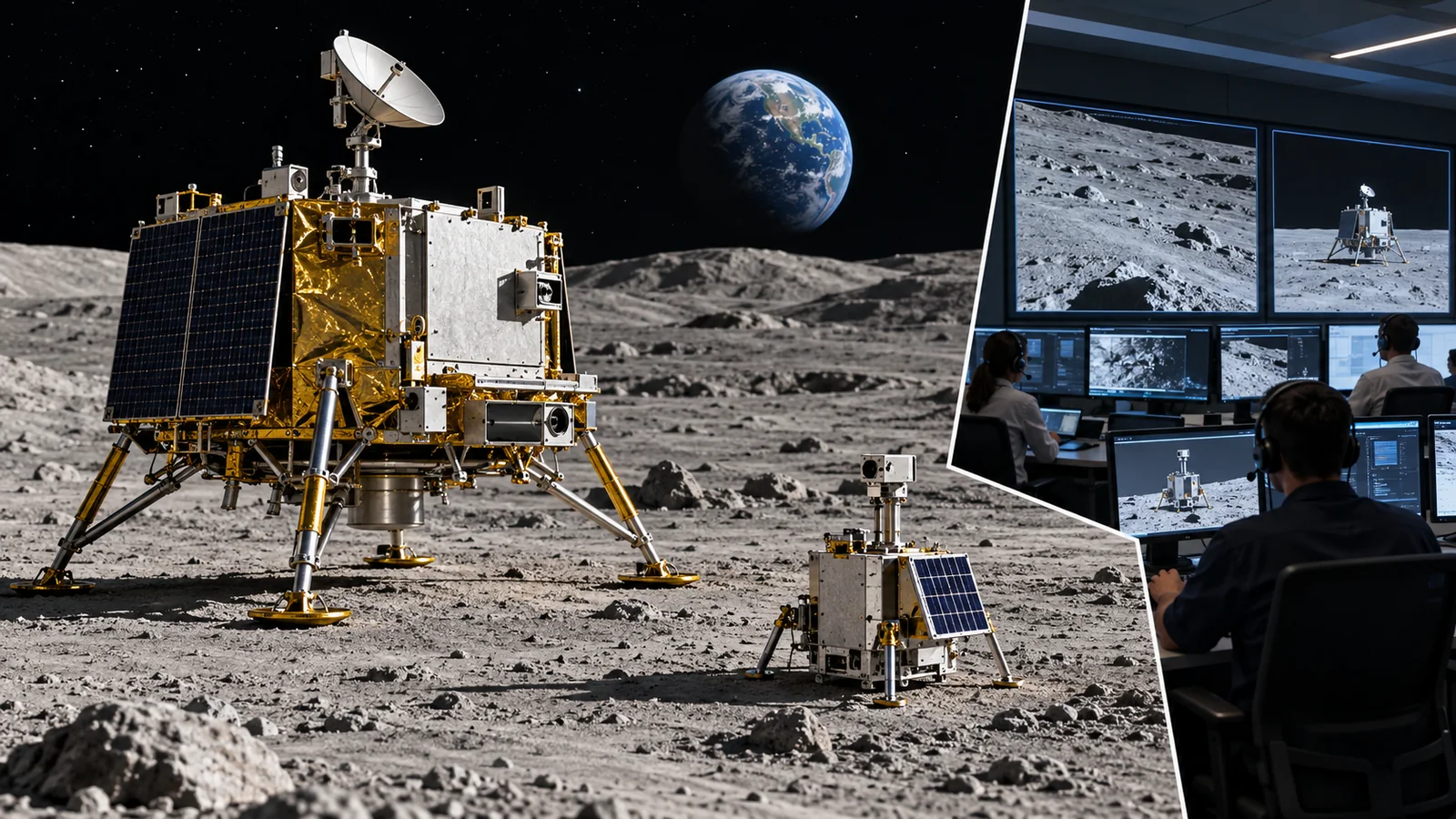
First, two terms. A lander is a spacecraft that descends slowly to the surface of the Moon or another body and sets down. A payload is the "cargo" that a rocket or lander carries: experiment equipment, small rovers, instruments from companies. Intuitive Machines builds the lander and delivers other people's payloads to the Moon, a bit like a courier service.
The Moon has no air, so a parachute is useless. A lander must slow itself using engine thrust alone and set down at a chosen spot. Radio signals take time to travel between Earth and the Moon, and in the last minutes the vehicle has to measure its own height and speed and land by itself. Both of Intuitive Machines' landings were in the south polar region, an uneven area where the Sun sits low in the sky (NASA gives 80.13 degrees south for IM-1; the company describes the IM-2 site as the lunar south pole region) Sourced. For the technical details of landers, see our explainers on lunar exploration and Artemis, and on rocket engines and propellants.
4. Scale
As a listed company, its scale can be checked in statutory filings Sourced. In the table below, figures up to the year to December 2025 are before the Lanteris purchase and the April to June 2026 figures are after it, so comparing them directly mixes the effect of the acquisition with any change in underlying strength.
| Measure (US$ thousand) | Year to Dec 2024 | Year to Dec 2025 | April to June 2026 (3 months) |
|---|---|---|---|
| Revenue (total) | 228,000 | 210,059 | 206,168 |
| Operating loss | (57,396) | (87,231) | Not tallied in this article |
| Net loss | (346,922) | (106,846) | Not tallied in this article |
| Backlog (period end) | 328,345 | 213,070 | 1,761,950 |
| Cash and cash equivalents (period end) | 207,600 (company release) | 582,600 | 367,400 |
| Employees | Number | Date and note |
|---|---|---|
| Before Lanteris (after KinetX) | 525 | 31 December 2025 |
| After Lanteris | About 1,695 | After the purchase closed on 13 January 2026 (company's 10-K) |
The net loss for the year to December 2024 (US$346.9 million) includes large non-cash accounting gains and losses, such as changes in the fair value of warrants and of "earn-out" conditional shares. The operating loss for the same year was US$57.4 million, so it is safer not to read the size of the net loss as the strength of the business Sourced. Backlog is also the company's own estimate of "work awarded but not yet booked as revenue". It is not guaranteed revenue (the company itself says backlog is not a guarantee of future revenue).
5. Resources committed to space
The table shows whether primary sources confirm four things: people, money, outside investments and acquisitions, and contracts with public bodies.
| Type of resource | What could be confirmed | Status |
|---|---|---|
| People | About 1,695 (after Lanteris). Sites: Houston (lunar lander design, production and operations), Glen Burnie, Maryland (mechanisms and robotics), Phoenix, Arizona (engineering), Palo Alto and San Jose, California (Lanteris), and Colorado | Sourced |
| Money: R&D | US$12.4 million in the year to December 2025 (US$1.4 million in 2024). The company reports R&D within general and administrative expense | Sourced |
| Money: capital spending | Purchases of property and equipment: US$41.6 million in 2025 (US$10.1 million in 2024). The rise was mainly for commercial communications satellites and a navigation network, and for expansion into a new leased facility at the Houston Spaceport | Sourced |
| Money: funding | US$345.0 million of 2.500% convertible senior notes due 2030 in August 2025 (net proceeds US$334.6 million). US$176.6 million from warrant exercises in the first quarter of 2025. US$175.0 million from a share sale to investors on 27 February 2026. Capital markets, not sales, supply much of the funding | Sourced |
| Acquisitions | KinetX (closed 1 October 2025; deep-space navigation; about US$31.3 million), Lanteris (closed 13 January 2026; about US$705.8 million consideration: US$403.3 million cash plus shares), Goonhilly UK and U.S. businesses (closed 3 August 2026; the UK part is £37.0 million, half cash and half shares) | Sourced |
| Joint ventures | Space Network Solutions (with KBR; the company holds 90%), within it the OMES III contract unit (the company's profit share is 47%, KBR's 53%), and IX, LLC (with X-energy; the company holds 51%; nuclear-powered space power and propulsion studies) | Sourced |
| Contracts with public bodies | NASA CLPS (lunar landings), Near Space Network (communications near the Moon), the Lunar Terrain Vehicle (LTV), the Gateway Power and Propulsion Element (a Lanteris contract), satellite buses for the Space Development Agency (SDA), an indefinite-delivery contract (a framework contract without fixed quantities) with a U.S. defence agency, and the Air Force Research Laboratory JETSON contract, among others. The amounts shown are revenue the company expects under fixed-price contracts; they are separate from NASA's authorised or paid amounts | Sourced |
| Start-up investments | The 10-K for 2025 shows no stand-alone investment cases (only joint ventures and acquisitions) | Could not confirm |
| University links | The March 2024 10-K mentions payloads from a nationwide university network. We could not find detail in the latest 10-K | Could not confirm |
Status of main vehicles, missions and products (checked 17 October 2026)
| Vehicle or product | Type | Main specifications (company's stated values) | Record | Stage and date | Source |
|---|---|---|---|---|---|
| Nova-C (IM-1 "Odysseus") | Lunar lander | About 100 kg of payloads (IM-1 actual). VR900 LOX/methane engine (900 lbf class) | Landed on 22 February 2024 (NASA: 80.13 degrees S, 1.44 degrees E, near Malapert A). NASA calls it the first successful soft landing under CLPS. We could not confirm the lander's posture after landing from the primary sources we read | Achieved (operations ended) | Ref. 3, 6 |
| Nova-C (IM-2 "Athena") | Lunar lander | As above (IM-2 carried items such as NASA's ice-drilling experiment) | Landed in March 2025 inside a crater in the Mons Mouton region (company: 250 m from the intended site). The company announced the lander was on its side, that it did not expect it to recharge, and that the mission had concluded | Achieved (operations ended) | Ref. 4 |
| Nova-C (IM-3) | Lunar lander | Expected NASA contract revenue US$91.3 million (company's fixed-price contract; US$9.7 million of conditional revenue excluded) | Described by the company as its next launch. Still booked as a loss contract at 30 June 2026 (estimated cost exceeds the contract amount) | In development and test. Performance period runs to March 2027. Launch date could not be confirmed | Ref. 1, 2 |
| Nova-C (IM-4) | Lunar lander | Expected revenue US$124.5 million (excluding US$16.2 million conditional) | None yet | In development. The 10-K for 2025 assumes a launch in the second half of 2027; the contract deadline is August 2028 | Ref. 1, 2 |
| IM-5 and IM-6 | Lunar lander (NASA contracts) | IM-6: US$160.1 million (awarded March 2026). IM-5: base period US$68.6 million, option US$79.7 million (not exercised) | None yet | Contract stage (Not yet confirmed) | Ref. 2 |
| µNova (Micro Nova) | Small rocket-powered "hopper" for the lunar surface | Up to 25 km from the host lander, 5 kg payload (March 2024 10-K) | Carried on IM-2. We could not confirm the operating result from the primary sources we read | Demonstration (carried on IM-2) | Ref. 3, 5 |
| Moon RACER (LTV) | Lunar rover | None given | One of three prime contractors for NASA's lunar terrain vehicle. The 10-K says the LTV contract was completed in the second quarter of 2025 (we could not confirm the result of the next selection from the primary sources we read) | Development (Not yet confirmed) | Ref. 1 |
| Lanteris 1300-class bus | Platform for geostationary communications satellites | Over 95 spacecraft still operating (company). The company describes a "lightweight, high-strength structure" | Built JUPITER 3 (for Hughes Network Systems) | In operation (achieved) | Ref. 1 |
| NSN lunar-orbit relay satellites | Lunar communications relay satellites | None given | The company says it is the sole awardee of NASA's data relay services (2.2). The satellite is being developed in-house | In development (Not yet confirmed) | Ref. 1, 2 |
6. What it has done so far
| When | What happened | Meaning |
|---|---|---|
| 2013 | Company founded (10-K) | - |
| June 2019 | NASA awarded the IM-1 cargo contract (CLPS) | The first lunar landing contract |
| February 2023 | Merger with the SPAC (special purpose acquisition company) Inflection Point Acquisition Corp. closed, and the company listed | Listing as a way to raise capital |
| 22 February 2024 | IM-1 "Odysseus" landed in the lunar south polar region. NASA calls it the first successful soft landing under CLPS | A privately operated lander reached the lunar surface. The company says it was the first U.S. vehicle to soft-land since 1972 (company claim) |
| March 2025 | IM-2 "Athena" landed inside a crater in the lunar south polar region. The company announced that the lander was on its side and that the mission had concluded | Some payloads operated, but the lander's attitude differed from plan |
| August 2025 | Issued US$345.0 million of convertible notes | Funding ahead of acquisitions |
| 1 October 2025 | Acquired KinetX (deep-space navigation) | Strengthens "Connect": communications and navigation |
| 13 January 2026 | Acquired Lanteris (formerly Maxar Space Systems) (about US$705.8 million consideration) | Adds geostationary satellite manufacturing and changes the revenue mix |
| June 2026 | Authorisation to proceed on three geostationary communications satellites (expected total value over US$600 million). IM-5 contract | The main reason backlog rose to US$1.76 billion |
| 30 June to August 2026 | Several EchoStar-related companies began U.S. Chapter 11 bankruptcy proceedings (10-Q) | May affect Lanteris' receivables (section 11) |
| 3 August 2026 | Acquired the businesses of Goonhilly, a UK ground-station and satellite communications company | Strengthens the ground-station network for lunar and deep-space communications |
7. What comes next
In its 10-K the company writes that proving sustained operations at the Moon is a foundation that can be applied to Earth orbit and to Mars Sourced. It also says that all of these timings are the company's expectations and can change with contracts, funding, launches and approvals Not yet confirmed.
None of the following is firmly stated in the primary sources we read Not yet confirmed.
The IM-3 launch date and landing date / the launch date of the lunar-orbit communications satellite / when the lunar rover (Moon RACER) might be selected / the specification and timing of the large lander (what the company calls the heavy cargo lander). Dates seen in news coverage or on third-party sites cannot be confirmed from primary sources and are not used here.
8. What the company is aiming for in space
This section includes points the company does not state directly. We set them out as inferences that can be read from primary sources, with the basis for each.
| What can be read | Primary basis | Status |
|---|---|---|
| The aim is to move from "lunar delivery service" to a company that keeps providing communications, navigation and operations | The 10-K says "from missions to infrastructure", and that service-based offerings may bring more predictable recurring revenue and higher margins | Sourced (company policy) |
| The Lanteris purchase is also a way to gain revenue scale and stability in one step | Against 2025 revenue of US$210 million, Lanteris alone booked US$308.3 million in the first half of 2026 (10-Q). Several lunar contracts are booked as loss contracts (IM-3, IM-4) | Inference |
| The lunar landing business may be valued less for profit than as a track record at the Moon and an entry point to a communications network | 10-Q: IM-3 and IM-4 are loss contracts. The 10-K, meanwhile, says that to sell additional products and services the company must show reliability through a successful lunar landing | Inference |
| U.S. government (NASA, SDA and others) budget policy is the largest external factor | The 10-K states that changes in federal budgets and priorities can affect the business | Sourced |
The 10-K says the Lanteris purchase makes the company "a vertically integrated, next generation space prime" that can design, build, deliver and operate missions Sourced. A "space prime" is a prime contractor that takes on whole spacecraft for governments and large customers. The same document says that lunar delivery contracts carry variable consideration of about 10% of the contract price, tied to landing success and treated as nil for accounting purposes. From this we read that the company wants to offset the way lunar landing results swing its revenue by adding steadier satellite manufacturing and service revenue Not yet confirmed.
9. Map of partnerships in the space industry
10. Technologies, products and services
The company describes its business through three pillars: Build, Connect and Operate. The illustration below is our arrangement of how they relate.
| Category | Content (company's description) | Status |
|---|---|---|
| Build: Nova-C lunar lander | A lander that descends on its own engine burning LOX (liquid oxygen) and methane. It carried about 100 kg of payloads on IM-1. The successors Nova-D (planned 500 to 2,500 kg) and Nova-M (planned about 5,000 to 7,500 kg) were concepts in the March 2024 10-K; the latest 10-K mentions only a "heavy cargo lander" within the LTV contract | Sourced (Nova-D and Nova-M: Not yet confirmed) |
| Build: lunar rover | NASA's Lunar Terrain Vehicle. The company is one of three prime contractors and develops the Moon RACER | Sourced |
| Build: satellites (Lanteris) | Geostationary communications satellites (1300-class) and the 500-class used for Earth-imaging satellites. Offered under the IM 300, IM 500 and IM 1300 series names. Lanteris also won the NASA Gateway power and propulsion contract (before the purchase) | Sourced |
| Connect: communications and navigation | One of two awardees of NASA Near Space Network direct-to-Earth services near and beyond the Moon (1.2 and 1.3), and the sole awardee for lunar-orbit relay satellites (2.2). KinetX deep-space navigation, Goonhilly ground stations, and a ground network with CSIRO and Fugro | Sourced |
| Operate: operations services | Mission operations, payload operations, navigation and timing (alternative PNT) and similar. The company presents these as growing from here | Sourced (includes Not yet confirmed) |
From the company's documents, three points stand out (all are company descriptions, including statements in the March 2024 10-K). First, the VR900 engine is made with metal 3D printing (additive manufacturing), the company says. Its plant has two EOS M290 machines that can handle Inconel (IN625, a nickel-based heat-resistant alloy) and titanium alloy (Ti64) Sourced. Second, the propellants are liquid oxygen and liquid methane; the company says their handling and ground testing have proved safe and that they allow more direct trajectories to the Moon. Third, the company has an in-house composites shop (composites are light structural materials made with carbon fibre and similar). The latest 10-K also lists research on "surviving the night" on the Moon, and improvements to pump and tank technology, as R&D priorities. The lunar night is extremely cold, so materials that hold heat in and battery design become the challenge (for the materials, see our explainers on spacecraft thermal control, additive manufacturing in space, and lightweight structural materials).
11. The risks this company carries
| Risk | Content | Status |
|---|---|---|
| Outcome of a lunar landing | Both IM-1 and IM-2 reached the lunar surface, but the company says about 10% of the contract price is variable consideration tied to landing success, treated as nil for accounting purposes. The landing result directly affects contract revenue | Sourced |
| Loss-making contracts | IM-3 (since 2021) and IM-4 (since the second quarter of 2025) are "loss contracts" whose estimated cost exceeds the amount expected to be received. In the first half of 2026 there were further losses of US$6.3 million on IM-3 and US$16.2 million on IM-4 | Sourced |
| Schedule slips | IM-3 was originally targeted for no later than June 2024, yet the August 2026 10-Q still calls it the "next launch". The company says launch delays can affect results | Sourced |
| Dependence on government budgets | The company mainly sells to U.S. government customers. The 10-K lists shutdowns, shifts in budget priorities and contract terminations as risks. NASA cancelled the OSAM task orders, and OMES III revenue fell by about US$71.9 million in 2025 | Sourced |
| Integrating acquisitions | Headcount rose from 525 to about 1,695, and KinetX, Lanteris and Goonhilly were taken in within about ten months. The 10-Q describes the allocation of the Lanteris purchase price as "preliminary" | Inference (the difficulty of integration is a general point) |
| Customer credit risk | EchoStar-related companies began Chapter 11 proceedings from 30 June 2026. Lanteris held US$10.1 million of receivables and US$41.4 million of "orbital receivables" at 30 June 2026, and had booked no additional credit-loss provision | Sourced |
| Funding | It carries US$345.0 million of convertible notes (due 2030). Cash fell from US$582.6 million at end-2025 to US$367.4 million at end-June 2026 after the acquisitions | Sourced |
| Export control and regulation | Subject to ITAR (International Traffic in Arms Regulations), EAR (Export Administration Regulations) and FAA and FCC approvals; delays can affect launch timing | Sourced |
12. Glossary
- CLPS
- Commercial Lunar Payload Services. A NASA programme that buys delivery of cargo to the Moon from commercial landers.
- Lander
- A spacecraft that makes a soft landing on the Moon or another body.
- Payload
- The cargo a spacecraft carries, such as experiment equipment or small rovers.
- LOX / methane
- Liquid oxygen and liquid methane, a propellant combination for rockets and landers.
- Additive manufacturing
- 3D printing of metals and similar: powder is melted and fused layer by layer to make a part.
- Geostationary orbit (GEO)
- An orbit about 36,000 km above the equator, where a satellite appears fixed in the sky. Many communications satellites sit here.
- Cislunar space
- The space between Earth and the Moon and around the Moon.
- Near Space Network (NSN)
- NASA's way of providing communications to spacecraft near Earth. It also uses commercial services.
- LTV
- Lunar Terrain Vehicle, a rover astronauts will use on the Moon.
- SPAC
- Special purpose acquisition company. A listed "blank cheque" shell merges with an operating company, which then becomes listed.
- Backlog
- The value of work awarded but not yet booked as revenue. Definitions differ by company.
- Variable consideration
- Part of a contract price received only if conditions such as success are met.
- Convertible notes
- Bonds that can be exchanged for shares under set conditions.
- 10-K / 10-Q
- Annual and quarterly reports filed with the U.S. SEC.
13. References
- Intuitive Machines, Inc. Form 10-K for the fiscal year ended December 31, 2025 (filed with the U.S. SEC on 19 March 2026). Business description, acquisitions (KinetX, Lanteris), revenue, losses, backlog, cash, funding, employees, contracts with NASA and others, contract revenue for IM-1 to IM-4, LTV and NSN. https://www.sec.gov/Archives/edgar/data/1844452/000162828026019865/lunr-20251231.htm
- Intuitive Machines, Inc. Form 10-Q for the quarterly period ended June 30, 2026 (filed with the U.S. SEC on 13 August 2026). First-half 2026 revenue, backlog, IM-3 to IM-6 contracts, the Goonhilly acquisition, the three-satellite programme, EchoStar-related bankruptcy proceedings, cash. https://www.sec.gov/Archives/edgar/data/1844452/000162828026056821/lunr-20260630.htm
- Intuitive Machines, Inc. Form 10-K for the fiscal year ended December 31, 2023 (filed with the U.S. SEC on 25 March 2024). Nova-C, the VR900 engine, additive manufacturing equipment, µNova, the then concepts for Nova-D and Nova-M, and the IM-1 landing. https://www.sec.gov/Archives/edgar/data/1844452/000184445224000036/lunr-20231231.htm
- Intuitive Machines, Inc. Press release "Intuitive Machines Executes Southernmost Lunar Landing and Operates Payloads" (7 March 2025). The IM-2 landing site and result. https://investors.intuitivemachines.com/news-releases/news-release-details/intuitive-machines-executes-southernmost-lunar-landing-and
- Intuitive Machines, Inc. Fourth-quarter and full-year 2024 results press release (Form 8-K Exhibit 99.1, 24 March 2025). Cash at end-2024, and statements on IM-2 and µNova. https://www.sec.gov/Archives/edgar/data/1844452/000184445225000016/lunr-20241231xexx991earnin.htm
- NASA NASA's LRO Images Intuitive Machine's Odysseus Lander (26 February 2024). The IM-1 landing date, time and position, and the description as the first soft landing under CLPS. https://www.nasa.gov/missions/lro/nasas-lro-images-intuitive-machines-odysseus-lander/
- Intuitive Machines Official website (source of the logo). https://www.intuitivemachines.com/
14. Claim-to-source audit
| Claim in the text | Status | Source |
|---|---|---|
| Founded 2013, headquarters in Houston, Nasdaq: LUNR, SPAC merger and listing | Sourced | Reference 1 https://www.sec.gov/Archives/edgar/data/1844452/000162828026019865/lunr-20251231.htm |
| Revenue, losses, backlog, cash (2024 and 2025), R&D, capital spending, funding | Sourced | Reference 1 https://www.sec.gov/Archives/edgar/data/1844452/000162828026019865/lunr-20251231.htm |
| Cash of US$207.6 million at end-2024 | Sourced | Reference 5 https://www.sec.gov/Archives/edgar/data/1844452/000184445225000016/lunr-20241231xexx991earnin.htm |
| 525 employees, about 1,695 after the acquisition, sites | Sourced | Reference 1 https://www.sec.gov/Archives/edgar/data/1844452/000162828026019865/lunr-20251231.htm |
| Consideration and dates for KinetX and Lanteris; stakes in Space Network Solutions and IX LLC | Sourced | Reference 1 https://www.sec.gov/Archives/edgar/data/1844452/000162828026019865/lunr-20251231.htm |
| April to June 2026 revenue of US$206.2 million, Lanteris US$166.7 million, backlog of US$1.76 billion, cash of US$367.4 million | Sourced | Reference 2 https://www.sec.gov/Archives/edgar/data/1844452/000162828026056821/lunr-20260630.htm |
| Goonhilly acquisition, three-satellite programme, EchoStar-related bankruptcy proceedings, IM-5 and IM-6 contracts | Sourced | Reference 2 https://www.sec.gov/Archives/edgar/data/1844452/000162828026056821/lunr-20260630.htm |
| IM-1 landed on 22 February 2024 (position; first soft landing under CLPS) | Sourced | Reference 6 https://www.nasa.gov/missions/lro/nasas-lro-images-intuitive-machines-odysseus-lander/ |
| IM-1 payload of about 100 kg, VR900 engine, additive manufacturing equipment, µNova specifications, concepts for Nova-D and Nova-M | Sourced (Nova-D and Nova-M: not yet confirmed) | Reference 3 https://www.sec.gov/Archives/edgar/data/1844452/000184445224000036/lunr-20231231.htm |
| IM-2 landed 250 m from the intended site inside a crater, on its side, mission concluded | Sourced | Reference 4 https://investors.intuitivemachines.com/news-releases/news-release-details/intuitive-machines-executes-southernmost-lunar-landing-and |
| IM-3 and IM-4 contract size, performance periods, loss contracts | Sourced | Reference 2 https://www.sec.gov/Archives/edgar/data/1844452/000162828026056821/lunr-20260630.htm |
| IM-4 launch assumed in the second half of 2027 | Not yet confirmed | Reference 1 https://www.sec.gov/Archives/edgar/data/1844452/000162828026019865/lunr-20251231.htm |
| NASA NSN contract, LTV, Gateway and SDA contracts, partners | Sourced | Reference 1 https://www.sec.gov/Archives/edgar/data/1844452/000162828026019865/lunr-20251231.htm |
| The Build, Connect and Operate pillars; the "from missions to infrastructure" policy | Sourced (company policy) | Reference 1 https://www.sec.gov/Archives/edgar/data/1844452/000162828026019865/lunr-20251231.htm |
| The four company types in Fig. 1; the Lanteris share (about 80%) | Our calculation | Our own arrangement (the share is Reference 2 figures divided by us) |
| IM-3 launch date, start of the lunar relay satellites, selection timing for the rover | Not yet confirmed | Outlook: not firmly stated in the primary sources we read. Dates from news reports are not used |
| IM-1 posture after landing; µNova operating result | Not yet confirmed | Outlook: not stated in the primary sources we read |
| Current state of start-up investments and university links | Not yet confirmed | Outlook: no stand-alone mention in the latest 10-K. We do not claim they do not exist |
| Reading of the aims (shift to infrastructure, steadier revenue) | Inference | Our own interpretation (basis: References 1 and 2) |
| Difficulty of integrating acquisitions as a risk | Inference | Our own interpretation (general point) |
| Link between landing results and contract revenue; customer credit risk | Sourced | Reference 1, 2 https://www.sec.gov/Archives/edgar/data/1844452/000162828026056821/lunr-20260630.htm |
Last updated: 17 October 2026 / Troy Technical
The figures in this article are based on statutory filings by Intuitive Machines, Inc. with the SEC, the company's official announcements and NASA public material. We have not used market-research estimates or figures that appear only in press coverage. Passages marked "Inference" are our reading of primary information, not statements by the company. Share prices, valuations and investment judgements are not discussed.