COMPANY PROFILE / SPACE INDUSTRY
LandSpace
- A Chinese private rocket company that flies on liquid oxygen and methane and has now landed a first stage on land
LandSpace was founded in 2015 and is a private rocket company in China. Its official website counts 10 flights of the methane-fuelled Zhuque-2 series. The first flight of its large reusable rocket, Zhuque-3, in December 2025, reached orbit, but the first stage failed to land. On 19 August 2026, the company announced that on the second flight the payload reached orbit and the first stage landed on land. LandSpace has also applied to list on the STAR Market of the Shanghai Stock Exchange, and the application was accepted on 31 December 2025 (as of 17 October 2026 the company is not listed). This article uses primary sources only (the company's own website and public Shanghai Stock Exchange data) and keeps what could be confirmed separate from what could not.
- LandSpace in 30 seconds, and where it sits in the space industry
- Logo and how the name is written
- Where the company sits in the space industry
- Company size
- Resources committed to the space industry
- Track record so far
- Plans
- What the company seems to be aiming for
- Partnership map in the space industry
- Technologies, products and services
- Risks the company faces
- Glossary / References / Claim-to-source audit
1. LandSpace in 30 seconds, and where it sits in the space industry
(Yizhuang development area)Founded in 2015 (company website)
STAR Market application pendingAccepted on 31 December 2025 (SSE). Listing date not yet confirmed
(carrying payloads up)Not a maker of satellites or probes
Zhuque-3Both are two-stage liquid oxygen and methane rockets
1 first-stage landing3 December 2025 and 19 August 2026. Company announcements
Many rocket companies are state-owned or grew up inside a government framework. LandSpace is a private rocket company in China that stresses doing its own engines, airframes, factories and launch-pad preparation Sourced. The company says it is the only private company in China to put a rocket into orbit using its own engine (a company claim). A second feature is that it chose liquid methane as fuel. Methane leaves less soot than kerosene and is considered well suited to reuse. And in August 2026 it announced that it had brought the first stage of an orbital-class rocket back to the ground and landed it. However, no recovered stage has yet been flown again. The announcement speaks only of a base for later reuse flights.
2. Logo and how the name is written

A note on naming: the company is known as LandSpace. Its Chinese name is written Lanjian Hangtian in pinyin, which roughly means "Blue Arrow Aerospace". Its rocket is named Zhuque, after a legendary bird of Chinese tradition, the guardian of the south. "Zhuque-2 Improved" is written ZQ-2E and "Zhuque-3" is written ZQ-3. The engines belong to the Tianque (TQ) series. Labels such as "Y1" and "Y2" mean the first and second flights of a given rocket type.
Official site: https://www.landspace.com/en/index.html (the logo used here is the English-site logo shown in the header of the official site)3. Where the company sits in the space industry
Companies in the space industry are easiest to sort by the role they play in space, which gives four types. LandSpace is a "Launch" company, the leftmost type. Its job is to carry satellites and other payloads up on a rocket.
Reuse means recovering part of a rocket and flying it again. A first-stage landing on land means the first stage returns to the ground after separation and sets down on landing legs, which differs from landing on a ship at sea. Liquid methane is the main component of natural gas cooled into a liquid. Compared with kerosene-type fuel it leaves less soot, which is said to make engines easier to maintain. The company's rockets burn liquid oxygen and liquid methane (often shortened to methalox). For the idea of reuse, see our explainers on reusable rockets and on rocket engines and propellants.
4. Company size
Because the company is not yet listed, it has had no obligation to publish revenue or profit on a regular basis. The table below sets out what could be confirmed from the company's materials and other sources Sourced.
| Item | What could be confirmed | Source |
|---|---|---|
| Founding and headquarters | Founded in 2015. Headquarters in the Beijing Economic-Technological Development Area (Yizhuang). English name: LandSpace Technology Co., Ltd. | References 3 and 4 |
| Representative | Zhang Changwu (founder and CEO, per the company's introduction). The SSE review data lists him as chairman and general manager | References 3 and 29 |
| Revenue and profit | Could not be confirmed (not on the company website. The prospectus is published on the SSE, but its text could not be retrieved in this article's working environment because of access restrictions, so its figures are not used) | Reference 29 |
| Number of employees | Could not be confirmed (the website says only that its team size is among the largest in the industry) | Reference 2 |
| Listing status | The application to list on the STAR Market was accepted on 31 December 2025. The planned fundraising figure is 75 (in the SSE data; the unit reads as hundred million yuan) and the sponsor is China International Capital Corporation (CICC). The SSE review data was last updated on 30 September 2026. The current review stage could not be confirmed | Reference 29 |
| Main sites | Beijing (headquarters and R&D), Xi'an (propulsion R&D), Shanghai (structures R&D), Huzhou in Zhejiang (engine manufacturing base), Jiaxing in Zhejiang (rocket manufacturing base), Jiuquan in Gansu (launch site) | Reference 2 |
Revenue, profit and headcount could not be confirmed as figures from primary sources Not yet confirmed. The documents published for the listing application (the prospectus) should contain financial information, but this article has not read them directly, so it states no numbers. Revenue, losses and order values reported in the press cannot be confirmed from primary sources and are not used. Also, acceptance of an application is not a decision to list. The result of the review and the listing date are not yet known.
5. Resources committed to the space industry
Four angles are covered (people, money, outside investments and acquisitions, and contracts with public agencies), showing what could and could not be confirmed.
| Angle | What could be confirmed | Category |
|---|---|---|
| People | R&D sites in Beijing, Xi'an and Shanghai. Headcount is not disclosed. A 2018 announcement said the propulsion and overall-design R&D teams numbered more than 100 as of the first quarter of 2018, but that is not a current figure | Sourced (current headcount not confirmed) |
| Money | Funding that can be confirmed on the official site runs to 2018: Series B of CNY 200 million (May 2018, led by Goldwind), Series B+ of CNY 300 million (November 2018, led by Huachuang Capital), and more than CNY 800 million in total (end of September 2018). Later amounts could not be confirmed on the site. The planned fundraising in the listing application is 75 (read as hundred million yuan) | Sourced (2019 onwards not confirmed) |
| Capital spending | The Huzhou manufacturing base (first phase about 70 mu, about 30,000 square metres of floor area, completed in January 2019), the Jiaxing manufacturing base (first phase about 40 mu, completed in June 2021), and a liquid oxygen and methane launch position at Jiuquan (which the company says it invested in and built itself). Amounts are not disclosed | Sourced (amounts not confirmed) |
| Investments, acquisitions, joint ventures, divestments | No investments in or acquisitions of other companies appear in official material. On the satellite side it has launched satellites of "Lantian Intelligent" (pinyin), which appears to be an affiliate, but the capital relationship could not be confirmed from official material | Could not be confirmed |
| Contracts and ties with public agencies | A Beijing municipal key laboratory set up jointly with Tsinghua University (February 2025). The company says it received a second-class National Science and Technology Progress Award (2024). Launches are supported by the Jiuquan Satellite Launch Center. Contract values with government bodies could not be confirmed | Sourced (contract values not confirmed) |
Status of main vehicles and products (checked 17 October 2026)
| Vehicle / product | Type | Main specifications (company's stated values, with conditions) | Track record | Stage |
|---|---|---|---|---|
| Zhuque-2 Improved (ZQ-2E) | Two-stage medium-lift rocket (liquid oxygen and methane) | Length about 55 m, diameter 3.35 m, liftoff mass 264 t, liftoff thrust 327 t (product page). Capability: 4 t to sun-synchronous orbit at 500 km, 6 t to low Earth orbit at 200 km | The company announced six successes (Y1, Y2, Y5, Y6, Y7 and Y4); see the illustration in Section 6 | In operation (the company describes "regular commercial launches") |
| Zhuque-3 (ZQ-3) | Large rocket aimed at reuse (stainless steel) | Product-page values for the production version: length 76.6 m, diameter 4.5 m, fairing diameter 5.2 m, liftoff thrust 900 t. To low Earth orbit (450 km): 21.3 t expendable, 18.3 t with downrange recovery, 12.5 t with return to the launch site. First stage: nine TQ-12B engines; second stage: one TQ-15B. Future first-stage reuse of up to 20 times. The first flight vehicle: length 66.1 m, liftoff mass about 560 to 570 t (the announcements differ), nine TQ-12A engines on the first stage | 3 December 2025: orbit reached, first-stage landing failed. 19 August 2026: orbit reached, first stage landed on land (company announcements) | In test and engineering-verification (no recovered stage reflown yet) |
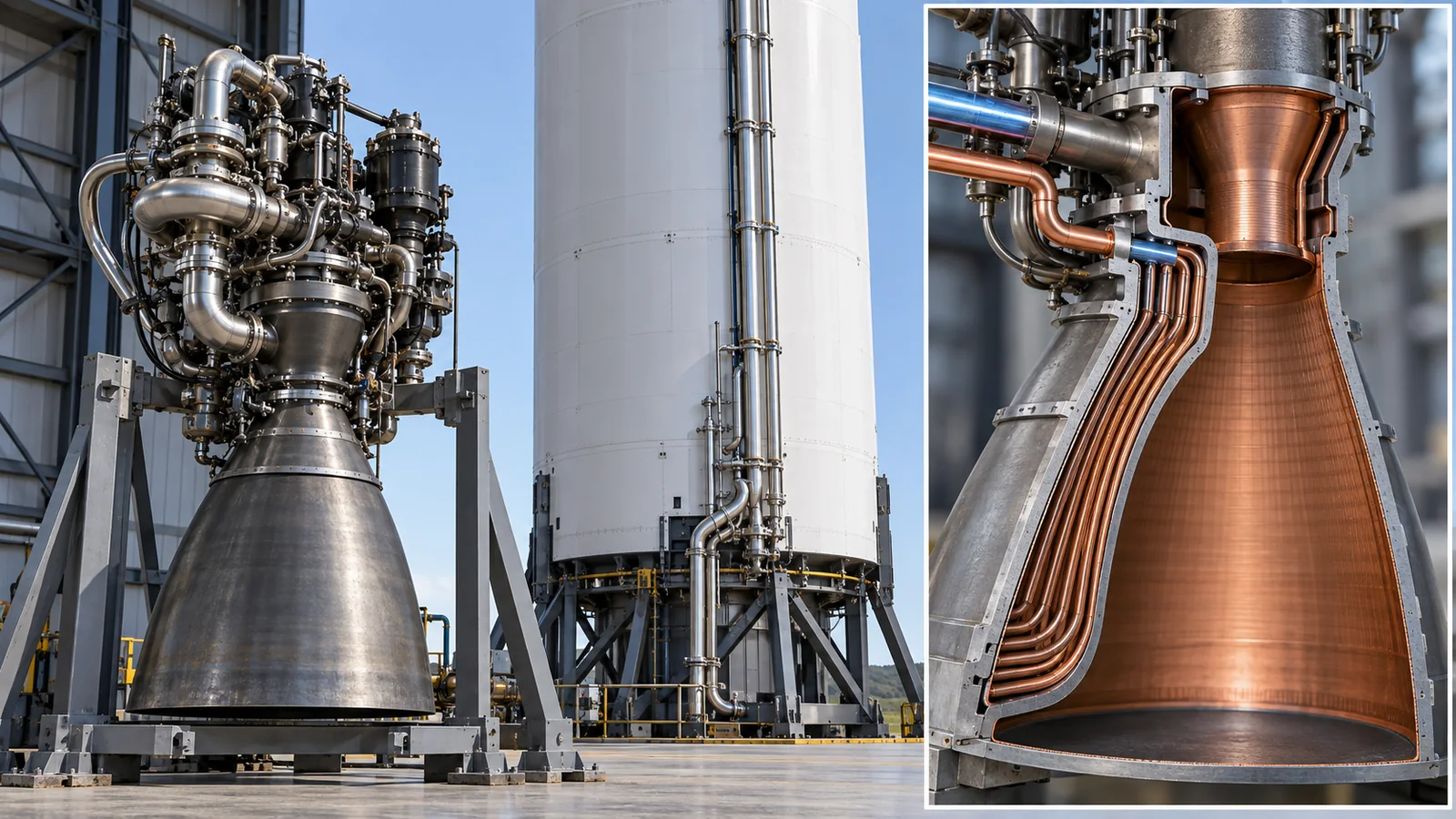
| Tianque (TQ-12A) engine | Liquid oxygen and methane engine | Sea-level thrust 84.6 t, sea-level specific impulse 293 s, mixture ratio 2.9 (product page). The company says restart in two ignition tests has been verified | Used on Zhuque-2E and Zhuque-3 | In operation |
| "Lanyan" engine | 220-tonne-class liquid oxygen and methane full-flow staged-combustion engine | First full-system test in May 2025. Full-engine long-duration test announced complete in March 2026. More than 100 ignitions in total | Ground testing only. Installation on a rocket could not be confirmed | In development and ground testing |
LandSpace's official announcements show materials being chosen to suit each purpose Sourced.
(1) Zhuque-3's tanks are stainless steel. The company says it developed its own system of high-strength stainless steel and laser-welding processes, and that it cut the manufacturing cost of large-diameter, very thin-walled stainless tanks by 80% compared with aluminium alloy and shortened production time by 40% (a company claim; the basis of comparison is not given). It also says stainless steel tolerates heat, which suits a vehicle that returns and is reused many times.
(2) The nozzle extension of the upper-stage engine is niobium alloy. The second-stage engine of Zhuque-2E uses a lightweight, heat-resistant niobium alloy nozzle extension. The company says it developed in-house the double-curvature sheet forming, precision machining of large thin-walled parts, laser welding in air with oxidation protection, and coating and sintering.
(3) Some parts use carbon fibre or metal 3D printing. The fairing (the payload cover) was changed from metal to composite (laminated glass-fibre plastic for the nose cap, carbon-fibre sandwich for the main body). On Zhuque-2E Y6, the company says it made the second-stage engine mount as a single 3D-printed structure to save weight and cost. All of this is the company's own explanation, and no third-party verification results could be confirmed Not yet confirmed.
6. Track record so far
Flight record of the Zhuque series (from the company's announcements)
| Date | Event | What it means |
|---|---|---|
| 2015 | Company founded | Described by the company as one of the earliest private rocket companies in China |
| May and November 2018 | Announced Series B of CNY 200 million and Series B+ of CNY 300 million | More than CNY 800 million in total (end of September 2018, company announcement) |
| 27 October 2018 | Launched Zhuque-1 | The company describes it as "running through the launch chain for a private rocket". The outcome in orbit is not stated in that item of the site |
| January 2019 | The Huzhou intelligent manufacturing base was completed | Engine and rocket manufacturing base. A capacity of more than 200 engines a year was planned |
| 14 December 2022 | The first Zhuque-2 flight (Y1) failed. The main engines of both stages worked normally, but the second-stage vernier engine (a small engine for fine attitude control) shut down abnormally | On 18 March 2023 the company announced the cause (a rupture of the oxygen pump's low-pressure casing under water hammer) and countermeasures, and said the problem had been "closed out" |
| 12 July 2023 | Zhuque-2 Y2 succeeded | The company says it was the world's first liquid oxygen and methane rocket to reach orbit (a company claim) |
| 9 December 2023 | Zhuque-2 Y3 succeeded, placing three satellites in a 460 km sun-synchronous orbit | The company calls it the first liquid oxygen and methane rocket to succeed in consecutive launches |
| 19 January and 11 September 2024 | Vertical takeoff and landing flight tests of the Zhuque-3 test vehicle (VTVL-1). In September it relit its engine in the air from an altitude of about 10 km and landed | Part of the recovery technology was confirmed on hardware (company announcement; the company says it landed 1.7 m from the centre of the target) |
| 27 November 2024 | Zhuque-2 Improved Y1 succeeded | The first of the improved version. The company says it entered commercial operation |
| 12 February 2025 | Set up the Beijing municipal key laboratory for overall integration and application of reusable liquid oxygen and methane launch vehicles, together with Tsinghua University | The company says it is the first provincial or ministerial-level key laboratory in reuse led by a company |
| 15 April 2025 | The 100th Tianque engine was completed at the Huzhou manufacturing base | The company states a capacity of 100 or more engines a year |
| 17 May 2025 | Zhuque-2 Improved Y2 succeeded, placing six satellites in orbit | The 5th flight of the Zhuque-2 series |
| 20 June 2025 | Ground firing of the nine-engine first stage of Zhuque-3 succeeded (total thrust 7,542 kN) | A large ground test before the first flight |
| 3 December 2025 | Zhuque-3 Y1 reached orbit. The first stage had an anomaly after landing ignition and fell at the edge of the recovery area (recovery failed) | The company claims it is the first reusable-type rocket to reach orbit in China. It said the cause was under investigation |
| 6 March 2026 | Completed a full-engine long-duration test of the 220-tonne-class "Lanyan" engine | A ground test for a future large rocket |
| 14 May to 9 June 2026 | Zhuque-2 Improved Y5 (14 May) and Y6 (9 June) succeeded | Y5 carried a 2.8 t test payload to 900 km. Y6 carried Qianfan and China Mobile satellites |
| 19 August 2026 | Zhuque-3 Y2 placed the Hongqing-3 satellite in orbit (pinyin of the satellite name), and the first stage made a soft landing at the landing site in Minqin County, Gansu | The company claims it is China's first land recovery of an orbital-class first stage. Reflight is still to come |
| 15 September and 14 October 2026 | Zhuque-2 Improved Y7 launched 10 Qianfan satellites, and Y4 launched 10 satellites | Y7 was the first use for launching a large satellite constellation |
7. Plans
Everything below is a company plan or target, not an achieved fact Not yet confirmed.
The company has also announced the following (all plans).
| Item | Company's explanation | Category |
|---|---|---|
| Combining Zhuque-2E and Zhuque-3 | Says it will offer a launch service that combines the two types | Not yet confirmed |
| Stacking several satellites | Completed vibration and release-shock tests (February 2026) of its in-house "multi-satellite stacking hold-down and release mechanism" (non-pyrotechnic). It was carried in flight on Zhuque-3 Y2 | Not yet confirmed |
| Putting the "Lanyan" engine to use | Described as a base for the power of large and heavy rockets. No vehicle or timing is named | Not yet confirmed |
| Scheduled launches | On the "Scheduled launch" page of the website, every row from F3 to F10 says "Inquire", with no dates | Not yet confirmed |
None of the following appears in official material Not yet confirmed.
The next Zhuque-3 launch date and the date of a reflight / the date and result of the 6th flight of the Zhuque-2 series / launch prices / the number of contracted customers and contract values / licence numbers or details of launch approvals / revenue, profit and headcount / the listing date. Figures such as "so many yuan of orders" or "profitable by such a year" mostly come from press reports and are not used in this article.
8. What the company seems to be aiming for
This section includes points the company has not stated directly. They are written as inferences that can be drawn from primary sources, with the basis given.
| What can be read | Primary-source basis | Category |
|---|---|---|
| It sees building China's satellite internet constellations as its main market | Its announcements repeatedly refer to satellite-internet and large-constellation deployment, and Zhuque-2E Y7 was the first flight for a large constellation | Inference |
| A two-track plan: earn revenue with the medium rocket (Zhuque-2E) while moving to the large reusable rocket (Zhuque-3) | The 14 October 2026 announcement describes "regular commercial launches of Zhuque-2E alongside engineering reuse verification of Zhuque-3" | Inference |
| It treats owning everything from engines to launch pad (vertical integration) as a strength | The website describes key technologies, products, processes and facilities as self-controlled. It built its factories in Huzhou and Jiaxing and its launch position at Jiuquan itself | Sourced (calling it a strength is an inference) |
| It also has large and heavy rockets in view for the future | It announced tests of the 220-tonne-class full-flow staged-combustion "Lanyan" engine and described it as a base for large and heavy rockets | Inference |
| Listing is a way to secure funds for capital spending and R&D | The STAR Market application and the planned fundraising of 75 (hundred million yuan). An explanation of how the funds would be used could not be confirmed here | Inference |
The announcement of 19 August 2026 (Zhuque-3 Y2) describes the first-stage recovery as an important flight test that moves from verifying recovery technology into engineering verification of reuse Sourced. "Engineering" here is a Chinese expression for the stage of making something a repeatable system rather than a test. From this, this article reads the next big hurdle as how the recovered stage is inspected and refurbished (the effort and days before it can fly again). The economics of reuse depend not on "whether it landed" but on "how many times, and how cheaply, it can be flown". This is, however, an interpretation of how the announcement frames the flight, and the company has not given a date for a reflight Not yet confirmed.
9. Partnership map in the space industry
10. Technologies, products and services
What LandSpace offers is a launch service that carries satellites and other payloads into orbit, and development of engines and spacecraft parts. Its official website lists services such as mission analysis and design, provision of its own launch facilities, tracking and control, special space insurance arrangements, and tailored financing plans Sourced.
| Technology or service | Company's explanation | In plain terms |
|---|---|---|
| Full sub-cooled loading on Zhuque-2E | Liquid oxygen and liquid methane are both loaded sub-cooled. Loading takes within 1.5 hours, and the denser propellant raises the payload capacity | Chill the propellant almost to freezing before loading, so more fits in the tanks |
| Common-bulkhead tank with internal piping | In the second stage, the upper and lower tanks share a wall and the piping runs inside | Fewer parts and less weight, and fewer bumps on the airframe |
| First-stage recovery (Zhuque-3) | After separation it turns itself around, fires to slow down on re-entry, and deploys landing legs for a soft landing | Bring the first stage back to the ground instead of discarding it, and reuse it |
| Stainless-steel airframe | Says tank manufacturing cost is 80% lower than aluminium alloy and production time 40% shorter (company claim) | A material said to be inexpensive and heat-resistant, and so suited to reuse |
| Multi-satellite stacking hold-down and release mechanism | Holds flat-panel satellites stacked together and releases them one after another in orbit. Non-pyrotechnic, with a small release shock | A shelf-like device for carrying many satellites on one launch |
| Disposal of the upper stage (debris mitigation) | A third ignition of the second stage de-orbits it from a high orbit, answering the aim of reducing space debris (Y5) | Do not leave the spent upper stage in orbit, but dispose of it safely |
| Engine fault diagnosis and self-correction | The first stage uses, for the first time, a function that diagnoses engine faults in flight and corrects for them automatically (Y5, a company claim) | Find a poorly performing engine in flight and deal with it |
On a reusable rocket, the tank material and the character of the fuel shape how much maintenance is needed. LandSpace says that combining (1) stainless-steel tanks and (2) liquid methane, which leaves little soot, can reduce the step of "taking the engine off the airframe for inspection" after recovery (from its Zhuque-3 explanation, including a company explanation of December 2023). Stainless steel tolerates heat and so copes better with re-entry heating, but it is heavier than aluminium alloy, so the ability to make it thin (welding large-diameter, ultra-thin walls) is the key. The company's statement that it built an in-house welding line for thin-walled stainless tanks can be read as its answer to this challenge Not yet confirmed. However, performance data such as fatigue and weld degradation after repeated reuse could not be confirmed in official material. For the basics of metals, see our explainers on lightweight structural materials and on reusable rockets.
11. Risks the company faces
| Risk | Content | Category |
|---|---|---|
| Reuse is not yet proven | A first-stage landing has succeeded once, but a recovered vehicle has not been reflown. The economics of reuse have not been confirmed | Sourced |
| The landing failure on the first Zhuque-3 flight | On 3 December 2025 the stage had an anomaly after landing ignition and fell at the edge of the recovery area (company announcement; the cause was said to be under investigation, and a published explanation of the cause could not be confirmed) | Sourced |
| A Zhuque-2 failure and one flight that could not be confirmed | The first flight (2022) failed, and the company published the cause and countermeasures. Counting from the website's flight numbers, the result of one flight could not be confirmed | Sourced (one flight not confirmed) |
| Finances are not visible from outside | The current state of revenue, profit and funding could not be confirmed from primary sources. The listing application is pending and the result is not yet known | Not yet confirmed |
| Possible concentration of customers in Chinese satellite networks | Many of the customers named in announcements are satellite-internet operators or domestic satellite firms. Overseas customers could not be confirmed from official material | Inference |
| Institutions and licensing | Details of China's launch and recovery approval system could not be confirmed from the primary sources used here. The company says it holds all required qualifications | Could not be confirmed |
| Competition with other companies | The company's medium rocket is compared with other companies' medium rockets on price and launch frequency. This article does not rank vehicles | Sourced |
12. Glossary
- Zhuque
- The name of LandSpace's rockets, after a legendary bird in Chinese tradition.
- Tianque (TQ)
- LandSpace's series of liquid oxygen and methane engines.
- Liquid oxygen and methane (methalox)
- A rocket propellant pair: liquid oxygen as oxidiser and liquid methane as fuel. Leaves less soot than kerosene.
- Low Earth orbit (LEO)
- An orbit a few hundred kilometres above the ground, where many communications satellites fly.
- Sun-synchronous orbit (SSO)
- An orbit that crosses any given place at the same local time each day. Often used by Earth-observation satellites.
- Full-flow staged combustion
- An engine cycle in which all the fuel and all the oxidiser first drive the turbines before entering the combustion chamber. High-performing but hard to develop.
- Full sub-cooled loading
- Loading propellant chilled almost to freezing so that its density rises.
- Niobium alloy
- A heat-resistant metal used for the nozzle of a rocket's upper-stage engine.
- Vernier engine
- A small engine used for fine attitude adjustment.
- STAR Market
- The Shanghai Stock Exchange's market for science and technology companies.
- Prospectus
- The document a company going public publishes to describe its business, finances and risks.
- Qianfan
- The name of a Chinese satellite-internet constellation (its operator is Yuanxin Satellite, as can be read from the company's announcements).
13. References
- LandSpace Products and services (official website, in Chinese). Specifications of Zhuque-2E, Zhuque-3 and the TQ-12A engine. Checked 17 October 2026. https://www.landspace.com/product.html
- LandSpace Technologies and infrastructure (official website, in Chinese). Description of sites and technologies. Checked 17 October 2026. https://www.landspace.com/wisdom.html
- LandSpace Company introduction and milestones (official website, in Chinese). Founding, representative, timeline, honours. Checked 17 October 2026. https://www.landspace.com/about.html?mao=3
- LandSpace Home page of the official English website (English name LandSpace Technology Co., Ltd., founding year). Checked 17 October 2026. https://www.landspace.com/en/index.html
- LandSpace Zhuque-2 Improved Y4 launch vehicle completes a ten-satellite mission successfully (14 October 2026, in Chinese). https://www.landspace.com/news-detail.html?itemid=78
- LandSpace Zhuque-2 Improved Y7 performs its first large-scale satellite-internet constellation mission (15 September 2026, in Chinese). https://www.landspace.com/news-detail.html?itemid=77
- LandSpace Zhuque-3 reusable Y2 launch vehicle achieves orbit and recovery successfully (19 August 2026, in Chinese). https://www.landspace.com/news-detail.html?itemid=76
- LandSpace Zhuque-3 reusable Y2 launch vehicle completes a static-fire test (29 June 2026, in Chinese). https://www.landspace.com/news-detail.html?itemid=74
- LandSpace Methane-oxygen propulsion system matures; Zhuque-2 supports high-frequency launch services (9 June 2026, in Chinese). Improvements on Y6, such as the 3D-printed mount. https://www.landspace.com/news-detail.html?itemid=73
- LandSpace Zhuque-2 Improved Y6 launch mission succeeds (9 June 2026, in Chinese). https://www.landspace.com/news-detail.html?itemid=72
- LandSpace Zhuque-2 Improved Y5 flight test mission succeeds (14 May 2026, in Chinese). https://www.landspace.com/news-detail.html?itemid=71
- LandSpace LandSpace's new high-thrust engine completes a full-engine, full-system long-duration test (6 March 2026, in Chinese). The "Lanyan" engine. https://www.landspace.com/news-detail.html?itemid=69
- LandSpace LandSpace successfully carries out multi-satellite stacking and satellite-assembly tests (6 February 2026, in Chinese). https://www.landspace.com/news-detail.html?itemid=67
- LandSpace Zhuque-3 reusable Y1 launch vehicle reaches orbit successfully (3 December 2025, in Chinese). https://www.landspace.com/news-detail.html?itemid=66
- LandSpace Zhuque-3 first-stage nine-engine ground firing test succeeds (20 June 2025, in Chinese). https://www.landspace.com/news-detail.html?itemid=64
- LandSpace Zhuque-2 Improved Y2 launch succeeds, placing six satellites in their planned orbit (17 May 2025, in Chinese). https://www.landspace.com/news-detail.html?itemid=63
- LandSpace LandSpace's 100th liquid oxygen and methane engine rolls off the line (15 April 2025, in Chinese). https://www.landspace.com/news-detail.html?itemid=62
- LandSpace Leading the joint building of a Beijing key laboratory to advance reusable-rocket technology innovation (13 February 2025, in Chinese). https://www.landspace.com/news-detail.html?itemid=60
- LandSpace LandSpace's Zhuque-2 Improved Y1 flight test mission succeeds (27 November 2024, in Chinese). https://www.landspace.com/news-detail.html?itemid=59
- LandSpace Zhuque-3 reusable rocket's ten-kilometre-class vertical takeoff and landing flight test succeeds (11 September 2024, in Chinese). https://www.landspace.com/news-detail.html?itemid=57
- LandSpace A methane-oxygen rocket reaches orbit again: LandSpace opens a new chapter of scaled commercial launches of domestic civil liquid rockets (9 December 2023, in Chinese). Zhuque-2 Y3. https://www.landspace.com/news-detail.html?itemid=44
- LandSpace Celebrating the world's first methane-oxygen launch vehicle to reach orbit: Zhuque-2 Y2 launch succeeds (13 July 2023, in Chinese). https://www.landspace.com/news-detail.html?itemid=35
- LandSpace Flight anomaly of Zhuque-2 Y1 passes the close-out review (18 March 2023, in Chinese). https://www.landspace.com/news-detail.html?itemid=26
- LandSpace Statement on the Zhuque-2 Y1 flight test mission (15 December 2022, in Chinese). https://www.landspace.com/news-detail.html?itemid=24
- LandSpace LandSpace completes a CNY 200 million Series B (7 May 2018, in Chinese). https://www.landspace.com/news-detail.html?itemid=1
- LandSpace LandSpace completes a CNY 300 million Series B+ (30 November 2018, in Chinese). https://www.landspace.com/news-detail.html?itemid=4
- LandSpace LandSpace's intelligent manufacturing base passes completion acceptance and enters service (30 January 2019, in Chinese). https://www.landspace.com/news-detail.html?itemid=5
- LandSpace Building mass-production capability for medium and large rockets: first phase of the Jiaxing LandSpace Center completed (30 June 2021, in Chinese). https://www.landspace.com/news-detail.html?itemid=7
- Shanghai Stock Exchange STAR Market IPO review information for LandSpace Technology Co., Ltd. (project number 2174; review data in JSON form, in Chinese). The data service requires a Referer header, so opening the address directly may give an error. https://query.sse.com.cn/statusAction.do?isPagination=true&sqlId=SH_XM_LB&keyword=%E8%93%9D%E7%AE%AD%E8%88%AA%E5%A4%A9&pageHelp.pageSize=20&pageHelp.pageNo=1&pageHelp.beginPage=1&pageHelp.endPage=1&pageHelp.cacheSize=1
14. Claim-to-source audit
| Claim in the article | Category | Source |
|---|---|---|
| Founded in 2015, headquarters, representative, English name, the company's claim of being the only private company to reach orbit with its own engine, the timeline | Sourced | References 3 and 4 https://www.landspace.com/about.html?mao=3 |
| Specifications of Zhuque-2E, Zhuque-3 and the TQ-12A engine; the services listed | Sourced | Reference 1 https://www.landspace.com/product.html |
| Sites (Beijing, Xi'an, Shanghai, Huzhou, Jiaxing, Jiuquan) and technology features | Sourced | Reference 2 https://www.landspace.com/wisdom.html |
| Zhuque-2E Y4 (14 October 2026, 10th flight, ten satellites) | Sourced | Reference 5 https://www.landspace.com/news-detail.html?itemid=78 |
| Y7 (15 September 2026, 9th flight, ten Qianfan satellites) | Sourced | Reference 6 https://www.landspace.com/news-detail.html?itemid=77 |
| Zhuque-3 Y2 (19 August 2026, orbit reached and first stage landed on land), improvements on Y2 | Sourced | Reference 7 https://www.landspace.com/news-detail.html?itemid=76 |
| Static-fire test of Y2 (29 June 2026) | Sourced | Reference 8 https://www.landspace.com/news-detail.html?itemid=74 |
| Improvements on Y6 (3D-printed mount, pneumatic pusher stage separation) and the 8th flight | Sourced | Reference 9 https://www.landspace.com/news-detail.html?itemid=73 |
| Y6 success (9 June 2026, Qianfan DTC 01 and China Mobile 02) | Sourced | Reference 10 https://www.landspace.com/news-detail.html?itemid=72 |
| Y5 success (14 May 2026, 2.8 t test payload to 900 km), upper-stage de-orbit, fault diagnosis | Sourced | Reference 11 https://www.landspace.com/news-detail.html?itemid=71 |
| The 220-tonne-class "Lanyan" engine (first test in May 2025, full-engine long-duration test in March 2026) | Sourced | Reference 12 https://www.landspace.com/news-detail.html?itemid=69 |
| Tests of the multi-satellite stacking mechanism (February 2026) | Sourced | Reference 13 https://www.landspace.com/news-detail.html?itemid=67 |
| Zhuque-3 Y1 (3 December 2025, orbit reached, first-stage landing failed), the claim of 80% lower stainless-tank cost and 40% shorter production time | Sourced | Reference 14 https://www.landspace.com/news-detail.html?itemid=66 |
| Ground firing of the nine-engine Zhuque-3 first stage (20 June 2025, 7,542 kN) | Sourced | Reference 15 https://www.landspace.com/news-detail.html?itemid=64 |
| Zhuque-2E Y2 (17 May 2025, 5th flight, composite fairing, niobium alloy nozzle) | Sourced | Reference 16 https://www.landspace.com/news-detail.html?itemid=63 |
| The 100th engine (15 April 2025) and the Huzhou capacity of 100 or more a year | Sourced | Reference 17 https://www.landspace.com/news-detail.html?itemid=62 |
| Beijing key laboratory (with Tsinghua University, 12 February 2025) | Sourced | Reference 18 https://www.landspace.com/news-detail.html?itemid=60 |
| Zhuque-2E Y1 (27 November 2024), full sub-cooled loading, common-bulkhead tank | Sourced | Reference 19 https://www.landspace.com/news-detail.html?itemid=59 |
| Zhuque-3 VTVL-1 ten-kilometre-class vertical takeoff and landing test (11 September 2024) | Sourced | Reference 20 https://www.landspace.com/news-detail.html?itemid=57 |
| Zhuque-2 Y3 (9 December 2023, three satellites, 460 km) | Sourced | Reference 21 https://www.landspace.com/news-detail.html?itemid=44 |
| Zhuque-2 Y2 (12 July 2023, 2nd flight) and the company's "world first" claim | Sourced | Reference 22 https://www.landspace.com/news-detail.html?itemid=35 |
| Cause of the Y1 failure (rupture of the oxygen pump's low-pressure casing) and the close-out review (18 March 2023) | Sourced | Reference 23 https://www.landspace.com/news-detail.html?itemid=26 |
| Announcement of the Y1 failure (flight of 14 December 2022) | Sourced | Reference 24 https://www.landspace.com/news-detail.html?itemid=24 |
| Series B of CNY 200 million (May 2018) | Sourced | Reference 25 https://www.landspace.com/news-detail.html?itemid=1 |
| Series B+ of CNY 300 million, more than CNY 800 million in total (2018) | Sourced | Reference 26 https://www.landspace.com/news-detail.html?itemid=4 |
| Completion of the Huzhou intelligent manufacturing base (January 2019) | Sourced | Reference 27 https://www.landspace.com/news-detail.html?itemid=5 |
| First phase of the Jiaxing manufacturing base completed (June 2021) | Sourced | Reference 28 https://www.landspace.com/news-detail.html?itemid=7 |
| Acceptance of the STAR Market listing application (31 December 2025), planned fundraising of 75, the representative, the data update date | Sourced | Reference 29 https://query.sse.com.cn/statusAction.do?isPagination=true&sqlId=SH_XM_LB&keyword=%E8%93%9D%E7%AE%AD%E8%88%AA%E5%A4%A9&pageHelp.pageSize=20&pageHelp.pageNo=1&pageHelp.beginPage=1&pageHelp.endPage=1&pageHelp.cacheSize=1 |
| The four-type grouping and the position in Fig. 1, the ordering of flights in the illustration | Our calculation | This article's own arrangement. Company names are examples from companies in this series |
| Revenue, profit, headcount, the current shareholder structure, the financial figures in the prospectus | Not yet confirmed | Not on the company website. The prospectus could not be retrieved, and this article does not estimate them (our note) |
| The date and result of the 6th flight of the Zhuque-2 series | Not yet confirmed | Could not be confirmed in news on the official website. This article observed that one flight is missing when counting from the stated flight numbers (5th, 8th, 9th and 10th) (our note) |
| The next Zhuque-3 launch, a reflight of a recovered stage, the listing date, details of launch approvals | Not yet confirmed | Company plans, not achieved facts. Reference 7 https://www.landspace.com/news-detail.html?itemid=76 |
| It sees building satellite-internet constellations as its main market | Inference | This article's interpretation of the company's announcements (our note) |
| A two-track plan of earning with the medium rocket while moving to the large reusable rocket | Inference | This article's interpretation of the announcement of 14 October 2026 (our note) |
| Large and heavy rockets are also in view for the future | Inference | This article's interpretation of the "Lanyan" engine announcement (our note) |
| Listing is a way to secure funds | Inference | This article's interpretation of the STAR Market application and the planned fundraising (our note) |
| The next hurdle is how the recovered stage is inspected and refurbished | Inference | This article's interpretation of the framing in the announcement of 19 August 2026 (our note) |
| The risk of customers concentrated in Chinese satellite networks | Inference | This article's interpretation of the mix of customers in the company's announcements (our note) |
Last updated 17 October 2026 / Troy Technical
The figures in this article are drawn from LandSpace's official website (Chinese and English) and Shanghai Stock Exchange review data. No research-firm estimates or press-based figures have been used. Performance figures and expressions such as "world first" and "first in China" are the company's claims and stated values, and do not imply third-party verification. The prospectus could not be retrieved, so no financial figures are given. Passages marked "Inference" are this article's interpretation of primary sources, not statements made by the company.