COMPANY PROFILE / SPACE INDUSTRY
SpaceX
Reusable rockets pushed up its launch count, it listed in 2026, and Starship has reached its first orbital flight
SpaceX lands the first stage of its rockets on the ground or at sea and flies it again and again (reuse), and that has raised its number of launches sharply. In June 2026 it listed on Nasdaq, and its SEC filings (a prospectus and quarterly report) now set out its business in detail. By the company's own account it launched Falcon 9 165 times in 2025, and on 28 September 2026 its newest and largest rocket, Starship, flew its 14th test and entered orbit around Earth for the first time. This profile sticks to the space business (rockets, spacecraft and Starlink satellites) and sets out what SpaceX launches, where it invests, who it works with, and what is still unconfirmed, within what the company's filings and public authorities have published. This field changes fast, so every vehicle and mission status carries its check date (17 October 2026).
- SpaceX in 30 seconds, and where it stands in the space industry
- The logo and how the name is written
- Where the company sits in the space industry
- Scale (limited to the space business)
- Resources committed to space
- What it has done so far
- What comes next
- What the company is aiming for in space
- Map of partnerships in the space industry
- Technology, products and services
- The risks this company carries
- Glossary / References / Claim-to-source audit
1. SpaceX in 30 seconds, and where it stands in the space industry
Satellite network (secondary)It also touches crewed flight and lunar work (Dragon, lunar lander). The classification is ours
Most of SpaceX's launches are not for outside customers but for its own Starlink satellite network. According to the 10-Q, of the 77 Falcon launches from January to June 2026, only 17 were "customer launches" (where an outside customer's payload is the main purpose); the other 60 were the company's own, mainly Starlink satellites Sourced. Customer launches are about 22% of the total Our calculation. The 10-Q also says that every Starship launch so far has been classed as internal. So SpaceX is a company that sells launches, and also one that uses its own rockets to grow its own satellite service. Keep this in mind when comparing it with other launch companies.
2. The logo and how the name is written

A note on names: the legal entity is Space Exploration Technologies Corp., known as SpaceX. In February 2026 it took the AI company xAI (and xAI's subsidiary X) into the group, so SpaceX's filings now report three segments: Space, Connectivity and AI. This profile covers space (rockets, Dragon and Starship) and the launch and operation of Starlink satellites, and leaves out the AI business. Note also that "Starbase" is both the address of the company's headquarters and the name of the launch site where Starship is flown.
Official site: https://www.spacex.com/3. Where the company sits in the space industry
4. Scale (limited to the space business)
Across the whole company, Starlink connectivity and AI now make up most of the revenue. This section centres on the Space segment. Amounts are in US$ millions; 2025 figures come from the prospectus and 2026 figures from the 10-Q Sourced.
| Measure (US$ millions) | 2025 | Apr-Jun 2026 | Jan-Jun 2026 |
|---|---|---|---|
| Company-wide revenue | 18,674 | 7,814 | 12,508 |
| Space segment revenue | 4,086 | 962 | 1,581 |
| Space segment operating result | (657) | (542) | (1,204) |
| Space segment capital expenditure | 3,832 | 1,174 | 2,226 |
Company-wide revenue includes xAI and X. Space segment revenue covers only customer launches and government development contracts; launches of the company's own Starlink satellites are not counted as revenue (the 10-Q says there is no inter-segment revenue for them).
Space segment revenue was about 12.6% of company-wide revenue in January to June 2026 Our calculation. The operating loss reflects the cost of developing the next-generation Starship; the prospectus says the company put US$3,004 million of R&D into Starship in 2025 Sourced.
The company's own measures give a sense of launch scale. "Mass to orbit" is the total mass delivered to orbit by successful launches and flight tests (failed or scrubbed attempts are excluded; Starlink satellites, customer payloads and development cargo are all included).
| Measure | 2023 | 2024 | 2025 | Jan-Jun 2026 |
|---|---|---|---|---|
| Launches (all rockets) | 98 | 138 | 170 | 78 (Falcon 77, Starship 1) |
| Mass to orbit (tonnes) | 1,210 | 1,699 | 2,213 | 1,041 |
Source: the prospectus (2023-2025) and the 10-Q (2026). For comparison, January to June 2025 had 84 launches and 1,102 tonnes, so the first half of 2026 has fewer launches and about the same mass. Both measures include launches of the company's own Starlink satellites.
The prospectus says the company employed over 22,000 full-time staff on 31 March 2026 (whole company) Sourced. A headcount for the space business alone could not be confirmed.
5. Resources committed to space
The table below shows whether the four resource points (people, money, outside investments and acquisitions, and contracts with public bodies) could be confirmed in filings and public documents.
| Type of resource | Content | Type |
|---|---|---|
| People | Over 22,000 on 31 March 2026 (whole company; no split by business could be confirmed). Several hundred employees and their families are described as living at Starbase. A headcount for the space business alone could not be confirmed | Sourced |
| Money: R&D | Space segment R&D was US$2,006 million in January-June 2026 (US$1,219 million a year earlier), mainly for Starship. The company says it put US$3,004 million into Starship R&D in 2025 | Sourced |
| Money: capital expenditure | Space segment capex was US$3,832 million in 2025 and US$2,226 million in January-June 2026. The prospectus says spending goes to launch sites, Starship production capacity, propellant plants and similar assets | Sourced |
| Money: funding | Net proceeds of the June 2026 IPO, after commissions and costs, were US$85,675 million (company-wide funds, not only for space) | Sourced |
| Outside investments and acquisitions | It took xAI into the group on 2 February 2026. Acquisitions of AI-related companies between May and August are also reported, but they are outside the space industry and are not covered here. No investment or divestment limited to the space business could be confirmed | Sourced |
| Public contracts: NASA | Commercial Resupply Services (CRS), Commercial Crew and the Human Landing System (HLS). The HLS contract is worth about US$4.3 billion at its potential (ceiling) value (about US$3 billion in July 2021 plus about US$1 billion in November 2022). NASA's inspector general says the contract's potential value has risen about 6% (about US$253 million) since the original award | Sourced |
| Public contracts: others | Direct contracts with the U.S. government (NASA, the Department of War, the General Services Administration and intelligence agencies) are described. The company says it flew 11 of the 12 medium- and heavy-lift National Security Space Launch (NSSL) missions in 2025 and all five NASA crew and cargo missions to the ISS. Individual contract amounts could not be confirmed | Sourced |
| University and research links | No university collaboration on the space business appears in the documents checked | Could not be confirmed |
The table below lists the main vehicles and their status as far as company and official sources show (checked 17 October 2026). Performance values are the company's stated values, and vehicles with different conditions are not ranked against each other.
| Vehicle | Type and main specifications (company's stated values) | Record or stage | Date | Source |
|---|---|---|---|---|
| Falcon 9 | Two-stage reusable rocket. About 23 t to low Earth orbit (with the first stage expended), about 8 t to geostationary transfer orbit | About 620 launches, success rate over 99% (company figures). First stage reflown up to 34 times. In service | As of 31 March 2026 | Reference 1 https://www.sec.gov/Archives/edgar/data/1181412/000162828026042639/spaceexplorationtechnologi.htm |
| Falcon Heavy | Heavy-lift rocket built from three Falcon 9 first stages. About 64 t to low Earth orbit, about 27 t to geostationary transfer orbit | 11 launches, all delivering their payloads (company figures). In service | As of 31 March 2026 | Reference 1 https://www.sec.gov/Archives/edgar/data/1181412/000162828026042639/spaceexplorationtechnologi.htm |
| Dragon (cargo and crew) | The cargo version carries up to 6,000 kg up and 3,000 kg back. The crew version seats up to seven. Launched on Falcon 9 | Has flown 78 crew members since 2020; over 50 visits to the ISS; over 30 cargo missions. In service | As of 31 March 2026 | Reference 1 https://www.sec.gov/Archives/edgar/data/1181412/000162828026042639/spaceexplorationtechnologi.htm |
| Starship | Two-stage vehicle designed for full reuse. 124 m tall. 33 Raptor engines on the booster and six on the upper stage. Designed for a payload of over 100 t | Flight 14 on 28 September 2026 was its first orbital flight, deploying 26 Starlink V3 satellites (company account). In flight testing | 28 September 2026 | Reference 6, 8 https://www.spacex.com/vehicles/starship https://www.spacex.com/launches/starship-flight-14 |
| Starship lunar lander (HLS) | A lander for NASA's Artemis programme to take astronauts to the lunar surface | In development. NASA's inspector general said in March 2026 that it will not be ready for a June 2027 landing, and that NASA is assessing proposals to aim for 2028 | 10 March 2026 | Reference 4 https://oig.nasa.gov/wp-content/uploads/2026/03/final-report-ig-26-004-nasas-management-of-the-human-landing-system-contracts.pdf |
"In flight testing" and "In development" do not mean operational use is assured. All performance values are the company's stated values and are not necessarily measured or third-party-certified figures.
The prospectus lists "durable reusable heat shields capable of withstanding repeated high-velocity reentries" among Starship's challenges Sourced. A heat shield is the material that protects a spacecraft from the intense heat of returning through the atmosphere. The company also says it makes its heat-shield tiles at its own dedicated site (which it calls the "Bakery"). It adds that the Raptor 3 engine saves nearly a tonne per engine by dropping the heat shields and simplifying the plumbing found on earlier versions.
For a reusable rocket, materials decide directly how many times it can fly. The company says a Falcon 9 first stage has been engineered and shown to support up to 40 flights, yet it uses an accounting useful life of 25 flights. It gives two reasons: the shift to Starship, which should cut future Falcon 9 demand, and some government contracts that bar the use of boosters flown more than five times Sourced. Material life, customer requirements and the company's business plan each set "how many uses" in a different sense.
The documents checked do not say what metal Starship's structure is made of, and this article does not guess. For how space environments affect materials and how heat protection works, see our explainers on thermal protection systems and reusable rockets.
6. What it has done so far
Starship flight tests are listed with dates and results as far as the company's accounts and NASA's inspector general report go. Failures and lost vehicles are described without asserting causes, together with what the authorities have confirmed.
| When | What happened | Meaning |
|---|---|---|
| 2002-2010 | Founded in 2002. In 2008 Falcon 1 became, by the company's claim, the first privately built liquid-fuelled rocket to reach orbit. Falcon 9 first flew in 2010 | The groundwork before reuse |
| December 2015 | A first stage that had reached orbit made the first vertical landing (company statement). By 2017 recovering and reflying first stages had become routine | The base for higher launch counts |
| May 2020 | Dragon became the first privately developed vehicle to carry astronauts to the ISS (Demo-2) | Crewed transport restored |
| 20 April 2023 | Flight 1 of Starship. Several engines went out, the vehicle began to tumble and the flight termination system was commanded (company account) | Start of integrated testing |
| 13 October 2024 | Flight 5. The booster was caught by the launch tower's arms for the first time (company account) | A new reuse method demonstrated |
| 16 January - 27 May 2025 | Flights 7, 8 and 9 each ended with a mishap that lost the Starship vehicle. The FAA reviewed the company's findings and closed all three investigations (NASA Office of Inspector General). Flight 9 was the first booster reflight (company account) | The FAA review step before the next flight |
| 26 August and 13 October 2025 | The company says flights 10 and 11 met all major objectives. Flight 11 was the last of the second generation. NASA's inspector general notes that a Starship exploded during static-fire testing before Flight 10 | The end of the second generation |
| 2 February 2026 | Took xAI into the group | Non-space businesses added |
| 22 May 2026 | Flight 12. First flight of V3 (third generation) and first use of a new launch pad (Pad 2). The booster made a partial boostback burn and then a hard splashdown; the upper stage lost one vacuum engine yet reached its planned trajectory and splashed down in the Indian Ocean (company account). The prospectus says the FAA made a mishap determination for Flight 12 | First flight of the new generation |
| June 2026 | Completed the IPO (net proceeds US$85,675 million) | Funding |
| 24 July 2026 | Flight 13. Second V3 flight. First deployment of 20 Starlink V3 satellites (on a planned suborbital trajectory, expected to re-enter and burn up about 20 minutes later). The upper stage came to rest intact in the ocean (company account) | A satellite-deployment demonstration |
| 28 September 2026 | Flight 14. First orbital flight. 26 Starlink V3 satellites deployed and the upper stage splashed down in the Pacific. The booster demonstrated its flight termination system after landing-burn shutdown and splashed down (company account) | Orbit reached and satellites deployed |
Dates for flights 1-11 are from NASA's inspector general report and for flights 12-14 from the company's pages. A company account includes the company's own assessment, so read "success" and "failure" together with what the authorities have confirmed.
7. What comes next
The items below are plans and targets, not achievements Not yet confirmed.
| Item | Content (company and authority statements) | Type |
|---|---|---|
| Propellant transfer in orbit | In its 15 September 2026 announcement the company says Starship will start orbital flights from Flight 14 and will conduct new tests such as the first orbital propellant transfer. No date for the transfer could be confirmed | Not yet confirmed |
| Booster return to the launch site | The Flight 14 booster made a test boostback burn designed to use up the liquid oxygen in its main tank, then splashed down. The company describes it as a test ahead of future return-to-launch-site missions | Not yet confirmed |
| More pads and factories | The pad at LC-39A in Florida is due by the end of 2026. Two pads are to be built at SLC-37, making four Starship pads by the end of 2027. A large integration building, "Gigabay", is due at Kennedy Space Center by the end of 2026 (company targets) | Not yet confirmed |
| Permission for launch frequency | The FAA's completed environmental review covers up to 25 launches a year from Boca Chica (Starbase). The company has proposed more to the FAA: up to 100 a year in phase 1 and up to 456 in phase 2. The FAA plans public scoping meetings in November 2026 (a proposal stage) | Not yet confirmed |
| Cargo flights to the Moon and Mars | The company's official page says cargo flights to the Moon and Mars start "no earlier than 2028". The Mars date is a company target | Not yet confirmed |
| AI computing in orbit | The prospectus says the company intends to launch its first orbital AI compute by the end of the decade and aims to launch 100 gigawatts of AI compute capacity a year. It also says no one has operated such systems in space and that the conditions have not been tested | Not yet confirmed |
The following do not appear in the documents checked Not yet confirmed.
The cumulative cost of developing Starship / the timing and value of Starship customer launches / a headcount for the space business alone / detailed causes of past Falcon 9 failures (the prospectus says only that some launch vehicles have had partial or total mission failures in the past) / the material of Starship's structure. Press-only figures such as "N launches in year X" are not used here.
8. What the company is aiming for in space
This section includes points the company does not state directly. They are inferences from what the primary sources show, given with their grounds.
| What can be read | Primary-source grounds | Type |
|---|---|---|
| Falcon 9 is the earner for the transition period, and Starship is the long-term mainstay | The prospectus calls Falcon 9 the base of launch revenue while moving development and production resources to Starship. It cites "the transition to Starship" as a reason for the 25-flight accounting life of a Falcon 9 first stage | Inference |
| The centre of launch demand is the company's own satellite network | The 10-Q launch breakdown (60 of 77 Falcon launches in January-June 2026 were the company's own). All Starship launches so far are classed as internal | Inference |
| Starship's next peak is orbital operations and propellant transfer | The company's 15 September 2026 announcement (orbital flights from Flight 14, first orbital propellant transfer as a test). The prospectus says in-orbit refuelling is needed for lunar and interplanetary missions | Sourced |
| The key to the lunar business is resolving delays in the Starship lander | NASA's inspector general (March 2026) says it will not be ready for a June 2027 landing and that NASA is assessing proposals for a 2028 landing | Sourced |
| Space-business investment concentrates on Starship, launch sites and propellant plants | The prospectus lists launch sites, mass production of Starship and engines, propellant plants, power and FAA approval as what high-frequency operation requires | Inference |
The 10-Q's description of Space segment revenue says it records no inter-segment revenue for launches of the company's own Starlink satellites. The launch cost is instead folded into the value of the satellites as capital assets Sourced. So Space segment revenue and profit reflect only customer launches and government development contracts. The more Falcon 9s are flown for the company itself, the less that raises Space revenue, and the more the Connectivity business grows its fleet. From this the article reads SpaceX's launch capacity as both "a product sold outside" and "internal infrastructure for growing its own services", with the second role strong Not yet confirmed.
9. Map of partnerships in the space industry
10. Technology, products and services
| Area | Main products | What the company's documents say |
|---|---|---|
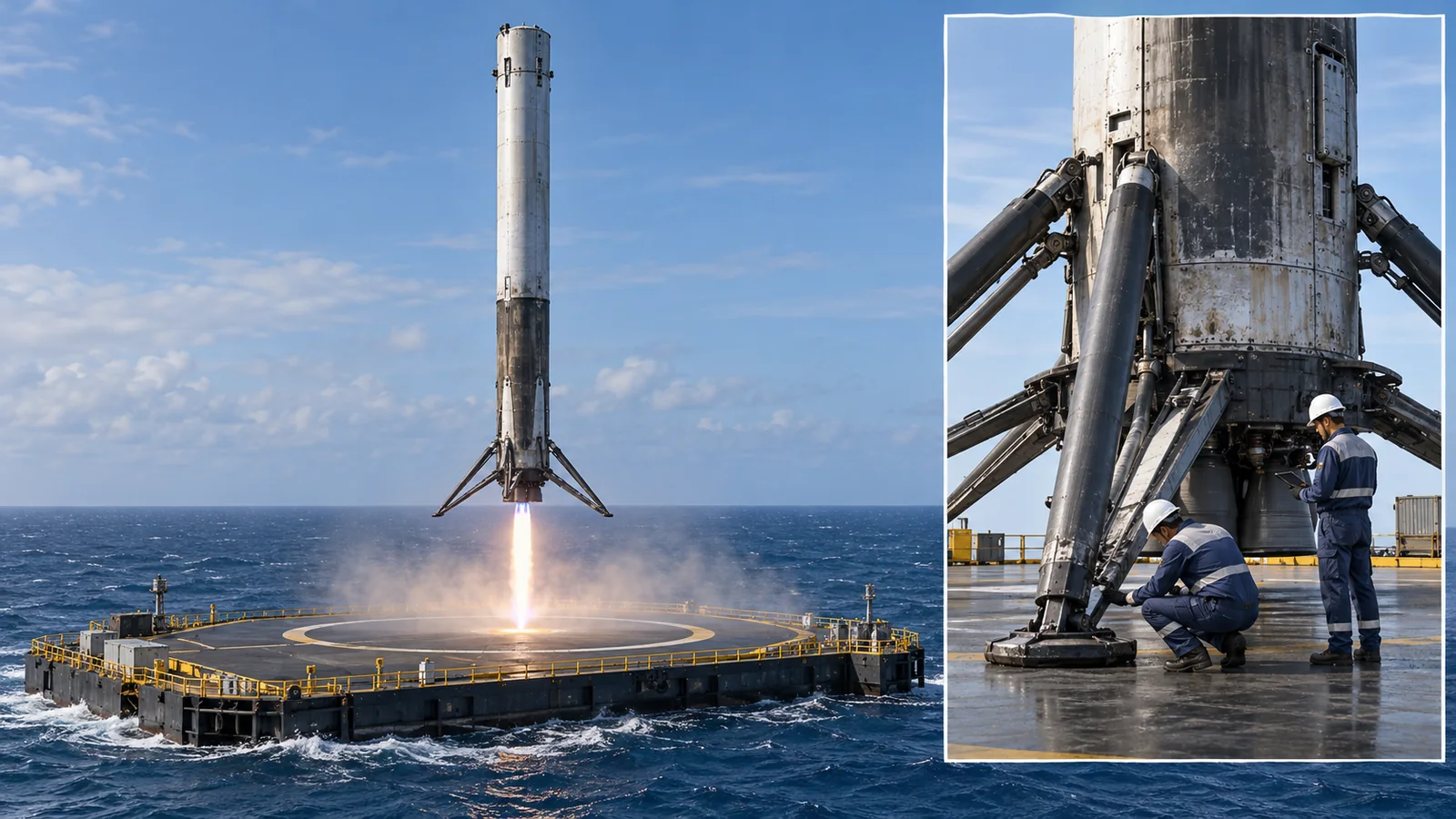
| Launch | Falcon 9, Falcon Heavy | Merlin engines designed and built in-house. The first stage lands on an autonomous ship at sea or on a landing zone ashore, and the two fairing halves (the covers around the payload) are recovered by splashdown and reused. The second stage is not recovered and re-enters the atmosphere |
| Super-heavy launch | Starship (Super Heavy and Starship) | Raptor engines burning methane and liquid oxygen (full-flow staged combustion). 33 on the booster, six on the upper stage. The company's stated values: 124 m tall, payload over 100 t |
| Spacecraft | Dragon (cargo and crew) | Automatic docking with the ISS. The crew version seats up to seven and has eight Super Draco engines for launch escape. It splashes down under parachutes and is recovered for reuse |
| Satellite network | Starlink | Over 10,200 satellites (as stated in the August 2026 10-Q). About 3,100 launched in 2025 (prospectus). The Redmond, Washington factory averaged about 70 satellites a week from December 2025 to April 2026 |
| Sites | Starbase, Hawthorne, McGregor, Cape Canaveral and others | Starbase: development, manufacturing and launch. McGregor: engine testing (15 test stands). Florida: LC-39A and SLC-40. Vandenberg in California: SLC-4 |
What stands out in SpaceX's documents is that it designs, builds and tests its engines (Merlin and Raptor) in-house Sourced. McGregor, Texas has 15 test stands and is where Merlin and Raptor engines are qualified, accepted and tested after flight. The propulsion metals and the pressure vessels (the company also mentions testing composite overwrapped pressure vessels) bear directly on both vehicle mass and safety.
Of Starship, the company says the purpose of flight tests is to collect data, so even the loss of a vehicle is not counted as a failure. NASA's inspector general, for its part, notes that after each mishap the FAA must review the company's findings and corrective actions before the next flight. It is a design that pairs break-it-and-fix-it development with a public safety check. Material and structural details could not be confirmed in primary sources, so this article does not describe them.
11. The risks this company carries
| Risk | Content | Type |
|---|---|---|
| Starship development slips | The prospectus lists what its target launch frequency needs: heat shields that survive repeated reentry, quick refurbishment of engines, more launch sites, propellant plants, power and FAA approval. It says there is no assurance these will be achieved on schedule | Sourced |
| Launch licensing and investigations | After each mishap the FAA reviews investigations and corrective actions. The company reports FAA mishap determinations for several flight tests including Flight 12. Raising the launch rate at Boca Chica also depends on the FAA's environmental review (meetings in November 2026) | Sourced |
| Lunar lander delay | NASA's inspector general says the Starship lander will not be ready for a June 2027 landing. It also notes that NASA and SpaceX disagree on whether the manual-control requirement is being met, for a vehicle where crew safety is at stake | Sourced |
| No insurance on vehicles | The prospectus says the company typically does not insure its satellites, payloads or launch vehicles, so it bears the full cost of any loss | Sourced |
| A broad business | Besides space it has connectivity and AI businesses. The AI segment has a large operating loss and heavy capital spending (company-wide capex in January-June 2026 was US$28.5 billion, of which AI was US$23.6 billion) | Sourced |
| Reliance on customers and government | "Customer A", which spans all three businesses, was 18.3% of April-June 2026 revenue. Government contracts carry terms that let the government end or reduce them unilaterally | Sourced |
| The harsh space environment | The prospectus notes that launch vibration, temperature swings, radiation and debris could cause failures | Sourced |
12. Glossary
- Reusable rocket
- A rocket whose parts (mainly the first stage) are recovered and flown again.
- First and second stage
- A rocket's lower stage (first) burns out and drops away, and the upper stage (second) carries on to orbit.
- Low Earth orbit (LEO)
- An orbit a few hundred to about 2,000 km up, used by Starlink and imaging satellites.
- Starship
- The super-heavy rocket and spacecraft SpaceX is developing, designed to reuse both stages.
- Raptor
- The Starship engine, burning methane and liquid oxygen.
- Mishap
- The FAA's term for a launch accident or malfunction. The FAA requires investigation and confirmation of corrective actions.
- HLS (Human Landing System)
- The lander that takes astronauts down to the Moon in NASA's Artemis programme.
- CRS / Commercial Crew
- NASA contract frameworks for private companies to carry cargo and astronauts to the ISS.
- NSSL
- The U.S. programme that buys national-security space launches from private companies.
- Starlink
- SpaceX's satellite communications service, run with thousands of low-orbit satellites.
- IPO
- Initial public offering: the first sale of a company's shares on a stock exchange.
- 10-Q and prospectus
- The quarterly report U.S. listed companies file with the SEC (10-Q) and the offering document used at a share sale (prospectus).
13. References
- SpaceX Final prospectus (Rule 424(b)(4), filed with the U.S. SEC on 12 June 2026). Business, vehicle specifications and track record, sites, headcount, regulation, risk factors, 2025 results by segment, targets. https://www.sec.gov/Archives/edgar/data/1181412/000162828026042639/spaceexplorationtechnologi.htm
- SpaceX Form 10-Q for the quarter ended 30 June 2026 (filed with the U.S. SEC on 4 August 2026). Revenue, results and capital expenditure by segment, launch counts and mass to orbit, Starship R&D, the IPO, acquisitions. https://www.sec.gov/Archives/edgar/data/1181412/000162828026052535/spcx-20260630.htm
- U.S. SEC EDGAR filing index for SpaceX (CIK 0001181412), used to confirm the Nasdaq listing and the dates of the prospectus, 10-Q and S-1. https://data.sec.gov/submissions/CIK0001181412.json
- NASA Office of Inspector General NASA’s Management of the Human Landing System Contracts (IG-26-004, 10 March 2026). Lander contract values, delays, Starship flight-test dates and mishaps. https://oig.nasa.gov/wp-content/uploads/2026/03/final-report-ig-26-004-nasas-management-of-the-human-landing-system-contracts.pdf
- U.S. Federal Aviation Administration (FAA) SpaceX Starship Super Heavy Project at the Boca Chica Launch Site (environmental-review status; last updated 15 October 2026). https://www.faa.gov/space/stakeholder_engagement/spacex_starship
- SpaceX Starship (the company’s stated vehicle specifications; checked 17 October 2026). https://www.spacex.com/vehicles/starship
- SpaceX Updates (“Starship to Orbit”, 15 September 2026; “Starlink Mobile”, 8 October 2026; “Terafab”, 6 August 2026; checked 17 October 2026). https://www.spacex.com/updates
- SpaceX Starship Flight 14 (28 September 2026). The company’s account of the first orbital flight. https://www.spacex.com/launches/starship-flight-14
- SpaceX Starship’s Thirteenth Flight Test (24 July 2026). https://www.spacex.com/launches/starship-flight-13
- SpaceX Starship’s Twelfth Flight Test (22 May 2026). https://www.spacex.com/launches/starship-flight-12
- SpaceX Starship’s Eleventh Flight Test (13 October 2025). https://www.spacex.com/launches/starship-flight-11
- SpaceX Starship’s Tenth Flight Test (26 August 2025). https://www.spacex.com/launches/starship-flight-10
- SpaceX Starship’s Ninth Flight Test (27 May 2025). https://www.spacex.com/launches/starship-flight-9
- SpaceX Starship’s Eighth Flight Test (6 March 2025). https://www.spacex.com/launches/starship-flight-8
- SpaceX Starship’s Fifth Flight Test (13 October 2024). https://www.spacex.com/launches/starship-flight-5
- SpaceX Starship Flight Test (the first flight, 20 April 2023). https://www.spacex.com/launches/starship-flight-test
- SpaceX Official website (source of the logo; checked 17 October 2026). https://www.spacex.com/
14. Claim-to-source audit
| Claim in the text | Type | Source |
|---|---|---|
| Legal name, headquarters, Nasdaq listing (SPCX), IPO net proceeds of US$85,675 million | Sourced | Reference 2, 3 https://www.sec.gov/Archives/edgar/data/1181412/000162828026052535/spcx-20260630.htm https://data.sec.gov/submissions/CIK0001181412.json |
| 2025 company-wide revenue, and Space segment revenue, operating result, capex and Starship R&D | Sourced | Reference 1 https://www.sec.gov/Archives/edgar/data/1181412/000162828026042639/spaceexplorationtechnologi.htm |
| 2026 Space segment revenue, operating result, capex and R&D; Falcon and Starship launch counts; mass to orbit | Sourced | Reference 2 https://www.sec.gov/Archives/edgar/data/1181412/000162828026052535/spcx-20260630.htm |
| Headcount over 22,000 (31 March 2026); sites at Starbase, Hawthorne, McGregor, Florida and Vandenberg | Sourced | Reference 1 https://www.sec.gov/Archives/edgar/data/1181412/000162828026042639/spaceexplorationtechnologi.htm |
| Specifications and track record of Falcon 9, Falcon Heavy, Dragon and Starship (company's stated values) | Sourced | Reference 1 https://www.sec.gov/Archives/edgar/data/1181412/000162828026042639/spaceexplorationtechnologi.htm |
| Starship stated specifications (124 m, payload over 100 t, 33 + 6 Raptor engines) | Sourced | Reference 6 https://www.spacex.com/vehicles/starship |
| Starship flights 1-11 dates, the mishaps of flights 7, 8 and 9 and the closure of FAA investigations, and the static-fire explosion before Flight 10 | Sourced | Reference 4 https://oig.nasa.gov/wp-content/uploads/2026/03/final-report-ig-26-004-nasas-management-of-the-human-landing-system-contracts.pdf |
| Company accounts of flights 1, 5, 8, 9, 10 and 11 (dates and results) | Sourced | Reference 16, 15, 14, 13, 12, 11 https://www.spacex.com/launches/starship-flight-test https://www.spacex.com/launches/starship-flight-5 https://www.spacex.com/launches/starship-flight-8 https://www.spacex.com/launches/starship-flight-9 https://www.spacex.com/launches/starship-flight-10 https://www.spacex.com/launches/starship-flight-11 |
| Dates and company accounts of flights 12, 13 and 14, and the deployment of 26 Starlink V3 satellites | Sourced | Reference 10, 9, 8 https://www.spacex.com/launches/starship-flight-12 https://www.spacex.com/launches/starship-flight-13 https://www.spacex.com/launches/starship-flight-14 |
| The FAA mishap determination for Flight 12, and FAA licensing and review statements | Sourced | Reference 1, 5 https://www.sec.gov/Archives/edgar/data/1181412/000162828026042639/spaceexplorationtechnologi.htm https://www.faa.gov/space/stakeholder_engagement/spacex_starship |
| The FAA environmental review (up to 25 launches a year), the proposals for 100 and 456 launches, and the November 2026 meetings | Sourced | Reference 5 https://www.faa.gov/space/stakeholder_engagement/spacex_starship |
| HLS contract potential value (about US$4.3 billion), the roughly 6% increase, not being ready for June 2027, and the 2028 landing aim | Sourced | Reference 4 https://oig.nasa.gov/wp-content/uploads/2026/03/final-report-ig-26-004-nasas-management-of-the-human-landing-system-contracts.pdf |
| The xAI acquisition on 2 February 2026, the three segments (Space, Connectivity, AI) and that all Starship launches are internal | Sourced | Reference 2 https://www.sec.gov/Archives/edgar/data/1181412/000162828026052535/spcx-20260630.htm |
| Falcon 9 first stage: 40 flights by design, 25 by accounting life, and government contracts barring use beyond five flights | Sourced | Reference 1 https://www.sec.gov/Archives/edgar/data/1181412/000162828026042639/spaceexplorationtechnologi.htm |
| Eleven of 12 NSSL missions in 2025 and all five NASA crew and cargo missions | Sourced | Reference 1 https://www.sec.gov/Archives/edgar/data/1181412/000162828026042639/spaceexplorationtechnologi.htm |
| Starship orbital-flight and propellant-transfer plans (15 September 2026) and the Terafab announcement (6 August 2026) | Sourced | Reference 7 https://www.spacex.com/updates |
| Customer launches as a share of Falcon launches in January-June 2026 (17 of 77) and Space revenue as a share of the total (12.6%) | Our calculation | Our calculation. The underlying figures are in Reference 2 https://www.sec.gov/Archives/edgar/data/1181412/000162828026052535/spcx-20260630.htm |
| Headcount for the space business alone, cumulative Starship development cost, customer-launch contract values and Starship structural material | Not yet confirmed | Not found in the documents checked; this article does not estimate them |
| Propellant transfer in orbit, four launch pads, Moon and Mars cargo flights, orbital AI compute and similar plans | Not yet confirmed | Company targets, at the outlook stage; not achievements https://www.sec.gov/Archives/edgar/data/1181412/000162828026042639/spaceexplorationtechnologi.htm https://www.spacex.com/updates |
| Falcon 9 is the transition-period earner and Starship the long-term mainstay | Inference | Our own reading of the prospectus (Falcon 9's role and the reason for its accounting life) |
| The centre of launch demand is the company's own satellite network | Inference | Our own reading of the 10-Q launch breakdown |
| Space-business investment concentrates on Starship, launch sites and propellant plants | Inference | Our own reading of the prospectus list of requirements |
| Launch capacity works as internal infrastructure as well as a product | Inference | Our own reading of the 10-Q revenue-recognition description |
Last updated 17 October 2026 / Troy Technical
Figures in this article come from SpaceX's statutory filings with the U.S. Securities and Exchange Commission, the NASA Office of Inspector General report, FAA public pages and company announcements. No research-firm estimates or press-based figures have been used. Vehicle performance values are the company's stated values, and no claim of superiority over vehicles under different conditions is made. Passages marked "Inference" are this article's interpretation of primary sources, not statements made by the company. Share prices, valuations and investment judgements are not discussed.