COMPANY PROFILE / SPACE INDUSTRY
Starcloud
A young company that wants data centers in space: one 60 kg demonstration satellite so far, and a concept of tens of thousands of satellites at gigawatt scale
AI computing needs huge amounts of electricity and cooling. Starcloud wants to make a business of putting the computers not on the ground but in an orbit where the Sun shines almost all the time. In November 2025 it launched Starcloud-1, a satellite of about 60 kg carrying a data-center-class GPU (the NVIDIA H100). Its white paper and its application to the FCC (the U.S. Federal Communications Commission) describe something on a different scale: up to 88,000 satellites and a 5-gigawatt facility. This profile separates what has already been demonstrated from what is still a concept or an application.
- Starcloud in 30 seconds, and where it stands in the space industry
- The logo and how the name is written
- Where the company sits in the space industry
- Scale (private, with little disclosed)
- Resources committed to space
- What it has done so far
- What comes next
- What the company is aiming for in space
- Map of space-industry partnerships
- Technology, products and services
- The risks this company carries
- Glossary, references and claim-to-source audit
1. Starcloud in 30 seconds, and where it stands in the space industry
(space data centers)It builds computers to sit in orbit, not rockets
5 GW classAn FCC application (under review) and a white paper. Realisation is in the future
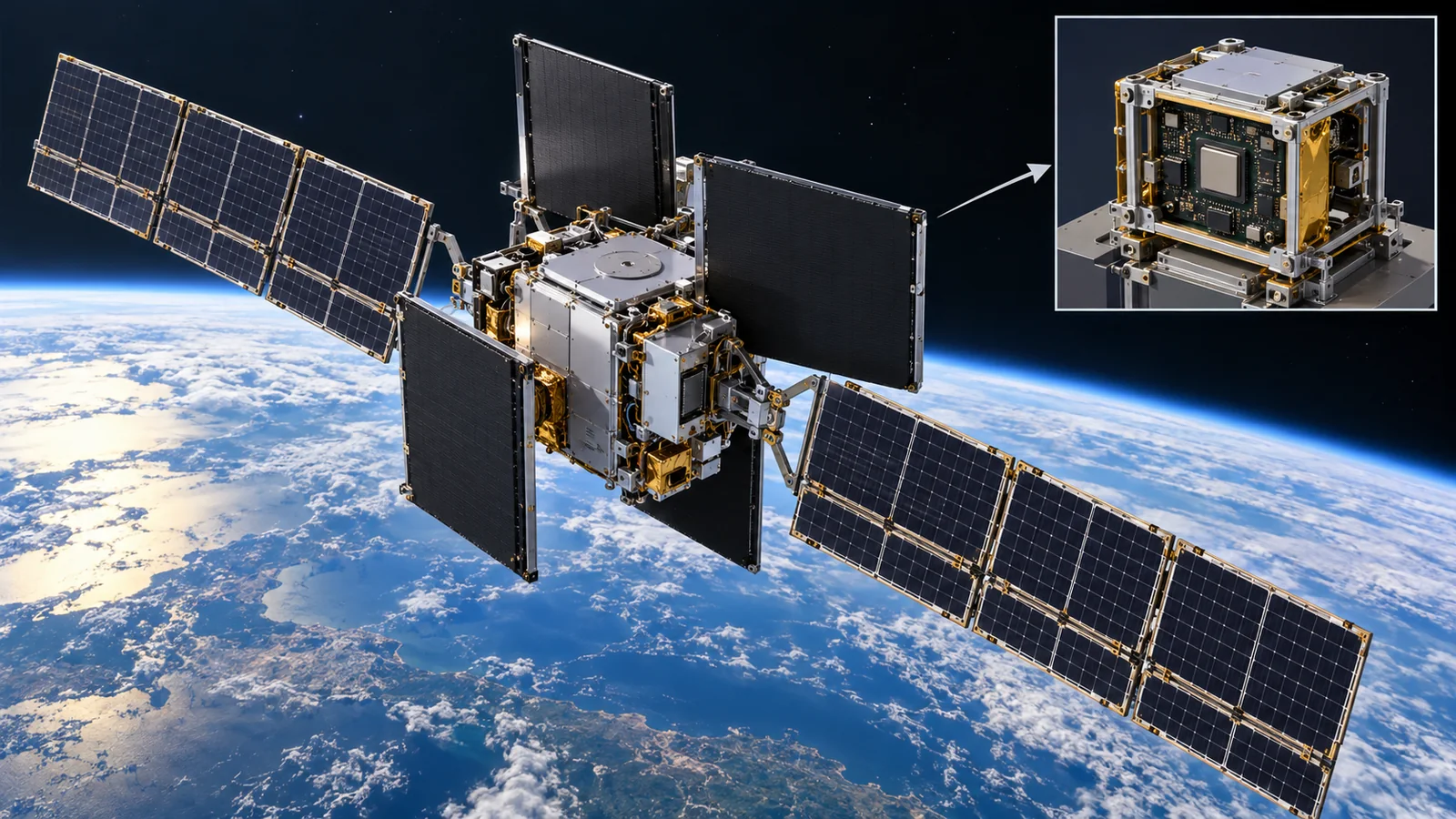
Talk of data centers in space can sound as if huge facilities already circle the Earth. What can be confirmed in orbit today is one test satellite of about 60 kg Sourced. The company's page says that in December 2025 this satellite ran Gemma, Google's open model, and trained nanoGPT, a small language model (the company's own account; this article found no independent verification record).
By contrast, up to 88,000 satellites (the FCC application) and a 5-gigawatt facility with solar arrays about 4 km on a side (the white paper and NVIDIA's blog) are an application or a concept Not yet confirmed. The application had only reached the stage of being accepted for filing by the FCC (13 March 2026), and this article found no record that a licence has been granted. The article keeps the two apart.
2. The logo and how the name is written

A note on names: the company is Starcloud, Inc. Its former name was Lumen Orbit, Inc., and both its January 2025 SEC Form D and its September 2024 white paper were issued under that name. The satellite also remains registered under the alias "LUMEN-1" (SatNOGS DB). A search of the SEC's database also turns up several Form D filings by separate investment vehicles (SPVs, or special-purpose vehicles) with "Starcloud" in their names. This article has not established how those relate to the company itself, so for the company's funding it uses only the filing made in the name of Lumen Orbit, Inc.
Official site: https://www.starcloud.com/The logo is the image used in the header of the official website. It is a light colour, so it is shown on a dark background. Retrieved 17 October 2026.
3. Where the company sits in the space industry
A communications satellite relays radio signals, and an imaging satellite photographs the ground. The satellite Starcloud wants to build is one in which the on-board GPUs (chips for AI computing) do the computing themselves. The plan is to link it by laser to other companies' communications networks (Starlink and others) to carry results and data (FCC application; the application says this is "subject to commercial arrangements", that is, depends on deals to be made).
Our series explainers on orbital computing, low-Earth-orbit constellations and optical inter-satellite links cover the mechanisms in detail.
4. Scale (private, with little disclosed)
Starcloud is a private company and publishes no audited accounts or annual securities reports. The table shows only what could be confirmed from the company's own materials and its SEC filing (Form D) Sourced.
| Item | What could be confirmed | Category |
|---|---|---|
| Incorporation | Incorporated in 2023 as a Delaware corporation (Form D). Located in Redmond, Washington | Sourced |
| Officers (as listed in Form D) | Philip Johnston, Ezra Feilden and Paul Adrian Oltean (each an Executive Officer and Director), and Morgan Beller (Director) | Sourced |
| Founders (official site) | Philip Johnston (CEO), Ezra Feilden (CTO) and Adi Oltean (Chief Engineer). Their backgrounds are on the website | Sourced |
| Headcount | Not disclosed (the Team page lists names and backgrounds, not the total) | Not disclosed |
| Revenue | Not disclosed (the Form D revenue-range field is marked as declined to disclose) | Not disclosed |
| Funding (statutory filing) | Form D (filed 13 January 2025): sales began on 5 December 2024; total sold US$14,137,498; 65 investors; no sales commissions | Sourced |
A Form D is a notice that a private company files when it raises money in certain private placements. It is not a financial statement. The amount above is the total for that one offering, not everything the company has raised.
The company is reported to have announced further funding in 2026, but this article could not open the announcement text (on a wire service), so it gives no amount, investors or company valuation for it Not yet confirmed. Figures from press reports and databases are not used.
5. Resources committed to space
The table shows, for four items (people, money, outside investments and acquisitions, and contracts with public bodies), whether primary sources confirm them. "Not in the record" is itself a finding.
| Type of resource | What it is | Category |
|---|---|---|
| People | The three founders come from satellite design (Airbus Defence and Space [SSTL] and Oxford Space Systems), SpaceX and Microsoft (GPU cluster operations), according to the website. Total headcount is not disclosed | Sourced / not disclosed |
| Money | One offering of US$14,137,498 from 65 investors in the January 2025 Form D. The 2026 announcements could not be read, so none is given. R&D spending and capital expenditure are not disclosed | Sourced / not disclosed |
| Outside investments, acquisitions, joint ventures, divestments | No mention in the company's materials, the SEC filing or the FCC documents | Not confirmed |
| Contracts or ties with public bodies | Contracts with NASA, the Space Force, ESA, JAXA and similar bodies could not be confirmed from company materials or government announcements. An FCC application is a licensing request, not a contract | Not confirmed |
| Ties with private companies | Crusoe (22 October 2025; a plan to offer cloud services from orbit), NVIDIA (member of its Inception start-up programme and the source of the GPUs it has chosen), Google (use of Gemma; graduate of a start-up accelerator programme) | Sourced |
| Launch route | Starcloud-1 flew on a SpaceX rocket on 2 November 2025 (per SatNOGS DB; the vehicle name and whether it was a rideshare could not be confirmed from primary sources). Launch contracts for Starcloud-2 onward could not be confirmed | Sourced / not confirmed |
Status of the main vehicles and programmes (checked 17 October 2026)
| Vehicle or plan | Type | Main specifications (company's stated values) | Record and status | Stage and date | Source |
|---|---|---|---|---|---|
| Starcloud-1 | Test satellite | About 60 kg, "about the size of a small fridge". One NVIDIA H100. NVIDIA says it should give "100x more powerful GPU compute" than any previous space-based operation (the company's expectation) | Launched 2 November 2025. The company says it ran Gemma and trained nanoGPT in December 2025 (not independently verified). Its orbital elements were updated on 16 October 2026, so it is still being tracked | In operation (trial) from November 2025 | References 2, 9 and 12 |
| Starcloud-2 | First commercial satellite | GPU cluster, persistent storage, 24/7 access, and the company's own thermal and power systems, in a small-satellite form (company's stated values) | The website says fully operational in a sun-synchronous orbit by 2027. Crusoe describes a satellite "scheduled to launch in late 2026". The two are not the same date | Apparently in development; date not confirmed | References 3 and 11 |
| Starcloud-3 and -4 | Plans | Official pages carry only a title and no specifications | Could not be confirmed | Not yet confirmed | Reference 1 |
| Constellation of up to 88,000 satellites | Application | Sun-synchronous orbits at 600 to 850 km, mainly laser links, radio only for backup telemetry, tracking and command (the application) | Accepted for filing by the FCC on 13 March 2026. No record of a licence could be confirmed | Application (under review) | References 6 and 7 |
In space there is no air, so radiation (emitting infrared) is the only way to shed heat. The white paper calculates that a black plate at 20 °C with an emissivity of 0.92 radiates about 770 W from its two faces, and after subtracting absorbed sunlight and Earth's heat can shed about 633 W per square metre Sourced (the company's estimate; the emissivity and absorptivity are values it takes from NASA documents). The design therefore turns on coatings and surface materials with high emissivity that absorb little sunlight, and on radiators that are light and can unfold over a very large area. Our explainers on thermal-control materials and radiative cooling, and on spacecraft thermal control, are relevant.
On the electrical side, the white paper envisages silicon solar cells thinner than 25 µm (more than 1,000 W per kilogram) that are rolled up for launch and unrolled in orbit. It says radiation damage heals by annealing at moderate temperatures, even without cover glass (the company's claim). The same paper also says that storage and power-delivery parts are sensitive to radiation and need shielding.
6. What it has done so far
| When | What happened | What it means |
|---|---|---|
| 2023 | Incorporated as Lumen Orbit, Inc. (Form D) | Later renamed Starcloud |
| September 2024 | Published the white paper "Why we should train AI in space", v1.03 | Puts the concept and estimates in writing. The figures are estimates built on the company's assumptions |
| 5 December 2024 | Sales began in the offering described in the Form D, filed on 13 January 2025. Total US$14,137,498 | The company's earliest statutory record of fundraising that can be confirmed |
| 2025 (month not confirmed) | Renamed from Lumen Orbit to Starcloud (white paper footnote) | The exact date could not be confirmed from official materials |
| 15 October 2025 | NVIDIA's blog described Starcloud-1's plan (H100 on board, launch expected in November) | An announcement of plans, made before launch |
| 22 October 2025 | Crusoe announced the partnership: Crusoe Cloud on a satellite, with limited GPU capacity offered by early 2027 | A plan. The release does not give the scale of the offering |
| 2 November 2025 | Starcloud-1 launched (on a SpaceX rocket; 05:09 UTC in the SatNOGS DB entry) | A primary record that the demonstration satellite exists in orbit |
| December 2025 | The company said on its official page that it ran Gemma and trained nanoGPT | The company's claim. No independent verification record could be confirmed |
| 4 February 2026 | Filed an application with the FCC for a constellation of up to 88,000 satellites | An application. It was accepted for filing on 13 March 2026, but no licence is confirmed |
| 16 March 2026 | At GTC, NVIDIA named Starcloud as one of the companies using its computing platforms | A mention by the counterparty. The release does not give contract terms |
| 17 May 2026 | Secure World Foundation published its comments to the FCC on Starcloud and other applications | A third party's view, asking for careful review |
| 16 October 2026 | Starcloud-1's orbital elements (Space-Track) were updated, per the SatNOGS DB | Shows that tracking continues. It does not show the state of the payload |
7. What comes next
by early 2027From Crusoe's announcement (October 2025). The scale is not disclosed
(FCC application)No licence confirmed. The application does not detail whether it would be built in stages
All four items are plans of the company or its partners, not things that have been achieved Not yet confirmed.
None of the following appears in the primary sources checked for this article Not yet confirmed.
A fixed launch date and launch vehicle for Starcloud-2 / the specifications of Starcloud-3 and -4 / the power and GPU count of a single satellite / contracts with public bodies / investment in manufacturing sites / independent verification of Starcloud-1's results. Figures that appear only in press coverage (satellite power, amounts raised, valuations) are not used.
8. What the company is aiming for in space
This section includes things the company has not said directly. They are inferences within what the primary sources support, given with their grounds.
| What can be read from the record | Primary-source basis | Category |
|---|---|---|
| The end goal is a gigawatt-scale AI computing base that avoids the limits of ground power, cooling and permitting | The white paper's summary (5 GW, solar arrays about 4 km on a side) and the FCC application (up to 88,000 satellites, and its references to limits of the terrestrial grid) | Sourced (company's goal) |
| The near-term revenue is more likely to come from processing data that is generated in orbit than from AI training for the ground | The Starcloud-2 page lists in-space users (such as Earth-observation data) first and ground users second. NVIDIA's blog also names Earth-observation analysis as the first use | Inference |
| 88,000 is probably a ceiling reserved for the review, not a target to build | The application says "up to 88,000" and describes testing in low orbits first. The attached Schedule S (draft) has only two orbital planes with one satellite each, and its relation to 88,000 is not explained | Inference |
| Scaling up depends on the launch price of large reusable rockets | The white paper's estimates assume future prices such as US$5 million for 100 tonnes. The FCC application also refers to fully reusable Starship-class rockets | Inference |
| It will keep its computing chips centred on NVIDIA | The H100 on board, the Blackwell consideration (NVIDIA's blog) and the mention in NVIDIA's release | Inference |
The FCC application describes a constellation of "up to 88,000" satellites placed in sun-synchronous orbits at 600 to 850 km, in thin shells no more than 50 km deep Sourced. It also says the first satellites will be tested at low altitude, so that any that fail early fall into the atmosphere and burn up, before being raised to the operating orbit.
Yet the Schedule S (the technical input form) attached to the same application lists only two orbital planes (at 600 km and 850 km) with one satellite each Sourced. The record does not say what that form represents, and this article gives it no meaning. Still, from the word "up to" and the cautious start, this article reads 88,000 as a ceiling to be secured in the review, not a number to be built from the outset Not yet confirmed. The real number has to be checked against whatever plan the company publishes later.
9. Map of space-industry partnerships
10. Technology, products and services
At present only Starcloud-1 is actually in orbit. Everything else is a plan or a concept. According to the Starcloud-2 page on the website, the company expects two kinds of user.
| Item | The company's description | Category |
|---|---|---|
| In-space users (expected) | Process in orbit the large volumes of raw data that spacecraft and space stations produce every day, cutting the amount that must be sent down. Examples: analysing raw data from Earth-observation satellites | Plan |
| Ground users (expected) | Secure data storage independent of Earth, and a "sovereign cloud" (computing that a country or company controls itself) | Plan |
| Design concept (white paper) | Computing "containers" joined to solar arrays and radiators, and added to over time. A dawn-dusk orbit (the Sun shines almost continuously). Heat shed by radiation, communications by laser | Concept (company document) |
| The company's estimate (white paper) | "About 22 times cheaper power" (US$0.002 per kWh). It assumes a future rocket carrying 100 tonnes for US$5 million per launch and solar cells at US$0.03 per watt, among other things, so these are not current prices | Not yet confirmed |
The white paper sizes the solar array for a 5 GW data center at about 4 km by 4 km (cell efficiency 22%, fill factor 90%, silicon cells). Using the solar intensity the paper itself uses (1,366 W per square metre), a simple calculation gives about 4.3 GW from 16 square kilometres Our calculation. That is within the range of "about", but slightly short of 5 GW, and real arrays would also lose output to degradation and wiring losses. It is safest to read the concept's numbers as rounded and dependent on assumptions.
On radiation, the white paper cites research suggesting logic circuits are fairly tolerant, and argues that the share of shielding falls as the compute grows, because shielding mass scales with surface area while compute scales with volume (the company's view). Whether a result from one small satellite carries over to a container of about 100 tonnes can be checked using the approach in our explainers on radiation and electronic parts and on space-grade semiconductors and COTS (commercial off-the-shelf parts).
11. The risks this company carries
| Risk | What it is | Category |
|---|---|---|
| The gap between demonstration and concept | What is confirmed in orbit is one satellite of about 60 kg. The concept is up to 88,000 satellites and 5 GW. Engineering problems in between (unfolding huge arrays, shedding heat, maintenance) cannot be settled by a one-satellite demonstration | Sourced |
| Dependence on large rockets and their prices | The white paper's estimates assume future prices for reusable launch | Sourced (stated assumption) |
| Review and regulation | The FCC application has only been accepted for filing. It also asks for waivers of five rules. Secure World Foundation has filed comments calling for careful review and phased authorisation | Sourced |
| Effects on the orbital environment | A huge increase in satellite numbers raises collision risk, debris and effects on astronomy. Both the company's explanation (testing at low altitude, automated collision avoidance, designs that burn up on re-entry) and third-party concerns are public. This article does not assess the actual effect | Sourced |
| Range of dates | On Starcloud-2, the website (by 2027) and Crusoe's announcement (late 2026) are not the same date | Sourced |
| Verification rests on the company's account | The December 2025 Gemma run and nanoGPT training rest mainly on the company's own page, and this article found no independent verification record | Sourced |
| Finances are opaque | Revenue, headcount and R&D spending are not disclosed. The 2026 funding could not be read | Sourced / not disclosed |
| Dependence on chip supply and generations | The on-board computers centre on NVIDIA parts, so product generations and supply at that company would affect it | Inference |
12. Glossary
- Orbital data center
- Computers (GPUs and the like) carried on satellites or structures orbiting the Earth instead of in a building on the ground.
- GPU
- A chip that grew out of graphics processing and is good at parallel computation. The workhorse of AI training and inference.
- H100
- NVIDIA's data-center GPU. Starcloud-1 is said to have taken it into orbit.
- Training and inference
- Training is teaching an AI; inference is using a trained AI to produce answers. Training needs far more electricity.
- Sun-synchronous orbit (SSO)
- An orbit that passes over any given place at the same local time each day. A dawn-dusk SSO keeps the satellite in sunlight almost all the time.
- Radiative cooling
- Shedding heat as infrared radiation into space. With no air in space, it is the only way.
- FCC
- The U.S. Federal Communications Commission, which reviews radio use by U.S. satellites. Separate from launch licensing (FAA).
- Form D
- A notice filed with the SEC when a private company raises money in certain private placements. It is not a financial statement.
- TT&C
- Telemetry, Tracking and Command: following a satellite's position, monitoring its health and sending it instructions.
13. References
- Starcloud, Inc. Official website (home page). The company's claims, founders' backgrounds, address and the link to its white paper. Checked on 17 October 2026. https://www.starcloud.com/
- Starcloud, Inc. Official page "Starcloud-1". The November 2025 launch, the NVIDIA H100 on board, and the company's account that in December 2025 it ran Gemma and trained nanoGPT. https://www.starcloud.com/starcloud-1
- Starcloud, Inc. Official page "Starcloud-2". The make-up of the first commercial satellite (GPU cluster, persistent storage, 24/7 access) and the statement that it will be fully operational in a sun-synchronous orbit by 2027. https://www.starcloud.com/starcloud-2
- Lumen Orbit (now Starcloud) White paper "Why we should train AI in space", v1.03 (September 2024). The concept, assumptions and estimates for orbital data centers (company document). https://starcloudinc.github.io/wp.pdf
- U.S. SEC Form D for Lumen Orbit, Inc., filed 13 January 2025 (accession no. 0001080368-25-000001). Year of incorporation, officers, total sold and number of investors. https://www.sec.gov/Archives/edgar/data/2051381/000108036825000001/xslFormDX01/primary_doc.xml
- U.S. FCC Public Notice, Report No. SAT-01982 (13 March 2026). Starcloud, Inc.'s application SAT-LOA-20260202-00073 accepted for filing. https://docs.fcc.gov/public/attachments/DOC-419509A1.txt
- Starcloud, Inc. (FCC filing) The application text, "Application for Launch and Operating Authority for the Starcloud Orbital Datacenter System" (dated 4 February 2026). https://api-prod.fcc.gov/icfs-attachment/exp/api/v1/5c6840321b3e365068b6a64ce54bcb49
- Starcloud, Inc. (FCC filing) The same application's Form 312 Schedule S (technical and operational description, draft). Frequencies and orbital-plane entries. https://api-prod.fcc.gov/icfs-attachment/exp/api/v1/dcf88c321b3e365068b6a64ce54bcb85
- NVIDIA NVIDIA Blog, "How Starcloud Is Bringing Data Centers to Outer Space" (15 October 2025). Starcloud-1 specifications, the 5 GW concept and the plan to run Gemma. https://blogs.nvidia.com/blog/starcloud/
- NVIDIA Press release, "NVIDIA Launches Space Computing, Rocketing AI Into Orbit" (16 March 2026). Starcloud named among companies using NVIDIA platforms. https://nvidianews.nvidia.com/news/space-computing
- Crusoe Press release (22 October 2025). The partnership with Starcloud and the plan to put Crusoe Cloud on a satellite. https://www.crusoe.ai/resources/newsroom/crusoe-to-become-first-cloud-operator-in-space-through-partnership-with-starcloud
- SatNOGS DB (Libre Space Foundation) Entry for STARCLOUD-1: launch time, NORAD ID 66303 and the update date of the Space-Track.org orbital elements. https://db.satnogs.org/satellite/98520
- Secure World Foundation Publication of its comments to the FCC (17 May 2026). A third party's view of the Starcloud, SpaceX and Blue Origin orbital data center applications. https://www.swfound.org/news/swf-publishes-three-fcc-filings-addressing-recent-applications-for-orbital-data-centers
- Starcloud, Inc. Official website, "Team" page. Names and backgrounds of the founders and engineers (it gives no total headcount). https://www.starcloud.com/team
14. Claim-to-source audit
| Claim in the article | Category | Source |
|---|---|---|
| Legal name Starcloud, Inc., former name Lumen Orbit, Inc., address, incorporation in 2023 in Delaware | Sourced | References 4, 5 and 7 https://starcloudinc.github.io/wp.pdf https://www.sec.gov/Archives/edgar/data/2051381/000108036825000001/xslFormDX01/primary_doc.xml https://api-prod.fcc.gov/icfs-attachment/exp/api/v1/5c6840321b3e365068b6a64ce54bcb49 |
| Officers (the four named in the Form D), and the three founders' names and backgrounds | Sourced | References 5 and 14 https://www.sec.gov/Archives/edgar/data/2051381/000108036825000001/xslFormDX01/primary_doc.xml https://www.starcloud.com/team |
| Form D: sales began 5 December 2024, total sold US$14,137,498, 65 investors, revenue range not disclosed | Sourced | Reference 5 https://www.sec.gov/Archives/edgar/data/2051381/000108036825000001/xslFormDX01/primary_doc.xml |
| Revenue, headcount, R&D spending and capital expenditure are not disclosed | Sourced | References 1, 5 and 14 https://www.starcloud.com/ https://www.sec.gov/Archives/edgar/data/2051381/000108036825000001/xslFormDX01/primary_doc.xml https://www.starcloud.com/team |
| Starcloud-1 is about 60 kg with an H100, and was planned for launch in November 2025 (as stated by NVIDIA) | Sourced | Reference 9 https://blogs.nvidia.com/blog/starcloud/ |
| Starcloud-1 launch time (2 November 2025, 05:09 UTC), NORAD ID 66303, orbital elements updated 16 October 2026 | Sourced | Reference 12 https://db.satnogs.org/satellite/98520 |
| The company's account that it ran Gemma and trained nanoGPT in December 2025 (no independent verification found) | Sourced | Reference 2 https://www.starcloud.com/starcloud-1 |
| Starcloud-2's make-up and the statement of operation by 2027 | Sourced | Reference 3 https://www.starcloud.com/starcloud-2 |
| Partnership with Crusoe (22 October 2025), a satellite "scheduled to launch in late 2026", and limited GPU capacity by early 2027 | Sourced | Reference 11 https://www.crusoe.ai/resources/newsroom/crusoe-to-become-first-cloud-operator-in-space-through-partnership-with-starcloud |
| NVIDIA Inception membership, graduate of Google for Startups Cloud AI Accelerator, plan to run Gemma, Blackwell consideration | Sourced | Reference 9 https://blogs.nvidia.com/blog/starcloud/ |
| NVIDIA's release naming Starcloud among users of its platforms (16 March 2026) | Sourced | Reference 10 https://nvidianews.nvidia.com/news/space-computing |
| FCC application: up to 88,000 satellites, 600 to 850 km, sun-synchronous, optical links, backup TT&C frequencies, five waiver requests | Sourced | References 6 and 7 https://docs.fcc.gov/public/attachments/DOC-419509A1.txt https://api-prod.fcc.gov/icfs-attachment/exp/api/v1/5c6840321b3e365068b6a64ce54bcb49 |
| The FCC accepted the application for filing on 13 March 2026 | Sourced | Reference 6 https://docs.fcc.gov/public/attachments/DOC-419509A1.txt |
| Application text: low-altitude testing, burn-up on re-entry, collision avoidance, triple-redundant propulsion | Sourced | Reference 7 https://api-prod.fcc.gov/icfs-attachment/exp/api/v1/5c6840321b3e365068b6a64ce54bcb49 |
| Schedule S (draft): two orbital planes (600 km and 850 km), one satellite each | Sourced | Reference 8 https://api-prod.fcc.gov/icfs-attachment/exp/api/v1/dcf88c321b3e365068b6a64ce54bcb85 |
| Secure World Foundation published comments on 17 May 2026 calling for careful review and phased authorisation | Sourced | Reference 13 https://www.swfound.org/news/swf-publishes-three-fcc-filings-addressing-recent-applications-for-orbital-data-centers |
| White paper: a 20 C plate with emissivity 0.92 radiates about 770 W, net about 633 W per square metre; thin silicon cells; shielding reasoning; 5 GW at about 4 km square; US$0.002 per kWh estimate and its assumptions | Sourced | Reference 4 https://starcloudinc.github.io/wp.pdf |
| A simple calculation with the paper's assumptions (22% efficiency, 90% fill factor, 1,366 W per square metre) over 16 square kilometres gives about 4.3 GW | Our calculation | Our calculation (area x 1,366 x 0.22 x 0.90). The paper's "about 4 km square" includes rounding |
| The four types of space company and Starcloud's position | Our calculation | Our own classification. Companies shown are examples from this series |
| Timing of Starcloud-2, Crusoe Cloud on a satellite, the large constellation and next-generation GPUs | Not yet confirmed | References 3 and 11 https://www.starcloud.com/starcloud-2 https://www.crusoe.ai/resources/newsroom/crusoe-to-become-first-cloud-operator-in-space-through-partnership-with-starcloud |
| Specifications of Starcloud-3 and -4, a fixed date for Starcloud-2, contracts with public bodies, the text of the 2026 funding announcements | Not yet confirmed | Could not be confirmed. This article uses neither estimates nor press figures |
| The reading that near-term revenue will come from processing data generated in orbit | Inference | This article's interpretation of the order on the Starcloud-2 page and NVIDIA's first-use example |
| The reading that 88,000 is a ceiling reserved for the review | Inference | This article's interpretation of the wording "up to" and the cautious start |
| The readings that scaling depends on large reusable rockets, and that chips will centre on NVIDIA | Inference | This article's interpretation of the white paper's assumptions and NVIDIA's statements |
Last updated 17 October 2026 / Troy Technical
The figures in this article come from Starcloud's own materials, public SEC and FCC documents, and official announcements by NVIDIA and Crusoe. No research-firm estimates, press-based figures or company valuations have been used. Passages marked "Inference" are this article's interpretation of primary sources, not statements made by the company. Plans and dates may change.