COMPANY PROFILE / SPACE INDUSTRY
Synspective
Selling data from small radar satellites that see the ground through clouds and at night. A growth stage in which investment and subsidies outweigh sales
Synspective, listed on the Tokyo Stock Exchange Growth market, builds its own small SAR (synthetic aperture radar) satellites, which can observe the ground through clouds and in darkness, launches them, and sells the images and the analysis built on them. According to its official list, it has launched StriX 13 times between 2020 and 26 September 2026. Yet its annual securities report says that about 90% of 2025 sales went to government bodies and that the company is at a stage where large sums go out on building and launching satellites before the revenue arrives. This profile sets out what role the company plays in space, what it spends on, how much it has actually achieved and what is still only a plan, using statutory filings and official announcements.
- Synspective in 30 seconds, and where it stands in the space industry
- The logo and how the name is written
- Where the company sits in the space industry
- Scale
- Resources committed to space
- What it has done so far
- What comes next
- What the company is aiming for in space
- Map of space-industry partnerships
- Technology, products and services
- The risks this company carries
- Glossary, references and claim-to-source audit
1. Synspective in 30 seconds, and where it stands in the space industry
(SAR satellite data)Its business is observation satellites and their data, not rockets
30 or more from 2028The company's plan (annual report). Not an achieved fact
H3 and SpaceX contractedLaunching is outsourced. The company builds no rockets
What Synspective sells is not a satellite but the radar images taken by its own satellites, and the analysis of them Sourced. The annual report divides the business into "data sales" and "solutions", and says data sales are the main line for now.
The same report states that about 90% of sales went to government bodies (fiscal years to December 2024 and December 2025) and that the company posted losses through the year to December 2025 Sourced. In other words, it is spending ahead of revenue to add satellites, on the premise that more satellites mean more sales. This article reads the money going out and the money coming in separately.
2. The logo and how the name is written

A note on names: the company is Synspective Inc. (Kabushiki Kaisha Synspective in Japanese), and the name begins with the letter S. It has four subsidiaries: Synspective SG Pte. Ltd. in Singapore, Synspective Japan Inc. in Japan (which runs satellite operations), and Synspective USA HD, Inc. and Synspective USA, Inc. in the United States (annual report). The satellites are called StriX. The official list includes StriX-alpha, StriX-beta and StriX-1, followed by names such as "Fifth StriX" and "Seventh StriX".
Official site: https://synspective.com/The logo is the image used in the header of the official website (the version for white backgrounds). Retrieved 17 October 2026.
3. Where the company sits in the space industry
An ordinary camera (an optical satellite) captures sunlight reflected from the ground, so it cannot see through clouds and is dim at night. A SAR satellite sends out its own radio waves (microwaves) and receives what bounces back, so it sees through clouds and works at night. StriX uses "X-band" radio (a wavelength of about 3 cm), and the shorter the wavelength, the finer the detail that can be resolved (annual report).
Our series explainer on satellite remote sensing and SAR describes the principle in detail.
4. Scale
As a listed company, Synspective's scale can be checked in its annual securities report. It has a single segment, satellite data, and no business outside space Sourced.
| Indicator (consolidated, in thousands of yen) | Year to Dec 2023 | Year to Dec 2024 | Year to Dec 2025 |
|---|---|---|---|
| Net sales | 1,386,283 | 2,316,649 | 2,376,506 |
| Ordinary loss | (1,951,232) | (3,594,948) | (1,074,946) |
| Net loss attributable to owners of the parent | (1,520,458) | (3,592,954) | (371,162) |
| Net assets | 7,870,638 | 19,872,941 | 38,793,398 |
| Total assets | 11,314,943 | 28,195,336 | 49,373,645 |
| Further details for the year to December 2025 | Amount or headcount | Category |
|---|---|---|
| Subsidy income | ¥3,764,376 thousand (non-operating income) | Sourced |
| Total revenue (net sales plus subsidy income; the company's management indicator) | ¥6,140,883 thousand (up 144.8% on the previous year) | Sourced (company's indicator) |
| Operating loss | ¥4,137,638 thousand | Sourced |
| Employees (consolidated) | 228 (plus 8 temporary staff, shown separately). Up 36 on the previous year | Sourced |
| Headcount by site | Head office (Koto-ku, Tokyo) 174; Yamato factory (Kanagawa) 45 (the filing entity, 31 December 2025) | Sourced |
"Total revenue" is the sum of net sales and subsidy income that the company uses as a management indicator. It is not accounting sales (the results summary labels it a non-GAAP measure). Subsidy income was about 61% of total revenue in the year to December 2025 (3,764,376 divided by 6,140,883) Our calculation. Net sales themselves rose only 2.6% on the previous year.
The annual report quotes research-firm estimates of the SAR market size (Global Market Insights, Euroconsult and others). This article does not use research-firm market estimates.
5. Resources committed to space
The tables show four items (people, money, outside investments and acquisitions, and contracts with public bodies) and the status of vehicles and missions, as far as primary sources confirm them. "Not in the record" is itself a finding.
| Type of resource | What it is | Category |
|---|---|---|
| People | 228 consolidated employees (31 December 2025). Sites: the head office in Tokyo, the Yamato factory in Kanagawa, Singapore and the United States (set up in March 2025). The annual report says a decision was taken in February 2026 to set up a European subsidiary | Sourced |
| Money: R&D spending | ¥1,224,219 thousand (year to December 2025) | Sourced |
| Money: capital expenditure | ¥11,620,077 thousand (same year), mainly observation satellites and parts, and satellite-manufacturing equipment | Sourced |
| Money: financing in 2025 | Third-party allotment tied to the listing over-allotment, ¥1,418,846 thousand; exercise of stock acquisition rights, ¥12,527,980 thousand; third-party allotment to Hulic, ¥4,509,468 thousand; syndicated loan, ¥8,100,000 thousand (signed February 2025). The company history says the exercise of rights and the allotment to Hulic raised ¥17.03 billion in total | Sourced |
| Money: financing in 2026 | On 17 September 2026 the board resolved to sign a syndicated loan of ¥20 billion in total (5 years 3 months, unsecured, with financial covenants). The signing date was scheduled for 18 September 2026 | Sourced |
| Outside investments, acquisitions, joint ventures, divestments | The subsidiaries table in the annual report lists no investment in or acquisition of other companies, so this could not be confirmed (all four consolidated subsidiaries are companies Synspective set up itself) | Not confirmed |
| Contracts or ties with public bodies (kinds of amount are separated in the table below) | The Cabinet Office; Ministry of Defense related work (through Tri-Sat Constellation and Mitsubishi Electric); JAXA's Space Strategy Fund; the Small and Medium Enterprise Innovation Creation program (SBIR) of the Ministry of Economy, Trade and Industry and the Ministry of Land, Infrastructure, Transport and Tourism | Sourced |
| Launch contracts | 47 launches with Rocket Lab in total (34 not yet flown). Rideshare with SpaceX for 5 satellites at the end of 2025. Two satellites on Mitsubishi Heavy Industries' H3 (2027) | Sourced |
Public funding and contracts (reading the kind of amount)
| Item | Amount | Kind of amount | Period and status |
|---|---|---|---|
| Imaging-data acquisition contract tied to the Ministry of Defense "Satellite Constellation Development and Operation" project (with Tri-Sat Constellation and Mitsubishi Electric) | ¥96,073,447 thousand (excluding tax) | Contract value (a signed contract amount) | 19 February 2026 to 31 March 2031. Amount paid so far is not disclosed |
| Budget of the project as a whole | ¥283.2 billion | Budget for the whole project (including six other companies; not Synspective's share) | Project contract signed in February 2026. Synspective's share is the contract value above |
| JAXA Space Strategy Fund, "Accelerating the Construction of Commercial Satellite Constellations" | ¥23.79 billion | Planned upper limit of support | About ¥16.4 billion has been decided for disbursement (the annual report gives ¥16.44 billion in one place and ¥16,464,008,666 in another, so the figures differ slightly) |
| Ministry of Economy, Trade and Industry, Small and Medium Enterprise Innovation Creation program | ¥4,100,000 thousand | Amount decided for disbursement | A subsidy project. Amount paid so far is not disclosed |
| Cabinet Office, FY2025 demonstration for wider use of small SAR satellite constellations | ¥1,067,166 thousand | Winning bid amount | April 2025 to March 2026 |
| Order backlog at the end of 2025 | ¥24,960,649 thousand | Backlog (the company counts adopted subsidies in it) | Subsidies are a large part (the company's definition) |
Status of the main vehicles and programmes (checked 17 October 2026)
| Vehicle or plan | Type | Main specifications (company's stated values) | Record and status | Stage and date | Source |
|---|---|---|---|---|---|
| StriX (small SAR satellite) | Observation satellite | 100 kg class. An antenna that unfolds to 5 m (a deployable slot-array antenna with a 1 kW-class amplifier). X-band. Imaging at 0.25 m resolution (steering spotlight mode) and a swath of about 1,400 square kilometres (strip-map mode). The risk section gives a service life of about five years | 13 launches (15 December 2020 to 26 September 2026, all on Rocket Lab's Electron). The first two demonstration satellites (StriX-alpha and StriX-beta) and the volume-production prototype (StriX-1) have ended commercial operation (as of March 2026) | In operation (13 launched) | References 1, 3 and 5 |
| Satellites 11 to 13 (three in a row in September 2026) | Observation satellites | The company's announcements say each satellite is tested and commissioned for several months before it enters service | Launched on 2, 19 and 26 September 2026. The start of service for each could not be confirmed in the latest official materials | Under testing and commissioning | References 3, 4 and 5 |
| Volume production | Factory | Yamato factory (8,594.52 square metres leased). Output can rise to 12 satellites a year in the year to December 2026 (company) | Operating since September 2024. The company says it takes about two years from the start of manufacturing to completion | Operating / expansion is a plan | Reference 1 |
| Third-generation StriX | Next-generation satellite | "A third generation with more imaging capacity is to become the main model" (company) | Numerical specifications could not be confirmed | In development | Reference 1 |
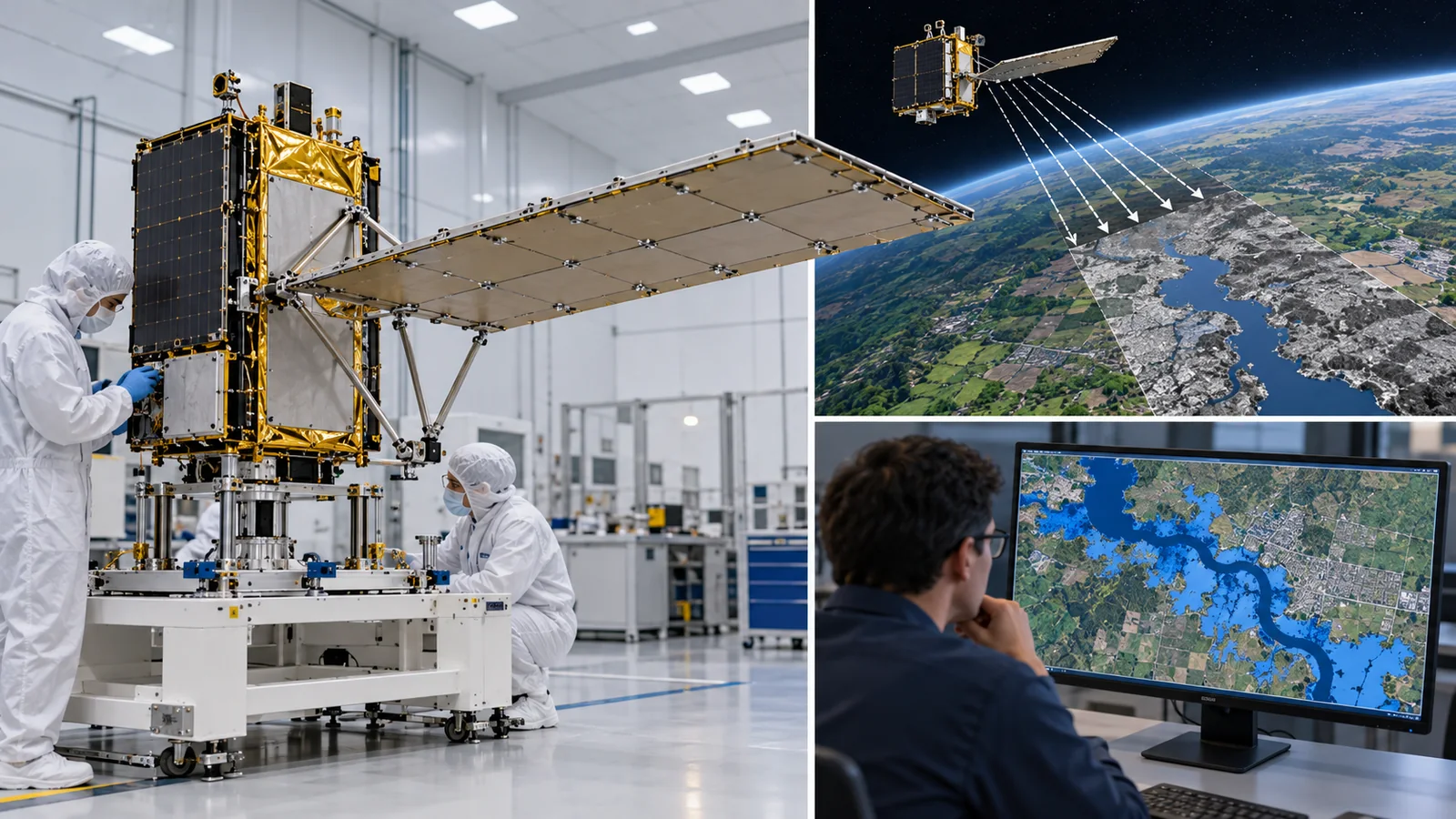
A SAR sees finer detail with a larger antenna, and picks up weaker echoes from farther away with more transmit power. But a satellite has to be light and small to keep launch costs down. StriX uses a deployable slot-array antenna that is folded for launch and opened to 5 m in orbit, a high-output amplifier of 1 kW class, and thermal control to remove the extra heat. With these the company says it matches the imaging capability of a large SAR satellite of about 3 tonnes at about one-tenth of the weight Sourced (the company's comparison, with JAXA's ALOS-4 as the large satellite).
On the materials side, the antenna panel is covered by a licence agreement with JAXA (patents and know-how, October 2022 to March 2027), and the company also holds patent licences from Science Tokyo (formerly Tokyo Institute of Technology). Satellite assembly is handled by SEIREN CO., LTD. (a partnership for volume production since 2021) and Tokyo Keiki Inc. (since 2022). The annual report does not say what material the antenna panel is made of (for example whether it is CFRP), so this article does not either. For the basics of structure and heat, see our explainers on satellite structures and small satellites, spacecraft thermal control, and CFRP and composite materials for space.
6. What it has done so far
| When | What happened | What it means |
|---|---|---|
| February 2018 | Founded in Chiyoda-ku, Tokyo. The starting point was to put to practical use the small-SAR-satellite results of the Cabinet Office's ImPACT program | A company that commercialised publicly funded research |
| 15 December 2020 | Launched the first demonstration satellite, StriX-alpha (Rocket Lab Electron). First image in February 2021 | The company calls it a first for a Japanese private company (the company's claim) |
| March and September 2022 | Launched StriX-beta and StriX-1. In April 2022 it was chosen as a project operator for a Cabinet Office demonstration | Three satellites so far. Volume production followed |
| March to December 2024 | Launched StriX-3 (March), the Fifth (August) and the Sixth (22 December). In July 2024 it took a 25 cm resolution image (the company calls it Japan's highest). The volume factory in Yamato began operating in September. It was chosen for the Space Strategy Fund in November. It listed on the TSE Growth market in December | Volume production, listing and public funding all came in the same year |
| March 2025 | Set up a holding company and an operating company in the United States (for North and Latin America) | Overseas bases expand |
| 15 October 2025 | Launched the Seventh StriX (7 in total at the end of 2025) | A turning point from about one a year |
| December 2025 | Raised ¥17.03 billion in total through the exercise of stock acquisition rights and an allotment to Hulic (the company's figure) | Up-front funds for manufacturing and launch |
| 19 February 2026 | Signed an imaging-data acquisition contract with Tri-Sat Constellation and Mitsubishi Electric for the Ministry of Defense project (contract value ¥96,073,447 thousand, excluding tax) | A contract that changed the order backlog and the sales outlook greatly |
| March to September 2026 | Launched the 8th (20 March), 9th (22 May), 10th (27 June), 11th (2 September), 12th (19 September) and 13th (26 September) | Six satellites in half a year. The official list |
| 14 August 2026 | The second-quarter results say it was also chosen for the second phase of the Space Strategy Fund, "Advanced Observation Functions for Next-Generation Earth Observation Satellites" | A second source of public funds |
| 28 August to 1 October 2026 | An agreement with NTT DOCOMO and NTT DATA on satellite imagery during disasters (28 August); the OMNIA program (15 September); a board resolution on a ¥20 billion syndicated loan (17 September); a launch agreement with Mitsubishi Heavy Industries for H3 (18 September); a 20-launch agreement with Rocket Lab (1 October) | Launch routes, funding and the service model all moved at once |
7. What comes next
about 21 at end 2027The plan in the annual report (March 2026). 30 or more from 2028
Electron (2028 to 2031, 20 launches)Announced on 18 September and 1 October 2026. Dates move with the launch provider
Net sales ¥6,353 millionCompany forecast (unchanged in the 14 August 2026 results)
All four items are the company's plans and forecasts, not things that have been achieved Not yet confirmed. The company states that the actual number of satellites built, the number and timing of launches will vary with customer demand, launch providers' circumstances, weather and other factors.
Synspective OMNIA, announced on 15 September 2026, is a program that shares a satellite constellation's imaging capacity among several users Sourced. Users are said to be able to secure priority imaging and acquisition rights for specific regions and paths without a large investment. The announcement also says that, separately from the StriX constellation of more than 30 satellites, it will build a new dedicated constellation, but it gives no number of satellites, timing or price Not yet confirmed.
The annual report says that from 2028 it aims to combine 30 or more satellites with additional functions such as inter-satellite links and its automated analysis, so as to deliver analysis results within one hour of imaging (the company's goal).
None of the following appears in the primary sources checked for this article Not yet confirmed.
The start-of-service dates of satellites 11 to 13 / the specifications of the third-generation StriX / the number of satellites and timing of the dedicated OMNIA constellation / the amount paid so far on the defense-related contract / the reason the official list has no entry for StriX-2 or a fourth satellite. External estimates such as research-firm market sizes are not used.
8. What the company is aiming for in space
This section includes things the company has not said directly. They are inferences within what the primary sources support, given with their grounds.
| What can be read from the record | Primary-source basis | Category |
|---|---|---|
| It plans three stages: add satellites, build up revenue from data sales, then raise margins with solutions | The growth strategy in the annual report (short term: sales to the Japanese government; medium term: overseas governments and a 30-satellite fleet; long term: solutions for private customers) | Sourced (company's strategy) |
| Near-term sales depend heavily on the contract terms of a few government bodies | 85.3% of sales went to the Cabinet Office and the Ministry of Defense (year to December 2025). The risk section also says about 90% went to government bodies | Inference |
| Even as satellites increase, sales take time to catch up | In the year to December 2025, capital expenditure was ¥11.6 billion while net sales rose 2.6%. It takes about two years from the start of manufacturing to completion, and a few months of commissioning follow each launch | Inference |
| Total revenue for the year to December 2026 is expected to be largely subsidies | The gap of ¥9,699 million between forecast total revenue of ¥16,052 million and forecast net sales of ¥6,353 million (the company defines total revenue as net sales plus subsidy income). About 60% | Our calculation |
| It is moving to spread launches across several providers | On top of Rocket Lab (47 contracts), there are SpaceX and Mitsubishi Heavy Industries' H3. The annual report mentions considering "launches by several rocket operators" | Inference |
In 2025 Synspective spent ¥11,620,077 thousand on capital expenditure, and its cumulative launches reached 7 by the year-end Sourced. Yet net sales in the year to December 2025 were ¥2,376,506 thousand, up only 2.6%. The annual report's explanation suggests the sales came from delivery of the Cabinet Office demonstration and the Ministry of Defense space demonstration, not from continuing data sales building up.
By contrast, the February 2026 defense-related contract (¥96,073,447 thousand, running to March 2031) provides a base for continuing sales once more satellites are in orbit. The company's forecast puts net sales for the year to December 2026 at ¥6,353 million, and this article reads it as meaning that added satellites turn into sales from 2026 on Not yet confirmed.
9. Map of space-industry partnerships
10. Technology, products and services
The annual report divides the services into data sales and solutions.
| Service | Description (the company's own) | Category |
|---|---|---|
| Data sales (StriX) | SAR images from its own satellites, sold on a contract for a number of images. Users specify an area of interest on a web platform and receive the images on the same platform after acquisition. There are three imaging modes (strip-map, sliding spotlight and steering spotlight) | Sourced |
| Object detection and classification | A solution that uses automated analysis of SAR images to find the position and type of ships and aircraft | Sourced |
| Land displacement monitoring | InSAR analysis that detects ground movement of a few millimetres as a time series from satellite data | Sourced |
| Flood and disaster damage assessment | Automated analysis, even in bad weather, to identify flooded areas and damaged roads and buildings | Sourced |
| Other | Forest condition (forest type and biomass), wind conditions near offshore wind farms and similar | Sourced |
| Synspective OMNIA (announced 15 September 2026) | Sharing of imaging capacity among several users. Plans to build a new dedicated constellation | Plan |
The company's announcements say that after launch a satellite spends several months in testing and commissioning before entering service Sourced. A SAR opens a large antenna that was folded for launch, and the shape it takes once opened (its flatness and pointing) affects image quality, so testing is needed.
The annual report notes that a satellite may lose function through a manufacturing defect, a collision with debris or an operational fault, and that the company counters this by launching several satellites every year to reduce dependence on any one. It is a business in which the quality of materials and manufacturing bears directly on continuity of operation.
11. The risks this company carries
| Risk | What it is | Category |
|---|---|---|
| Dependence on government customers | Government bodies account for about 90% of consolidated net sales (years to December 2024 and December 2025). The company says a change in bidding conditions or an inability to continue could have a material effect | Sourced |
| Up-front investment and losses | Losses through the year to December 2025. The company says that for a certain period it will prioritise sales growth over profitability | Sourced |
| The going-concern note | The notes to the results say that, because of continuing operating losses, "events or conditions exist that raise substantial doubt". The company concludes there is no material uncertainty, given cash of ¥16,209,788 thousand (end of June 2026), its credit lines, the defense-related contract and subsidy income | Sourced (company's judgement) |
| Securing funds | Payments for manufacturing and launch come ahead of sales. Borrowings carry financial covenants (keeping net assets at 1 yen or more, and not letting cash plus expected revenue minus interest-bearing debt fall below zero, among others) | Sourced |
| Launch opportunities and failure | Launch capacity is tight because newer rockets are late. The company carries insurance against launch failure (from ignition to satellite separation), but faults after separation are not covered | Sourced |
| Satellite operation | Design life is about five years. A satellite may lose function through part failure or a collision | Sourced |
| Volume production | It used to build one or two satellites a year. It is scaling up to a capacity of about 12 a year, and the company names hiring, training and coordination with partners as challenges | Sourced |
| Regulatory compliance | The company says that complying with the Act on Ensuring Appropriate Handling of Satellite Remote Sensing Records and the Radio Act takes a great deal of effort and time | Sourced |
| Dependence on subsidies | About 61% of total revenue in the year to December 2025 was subsidy income (our calculation). The forecast for the year to December 2026 is also about 60% | Our calculation |
12. Glossary
- SAR (synthetic aperture radar)
- A technique in which a satellite sends radio waves and builds an image from the waves returning from the ground. It works through clouds and at night.
- X-band
- One of the radio bands used by SAR satellites (wavelength about 3 cm). The shorter the wavelength, the finer the detail.
- Constellation
- Many satellites operated together as one system. The more satellites, the more often the same place is imaged.
- InSAR (interferometric SAR)
- Imaging the same place twice and comparing the phase of the waves to measure ground movement of a few millimetres.
- Resolution
- The smallest size that can be told apart in an image. 0.25 m means objects 25 cm across can be distinguished.
- Space Strategy Fund
- A support fund held by JAXA, of about ¥1 trillion over ten years, for private-sector space technology development.
- Total revenue
- The management indicator the company uses: net sales plus subsidy income. It is not accounting sales.
- Going concern
- The principle that accounts are prepared on the assumption that the company will continue in business. If there is doubt, a note is required.
- Rideshare
- Launching satellites of several companies together on one rocket.
- Annual securities report
- The audited annual report that Japanese listed companies file each year (published on EDINET).
13. References
- Synspective Annual securities report for the 8th fiscal year (1 January to 31 December 2025), filed via EDINET on 26 March 2026 (in Japanese). Business description, management policy, risks, employees, facilities, R&D, material contracts and subsequent events (the value of the defense-related contract). https://disclosure2dl.edinet-fsa.go.jp/searchdocument/pdf/S100XUO9.pdf
- Synspective Second-quarter (interim) financial results for the year ending December 2026, consolidated, Japanese GAAP, released on TDnet on 14 August 2026 (in Japanese). Interim results, full-year forecast, the going-concern note and the Space Strategy Fund selection. https://www2.jpx.co.jp/disc/290A0/140120260813519868.pdf
- Synspective Official website, "Launch Mission". The list of StriX launches (dates and rockets). Checked on 17 October 2026. https://synspective.com/satellite/launch-mission/
- Synspective Press release, "Synspective's 11th SAR Satellite Successfully Reaches Target Orbit" (2 September 2026). Launch time and site, and the explanation of post-launch testing and commissioning. https://synspective.com/news/11th_launch/
- Synspective Press release, "Synspective's 13th SAR Satellite Successfully Reaches Target Orbit" (26 September 2026). The 13th launch. https://synspective.com/news/13th_launch/
- Synspective Press release, "Synspective Signs 20-Launch Agreement with Rocket Lab" (1 October 2026). Twenty launches in 2028 to 2031; 47 launches contracted with Rocket Lab in total, 34 not yet flown. https://synspective.com/news/rocketlab_20_mla/
- Synspective Press release, "Synspective Signs Launch Service Agreement with Mitsubishi Heavy Industries for SAR Satellite Launch on H3 Launch Vehicle" (18 September 2026). Two satellites on H3 in 2027, under the Space Strategy Fund. https://synspective.com/news/mhi_lsa/
- Synspective Press release, "Synspective Announces Synspective OMNIA" (15 September 2026). A new program that shares the capacity of a small SAR constellation among several users. https://synspective.com/news/synspective_omnia/
- Synspective Press release, "Synspective Signs Agreement on the Use of Satellite Imagery During Disasters with NTT DOCOMO and NTT DATA" (28 August 2026). https://synspective.com/news/docomo_nttdata_partnership/
- Synspective Timely disclosure, "Notice Regarding Conclusion of a Syndicated Loan Subject to Financial Covenants and the Recognition of Non-Operating Expenses" (17 September 2026). Total loan of 20 billion yen and the financial covenants. https://contents.xj-storage.jp/xcontents/AS04951/932d829d/d650/4e19/835d/9c1fbf6432f2/140120260917538168.pdf
- Synspective Official website (English home page). Company overview and the source of the logo. Checked on 17 October 2026. https://synspective.com/
14. Claim-to-source audit
| Claim in the article | Category | Source |
|---|---|---|
| Legal name, head office address, listing venue, founding (February 2018) and four subsidiaries | Sourced | Reference 1 https://disclosure2dl.edinet-fsa.go.jp/searchdocument/pdf/S100XUO9.pdf |
| Net sales, ordinary loss, net loss, net assets and total assets (years to December 2023 to 2025) | Sourced | Reference 1 https://disclosure2dl.edinet-fsa.go.jp/searchdocument/pdf/S100XUO9.pdf |
| Subsidy income of ¥3,764,376 thousand, total revenue of ¥6,140,883 thousand, operating loss, 228 employees and headcount by site | Sourced | Reference 1 https://disclosure2dl.edinet-fsa.go.jp/searchdocument/pdf/S100XUO9.pdf |
| R&D spending of ¥1,224,219 thousand, capital expenditure of ¥11,620,077 thousand and the breakdown of 2025 financing | Sourced | Reference 1 https://disclosure2dl.edinet-fsa.go.jp/searchdocument/pdf/S100XUO9.pdf |
| Defense-related service contract: contract value ¥96,073,447 thousand (excluding tax), 19 February 2026 to 31 March 2031 | Sourced | Reference 1 https://disclosure2dl.edinet-fsa.go.jp/searchdocument/pdf/S100XUO9.pdf |
| Project budget of ¥283.2 billion (whole project), Space Strategy Fund limit of ¥23.79 billion and about ¥16.4 billion decided, METI SBIR ¥4,100,000 thousand, Cabinet Office ¥1,067,166 thousand, backlog of ¥24,960,649 thousand | Sourced | Reference 1 https://disclosure2dl.edinet-fsa.go.jp/searchdocument/pdf/S100XUO9.pdf |
| Sales shares of the Cabinet Office (58.0%) and the Ministry of Defense (27.3%) in the year to December 2025, and about 90% from government bodies | Sourced | Reference 1 https://disclosure2dl.edinet-fsa.go.jp/searchdocument/pdf/S100XUO9.pdf |
| StriX specifications (100 kg class, 5 m deployable antenna, 0.25 m, about 1,400 square kilometres, 12 a year expected, design life about five years) | Sourced | Reference 1 https://disclosure2dl.edinet-fsa.go.jp/searchdocument/pdf/S100XUO9.pdf |
| Thirteen StriX launches (dates and rockets) and the three demonstration satellites that have ended operation | Sourced | References 3 and 1 https://synspective.com/satellite/launch-mission/ https://disclosure2dl.edinet-fsa.go.jp/searchdocument/pdf/S100XUO9.pdf |
| The 11th launch (2 September 2026, 12:01 UTC) and the explanation of post-launch testing and commissioning | Sourced | Reference 4 https://synspective.com/news/11th_launch/ |
| The 13th launch (26 September 2026, 00:39 UTC) | Sourced | Reference 5 https://synspective.com/news/13th_launch/ |
| The 20-launch agreement with Rocket Lab (2028 to 2031), 47 contracted and 34 not yet flown | Sourced | Reference 6 https://synspective.com/news/rocketlab_20_mla/ |
| The agreement with Mitsubishi Heavy Industries for two satellites on H3 (2027, under the Space Strategy Fund) | Sourced | Reference 7 https://synspective.com/news/mhi_lsa/ |
| The OMNIA program (15 September 2026) | Sourced | Reference 8 https://synspective.com/news/synspective_omnia/ |
| The agreement with NTT DOCOMO and NTT DATA on imagery during disasters (28 August 2026) | Sourced | Reference 9 https://synspective.com/news/docomo_nttdata_partnership/ |
| The ¥20 billion syndicated loan (resolved 17 September 2026) and its financial covenants | Sourced | Reference 10 https://contents.xj-storage.jp/xcontents/AS04951/932d829d/d650/4e19/835d/9c1fbf6432f2/140120260917538168.pdf |
| Forecast for the year to December 2026 (total revenue ¥16,052 million, net sales ¥6,353 million), interim results, cash of ¥16,209,788 thousand, the company's going-concern judgement and the second-phase Space Strategy Fund selection | Sourced | Reference 2 https://www2.jpx.co.jp/disc/290A0/140120260813519868.pdf |
| The plan for satellites in operation (10 at end 2026, about 21 at end 2027, 30 or more from 2028) | Not yet confirmed | Reference 1 https://disclosure2dl.edinet-fsa.go.jp/searchdocument/pdf/S100XUO9.pdf |
| Subsidy income at about 61% of total revenue (year to December 2025) and a forecast gap of ¥9,699 million (about 60%) | Our calculation | Our calculation (3,764,376 / 6,140,883 and (16,052 - 6,353) / 16,052). Total revenue is the company's definition of net sales plus subsidy income |
| The combined 85.3% sales share of the Cabinet Office and the Ministry of Defense | Our calculation | Our calculation (58.0% plus 27.3%) |
| The four types of space company and Synspective's position | Our calculation | Our own classification. Companies shown are examples from this series |
| Start-of-service dates of satellites 11 to 13, third-generation StriX specifications, the OMNIA dedicated constellation, amount paid on the defense contract | Not yet confirmed | Could not be confirmed. This article uses neither estimates nor outside figures |
| The reading that near-term sales depend heavily on the contract terms of a few government bodies | Inference | This article's interpretation of the high sales share |
| The readings that sales lag behind satellite additions, and that launches are being spread across providers | Inference | This article's interpretation of capital expenditure against sales, and of the make-up of launch contracts |
Last updated 17 October 2026 / Troy Technical
Figures in this article come from Synspective's statutory disclosures (annual securities report, results releases, timely disclosures) and its website and press releases. No research-firm market estimates, press-based figures, share prices or company valuations have been used. Passages marked "Inference" are this article's interpretation of primary sources, not statements made by the company. Plans, forecasts and dates may change.