INSTITUTION PROFILE / SPACE INDUSTRY
Federal Aviation Administration (FAA), Office of Commercial Space Transportation
The U.S. body that decides whether a rocket may fly
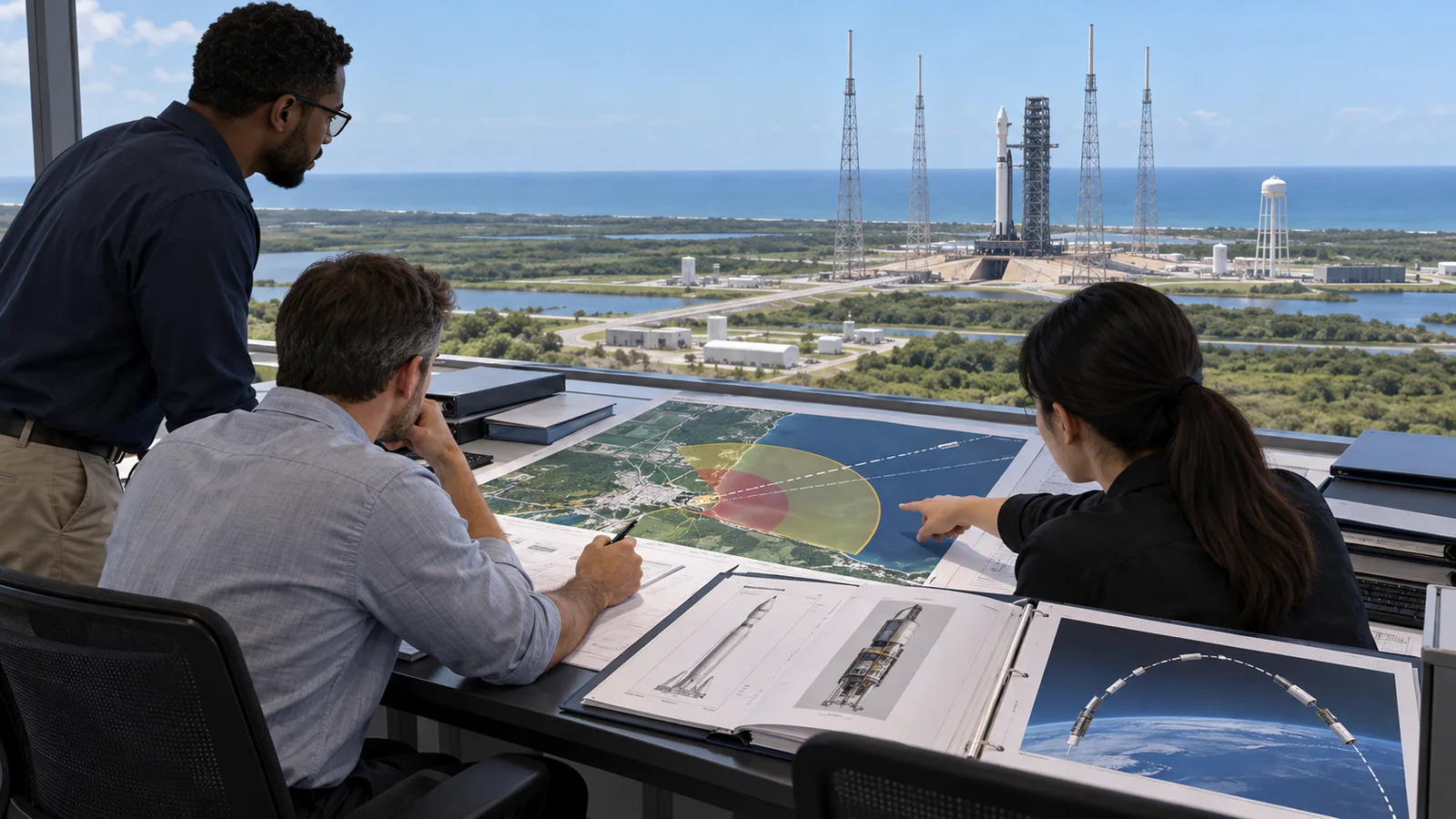
The FAA is a federal agency within the U.S. Department of Transportation. Its Office of Commercial Space Transportation (AST) licenses and permits private rocket launches, spacecraft reentries and the operation of launch sites, writes the safety rules, and supervises compliance. It does not run exploration programmes (NASA's job), fund research (the job of NASA and DARPA), or license satellite radio use (the FCC's job). This profile looks at one question: what the FAA can decide in the space industry, and what it cannot. Licensing rules are cited by their numbers in Title 14 of the Code of Federal Regulations (14 CFR), and we checked those numbers against official texts.
- The FAA in 30 seconds
- What kind of body it is: the four types of influence
- What it does in the space industry (licence types and rule numbers)
- How far its influence reaches (powers and geography): what it can and cannot decide
- Related organisations and companies
- Outlook (separating the stages of rule proposals)
- Glossary, references and claim-to-source audit
1. The FAA in 30 seconds
Office of Commercial Space Transportation (AST)The FAA's only space-related line of business
What the FAA decides is "may this rocket fly, under these safety conditions?" It does not decide what is flown, where it goes, or who pays. The FAA describes its role as licensing all U.S. commercial launches and reentries, at home and abroad Sourced. By law, the office has a double role: it regulates the industry and it also encourages and promotes private launches Sourced. Exploration programmes and agency research and development belong to other bodies.
2. What kind of body it is: the four types of influence
Institutions in the space industry differ from companies. What separates them is the route by which they influence the industry, and that gives four types. The FAA is a "Policy & regulation" body: through licences and rules, it shapes who can fly and when.
3. What it does in the space industry (licence types and rule numbers)
The FAA's commercial space rules are in Chapter III (Parts 400 to 460) of Title 14 of the Code of Federal Regulations, and they put the statute (Title 51 of the U.S. Code, Chapter 509) into practice Sourced. The main types are below (checked 17 October 2026; the eCFR text is as of 15 October 2026).
| What is authorised | Rule number | What it covers |
|---|---|---|
| Launch and reentry (rockets and spacecraft) | 14 CFR Part 450 | The "vehicle operator licence" authorises a launch, a reentry, or both, including pre- and post-flight ground operations. One licence can cover several vehicle configurations and several launch sites |
| Experimental permits | 14 CFR Part 437 | A permit that can be issued instead of a licence for developing and testing, for example, reusable suborbital rockets |
| Operating a launch or reentry site | Part 420 / Part 433 | Licences to operate a private spaceport (a launch site or a reentry site) |
| Safety element approvals | Part 414 | Approval of safety-related equipment, processes or personnel, separate from a licence |
| Application procedures | Part 413 | How to apply and how long review takes. The statute requires a licensing decision within 180 days of accepting an application |
| Insurance against damage | Part 440 | Requires licence and permit holders to carry insurance or show financial responsibility against the maximum probable loss to third parties |
| Human spaceflight | Part 460 | Crew training, informing spaceflight participants of risk, life-support requirements and so on |
Note: the old rules (Parts 415, 417, 431 and 435) have been replaced by Part 450. On 17 March 2026 the FAA said that operators had moved their legacy licences to Part 450 by the 9 March 2026 deadline: Blue Origin New Shepard, Firefly Aerospace Alpha, SpaceX Falcon 9, Falcon Heavy and Dragon, Rocket Lab Electron, and United Launch Alliance (ULA) Atlas and Vulcan. The eCFR also shows those old part numbers as "Reserved" Sourced.
| What the FAA does | What it involves | Status |
|---|---|---|
| Licence review | Beyond safety, it carries out a policy review (whether national security, foreign policy or international obligations are affected), a payload review and an environmental review (NEPA). The FAA said it met the deadline (180 days after acceptance) 98% of the time in FY2024. That figure is from 2024, and we could not find a more recent rate | Sourced |
| Safety inspections and enforcement | Inspections before, during and after launches. The forecast report says as many as 750 inspections a year. Violations can bring licence suspension or revocation, emergency orders and civil penalties (per the FAA) | Sourced |
| Mishap response | Under an approved mishap plan, the operator reports to the FAA (a preliminary written report within five days), finds the root cause and takes corrective action. The operator may lead the investigation under FAA oversight, or the FAA may investigate itself. Return to flight needs either FAA acceptance of the final report or an FAA determination that public safety is not at risk. The National Transportation Safety Board (NTSB) has a separate memorandum of agreement with the FAA | Sourced |
| User fees | A law signed on 4 July 2025 (Pub. L. 119-21) set a fee, beginning in 2026, for each licensed or permitted launch or reentry. It is the lesser of two amounts: one based on payload weight per pound, and a maximum amount. The FAA issued a policy notice on 22 April 2026. This article does not give the amounts | Sourced |
| Insurance and government payments | The statute requires insurance of up to US$500 million for third-party claims and US$100 million for damage to government property (less if the insurance available on the world market at reasonable cost is smaller). Above that, the government pays claims only to the extent provided in advance in an appropriation law, up to US$1.5 billion in 1989 dollars adjusted for inflation. The amounts are set by the Secretary of Transportation on the basis of the maximum probable loss | Sourced (the statute, 2024 edition) |
| Spaceport grants | The statute has a programme (Chapter 511) under which the Secretary of Transportation can give grants to public agencies such as states for space transportation infrastructure. We could not find how much has actually been spent on these grants | Sourced (the programme) Not yet confirmed (the amount) |
Part 450 sets performance requirements such as flight safety analysis, system safety and flight safety systems. It does not take the form of specifying particular materials or parts Sourced (Part 450 is organised into general information, requirements to obtain a licence, safety requirements, and licence terms and conditions). For suppliers of materials and parts, the effect is indirect: it comes through how a launch company shows the safety of its own vehicle (analysis and testing) to obtain a licence. Which material tests a review asks for depends on each operator's application, so this article does not generalise Not yet confirmed.
4. How far its influence reaches (powers and geography): what it can and cannot decide
Here is a one-glance split of what the FAA can and cannot do.
| Aspect | What the FAA has | What the FAA does not have |
|---|---|---|
| Powers | Issues licences and permits for launch, reentry and launch sites, writes the rules, inspects, and enforces through suspension, revocation and civil penalties. It must follow the statutory deadline of 180 days after accepting an application | Radio licences for satellites (Federal Communications Commission), licences for private Earth-imaging satellites (Commerce Department), exploration plans and research funding. We found no statement that the FAA's mission includes these |
| Legal basis | Title 51 of the U.S. Code, Chapter 509. The authority rests with the Secretary of Transportation and is delegated to the FAA Administrator. The statute asks the FAA both to regulate and to promote | Rules beyond what the law allows. For example, rules on the safety of crew and participants are limited by a statutory "learning period", and the limits relax from 1 January 2028 (2024 edition of the text) |
| Geography | All commercial launches and reentries in the United States, and those carried out abroad by U.S. citizens and U.S. companies. In FY2025, 15 launches from Mahia, New Zealand, were U.S.-licensed | Launches by foreign firms outside the United States (the statute covers activity in the U.S. and activity by U.S. citizens and companies abroad, so other activity appears to fall outside it). Other countries' rules and space agencies' plans |
| Duration | One licence can cover several operations, vehicle configurations and launch sites (Part 450). Changes are handled by licence modifications | Control over launch dates themselves (dates depend on coordination between operators, ranges and airspace) |
| Scale | 165 staff in AST (end of FY2024). 204 licensed operations in FY2025 (195 launches, 9 reentries) and 982 licensed launches and reentries from 1989 to 2025 | The FAA's budget: the Department of Transportation's website refused automated access to the budget document that shows AST's budget, so we could not confirm it |
"204" is the number of operations the FAA licensed or permitted, not all U.S. launches. For FY2025 (October 2024 to September 2025) it breaks down into 195 launches and 9 reentries Sourced. Of the 195 launches, SpaceX made 161 (83%), Rocket Lab 15, Blue Origin 10, ULA and Stratolaunch four each, and Firefly Aerospace one Sourced. The "214" for FY2026 (high case) is the FAA's own forecast, not an actual count Not yet confirmed. Another FAA document (the request for information of August 2026) mentions an expected rate of "10,000 launches and reentries a year by 2035", a different order of magnitude from the forecast report's high case of 507 in FY2036. We could not find the assumptions behind it Not yet confirmed.
5. Related organisations and companies
The FAA licenses under laws written by Congress, as part of the Department of Transportation. Operators receive the licences, and many launches take place from federal ranges. Fig. 3 shows only relationships documented in primary sources.
In this series' company profiles, SpaceX, Blue Origin, Rocket Lab, Firefly Aerospace and Varda Space Industries appear on the receiving end of FAA licences. In its announcement of November 2024, the FAA said it had issued Part 450 licences to Astra Space, ABL Space, Inversion Space, Relativity Space, SpaceX, Stratolaunch and Varda Space Sourced. Holding a licence is a fact about authorisation. It does not mean the FAA recommended or rated any company's vehicle or products. Our explainers on national space strategies and regulation, on reusable rockets, and on space manufacturing and microgravity give useful background.
6. Outlook (separating the stages of rule proposals)
FAA rules move through proposal (a proposed rule), comment period, final rule and entry into force. The table distinguishes which stage each item has reached.
| What can be read from the sources | Supporting primary source | Status |
|---|---|---|
| Proposed rules (proposal stage): five Part 450 burden-reducing proposals were published in the Federal Register on 5 October 2026 (simplifying flight safety analysis methods, an exception for lightning hazard mitigation, clarifying blast overpressure analysis, simplifying physical containment, and wider electronic submission of applications). Comments are due 4 November 2026 | Federal Register 2026-20387, 20386, 20388, 20391 and 20392. The FAA cites Executive Order 14335, "Enabling Competition in the Commercial Space Industry" (13 August 2025). No final rule has been issued | Not yet confirmed |
| Proposed rule (proposal stage): a plan under which the Secretary of Transportation would waive requirements of 13 laws for licences and permits (proposed 30 July 2026; the comment period closed 31 August 2026). The FAA says environmental laws are among them, and that requirements needed for safety, property, national security and foreign policy would not be affected | Federal Register 2026-15415 and the FAA announcement of 28 July 2026. We could not find a final rule by the date checked | Not yet confirmed |
| Request for information (before any rule): comments sought on siting new spaceports and on priority airspace for launch corridors (comments due 26 October 2026) | Federal Register 2026-17290, which says it follows the 2026 National Space Transportation Policy | Not yet confirmed |
| Start of an environmental review: on 14 October 2026 the FAA gave notice that it intends to prepare a programmatic environmental impact statement (PEIS) on expanded SpaceX Starship-Super Heavy operations. Comments on its scope are open, and a draft will follow | Federal Register 2026-20963. No licensing decision has been announced | Not yet confirmed |
| The statutory limits on rules for crew and participant safety relax from 1 January 2028. Whether the FAA will then propose rules is undecided | 51 U.S.C. 50905(c)(9) (2024 edition). We did not check later amendments | Not yet confirmed |
| The number of licensed operations to review will keep growing. The FAA forecasts 214 in FY2026 rising to 507 in FY2036 (high case), or 209 rising to 282 (low case) | FAA Aerospace Forecast 2026-2046, based on information from operators. Actual numbers may differ | Not yet confirmed |
| Rule simplification and wider electronic filing will continue as the FAA's review workload grows | The forecast above, and the stated direction of the 2026 proposals and announcements | Inference |
7. Glossary
- AST
- The FAA's Office of Commercial Space Transportation. It licenses private launches and reentries and writes the rules.
- 14 CFR
- Title 14 of the Code of Federal Regulations, "Aeronautics and Space". The commercial space rules are in Chapter III (Parts 400 to 460).
- Part 450
- The rule that gathers the requirements for launch and reentry licences. It states requirements as performance goals, and it replaced the older rules.
- Licence and permit
- A licence is for commercial operations; a permit is for experiments. Both cover a defined scope of operations, not a single launch.
- Mishap
- A serious event within a licensed scope (injury or death, failure of a safety-critical system, loss of the vehicle, hazardous debris and so on). It must be reported and investigated.
- Proposed rule and final rule
- A proposed rule (NPRM) is a draft for public comment and has no force. A rule takes effect only after a final rule is issued and enters into force.
- NEPA / PEIS
- The U.S. National Environmental Policy Act and the environmental assessments it requires. A PEIS is an impact statement covering a broad programme.
- FCC / NOAA CRSRA
- The FCC is the Federal Communications Commission, which authorises satellite radio use. CRSRA, in the Commerce Department, licenses private Earth-imaging satellites.
- Learning period
- The period during which the law limits rules on crew and participant safety in human spaceflight. The limits change from 1 January 2028.
8. References
- FAA Commercial Space Transportation (licenses all U.S. commercial launches and reentries; the 1,000th licensed or permitted operation on 14 August 2025). https://www.faa.gov/space
- FAA About the Office of Commercial Space Transportation (AST founded in 1984, moved to the FAA in November 1995, regulatory and promotional roles). https://www.faa.gov/about/office_org/headquarters_offices/ast
- FAA Licenses, Permits and Approvals (licence and permit types, part numbers, and the replacement of the legacy rules by Part 450). https://www.faa.gov/space/licenses
- FAA Legislation & Policies, Regulations & Guidance (14 CFR Chapter III covers Parts 400 to 460, the performance-based description of Part 450, and the list of memoranda with NASA, the Air Force and NTSB). https://www.faa.gov/space/legislation_regulation_guidance
- Code of Federal Regulations (eCFR) 14 CFR Chapter III (as of 15 October 2026: the structure of parts, and Parts 450, 460, 413 and others). https://www.ecfr.gov/current/title-14/chapter-III
- U.S. Code (GovInfo) 51 U.S.C. Chapter 509, Commercial Space Launch Activities (2024 edition: Section 50904 on when a licence is required, 50905 on the review deadline and the learning period, 50914 on insurance, 50915 on government payments). https://www.govinfo.gov/content/pkg/USCODE-2024-title51/html/USCODE-2024-title51-subtitleV-chap509.htm
- U.S. Code (GovInfo) 51 U.S.C. Chapter 511, Space Transportation Infrastructure Matching Grants (2024 edition). https://www.govinfo.gov/content/pkg/USCODE-2024-title51/html/USCODE-2024-title51-subtitleV-chap511.htm
- FAA FAA Aerospace Forecast Fiscal Years 2026-2046, Commercial Space (FY2025 results, inspections, number of licensed launch sites, forecasts). https://www.faa.gov/data_research/aviation/aerospace_forecasts/2026_Commercial_Space_2.pdf
- FAA New Record for FAA-Licensed Commercial Space Operations, Aerospace Rulemaking Committee Launched to Update Licensing Rule (14 November 2024: AST staff of 165, the 98% deadline rate, holders of Part 450 licences). https://www.faa.gov/newsroom/new-record-faa-licensed-commercial-space-operations-aerospace-rulemaking-committee
- FAA FAA Streamlines Commercial Space License Approvals (17 March 2026: legacy licences moved to Part 450). https://www.faa.gov/newsroom/faa-streamlines-commercial-space-license-approvals
- FAA Compliance, Enforcement & Mishap (inspections, enforcement, mishap response and return-to-flight decisions). https://www.faa.gov/space/compliance_enforcement_mishap
- FAA LIFTOFF: Trump's Transportation Secretary Sean P. Duffy Announces Major Move to Streamline Commercial Space Licensing (28 July 2026: the proposal to waive 13 laws). https://www.faa.gov/newsroom/liftoff-trumps-transportation-secretary-sean-p-duffy-announces-major-move-streamline
- Federal Register Space Launch and Reentry Licensing and Permitting User Fees (22 April 2026: the authority of the Secretary and the FAA Administrator, and the fees). https://www.federalregister.gov/documents/2026/04/22/2026-07789/space-launch-and-reentry-licensing-and-permitting-user-fees
- Federal Register Waiver of Specified Statutory Requirements for Commercial Space Launch and Reentry Actions (proposed rule, 30 July 2026). https://www.federalregister.gov/documents/2026/07/30/2026-15415/waiver-of-specified-statutory-requirements-for-commercial-space-launch-and-reentry-actions
- Federal Register Digital Modernization for Licensing Electronic Application Submissions (proposed rule, 5 October 2026). https://www.federalregister.gov/documents/2026/10/05/2026-20387/digital-modernization-for-licensing-electronic-application-submissions
- Federal Register Simplifying Physical Containment Requirements (proposed rule, 5 October 2026). https://www.federalregister.gov/documents/2026/10/05/2026-20386/simplifying-physical-containment-requirements
- Federal Register Streamlining Flight Safety Analysis Methodology Means of Compliance (proposed rule, 5 October 2026). https://www.federalregister.gov/documents/2026/10/05/2026-20388/streamlining-flight-safety-analysis-methodology-means-of-compliance
- Federal Register Lightning Hazard Mitigation Burden-Reducing Exception (proposed rule, 5 October 2026). https://www.federalregister.gov/documents/2026/10/05/2026-20391/lightning-hazard-mitigation-burden-reducing-exception
- Federal Register Overpressure Blast Effects Analysis Burden Reducing Clarification (proposed rule, 5 October 2026). https://www.federalregister.gov/documents/2026/10/05/2026-20392/overpressure-blast-effects-analysis-burden-reducing-clarification
- Federal Register Siting New Spaceports and Use of Priority Airspace for Critical Space Launch Corridors (request for information, 25 August 2026). https://www.federalregister.gov/documents/2026/08/25/2026-17290/siting-new-spaceports-and-use-of-priority-airspace-for-critical-space-launch-corridors
- Federal Register Notice of Intent To Prepare a Programmatic Environmental Impact Statement ... SpaceX Starship-Super Heavy ... Boca Chica (14 October 2026). https://www.federalregister.gov/documents/2026/10/14/2026-20963/notice-of-intent-to-prepare-a-programmatic-environmental-impact-statement-peis-open-public-scoping
- Code of Federal Regulations (eCFR) 47 CFR 25.102, Station authorization required (operating a satellite station needs FCC authorisation). https://www.ecfr.gov/current/title-47/section-25.102
- NOAA Commercial Remote Sensing Regulatory Affairs (licensing of private Earth-imaging satellite systems). https://www.nesdis.noaa.gov/about/our-offices/commercial-remote-sensing-regulatory-affairs
9. Claim-to-source audit
| Claim in the article | Status | Source |
|---|---|---|
| The FAA licenses all U.S. commercial launches and reentries; 1,000 licensed or permitted operations by 14 August 2025 | Sourced | Reference 1 https://www.faa.gov/space |
| AST's founding (1984), its move to the FAA in November 1995, and its regulatory and promotional roles | Sourced | Reference 2 https://www.faa.gov/about/office_org/headquarters_offices/ast |
| Licence and permit types and part numbers (Parts 450, 437, 420, 433), and the replacement of the old rules by Part 450 | Sourced | Reference 3 https://www.faa.gov/space/licenses |
| 14 CFR Chapter III covers Parts 400 to 460; Part 450 is performance-based; memoranda with NASA, the Air Force and NTSB exist | Sourced | Reference 4 https://www.faa.gov/space/legislation_regulation_guidance |
| Part structure (Parts 413, 414, 440, 450, 460), the old part numbers shown as "Reserved" (as of 15 October 2026), and the structure of Part 450 | Sourced | Reference 5 https://www.ecfr.gov/current/title-14/chapter-III |
| When a licence is required, the 180 days after acceptance, the limits on crew and participant rules and 1 January 2028, the insurance ceilings, and the government payment mechanism | Sourced | Reference 6 https://www.govinfo.gov/content/pkg/USCODE-2024-title51/html/USCODE-2024-title51-subtitleV-chap509.htm |
| The spaceport infrastructure grant programme (Chapter 511) | Sourced | Reference 7 https://www.govinfo.gov/content/pkg/USCODE-2024-title51/html/USCODE-2024-title51-subtitleV-chap511.htm |
| 204 operations in FY2025 (195 launches, 9 reentries) and the breakdown by operator, 982 cumulative, up to 750 inspections, 14 licensed launch sites, and the forecasts (214 to 507; 209 to 282) | Sourced (actuals); forecasts not yet confirmed | Reference 8 https://www.faa.gov/data_research/aviation/aerospace_forecasts/2026_Commercial_Space_2.pdf |
| AST staff of 165 (end of FY2024) and 118 (end of FY2022), the 98% deadline rate, and the Part 450 licence holders | Sourced | Reference 9 https://www.faa.gov/newsroom/new-record-faa-licensed-commercial-space-operations-aerospace-rulemaking-committee |
| Legacy licences moved to Part 450 (deadline 9 March 2026), and the vehicles that moved | Sourced | Reference 10 https://www.faa.gov/newsroom/faa-streamlines-commercial-space-license-approvals |
| Inspection and enforcement tools, and the mishap reporting, investigation and return-to-flight process | Sourced | Reference 11 https://www.faa.gov/space/compliance_enforcement_mishap |
| The proposal to waive 13 laws (FAA announcement) | Sourced (a proposal, not a final rule) | Reference 12 https://www.faa.gov/newsroom/liftoff-trumps-transportation-secretary-sean-p-duffy-announces-major-move-streamline |
| Delegation of authority from the Secretary to the FAA Administrator, and the fee mechanism from 2026 | Sourced | Reference 13 https://www.federalregister.gov/documents/2026/04/22/2026-07789/space-launch-and-reentry-licensing-and-permitting-user-fees |
| The proposed rule to waive 13 laws (30 July 2026) and its comment deadline of 31 August 2026 | Sourced (proposal); final rule not yet confirmed | Reference 14 https://www.federalregister.gov/documents/2026/07/30/2026-15415/waiver-of-specified-statutory-requirements-for-commercial-space-launch-and-reentry-actions |
| The five proposed rules of 5 October 2026 (electronic filing and others) and the comment deadline of 4 November 2026 | Sourced (proposals); final rules not yet confirmed | Reference 15 https://www.federalregister.gov/documents/2026/10/05/2026-20387/digital-modernization-for-licensing-electronic-application-submissions |
| The other four proposals of the same day: physical containment, flight safety analysis, lightning exception and blast overpressure | Sourced (proposals); final rules not yet confirmed | Reference 16 https://www.federalregister.gov/documents/2026/10/05/2026-20386/simplifying-physical-containment-requirements, Reference 17 https://www.federalregister.gov/documents/2026/10/05/2026-20388/streamlining-flight-safety-analysis-methodology-means-of-compliance, Reference 18 https://www.federalregister.gov/documents/2026/10/05/2026-20391/lightning-hazard-mitigation-burden-reducing-exception, Reference 19 https://www.federalregister.gov/documents/2026/10/05/2026-20392/overpressure-blast-effects-analysis-burden-reducing-clarification |
| The request for information on spaceports and priority airspace (comments due 26 October 2026) and the reference to "10,000 a year" | Sourced (the request); the future rate is not yet confirmed | Reference 20 https://www.federalregister.gov/documents/2026/08/25/2026-17290/siting-new-spaceports-and-use-of-priority-airspace-for-critical-space-launch-corridors |
| The notice of intent to prepare a PEIS on Starship (14 October 2026) | Sourced (the notice); the licensing decision is not yet confirmed | Reference 21 https://www.federalregister.gov/documents/2026/10/14/2026-20963/notice-of-intent-to-prepare-a-programmatic-environmental-impact-statement-peis-open-public-scoping |
| Operating a satellite station requires FCC authorisation | Sourced | Reference 22 https://www.ecfr.gov/current/title-47/section-25.102 |
| Licences for private Earth-imaging satellites come from the Commerce Department's CRSRA | Sourced | Reference 23 https://www.nesdis.noaa.gov/about/our-offices/commercial-remote-sensing-regulatory-affairs |
| The four-type classification of institutions and the layout of Figs. 2 and 3 | Our calculation | our own arrangement (this article) |
| AST's budget, the amount spent on grants, the latest deadline rate, final rules for each proposal, later amendments of the statute, and the assumptions behind "10,000 a year" | Not yet confirmed | Not stated in the sources checked; this article makes no estimate |
| Section 6: "rule simplification and wider electronic filing will continue" | Inference | our own reading (outlook) of Reference 8 and References 14 to 21 |
Last updated: 17 October 2026 / Troy Technical
Rule numbers and statutory text in this article are based on the Code of Federal Regulations (eCFR, as of 15 October 2026) and Title 51 of the U.S. Code (2024 edition). Proposed rules are proposals, not final rules. This field changes quickly, so rules, counts and schedules are as of the date checked. Items marked "Inference" are our own reading of the primary sources.