INSTITUTION PROFILE / SPACE INDUSTRY
NASA
The U.S. exploration agency that acts as a buyer of commercial space services
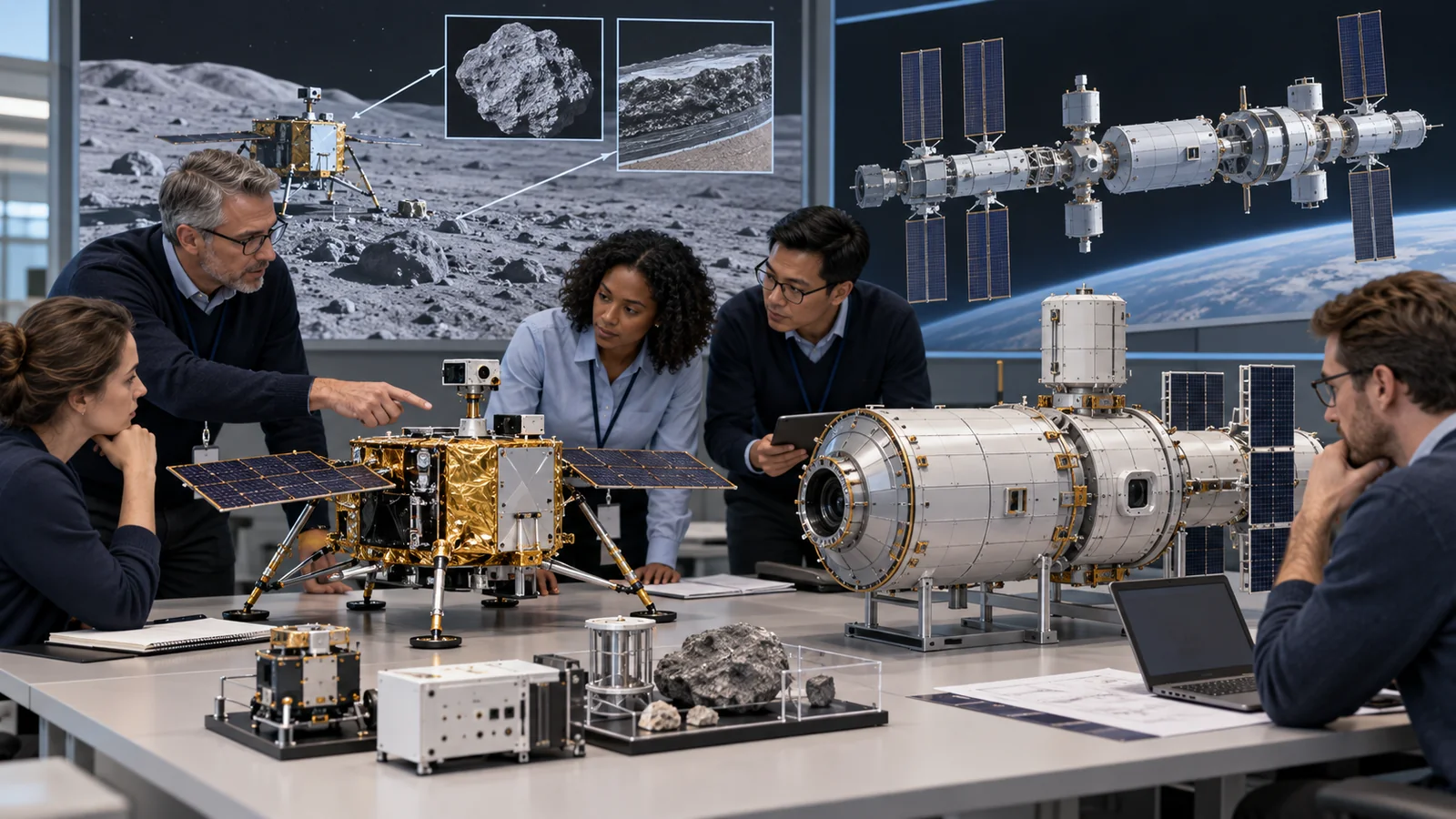
NASA, the National Aeronautics and Space Administration, is the civil (non-military) space agency of the United States. It runs the Artemis programme to return people to the Moon, and it buys or supports commercial services for deliveries to the lunar surface, for lunar landers and for private space stations to follow the International Space Station. But the FAA licenses private launches, the FCC licenses commercial satellite radio, and Congress sets the total budget. This profile looks at one question: what NASA can decide for the space industry, and what it cannot.
- NASA in 30 seconds
- What kind of body it is: the four types of influence
- What it does for the space industry
- How far its influence reaches (what it can and cannot decide)
- Companies and organisations it works with
- Outlook
- Glossary, references and claim-to-source audit
1. NASA in 30 seconds
NASA's influence comes from being a buyer with a budget, not from writing rules. Within the budget Congress enacts, NASA runs exploration programmes and signs contracts and agreements with companies Sourced. A private launch or reentry, by contrast, needs a license from the FAA; commercial satellite radio is handled by the FCC, and federal agencies' radio use by NTIA Sourced. NASA does not issue those permissions. So NASA has real power over what it chooses to build and buy, but it cannot decide what a private company may launch.
2. What kind of body it is: the four types of influence
The institutions in space-industry articles are not companies, and they do not trade for profit. They differ in the route by which they influence the industry, which gives four types. NASA belongs to the first type on the left, "Funding".
3. What it does for the space industry
NASA's work with the industry falls into three kinds: running its own programmes, buying from companies, and growing companies through agreements. All amounts are in U.S. dollars, and years are U.S. fiscal years (FY2026 runs from October 2025 to September 2026). "Enacted" means the amount Congress set in an appropriations act; "request" means what the President asked Congress for, which is not yet decided Sourced.
| Area | Budget (FY2026 enacted / FY2027 request) | What it involves | Main players |
|---|---|---|---|
| Artemis programme (exploration) | US$7,783.0 million / US$8,513.9 million | Artemis II flew a crew around the Moon in April 2026. Artemis III is planned for 2027 as a low-Earth-orbit test with landers; the first lunar landing is targeted for 2028 Not yet confirmed | NASA (SLS rocket and Orion capsule); crewed landers from SpaceX and Blue Origin |
| Deliveries to the Moon (CLPS) | Contract ceiling of US$2.6 billion in total through November 2028 (not a single year's budget) | NASA buys end-to-end delivery of payloads to the Moon, from integration and launch to landing. It has awarded 17 deliveries to five vendors, carrying more than 60 NASA instruments | Astrobotic, Blue Origin, Firefly Aerospace and Intuitive Machines are among the providers listed |
| Low Earth orbit (ISS and commercial stations) | Space Operations US$4,175.0 million / US$3,047.2 million of which Commercial LEO Development US$299.8 million / US$599.8 million | The ISS is planned to end operations in 2030. NASA intends to buy services from privately owned and operated stations afterwards. Phases 1 and 2 use funded Space Act Agreements for design and demonstration; Phase 3 is planned to use contracts to buy services | Axiom Space, Blue Origin, Starlab Space, Vast and others |
| Space technology | US$920.5 million / US$624.3 million | Money to demonstrate new technology with industry and universities. The FY2027 request mentions support for commercial efforts such as lunar rocket propellant and radioisotope power systems | Companies, universities, government agencies |
| Science | US$7,250.0 million / US$3,893.9 million | Space telescopes, planetary probes and other science missions. For industry, these are also orders for instruments and spacecraft | NASA centers, JPL and others |
| Technical standards | - | The Office of the NASA Chief Engineer runs the NASA Technical Standards System. NASA and center standards approved for public release can be read by anyone | Office of the NASA Chief Engineer |
| International framework | - | The Artemis Accords set shared principles for civil exploration and use of the Moon. NASA created them in 2020 with the U.S. Department of State and seven other initial signatories. Each country decides for itself whether to sign; 76 have | Governments of the signatory countries |
A CLPS contract buys the delivery as a whole service, covering integration, operations, launch and landing on the Moon Sourced. For a company that makes materials or parts, NASA is probably a direct buyer only for NASA's own vehicles, such as the SLS and Orion. For lunar landers and commercial space stations, the vehicle maker is the likely buyer (Inference). NASA's technical standards are a reference for what vehicle makers are asked to meet, but publishing a standard is not the same as requiring it of private companies.
4. How far its influence reaches (what it can and cannot decide)
| Aspect | What NASA has | What NASA does not have |
|---|---|---|
| Powers | Authority, within the budget Congress enacts, to enter contracts, leases, cooperative agreements and other transactions (including Space Act Agreements). It is the civil agency that directs U.S. non-military space activity | Power to set the total budget (Congress), to license private launch and reentry (FAA) or commercial satellite radio (FCC), or to direct military space activity (Department of Defense) |
| Geography | Projects funded by the U.S. budget. CLPS contracts are with American companies. Internationally, it created the Artemis Accords with the Department of State (76 signatories) and works with partners on the ISS | Power to regulate other countries' space policy, or other countries' launches and satellites |
| Time span | Multi-year programmes (Artemis, the move to commercial stations) and contract frameworks (CLPS runs to November 2028) | Congress sets the budget each year. NASA cannot legally guarantee a programme's schedule |
| Scale | 17,438 federal staff. A FY2026 budget of US$24.4 billion. 20 centers and facilities | Contractor staff are not included in these numbers |
NASA's budget looks different depending on the document. For FY2025, the amount Congress enacted as ordinary appropriations was US$24.8 billion (US$24,838.3 million), but the agency's financial report also shows US$35.6 billion, which adds disaster-relief supplemental funds and special mandatory appropriations of US$9.995 billion under another law (available until 30 September 2032) Sourced. The FY2027 figure of US$18.8 billion is a request, not an enacted amount. This article keeps "enacted" and "request" apart. As of the date we checked (17 October 2026), we could not find an enacted FY2027 amount on NASA's official pages Not yet confirmed.
5. Companies and organisations it works with
| Programme | Companies and organisations named on NASA's pages | The relationship | Profile in this series |
|---|---|---|---|
| Crewed lunar landers | SpaceX, Blue Origin | As NASA's commercial providers, they are building the landers that will carry Artemis astronauts to the lunar surface Sourced | SpaceX, Blue Origin |
| Lunar deliveries (CLPS) | Astrobotic, Blue Origin, Firefly Aerospace, Intuitive Machines and others | Named on the CLPS provider list. 17 lunar deliveries awarded to five vendors Sourced | Astrobotic Technology, Blue Origin, Firefly Aerospace, Intuitive Machines |
| Commercial space stations | Axiom Space, Blue Origin, Starlab Space, Northrop Grumman, Vast and others | NASA awarded Axiom Space a contract in 2020. In 2021 it signed Space Act Agreements with Blue Origin, Northrop Grumman and Starlab; Northrop Grumman later withdrew and joined the Starlab effort Sourced | Axiom Space, Blue Origin, Northrop Grumman |
| International astronauts | CSA (Canadian Space Agency), JAXA, ESA, ISRO | A CSA astronaut flew on Artemis II. A JAXA astronaut flew on Crew-1; ISRO and ESA astronauts flew on Ax-4 Sourced | - (see separate profiles of JAXA, ESA and ISRO) |
| Research centers | JPL (managed by Caltech) | NASA's only federally funded research and development center Sourced | - |
6. Outlook
| What the sources suggest | Primary source | Category |
|---|---|---|
| The FY2027 budget is a request of US$18.8 billion, lower than the US$24.4 billion enacted for FY2026. Science would fall from US$7,250.0 million to US$3,893.9 million, while exploration would rise from US$7,783.0 million to US$8,513.9 million. Congress decides the enacted amount | FY2027 budget request, agency summary (April 2026) | Not yet confirmed |
| Artemis III is planned for 2027 as a low-Earth-orbit test, and the first lunar landing (Artemis IV) is targeted for 2028. After Artemis V (expected in 2028), NASA expects to keep a pace of one mission a year | NASA's Artemis page (checked 17 October 2026) | Not yet confirmed |
| The ISS is planned to end operations in 2030, and NASA aims to have commercial stations in orbit before then. NASA plans multiple funded agreements in Phase 2 and contracts to buy services in Phase 3 (the page was last updated in August 2025, and we could not confirm the status of the Phase 2 awards) | NASA's Commercial Space Stations page; FY2027 budget request | Not yet confirmed |
| The FY2027 request moves transport after Artemis V to commercial services. For materials and parts makers, selling to vehicle makers may become more common than selling to NASA directly | FY2027 budget request (commercial services after Artemis V); CLPS buys delivery as a whole service | Inference |
| Even if the FY2027 request is not enacted as asked, multi-year contracts such as CLPS run across budget years, so contracted work may be less affected than annual budget figures suggest | CLPS contract frameworks run to November 2028; Congress sets the budget each year | Inference |
7. Glossary
- Fiscal year (FY)
- The U.S. government's budget year. FY2026 runs from October 2025 to September 2026.
- Request and enacted
- A request is what the President asks Congress for. Enacted is what Congress sets in an appropriations act.
- Artemis programme
- NASA's Moon exploration programme, sending astronauts to the Moon on the SLS rocket and the Orion capsule.
- CLPS
- Commercial Lunar Payload Services. NASA buys delivery of payloads to the Moon on private landers.
- HLS
- Human Landing System. The crewed lander that carries astronauts between lunar orbit and the surface.
- Space Act Agreement
- An agreement NASA signs with a company, using technical help or funding to back private development, expecting to buy services later.
- LEO (low Earth orbit)
- The low orbits around Earth where the ISS and many satellites fly.
- FAA, FCC, NTIA
- The Federal Aviation Administration (launch and reentry licenses), the Federal Communications Commission (commercial radio licenses) and the National Telecommunications and Information Administration (federal agencies' radio use).
8. References
- NASA About NASA (founding on 1 October 1958; 20 centers and facilities; role in Artemis and commercial space). https://www.nasa.gov/about/
- NASA NASA Organization (four mission directorates, centers, the position of JPL; checked 17 October 2026). https://www.nasa.gov/nasa-organization/
- NASA FY 2025 Agency Financial Report (17,438 federal staff; headquarters address; US$35.6 billion for FY2025 and its breakdown). https://www.nasa.gov/wp-content/uploads/2023/11/fy25-afr-final-tagged.pdf
- NASA FY 2027 Budget Request Agency Fact Sheet (totals for FY2025 to FY2027; notes on the laws). https://www.nasa.gov/wp-content/uploads/2026/04/fiscal-year-2027-agency-fact-sheet.pdf
- NASA FY 2027 Budget Request Summary (enacted and requested amounts by area). https://www.nasa.gov/wp-content/uploads/2026/04/fiscal-year-2027-budget-request-summary.pdf
- NASA Commercial Lunar Payload Services (US$2.6 billion contract ceiling, 17 deliveries, five vendors, provider list). https://www.nasa.gov/commercial-lunar-payload-services/
- NASA CLPS Providers (provider list). https://www.nasa.gov/commercial-lunar-payload-services/clps-providers/
- NASA Commercial Space (providers of the crewed landers; the policy of buying services from industry). https://www.nasa.gov/humans-in-space/commercial-space/
- NASA Commercial Space Stations (Space Act Agreements, Axiom Space, Starlab, ISS end of operations in 2030). https://www.nasa.gov/humans-in-space/commercial-space/commercial-space-stations/
- NASA Artemis (Artemis II flown; plans for Artemis III, IV and V). https://www.nasa.gov/humans-in-space/artemis/
- NASA Artemis Accords (how they were set up; 76 signatories). https://www.nasa.gov/artemis-accords/
- NASA NASA Technical Standards System (run by the Office of the Chief Engineer; public standards can be read). https://standards.nasa.gov/
- U.S. Government Publishing Office 51 U.S.C. §20102 (a civilian agency directs space activity; the Department of Defense handles military activity). https://www.govinfo.gov/link/uscode/51/20102?link-type=html
- U.S. Government Publishing Office 51 U.S.C. §20113 (NASA's authority to enter contracts, cooperative agreements and other transactions). https://www.govinfo.gov/link/uscode/51/20113?link-type=html
- U.S. Government Publishing Office 51 U.S.C. §50904 (a license or permit is required for launch and reentry). https://www.govinfo.gov/link/uscode/51/50904?link-type=html
- FAA Commercial Space Transportation (licenses U.S. commercial launches and reentries). https://www.faa.gov/space
- FCC Space Bureau (authorizes satellite and earth station systems; checked 17 October 2026). https://www.fcc.gov/space
- NTIA Spectrum Management (manages federal agencies' use of spectrum). https://www.ntia.gov/category/spectrum-management
- NASA Low Earth Orbit Economy (crew of the Ax-4 private astronaut mission). https://www.nasa.gov/humans-in-space/commercial-space/low-earth-orbit-economy/
9. Claim-to-source audit
| Claim in the article | Category | Source |
|---|---|---|
| Founding on 1 October 1958; 20 centers and facilities | Sourced | Reference 1 https://www.nasa.gov/about/ |
| Four mission directorates; JPL is the only federally funded R&D center, managed by Caltech | Sourced | Reference 2 https://www.nasa.gov/nasa-organization/ |
| 17,438 federal staff; headquarters location; US$35.6 billion for FY2025 and its breakdown | Sourced | Reference 3 https://www.nasa.gov/wp-content/uploads/2023/11/fy25-afr-final-tagged.pdf |
| US$24.8 billion for FY2025, US$24.4 billion for FY2026 (enacted), US$18.8 billion for FY2027 (request) | Sourced | Reference 4 https://www.nasa.gov/wp-content/uploads/2026/04/fiscal-year-2027-agency-fact-sheet.pdf |
| Enacted and requested amounts by area (exploration, space operations, commercial LEO development, space technology, science) | Sourced | Reference 5 https://www.nasa.gov/wp-content/uploads/2026/04/fiscal-year-2027-budget-request-summary.pdf |
| CLPS contract ceiling of US$2.6 billion through November 2028; 17 deliveries to five vendors; more than 60 instruments | Sourced | Reference 6 https://www.nasa.gov/commercial-lunar-payload-services/ |
| Astrobotic, Blue Origin, Firefly Aerospace and Intuitive Machines appear on the CLPS provider list | Sourced | Reference 7 https://www.nasa.gov/commercial-lunar-payload-services/clps-providers/ |
| SpaceX and Blue Origin build the crewed landers; NASA's policy of buying services from industry | Sourced | Reference 8 https://www.nasa.gov/humans-in-space/commercial-space/ |
| Space Act Agreements; Axiom Space (2020); the 2021 agreements; Northrop Grumman's withdrawal and Starlab; the 2023 collaborations; ISS end of operations in 2030 | Sourced | Reference 9 https://www.nasa.gov/humans-in-space/commercial-space/commercial-space-stations/ |
| Artemis II flown (April 2026); Artemis III (2027); first lunar landing target (2028); pace after Artemis V | Sourced / Not yet confirmed | Reference 10 https://www.nasa.gov/humans-in-space/artemis/ |
| How the Artemis Accords were set up; 76 signatories (25 September 2026) | Sourced | Reference 11 https://www.nasa.gov/artemis-accords/ |
| NASA's system for publishing technical standards | Sourced | Reference 12 https://standards.nasa.gov/ |
| A civilian agency directs space activity; the Department of Defense handles military activity | Sourced | Reference 13 https://www.govinfo.gov/link/uscode/51/20102?link-type=html |
| Authority to enter contracts, cooperative agreements and other transactions | Sourced | Reference 14 https://www.govinfo.gov/link/uscode/51/20113?link-type=html |
| A license or permit is required for launch and reentry | Sourced | Reference 15 https://www.govinfo.gov/link/uscode/51/50904?link-type=html |
| The FAA licenses U.S. commercial launches and reentries | Sourced | Reference 16 https://www.faa.gov/space |
| The FCC Space Bureau authorizes satellite and earth station systems | Sourced | Reference 17 https://www.fcc.gov/space |
| NTIA manages federal agencies' use of spectrum | Sourced | Reference 18 https://www.ntia.gov/category/spectrum-management |
| ISRO and ESA astronauts were on the Ax-4 crew | Sourced | Reference 19 https://www.nasa.gov/humans-in-space/commercial-space/low-earth-orbit-economy/ |
| The four types of institution, the powers diagram and the company-relationship excerpts | Our calculation | Our own summary of references 3 to 19 |
| The enacted FY2027 amount | Not yet confirmed | Not found in the sources at the date checked; not estimated in this article |
| The two inferences in the outlook, and the buyer analysis for materials and parts suppliers | Inference | Our own reading of the timing and policy in references 5, 6 and 9 |
Last updated 17 October 2026 / Troy Technical
Figures in this article are based on NASA's official website, budget documents and financial report, the U.S. Code, and the official pages of the FAA, FCC and NTIA. Plans, schedules and requested amounts can change. Items marked "Inference" are our own reading of the primary sources.