TECHNOLOGY EXPLAINER
Low-Earth-orbit constellations
— Why many satellites are flown in low orbit, how orbits and frequencies are authorised, and what happens at end of life
A constellation is a group of satellites that work together to provide one service. One low-Earth-orbit (LEO) satellite is overhead for only a few minutes, so hundreds to tens of thousands are flown to give communication or Earth observation that never breaks. This article is written so that a materials engineer with no background in spaceflight can follow it: (1) why satellites are lined up, (2) how altitude relates to satellite count, with worked numbers, (3) how orbits and frequencies are authorised, with numbers and dates from FCC and ITU documents, (4) lifetime and re-entry, and what happens to the materials. It does not rank operators.
- The short version / what to know first / place in the series
- Why so many? A satellite is overhead for minutes
- Altitude, period and satellite count: worked numbers
- Two uses: communication and observation
- Frequencies and orbit authorisation: ITU and FCC
- Lifetime and re-entry: the five-year rule
- What happens at re-entry: a materials view
- A materials engineer's view
- Yardsticks and standards / glossary / references / audit
Sourced = stated in a published source (link given)
Our calculation = a value this article calculated from stated assumptions
Not yet confirmed = company targets and plans, pending applications and proceedings — anything not settled
Inference is shown in bold. Every analogy comes with its limits.
The period, area and count numbers in Chapters 3 and 4 are explanatory values calculated here. Authorised counts, altitudes and dates are written as they appear in FCC, ITU, Planet and ESA documents, with a check date (17 October 2026). Operators' plans are written as plans, and authorisation, deployment and operation are kept apart. This field moves fast, so statuses are as of the check date.
1. The short version, what to know first, and where this fits
- A low-orbit satellite is overhead for minutes: at 550 km, at most about 4.5 minutes (our calculation). That is why many satellites are needed, each handing over to the next Our calculation
- Counts are set by authorisation and deployment: the FCC authorised 15,000 Gen2 satellites for SpaceX (9 January 2026) and 3,236 for Kuiper (30 July 2020). Authorisation is not launch Sourced [ref. 1, 2]
- End of life is part of the design: the FCC requires low-orbit satellites to be disposed of within five years of end of mission. For materials, a question is that burning aluminium becomes oxide particles Sourced [ref. 3, 10]
No background in spaceflight is needed. An orbit is falling continuously while moving sideways fast enough never to hit the ground (the cannonball analogy; its limit: thin air drags a low orbit down slowly). Low Earth orbit (LEO) is, in ITU's description, an orbit a few hundred to about 2,000 km up Sourced [ref. 4]. "Frequency" is the number (in GHz and so on) that names a type of radio wave, like a lane for communication (limit: unlike lanes, radio spreads and can interfere).
The space environment (vacuum, radiation, atomic oxygen) is in our explainer on the space environment and materials, and the satellites themselves in the one on satellite structure and small satellites. Optical links between satellites follow in the explainer on inter-satellite optical communication, Earth observation in the one on remote sensing and SAR, and debris and in-orbit services in the one on in-orbit services and space debris. Data processing in space is in the preceding article on orbital computing.
2. Why so many? A satellite is overhead for minutes
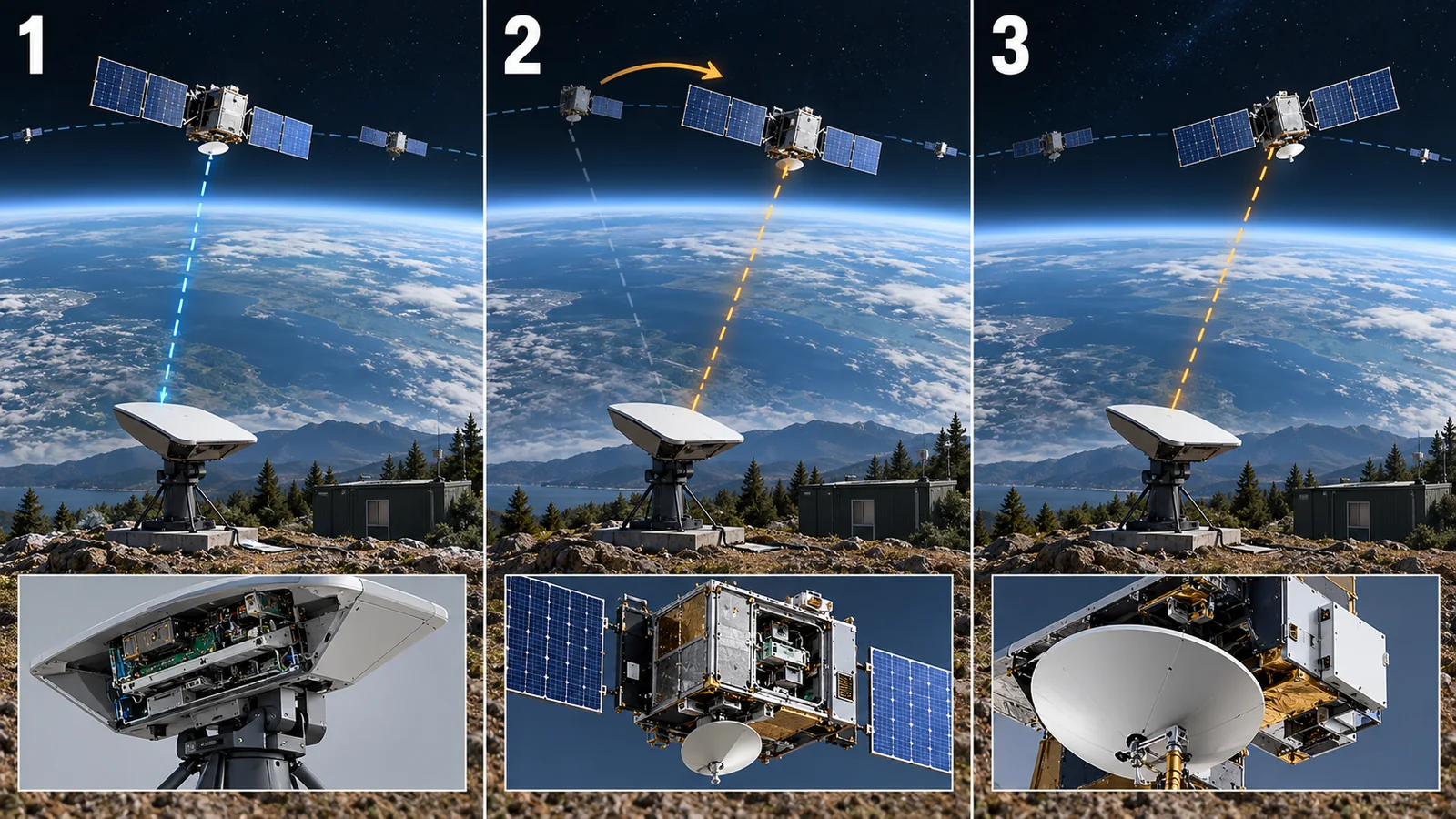
Start with an analogy. A person walking at night can see the road only under street lamps. If lamps are far apart there are dark stretches. Place them close enough that the next one is visible and the dark stretches vanish. A low-orbit satellite is a moving street lamp: they are arranged so that as one passes overhead the next one appears. Limit of the analogy: lamps stand still, but satellites move at about 7.6 km/s and the ground terminals keep switching to other satellites.
View original SVG, values and sources
Original SVG reference: Conceptual diagram (vector drawing). Top: schematic of a ground user and three satellites (not to scale). Bottom: how long each satellite is visible above 25 degrees elevation.
The "elevation angle" is the angle at which you look up at a satellite, with the horizon at 0 degrees and straight up at 90. At low elevation buildings and hills block the view, so ground terminals normally use only satellites above some angle, for example 25 degrees. In the FCC grant for SpaceX Gen2, the minimum elevation of W-band earth stations is given as 10, 20 and 25 degrees depending on satellite altitude Sourced [ref. 1]. We use 25 degrees as an example and calculate that a satellite passing straight overhead at 550 km is visible for at most about 4.5 minutes Our calculation.
The number of satellites is a design value set by service scale, altitude, frequency and user count; by itself it does not decide quality. Covering the whole Earth once needs only hundreds (Chapter 3), but communication used by many people at once needs far more because each satellite has limited capacity. An authorised number is a ceiling and does not equal the number actually launched (Chapter 5).
3. Altitude, period and satellite count: worked numbers
Altitude fixes the time of one lap (the period): the lower the faster. In our calculation the period is about 91 minutes at 340 km, about 96 minutes at 550 km, about 127 minutes at 2,000 km and about 24 hours at geostationary altitude (~35,786 km) Our calculation. A geostationary orbit matches Earth's rotation, so the satellite seems to stand still.
Real altitudes differ by system. The SpaceX Gen2 system authorised by the FCC on 9 January 2026 comprises 15,000 satellites in shells (orbital layers) at 340, 345, 350, 355, 360, 365, 475, 480 and 485 km, and satellites at the older 525, 530 and 535 km are to be lowered into the new shells Sourced [ref. 1]. Kuiper planned 3,236 satellites — 784, 1,296 and 1,156 at 590, 610 and 630 km — and was authorised on 30 July 2020 Sourced [ref. 2]. Planet's Earth-observation satellites, the Doves, fly in a sun-synchronous orbit at 525 km (inclination 98 degrees) and circle the Earth in about 90 minutes (per Planet) Sourced [ref. 6].
Next, how many satellites does it take, at the very least, to cover the Earth? The area one satellite can serve grows with altitude. At 550 km and above 25 degrees elevation, one satellite covers a circle of radius about 940 km (about 2.78 million km²). Dividing Earth's area, about 511 million km², by this gives about 184 satellites. The same calculation gives about 414 at 340 km and about 29 at 2,000 km Our calculation.
A higher orbit needs fewer satellites, but radio weakens with distance and the signal takes longer. In our calculation the one-way radio time to a satellite straight overhead is about 1.8 milliseconds at 550 km and about 119 ms at geostationary altitude. A relay between ground station and user via the satellite (four legs including up and down) takes about 7 ms at 550 km and about 480 ms at geostationary altitude Our calculation. ITU also notes that lower altitudes can reduce signal delay Sourced [ref. 4]. The trade is that lower orbits need more satellites, while re-entry comes sooner.
4. Two uses: communication and observation
(1) Communication: user terminals, satellites and gateway stations
A communication constellation consists of user terminals at homes and so on, the satellites, and gateways (ground stations) that connect satellites to the internet. In the FCC grant, Kuiper is described as a system that includes gateway earth stations, customer terminals and satellite control facilities alongside the satellites Sourced [ref. 2]. Optical links between satellites are covered in the next explainer. The SpaceX Gen2 grant covers fixed-satellite service (FSS) and also mobile-satellite service (MSS) and supplemental coverage from space (SCS) for handsets Sourced [ref. 1].
(2) Observation: many small satellites on a sun-synchronous orbit
For observation, Planet's Dove is a 3U CubeSat (a standard small-satellite size) measuring 10 cm × 10 cm × 30 cm that takes images at 3 m resolution. The company says it launched 88 satellites (Flock 3P) in February 2017 and 48 (Flock 2K) in July 2017 and achieved near-daily imaging of all landmasses, and has since replenished the fleet with new flocks several times a year (company description) Sourced [ref. 6]. To image all land almost daily, a sun-synchronous orbit passes over the same place at the same local time, and the number of satellites shortens the revisit interval. The definition of resolution is in the explainer on remote sensing and SAR.
5. Frequencies and orbit authorisation: ITU and FCC
Radio crosses borders, so frequencies and satellite orbits are managed by two layers: an international framework and national authorisations. The Radio Regulations of ITU (the International Telecommunication Union, a United Nations agency) form the international framework, and national regulators (the FCC in the United States) license their own operators. Here we give document numbers and dates. No advice on whether or how to obtain authorisation is given.
As the chart shows, SpaceX Gen2 spans the Ku band (10.7-12.7 GHz downlink and others), Ka, V, E and W bands, while Kuiper uses the Ka band (17.7-18.6 and 18.8-20.2 GHz downlink and 27.5-30.0 GHz uplink) Sourced [ref. 1, 2]. In general, higher frequencies offer wider bandwidth but are more affected by rain (commentary).
- Deployment milestones (ITU Resolution 35): WRC-19 (2019) set a staged scheme for non-geostationary (NGSO) systems: 10% two years after the end of the period for bringing frequencies into use, 50% after five years, and the full system after seven. It aims to prevent paper registrations (spectrum "warehousing") and make the international register reflect real deployment. WRC-23 revised Resolution 35 and added provisions on changes after the milestones Sourced [ref. 5, 4]
- Orbit tolerances (Resolution 8): WRC-23 set how to treat differences between declared and observed orbits. The FCC grant for SpaceX requires satellites counted toward a milestone to stay within +/-30 km in altitude and +/-2 degrees in inclination Sourced [ref. 4, 1]
- Protecting other systems (Resolution 76): WRC-23 revised the limits (EPFD: equivalent power flux density) on the combined interference from many NGSO satellites to geostationary networks. The FCC granted SpaceX a waiver of the EPFD limits for operations inside the US Sourced [ref. 4, 1]
- FCC authorisations and deadlines: FCC 20-102 (30 July 2020) required Kuiper to launch and operate 50% by 30 July 2026 and the rest by 30 July 2029, and to show compliance or notify non-compliance by 14 August 2026. How that deadline was later treated could not be confirmed in the primary sources checked. FCC DA 26-36 (9 January 2026) requires 50% of SpaceX Gen2 by 1 December 2028 and the rest by 1 December 2031 Sourced [ref. 2, 1]
In FCC DA 26-36, of SpaceX's application for 29,988 satellites, 15,000 were authorised and a decision on the other 14,988 was deferred Sourced [ref. 1]. Authorisations carry deadlines (milestones) and conditions, and the authorised number may be reduced if conditions are not met (wording of FCC 20-102) Sourced [ref. 2]. Authorised, launched and operating counts are different numbers. As of the check date, ESA's model estimates about 11,300 active payloads in all orbits (reference epoch 1 February 2026), and in 2025 alone there were more than 300 launches and more than 4,000 new payloads reached orbit Sourced [ref. 7, 8].
6. Lifetime and re-entry: the five-year rule
A low-orbit satellite slowly loses altitude to the drag of thin air; the lower, the denser the air and the faster the fall. This is used to bring a retired satellite back and avoid leaving debris, which is the basis of disposal. In an order adopted on 29 September 2022 (FCC 22-74), the FCC adopted a rule that spacecraft ending their mission in, or passing through, low orbit (below 2,000 km) must re-enter within five years of end of mission, shortening the earlier 25-year benchmark. It applies to satellites launched after 29 September 2024 Sourced [ref. 3].
The FCC defines end of mission as the point at which the satellite can no longer perform collision-avoidance manoeuvres; a satellite that can manoeuvre is deemed to have zero collision risk under the rules Sourced [ref. 3, 1]. FCC DA 26-36 makes SpaceX report the number of satellites that failed to dispose and the total years failed satellites remain in orbit (object-years), and sets a condition that no more satellites may be deployed if failures exceed 100 post-failure object-years. The FCC records that SpaceX reported 6 disposal failures in the first year of its first-generation system and 2 in the first year of Gen2 Sourced [ref. 1].
ESA's 2026 report says that in 2025 more than three intact satellites or rocket bodies re-entered every day on average while about ten new payloads were launched daily. In addition to the IADC (Inter-Agency Space Debris Coordination Committee) guideline of up to 25 years, ESA cut its own 2023 standard to under five years (and a collision probability under 10⁻³), binding ESA projects only Sourced [ref. 7, 8, 13]. ESA also says congestion is highest in the band of manoeuvrable satellites at 400-600 km, where coordination between satellites matters Sourced [ref. 7].
The time to fall by drag depends strongly on altitude and on the satellite's mass and area. ESA's report says that 88-99% of satellites under 1,000 kg that reached end of mission since 2020 are in orbits that naturally decay within 25 years, but meeting a five-year benchmark means more satellites must actively lower their orbit Sourced [ref. 7]. And a satellite that fails and cannot move cannot avoid others either (the idea behind the FCC's "object-years").
7. What happens at re-entry: a materials view
A satellite entering the atmosphere is heated by friction with air, mostly melts and vaporises, and only some tough parts may reach the ground. ESA's 2026 report added a new metric of the risk of casualties from fragments surviving re-entry and says the probability, though low compared with everyday risks, has risen with more re-entries Sourced [ref. 8]. Apart from ground risk, the fate of the vaporised material matters from a materials viewpoint.
Using molecular dynamics, Ferreira and co-workers estimated that when a satellite with an aluminium structure re-enters, a 250 kg satellite can yield about 30 kg of aluminium-oxide nanoparticles that may persist for decades. They estimate about 17 tonnes from all satellites re-entering in 2022 and over 360 tonnes a year in mega-constellation scenarios, and note that aluminium oxide can act as a catalyst for chlorine activation that depletes ozone Sourced [ref. 10]. This is a model estimate, not a measurement.
Murphy and co-workers showed by analysing stratospheric sulfuric-acid particles that metals from re-entry are actually present. More than 20 elements were detected in ratios consistent with spacecraft alloys, and the amounts of Li, Al, Cu and Pb exceeded the cosmic-dust influx. About 10% of sulfuric-acid particles over 120 nm contained aluminium and other elements. They write that planned satellite growth could put metals in up to half of such particles, and that the influence of this metal content on stratospheric aerosol is unknown Sourced [ref. 9].
What is known is that metals from re-entry are present in stratospheric particles (observation). What is not known is how large their effect on ozone or climate is. The simulation indicates how much aluminium oxide forms and its potential for ozone depletion, but does not include real atmospheric chemistry. Both are peer-reviewed papers, but more research is needed before conclusions (Inference).
8. A materials engineer's view
Spacecraft materials were traditionally chosen to survive launch and operation. With re-entry within five years assumed, it also becomes a design condition that the craft reliably melts and leaves no large fragments. ESA's report notes that constellations use design-for-demise approaches, in which parts are designed to burn up, and targeted re-entry strategies Sourced [ref. 7]. Ferreira and co-workers' estimate, however, shows another issue: the aluminium structure itself becomes a source of oxide particles. Materials that melt easily and burn up and materials that emit no particles may not be achievable together (Inference). This article does not rank specific materials.
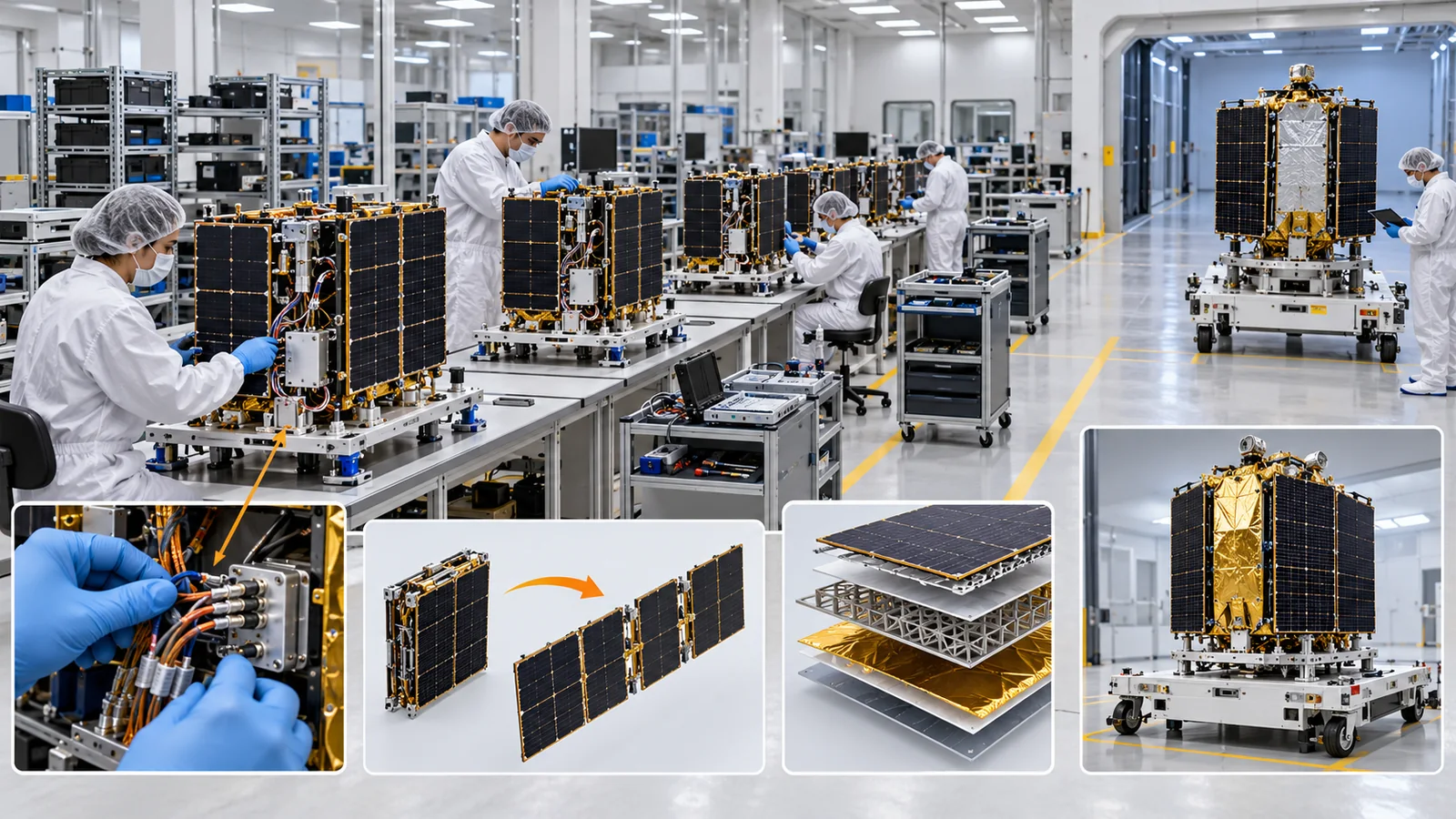
Building hundreds to tens of thousands of satellites means that materials per unit are chosen not only for performance but for manufacturing reproducibility, yield and cost. ESA's report describes constellations growing, with more than 4,000 new payloads reaching orbit in more than 300 launches in 2025 Sourced [ref. 7, 8]. The more units of one design are built, the more lot-to-lot differences and variation in bonding, soldering and surface treatment appear as a count of failures (Inference). This article gives no figures for specific manufacturing methods, because none could be confirmed.
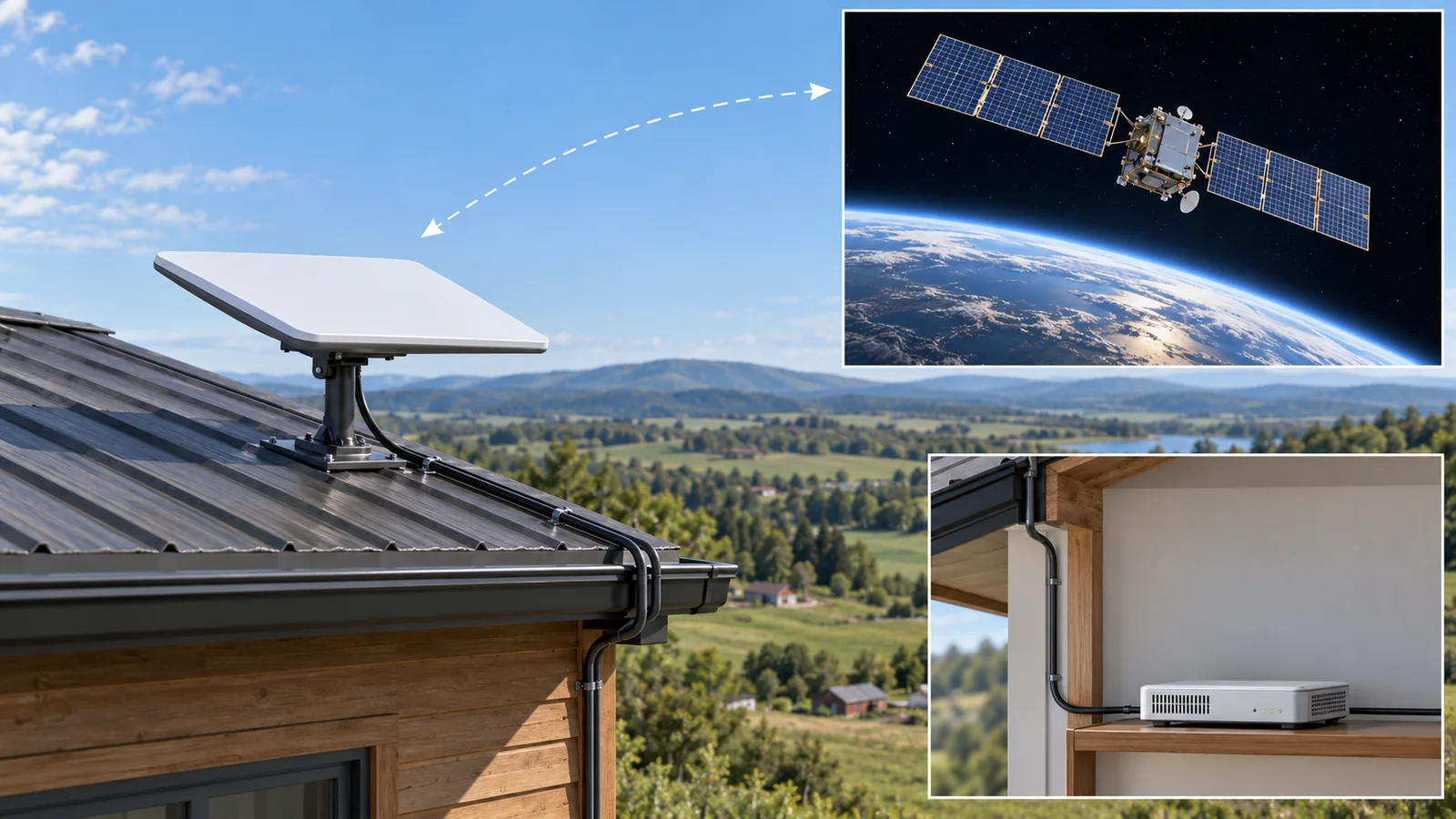
Low shells such as 340-365 km still hold thin air, and satellite surfaces are exposed to fast-hitting air molecules and atomic oxygen. For low-orbit satellites, both surface degradation of materials and the propulsion needed to hold altitude affect the design. Of the "five enemies" in our explainer on the space environment and materials, number four, atomic oxygen and ultraviolet light, grows here. Lowering a constellation toward the 340 km range, as the FCC authorised, therefore also changes the materials' service environment (Inference). Specific degradation amounts were not in the primary sources checked and could not be confirmed.
9. How to read the yardsticks and standards
The yardsticks of a constellation appear more in authorisation conditions and end-of-life treatment than in performance figures. Read four things: (1) how many satellites are authorised and what share must be deployed by when (authorisation and deadlines), (2) how interference is avoided (frequency), (3) how many years until the satellite comes down after end of mission (disposal), and (4) what comes out at re-entry (environmental effect). Each standard or rule applies in its own scope.
| What is assessed | Typical method or document (name, source) | Standards, guidance and rules | Reading notes |
|---|---|---|---|
| Count and deployment deadlines | FCC authorisations (Gen2: 15,000, 50% by 2028-12-01, 100% by 2031-12-01 / Kuiper: 3,236, 50% by 2026-07-30, 100% by 2029-07-30) Sourced | FCC DA 26-36 (9 January 2026), FCC 20-102 (30 July 2020), ITU Resolution 35 (WRC-19, revised at WRC-23) [ref. 1, 2, 4, 5] Sourced | Authorised count is a ceiling, not deployed count. Treatment after a deadline (extension, waiver) can change |
| Frequency and interference | Frequency tables in grants and limits such as EPFD (with a waiver example inside the US) Sourced | ITU Radio Regulations, Resolution 76 (revised at WRC-23), Resolution 8 (orbit tolerances) [ref. 4] Sourced | A waiver applies only to that case and region. Texts not checked |
| Post-mission disposal | Re-entry within five years of end of mission in low orbit (FCC) Sourced. ESA: under five years + collision probability under 10⁻³ (ESA projects only) Sourced | FCC 22-74 [ref. 3] / ISO 24113:2023 (Edition 4, May 2023; to be revised) [ref. 11] / ECSS-U-AS-10C Rev.2 (adoption notice of ISO 24113, 9 February 2024) [ref. 14] / IADC-02-01 Rev. 4 (posted 22 January 2025) [ref. 13] Sourced | The FCC rule is a US licensing condition. ISO, ECSS and IADC are requirements or guidance whose force depends on adoption. The text of ISO 24113 was not checked |
| Orbit-lifetime estimation | Methods that estimate years to decay from atmospheric density, solar activity and the area-to-mass ratio | ISO 27852:2024 "Space systems — Estimation of orbit lifetime" (Edition 3, February 2024) [ref. 12] Sourced | Estimates depend on atmosphere and solar-activity assumptions (ESA's report also notes they are estimates) |
| Collision avoidance and conjunctions | The grant requires reports of conjunctions, manoeuvres, disposal failures and the 100 object-year limit Sourced. ESA's report publishes conjunction statistics each year | Not found (no international collision-avoidance standard number was checked here) [ref. 1, 7] | Notification thresholds (such as probability limits) differ by operator |
| Ground risk and atmospheric effect of re-entry | ESA's report adds a new ground-casualty metric. Murphy et al. (observation), Ferreira et al. (simulation) Sourced | Not found (no standard for assessing atmospheric effects was found) [ref. 8, 9, 10] | Research is ongoing and the size of the effect is not settled |
| Plans and deployed counts | Operators' plans and applications (e.g. SpaceX orbital data center, up to one million satellites, accepted 4 February 2026) Not yet confirmed | Not found (no standard) | Application, acceptance, authorisation, launch and operation are separate stages |
The arrangement of this table is Our calculation (organisation only). FCC, ITU and ESA items were checked in each document, ISO items on ISO pages, ECSS items in the ECSS list and IADC items on the IADC public-documents list (checked 17 October 2026). The texts of standards and rules were not checked. No legal advice is given.
Reading notes for materials engineers
- Authorisation, deployment and operation differ: the authorised count (a ceiling), the launched count and the operating count are different numbers. Check the conditions (deadlines, reporting) too.
- Rules, standards and guidance differ in force: the FCC five-year rule is a US licence condition, the ESA standard binds ESA projects only, and the IADC guidelines are non-binding agreements. Check which document and which edition any "compliance" refers to.
- Simulation and observation differ: the amount of aluminium oxide from re-entry is an estimate, while the presence of metals in the stratosphere is observed. Neither fixes the size of the effect.
- Plans are not achievements: applications, acceptances and planned deadlines are not settled facts.
10. Glossary
- Constellation
- A group of satellites cooperating to provide one service.
- Low Earth orbit (LEO)
- In ITU's description, an orbit a few hundred to about 2,000 km up.
- Geostationary orbit (GEO)
- About 35,786 km up; appears fixed in the sky.
- NGSO (non-geostationary orbit)
- Non-geostationary orbit; covers low- and medium-orbit systems.
- Sun-synchronous orbit
- An orbit that passes over a place at the same local time; suited to observation.
- Shell
- A layer of many orbits at the same altitude and inclination.
- Inclination
- The angle of the orbital plane against the equator.
- Orbital period
- The time to complete one lap.
- Elevation angle
- The angle at which a satellite is seen, horizon 0 degrees and zenith 90.
- Handover
- A ground terminal switching to the next satellite.
- Gateway
- A ground station linking satellites to terrestrial networks.
- CubeSat
- A small-satellite standard size built on a 10 cm cube, called 1U.
- ITU
- The International Telecommunication Union, the UN agency that sets the international Radio Regulations.
- WRC (World Radiocommunication Conference)
- A conference held about every four years to revise the Radio Regulations.
- FCC (Federal Communications Commission)
- The US regulator that licenses spectrum and satellite communication.
- FSS / MSS / SCS
- Fixed-satellite service / mobile-satellite service / supplemental coverage from space.
- EPFD (equivalent power flux density)
- A measure of the interference many NGSO satellites cause at geostationary receivers.
- Milestone
- The share of satellites that must be deployed by a deadline to keep an authorisation or frequency right.
- Waiver
- An exemption from part of a rule for a specific case.
- End of mission
- In the FCC definition, the point at which a satellite can no longer manoeuvre to avoid collisions.
- Object-years
- Years that failed satellites remain in orbit, summed over all of them.
- Debris
- Retired satellites and rocket stages, and their fragments.
- IADC
- The Inter-Agency Space Debris Coordination Committee of space agencies, which issues debris-mitigation guidelines.
- Design for demise
- Choosing parts and materials so a craft burns up reliably on re-entry.
11. References
- FCC Space Bureau DA 26-36 "Authorization and Order" (SpaceX second-generation Starlink; granted in part, deferred in part; 9 January 2026) — docs.fcc.gov/public/attachments/DA-26-36A1.txt
- FCC FCC 20-102 "Order and Authorization" (Kuiper Systems authorization; 30 July 2020) — docs.fcc.gov/public/attachments/FCC-20-102A1.pdf
- FCC FCC 22-74 "Second Report and Order" (orbital debris; disposal in low orbit within five years; adopted 29 September 2022) — docs.fcc.gov/public/attachments/FCC-22-74A1.pdf
- ITU "Non-geostationary satellite systems" (backgrounder; last update October 2026) — itu.int/en/mediacentre/backgrounders/…/Non-geostationary-satellite-systems.aspx
- ITU "ITU Members agree to new milestones for non-geostationary satellite deployment" (on the WRC-19 decision; January 2020) — itu.int/hub/2020/01/itu-members-agree-to-new-milestones…
- Planet Labs "PlanetScope" (Planet documentation; company material; checked 17 October 2026) — docs.planet.com/data/imagery/planetscope/
- ESA Space Debris Office "ESA's Annual Space Environment Report", Issue 10.1 (8 September 2026; data to the end of 2025) — sdo.esoc.esa.int/environment_report/Space_Environment_Report_latest.pdf
- ESA "ESA Space Environment Report 2026" (summary page) — esa.int/Space_Safety/Space_Debris/ESA_Space_Environment_Report_2026
- Murphy D. M. et al. "Metals from spacecraft reentry in stratospheric aerosol particles", Proc. Natl. Acad. Sci. USA 120 (2023), DOI 10.1073/pnas.2313374120 — doi.org/10.1073/pnas.2313374120
- Ferreira J. P. et al. "Potential Ozone Depletion From Satellite Demise During Atmospheric Reentry in the Era of Mega-Constellations", Geophys. Res. Lett. 51 (2024), DOI 10.1029/2024GL109280 — doi.org/10.1029/2024GL109280
- ISO ISO 24113:2023 "Space systems — Space debris mitigation requirements" (Edition 4, May 2023; to be revised) — iso.org/standard/83494.html
- ISO ISO 27852:2024 "Space systems — Estimation of orbit lifetime" (Edition 3, February 2024) — iso.org/standard/85364.html
- IADC IADC public documents list: IADC-02-01 "Space Debris Mitigation Guidelines" Rev. 4 (posted 22 January 2025) — iadc-home.org/documents_public/view/id/318
- ECSS "List of published ECSS Standards (long)" (ECSS-U-AS-10C Rev.2 and others; checked 17 October 2026) — ecss.nl/list-of-published-ecss-standards-long
12. Claim-to-source audit
| Claim in the text | Basis | Type |
|---|---|---|
| FCC DA 26-36 (9 January 2026): SpaceX Gen2 15,000 satellites, shells (340-485 km), move from 525/530/535 km, 50% by 2028-12-01 and 100% by 2031-12-01, disposal-failure reports (6 in the first year of Gen1, 2 for Gen2), 100 object-years, EPFD waiver, frequency tables, application for 29,988 with the other 14,988 deferred | Text of the FCC authorisation and order Reference 1 https://docs.fcc.gov/public/attachments/DA-26-36A1.txt | Sourced |
| FCC 20-102 (30 July 2020): Kuiper 3,236 satellites, 590/610/630 km (784/1,296/1,156), frequencies, 50% by 2026-07-30 and 100% by 2029-07-30, report by 14 August 2026 | Text of the FCC order Reference 2 https://docs.fcc.gov/public/attachments/FCC-20-102A1.pdf | Sourced |
| FCC 22-74 (adopted 29 September 2022): re-entry within five years of end of mission in low orbit (below 2,000 km), applying to satellites launched after 29 September 2024, definition of end of mission | Text of the FCC order Reference 3 https://docs.fcc.gov/public/attachments/FCC-22-74A1.pdf | Sourced |
| ITU: low-orbit altitudes (a few hundred to about 2,000 km), WRC-19 staged milestones (10% at 2 y, 50% at 5 y, 100% at 7 y), WRC-23 revisions of Resolutions 35, 8 and 76, lower altitude can reduce delay | ITU backgrounder and 2020 news article Reference 4 https://itu.int/en/mediacentre/backgrounders/Pages/Non-geostationary-satellite-systems.aspx Reference 5 https://www.itu.int/hub/2020/01/itu-members-agree-to-new-milestones-for-non-geostationary-satellite-deployment/ | Sourced |
| Planet Dove: 3U (10×10×30 cm), 3 m resolution, 525 km, sun-synchronous, 98 degrees, about 90 minutes, 88 + 48 satellites in 2017 for near-daily land imaging | Planet documentation (company description) Reference 6 https://docs.planet.com/data/imagery/planetscope/ | Sourced |
| ESA 2026: over 300 launches and 4,000 new payloads in 2025, about 10 launches and over 3 re-entries daily, about 11,300 active payloads (1 February 2026), ESA's five-year standard, IADC's 25 years, congested band (400-600 km), share naturally decaying within 25 years (88-99%), new ground-risk metric | ESA report and summary page Reference 7 https://www.sdo.esoc.esa.int/environment_report/Space_Environment_Report_latest.pdf Reference 8 https://www.esa.int/Space_Safety/Space_Debris/ESA_Space_Environment_Report_2026 Reference 13 https://iadc-home.org/documents_public/view/id/318 | Sourced |
| Murphy et al. (2023): stratospheric particle observations; Ferreira et al. (2024): 250 kg gives about 30 kg, about 17 t in 2022, over 360 t a year, ozone potential | Abstracts of peer-reviewed papers Reference 9 https://doi.org/10.1073/pnas.2313374120 Reference 10 https://doi.org/10.1029/2024GL109280 | Sourced |
| Numbers, titles and status of ISO 24113:2023, ISO 27852:2024, ECSS-U-AS-10C Rev.2 and IADC-02-01 Rev. 4 | ISO, ECSS and IADC pages Reference 11 https://www.iso.org/standard/83494.html Reference 12 https://www.iso.org/standard/85364.html Reference 14 https://ecss.nl/list-of-published-ecss-standards-long/ Reference 13 https://iadc-home.org/documents_public/view/id/318 | Sourced |
| Periods and speeds (340-35,786 km), per-satellite coverage and minimum counts (414, 230, 184, 148, 57, 29), at most about 4.5 minutes overhead, one-way and relay times of radio | Our calculation (Python; circular orbit, Earth radius 6,378 km, 25 degrees elevation) | Our calculation |
| Treatment of Kuiper after its 30 July 2026 deadline, whether the FCC granted the SpaceX orbital-data-center application, an international collision-avoidance standard number, a standard for assessing atmospheric effects of re-entry, and the actual operating count of each system | Not confirmed within the scope of this article's survey, so not stated (commentary) | Explanation |
| The readings and explanations "more satellites does not mean better performance", "authorisation, deployment and operation differ", "low orbit does not always mean natural decay" and "easy melting versus emitting no particles" | This article's own organisation of the published material | Explanation |
Last updated 17 October 2026. Sources are limited to primary material (FCC orders and grants, official material of ITU, ESA, Planet, ISO, ECSS and IADC, and peer-reviewed papers). Operators' plans are written as plans and no operator is ranked. The numerical examples are explanatory calculations, not design values of real systems. Treatment of Kuiper after its deadline, whether the SpaceX orbital-data-center application was granted, an international collision-avoidance standard and a standard for assessing atmospheric effects of re-entry could not be confirmed and are not stated. The figures are conceptual diagrams or drawings including our calculations; Figs. 1 and 9 are AI-image frames (images not yet placed). No legal advice is given.