TECHNOLOGY EXPLAINER
Lunar Exploration and Artemis
— Half a century after Apollo: what has been achieved, and where the "plan" begins (checked 17 October 2026)
The Artemis program has seen its schedule move many times and was reorganized substantially in 2026. For materials engineers with little background in spaceflight, this article lays out, with dates, (1) the history of lunar exploration from Apollo to today, (2) the flights Artemis has achieved (Artemis I in 2022, Artemis II in April 2026) and what is still planned, (3) landers (HLS and CLPS), (4) how Gateway is treated and (5) the Moon Base plan.
Plans (Artemis III onward, the Moon Base and lander schedules) are treated as Not yet confirmed and are not mixed with achieved facts. NASA plans to present an update on 23 October 2026, so note that things may change after the check date of 17 October.
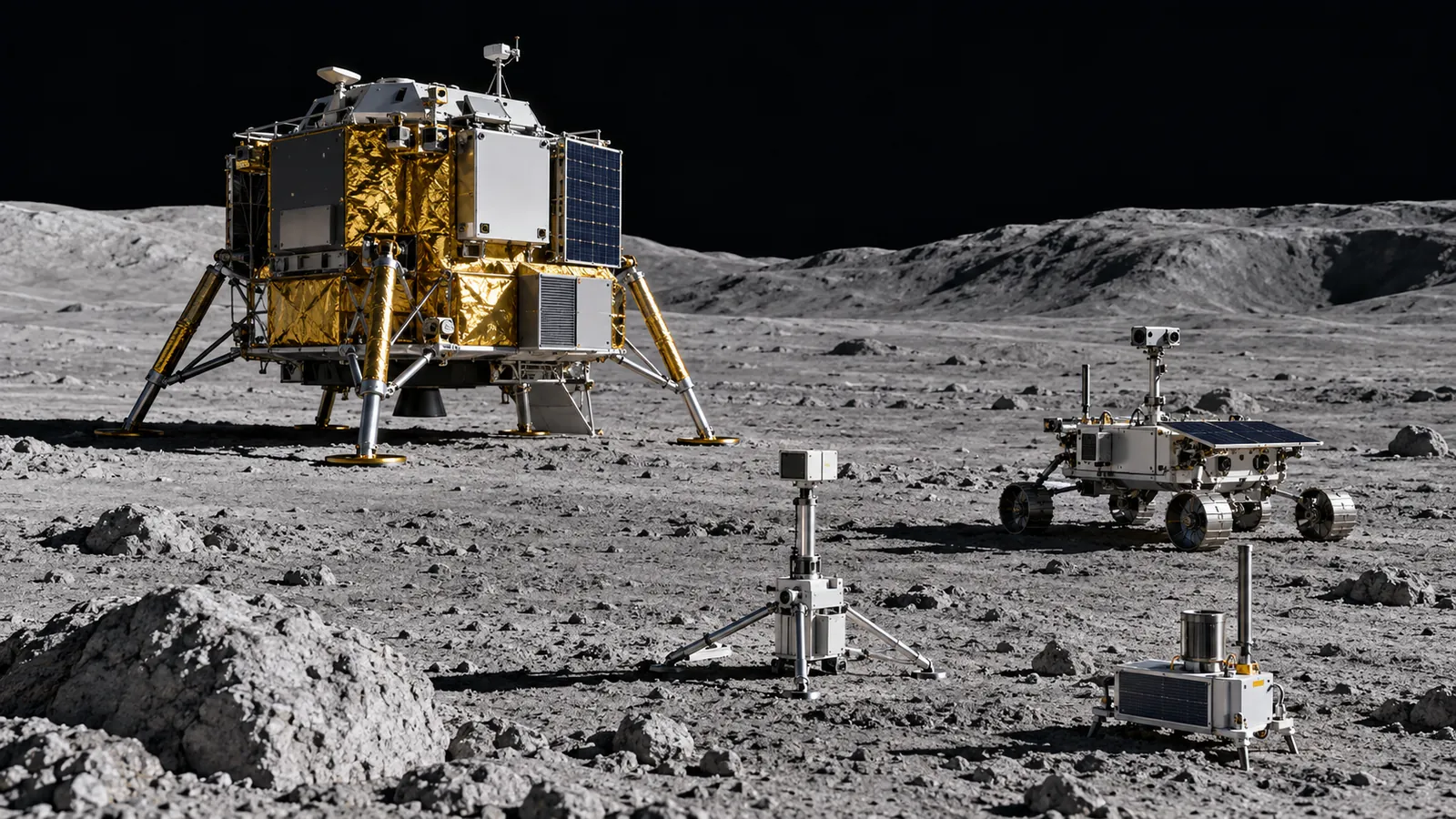
- Summary / before you read / place in the series
- History of lunar exploration: Apollo and after
- Landings today: nations and companies
- How Artemis works
- Artemis record and plans, with dates
- Landers: HLS and CLPS
- The treatment of Gateway
- The Moon Base plan
- A materials engineer's view, and what could not be confirmed
- How to read the yardsticks / glossary / references / audit
Sourced = stated in a published source (linked)
Our calculation = a value this article organized or converted from stated assumptions
Not yet confirmed = plans, targets and schedules that are not yet confirmed
Interpretation is marked commentary and inference is shown in bold.
This field changes fast, and dates come from official NASA pages as of the check date (17 October 2026). Flights achieved are written as record and everything else as plans and targets. The history of delays and changes is limited to what official sources state. Dates are quoted as the sources give them, since a landing date can differ by a day by time zone.
1. Summary / before you read / place in the series
- Half a century after Apollo, crewed landings had stopped at six: six pairs of astronauts landed in 1969-1972, and Apollo brought back 382 kg of samples. [Ref. 10, 12] Artemis is the program to resume them.
- Achieved so far are Artemis I (2022, uncrewed) and Artemis II (April 2026, a crewed lunar flyby): no flight has yet put people on the surface. In NASA's sources Artemis III (2027) is a low-Earth-orbit test and the first landing is Artemis IV in early 2028 (target). [Ref. 1, 2, 3, 4, 5]
- Plans move: on 27 February 2026 NASA turned Artemis III from a landing into an orbital test and presented a lunar-base plan called Moon Base. NASA's FY2027 budget request says Gateway (a space station around the Moon) will transition to support development of the lunar base camp, but the final treatment, including appropriations, could not be confirmed. [Ref. 5, 16, 26]
All you need is the common knowledge that the Moon orbits the Earth and that Apollo astronauts landed on it. Rocket and orbit terms are explained where used. The idea of an orbit (falling while moving sideways) is in the series articles on in-space manufacturing and microgravity and on rocket fundamentals.
This is the background for the articles on lunar resources and ISRU and on national space strategies and regulation. Thermal protection at re-entry is treated in the thermal-protection article and reusable rockets in the reusable-rocket article.
2. History of lunar exploration: Apollo and after
NASA's timeline (NSSDCA) runs from the Soviet Luna 1 flyby in 1959 through the US Ranger, Surveyor and Lunar Orbiter craft and the Soviet Luna and Zond craft. Landers include Luna 9, launched in January 1966, and the US Surveyor 1 (May 1966). [Ref. 13] Then came the Apollo program.Sourced
| Item | Apollo (as stated by NASA) | Source |
|---|---|---|
| First crewed landing | Apollo 11: launched 16 July 1969; lunar landing on 20 July | [Ref. 13, 25] |
| Number of landings | Six pairs landed in 1969-1972 (Apollo 13 aborted its landing) | [Ref. 10, 13] |
| Last landing | Apollo 17: launched 7 December 1972, returned 19 December; more than 73 hours on the surface | [Ref. 11, 13] |
| Samples returned | 382 kg, about 2,200 samples, six sites; about 300 g from three Soviet automated craft | [Ref. 12] |
| Afterward | In NASA's timeline there is no lander entry after 1976 (Luna 24) until 2013 (Chang'e 3) | [Ref. 13] |
Sourced "No entry" in the last row is our reading of what the timeline lists (commentary).
In its Moon Base material NASA writes that Apollo proved humans could reach the Moon, explore its surface and return safely, but that those missions were brief and reached only a small part of the lunar surface. Artemis aims to change this from brief expeditions to sustained exploration. [Ref. 17]Sourced
What this check confirmed is only that the timeline's lander entries break off. Why (budget, priorities, politics and so on) is not stated in the primary sources checked, and this article does not give reasons.
3. Landings today: nations and companies
Since the 2010s China, India, Japan and US companies have been sending landers and sample-return craft to the Moon. Success or failure of each landing is a separate story per vehicle. The table gives what could be confirmed.Sourced
| Mission | Operator | What was confirmed (as stated) | Source |
|---|---|---|---|
| Chang'e 3 and 4 | China | Chang'e 3: lander and rover launched 1 December 2013. Chang'e 4: far-side lander and rover launched 7 December 2018 | [Ref. 13] |
| Chang'e 5 | China | Sample return launched 23 November 2020. A lead-lead age of 2,030 ± 4 million years for the returned basalt extends lunar volcanism by about 800-900 million years | [Ref. 13, 22] |
| Chang'e 6 | China | Launched 3 May 2024. A paper states it successfully completed the first robotic sample return from the far side | [Ref. 13, 23] |
| Chandrayaan-3 | India (ISRO) | Soft-landed on 23 August 2023 | [Ref. 20] |
| SLIM | Japan (JAXA) | Landed 20 January 2024 at 0:20 JST. The attitude differed from plan, solar cells could not generate power and it was shut down about 2.6 hours later. Reached a point about 55 m east of the target; accuracy before obstacle avoidance was about 10 m or less | [Ref. 21] |
| Four CLPS craft | Four US companies | Peregrine (launched 8 January 2024, no landing), IM-1 (landed 22 February), Blue Ghost 1 (landed 2 March 2025), IM-2 (landed 6 March 2025) | [Ref. 15] |
Sourced The time until SLIM shut down is our calculation from 0:20 to 2:57 JST (Our calculation).
Israel's Beresheet (2019), Russia's Luna 25 (2023), landers of Japan's ispace and others have also been launched, but their outcomes could not be confirmed within this check, so they are not described (NASA's timeline lists only launch dates). [Ref. 13]
"Landed" means the vehicle reached the ground, which is not the same as continuing to operate. SLIM could not generate power because its attitude differed from plan, yet JAXA assessed that the pinpoint-landing demonstration within 100 m had been achieved. [Ref. 21] The same word "landing" is judged differently depending on the goal.
4. How Artemis works
Artemis chains three kinds of vehicles. (1) SLS (Space Launch System): the heavy rocket, which NASA describes as the only one that can send Orion, crew and cargo directly to the Moon in a single launch. (2) Orion: the spacecraft that carries four crew to lunar orbit and back; it is described as the only spacecraft able to return crews to Earth at lunar re-entry velocity. (3) HLS (Human Landing System): the lander that docks with Orion in lunar orbit and takes two crew to the surface and back. [Ref. 3, 4]Sourced
Giving the Earth-return spacecraft (Orion) the power to land on and lift off from the Moon would make it heavy and large. So the round-trip spacecraft and a dedicated lander are separated, with a transfer in lunar orbit. It is like splitting a long-distance train from a small cable car that shuttles to a mountain station (limit of the analogy: unlike a cable car, a lander carries propellant and descends and ascends under its own power).
5. Artemis record and plans, with dates
(1) Flights achieved
Artemis I: an uncrewed test flight launched on 16 November 2022 and splashed down on 11 December (25 days 10 hours 53 minutes). Orion traveled 268,563 miles from Earth and 43,471 miles beyond the far side of the Moon. [Ref. 1] Artemis II: launched on 1 April 2026 and splashed down on 10 April (9 days 1 hour 32 minutes), carrying three NASA astronauts and one Canadian Space Agency astronaut around the Moon and back. NASA calls it the first crewed lunar flyby in 50 years. [Ref. 2]Sourced
(2) The change of plan on 27 February 2026
On 27 February 2026 NASA announced that it was raising mission cadence, standardizing the SLS configuration and adding a mission. Artemis III became a mid-2027 test in low Earth orbit: Orion launched with crew will test rendezvous and docking with one or both of the commercial landers from SpaceX and Blue Origin. The first landing is Artemis IV, targeted for early 2028, a target described as in place since mid-2025. Artemis V is anticipated for late 2028 and is described as when Moon Base building begins. NASA also dropped plans to use the Exploration Upper Stage and Mobile Launcher 2 because of development delays. [Ref. 5, 6]SourcedNot yet confirmed
For Artemis II, a helium flow issue was found in the upper stage during pre-launch tests in February, and the rocket was rolled back to the assembly building for repairs; the launch therefore took place in April. [Ref. 5] According to a 14 October 2026 advisory, NASA will present on 23 October how Artemis III and the 2028 landing are progressing. [Ref. 8] These schedules can change after the check date.SourcedNot yet confirmed
NASA's 13 October 2026 report says stacking of the Artemis III solid rocket boosters is complete, all four RS-25 engines are installed on the core stage, and the crew (NASA's Randy Bresnick, Frank Rubio and Andre Douglas and ESA's Luca Parmitano) continues training. [Ref. 7] Earlier target dates were not checked in this article.Sourced
(3) A materials story: what Orion's heat shield showed at re-entry
Returning from the Moon, Orion hits the Earth's atmosphere at tremendous speed. According to NASA's 15 October 2026 analysis, Artemis II's Orion reached 39 times the speed of sound at most, with outer temperatures above 4,000 F (about 2,200 C), while the cabin stayed in the mid-70s F (about 24 C). The heat shield is made of 186 blocks of Avcoat, an "ablator" that carries heat away as it burns. Because the Artemis I heat shield showed loss of charred material at 103 spots, NASA investigated with ground arc-jet tests and, for Artemis II, changed the re-entry path to shorten the downrange distance. Char loss fell to nine spots, and cracking and char loss fell by a factor of ten, NASA says. [Ref. 9]SourcedOur calculation
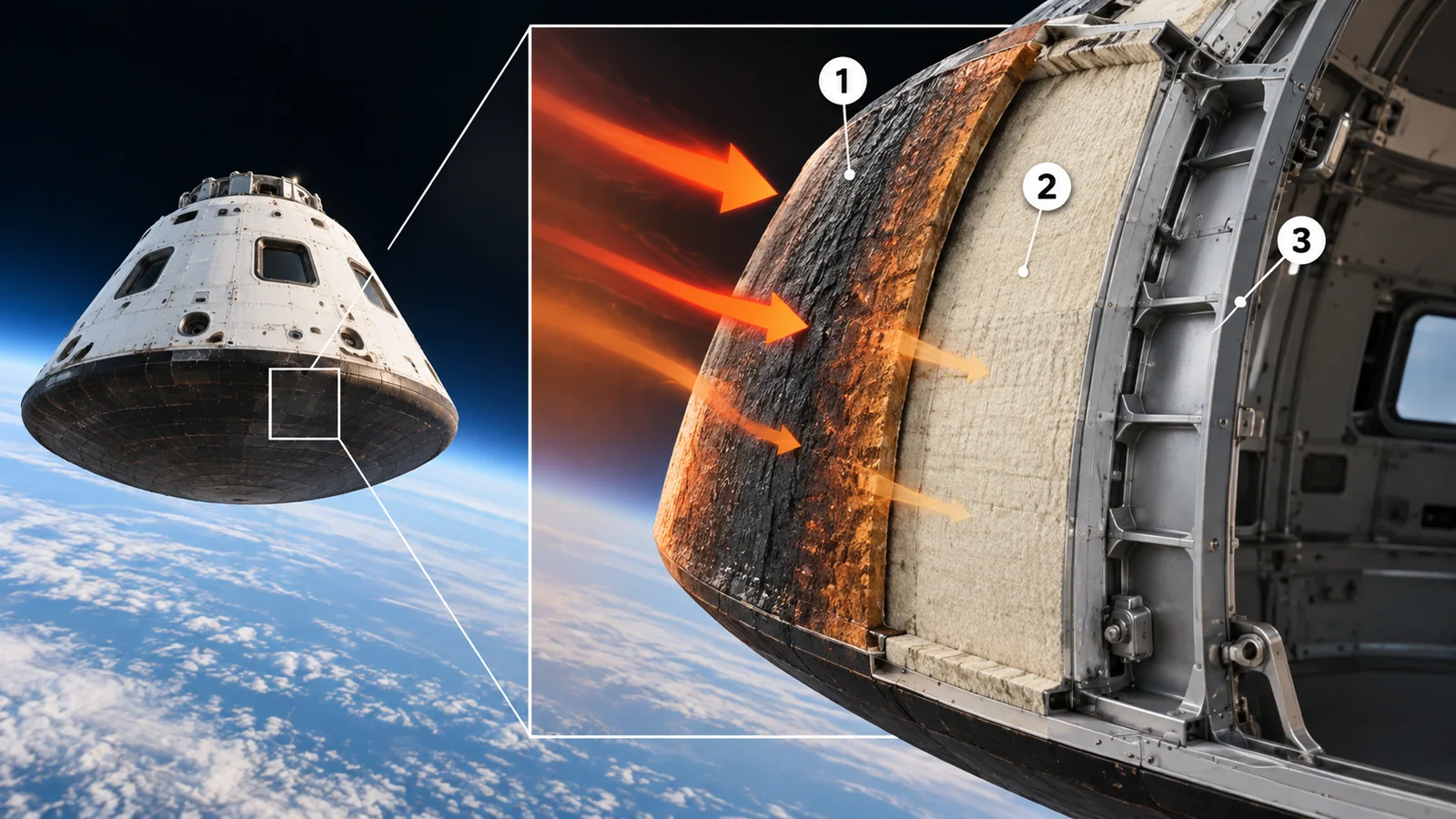
View original SVG, values and sources
Original SVG reference: Figure including our calculation (vector drawing). Left: spots of char loss reported by NASA (103 and 9). Right: key Artemis II re-entry figures as stated by NASA. Celsius values are our conversion.
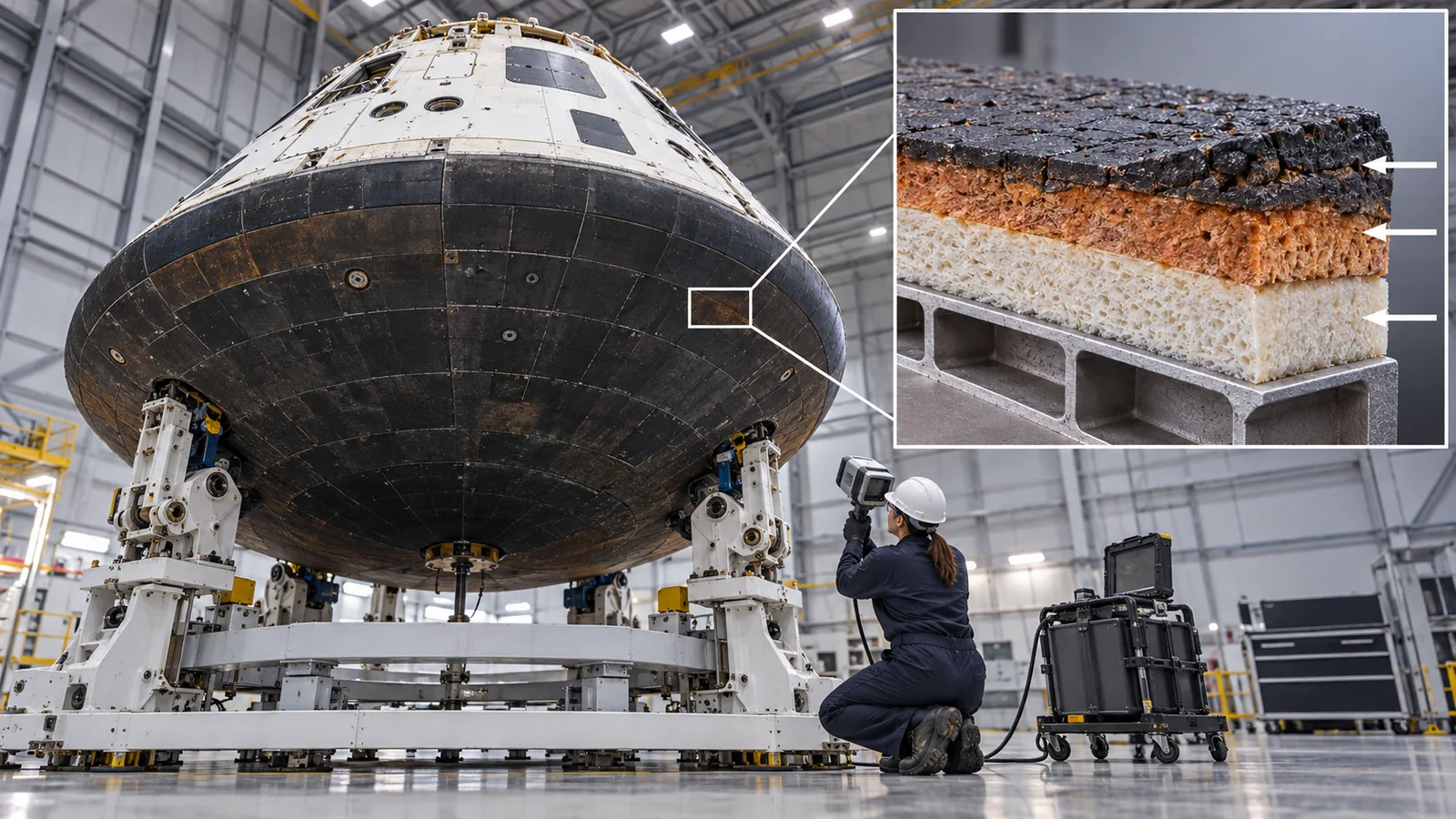
NASA says it upgraded the Artemis III heat shield to achieve uniformity and consistent permeability of the Avcoat blocks and attached it in July 2026. [Ref. 9] It is a clear example of the materials-development loop: find the cause by ground tests, confirm in flight and return to design (our commentary).Sourced
Correctly: Artemis II was a flight around the Moon and back, not a landing. In NASA's plan Artemis III (docking tests in low Earth orbit, 2027) comes in between, and the landing is Artemis IV (early 2028 is the target). [Ref. 2, 3, 4, 5] The landing date can change with the readiness of the landers.
6. Landers: HLS and CLPS
Vehicles that land on the Moon fall into two families. HLS is the lander that carries people, and NASA is developing it with two US companies (SpaceX and Blue Origin). On Artemis III one or both will be tested in low Earth orbit for docking. Which lander goes down on Artemis IV depends on lander readiness, NASA says. [Ref. 3, 5] The other, CLPS (Commercial Lunar Payload Services), is the scheme that carries NASA science and technology payloads to the Moon on commercial landers. NASA has awarded 17 deliveries to five vendors, carrying more than 60 instruments; the maximum combined contract value is $2.6 billion through November 2028. NASA writes that it accepts that failures could occur as a risk. [Ref. 14]Sourced
In NASA's Moon Base material, upcoming landers include Blue Origin's Blue Moon MK1 (Endurance, which will attempt a landing on the Shackleton Connecting Ridge near the south pole), Voyager Technologies' Griffin-1 (planned to launch in late 2026, carrying an Astrolab rover), Intuitive Machines' IM-3 (the Reiner Gamma magnetic anomaly) and Firefly's Blue Ghost 2 (the far side). [Ref. 16, 18] All are plans and dates are not fixed.SourcedNot yet confirmed
7. The treatment of Gateway
Gateway is a small space station orbiting the Moon, including parts such as the HALO habitation and logistics module. NASA's Gateway page (updated 23 July 2026) says it is being built with international and commercial partners and shows launch as "no earlier than 2027," while carrying a note that the website is being updated to align with the latest plans announced in February and March. [Ref. 19] The summary of NASA's April 2026 FY2027 budget request says a 2025 law (the Working Families Tax Cut Act) added $1.8 billion for up to two additional SLS flights beyond Artemis III and for Gateway, and says the agency "will transition" Gateway "to support development of the lunar base camp." [Ref. 26] NASA's August 2026 Moon Base item likewise says Northrop Grumman's lunar-surface technology demonstrations repurpose power and avionics hardware developed for Gateway's HALO, describing this as following a "shift from an orbital-focused lunar strategy to one centered on surface operations." [Ref. 16] The 27 February 2026 Artemis update and the Artemis III and IV pages, on the other hand, do not mention Gateway (within what we checked).SourcedNot yet confirmed
Correctly: NASA's FY2027 request says "transition," the Moon Base item says "repurposed," and the Gateway page shows "no earlier than 2027." Within this check the final treatment, including budgets set by Congress, cannot be stated for certain. Check primary sources and dates before reading a headline of either "cancelled" or "continuing." [Ref. 19, 16, 26]
8. The Moon Base plan
In March 2026 NASA presented a plan to build a Moon Base, humanity's first lunar outpost, near the lunar south pole. According to the FAQ, the base will proceed in phases: Phase One (to 2029) uses more than 20 robotic landings to explore the south pole region and test technology; Phase Two (2029-2032) begins deploying foundational power, communications, transport and logistics; Phase Three (from 2032) combines habitats and other systems toward an enduring human presence. [Ref. 17, 18] As reasons for the south pole NASA cites that its ancient terrain preserves a record of the early solar system and that water ice and other frozen materials may help future explorers. [Ref. 17] All of this is plan and target.SourcedNot yet confirmed
"Water ice exists" does not mean "usable amounts are known." NASA's FAQ also says only that the region "may contain resources." Lunar resources and their use (ISRU) are treated in the series article on lunar resources and ISRU, with stages (concept, ground test, lunar demonstration) kept apart.
9. A materials engineer's view, and what could not be confirmed
Orion's heat shield shows the materials-development loop clearly: char loss found on Artemis I was investigated with ground arc-jet tests, improved by changing how the material is used (the re-entry path) rather than the material itself, confirmed in flight, and then block uniformity was raised for Artemis III. [Ref. 9] Another lesson is that a phenomenon invisible in ground tests appeared in actual flight (our commentary).
NASA's Moon Base FAQ lists radiation and space weather, extreme temperatures, lunar dust and communications disruptions among lunar hazards. [Ref. 17] Northrop Grumman's demonstrations will test "survive-the-night" systems that endure multi-day shadow periods and shared surface power. [Ref. 16] The difficulty of selecting materials that withstand temperature swings, dust, vacuum and radiation and of qualifying them on the ground is treated in the series articles on the space environment and its effects on materials and on how to read space-materials evaluations (our commentary).
The 382 kg of Apollo samples are still used in research. [Ref. 12] The paper says the precise lead-lead age of 2,030 ± 4 million years for Chang'e-5 basalt provides a calibration point for the crater-counting method of estimating ages. [Ref. 22] Unlike rocks on Earth, lunar samples are valuable above all because the collection site is known (our commentary).
What could not be confirmed
- The content of NASA's 23 October 2026 update (after the check date); schedules for Artemis III onward may change
- The detailed history of target dates for landings and missions before then (within NASA's sources: the early-2028 target since mid-2025, the February 2026 reorganization and the February 2026 rollback of Artemis II)
- The final treatment of Gateway (NASA's FY2027 request says "transition" and the Moon Base item "repurposed," but the decision including appropriations could not be confirmed)
- The outcomes of Beresheet, Luna 25, ispace landers and others (only launch dates were confirmed)
- The mass of samples returned by Chang'e 6 and detailed results (a paper says only that it completed the first robotic far-side sample return)
- The current test progress of the two HLS vehicles (NASA's sources go only as far as saying it depends on readiness)
- The detailed scientific results of Artemis II (NASA has released a preliminary report, but this article keeps to dates and the heat shield)
Summary
Apollo made six landings in 1969-1972, after which NASA's timeline has no lander entries until 2013. Today China, India, Japan, US companies and others are landing and returning samples. Artemis has achieved Artemis I in 2022 and Artemis II in April 2026, but no flight has yet put people on the surface. Artemis III (2027) is a low-Earth-orbit test and the first landing is targeted for Artemis IV in early 2028; these are unconfirmed plans. NASA's sources point to Gateway being transitioned or repurposed (the final treatment is unconfirmed), and NASA has presented a plan to build the Moon Base near the south pole in phases.
10. How to read the yardsticks and standards
The yardsticks of lunar exploration are easier to see if split into four: did the flight succeed, did the landing succeed, did the materials work as designed, and was the plan kept. Checked on 17 October 2026.
| What is evaluated | Typical test or evaluation method (name, source) | Standard or guideline (name, edition, source checked) | How to read it |
|---|---|---|---|
| Flight achievement | Launch and splashdown dates and duration on NASA mission pages (Artemis I: 25 d 10 h 53 min; Artemis II: 9 d 1 h 32 min). [Ref. 1, 2]Sourced | NPR 8705.2C "Human-Rating Requirements for Space Systems" (effective 10 July 2017, expires 16 December 2028; certification process for crewed space systems). [Ref. 24]Sourced | A procedure mandatory for NASA employees, not legally binding on the public. The outcome of certification itself was not checked here |
| Heat shield | Post-flight visual and underwater imagery, X-ray and laser scans, ground arc-jet tests (NASA Ames) and counts of char-loss spots (103 to 9). [Ref. 9]Sourced | not found | The result changed with the re-entry path even for the same design. Ground test values and flight results differ |
| Landing accuracy and success | SLIM: reached a point about 55 m east of the target; accuracy before obstacle avoidance about 10 m or less. CLPS: landed or did not land. [Ref. 21, 15]Sourced | not found | "Landing" success differs from "mission accomplished." Look at what the goal was |
| Quality of samples | Lead-lead age measurement (Chang'e 5: 2,030 ± 4 million years); curation and distribution of samples (NASA's lunar sample laboratory). [Ref. 22, 12]Sourced | not found | The value is knowing the site. Read ages with their measurement uncertainty |
| Reliability of plans | NASA update announcements (27 February 2026; one planned for 23 October) and the "target" on each mission page. [Ref. 5, 8]SourcedNot yet confirmed | not found | Schedules are targets and can change. Look at the check date and the source's update date |
The arrangement of the table is Our calculation (organization). No applicable ASTM standard was found.
Reading notes (for materials engineers)
- Separate record from plan: Artemis I and II are achieved; III onward are plans. Check which one a headline "back on the Moon" refers to.
- Ground tests and flight differ: NASA says the Orion heat shield fell within what ground tests predicted, yet Artemis I showed a phenomenon not seen in ground tests.
- Company targets and NASA announcements: lander timings listed as "planned" on NASA pages are still company plans and are not fixed.
11. Glossary
- Artemis program
- NASA's lunar exploration program to send people back to the Moon and sustain exploration.
- SLS (Space Launch System)
- NASA's heavy rocket that sends Orion and crew to the Moon.
- Orion
- The spacecraft carrying four crew to lunar orbit and back.
- HLS (Human Landing System)
- A crewed lander that goes from lunar orbit to the surface and back.
- CLPS (Commercial Lunar Payload Services)
- A scheme that carries NASA payloads to the Moon on commercial landers.
- Gateway
- A small space station planned to orbit the Moon.
- HALO
- Gateway's Habitation and Logistics Outpost module.
- Moon Base
- The lunar outpost NASA plans to build near the south pole.
- Lunar south pole region
- A region with the Sun near the horizon and many shadows; water ice is a subject of discussion.
- Low Earth orbit (LEO)
- An orbit near the Earth; the place of the Artemis III test.
- Docking
- Joining of two spacecraft.
- Re-entry
- Flight from space back into the atmosphere with strong aerodynamic heating.
- Ablator (Avcoat)
- A heat-shield material whose surface burns and erodes to carry heat away; Avcoat is used on Orion.
- Arc-jet testing
- A ground test that blows a hot gas stream made by an electric arc over a material.
- Char loss
- Loss of the charred layer of an ablator.
- Sample return
- Bringing samples of the Moon or other bodies back to Earth.
- Far side
- The hemisphere of the Moon never seen from Earth; relay satellites support communications.
- Soft landing
- Reaching the surface without a crash.
- Pinpoint landing
- The ability to land close to a target (within 100 m for SLIM).
- NPR 8705.2C
- NASA's document on human-rating certification requirements for crewed space systems.
12. References
- NASA Artemis I (mission page: 16 November to 11 December 2022, 25 days 10 hours 53 minutes) — www.nasa.gov/mission/artemis-i/
- NASA Artemis II (mission page: launched 1 April 2026, splashdown 10 April, 9 days 1 hour 32 minutes) — www.nasa.gov/mission/artemis-ii/
- NASA Artemis III (mission page: 2027, low-Earth-orbit demonstration, four crew) — www.nasa.gov/mission/artemis-iii/
- NASA Artemis IV (mission page: early 2028, crewed landing, about a week) — www.nasa.gov/mission/artemis-iv/
- NASA NASA Strengthens Artemis: Adds Mission, Refines Overall Architecture (dated 3 March 2026; announced 27 February) — www.nasa.gov/directorates/esdmd/nasa-strengthens-artemis-adds-mission-refines-overal
- NASA NASA Outlines Preliminary Artemis III Mission Plans (Artemis III as a low-Earth-orbit test) — www.nasa.gov/missions/artemis/artemis-3/nasa-outlines-preliminary-artemis-iii-missio
- NASA NASA Completes Artemis III Booster Stacking, Shares Status Update (13 October 2026; Artemis III crew) — www.nasa.gov/blogs/missions/2026/10/13/nasa-completes-artemis-iii-booster-stacking-s
- NASA NASA to Discuss Artemis Acceleration, Status of Upcoming Moon Missions (media advisory, 14 October 2026; briefing on 23 October) — www.nasa.gov/news-release/nasa-to-discuss-artemis-acceleration-status-of-upcoming-mo
- NASA Rigorous Analysis Confirms NASA's Artemis II Heat Shield Performance (15 October 2026) — www.nasa.gov/missions/artemis/artemis-2/rigorous-analysis-confirms-nasas-artemis-ii-
- NASA The Apollo Program (six pairs of astronauts landed from 1969 to 1972) — www.nasa.gov/the-apollo-program/
- NASA Apollo 17 (last crewed landing; more than 73 hours on the surface) — www.nasa.gov/mission/apollo-17/
- NASA (Lunar Sample Laboratory) Lunar Samples (Apollo: 382 kg and about 2,200 samples over six flights; three Soviet automated craft: about 300 g) — curator.jsc.nasa.gov/lunar/
- NASA (NSSDCA) Lunar Exploration Timeline (updated 10 July 2025) — nssdc.gsfc.nasa.gov/planetary/lunar/lunartimeline.html
- NASA Commercial Lunar Payload Services (CLPS: 17 deliveries, 5 vendors, 60+ instruments, $2.6 billion maximum; updated 6 July 2026) — www.nasa.gov/commercial-lunar-payload-services/
- NASA Timeline of Past and Future CLPS Deliveries (July 2025: results of Peregrine, IM-1, Blue Ghost 1 and IM-2) — www.nasa.gov/wp-content/uploads/2025/07/clps-timeline-graphic-1.pdf
- NASA NASA Provides Updates on Moon Base Cargo Landers, Tech Demonstrations (4 August 2026; repurposing of Gateway HALO hardware) — www.nasa.gov/missions/moon-base/nasa-provides-updates-on-moon-base-cargo-landers-tec
- NASA Moon Base: Frequently Asked Questions (phase periods, south pole, March 2026 Ignition Day) — www.nasa.gov/moon-base-frequently-asked-questions/
- NASA Moon Base Phases (list of Phase One assets; Griffin-1 planned for late 2026) — www.nasa.gov/moonbase-phases/
- NASA Gateway (page updated 23 July 2026: launch "no earlier than 2027", note that the website is being updated) — www.nasa.gov/gateway/
- ISRO Chandrayaan-3 (mission page: soft-landed on 23 August 2023) — www.isro.gov.in/Chandrayaan3.html
- JAXA Outcome for the Smart Lander for Investigating Moon (SLIM)'s Moon Landing (25 January 2024) — global.jaxa.jp/press/2024/01/20240125-1_e.html
- Nature Li Q.-L. et al. "Two-billion-year-old volcanism on the Moon from Chang'e-5 basalts" (2021, DOI 10.1038/s41586-021-04100-2) — doi.org/10.1038/s41586-021-04100-2
- Space: Science & Technology "Mission Orbit Design for the First-Ever Lunar Far-Side Sample Return Mission" (4 August 2026, DOI 10.34133/space.0502; Chang'e-6) — spj.science.org/doi/10.34133/space.0502
- NASA NPR 8705.2C "Human-Rating Requirements for Space Systems" (effective 10 July 2017, expires 16 December 2028) — nodis3.gsfc.nasa.gov/displayDir.cfm?t=NPR&c=8705&s=2C
- NASA Apollo 11 (mission page: lunar landing of 20 July 1969) — www.nasa.gov/mission/apollo-11/
- NASA FY 2027 Budget Request: Agency Fact Sheet (April 2026: budgets for FY2025, FY2026 and FY2027; says Gateway will transition to support development of the lunar base camp) — www.nasa.gov/wp-content/uploads/2026/04/fiscal-year-2027-agency-fact-sheet.pdf
13. Claim-to-source audit
| Claim in the text | Basis | Type |
|---|---|---|
| Artemis I: launched 16 November 2022, splashdown 11 December, 25 days 10 hours 53 minutes, uncrewed; 268,563 miles from Earth and 43,471 miles beyond the far side | NASA Artemis I page Reference 1 https://www.nasa.gov/mission/artemis-i/ | Sourced |
| Artemis II: launched 1 April 2026, splashdown 10 April, 9 days 1 hour 32 minutes, four crew (Wiseman, Glover, Koch, Hansen), crewed lunar flyby | NASA Artemis II page Reference 2 https://www.nasa.gov/mission/artemis-ii/ | Sourced |
| Artemis III: 2027, low-Earth-orbit demonstration, four crew. Artemis IV: early 2028, crewed landing, about a week near the south pole, two crew descend | NASA Artemis III and IV pages Reference 3 https://www.nasa.gov/mission/artemis-iii/ Reference 4 https://www.nasa.gov/mission/artemis-iv/ | SourcedNot yet confirmed |
| The 27 February 2026 update: a new mission added, Artemis III as a mid-2027 low-orbit test, Artemis IV landing target of early 2028 (target since mid-2025), Artemis V in late 2028 and the start of Moon Base, dropping of the Exploration Upper Stage and Mobile Launcher 2, the February helium issue and rollback of Artemis II | NASA announcement Reference 5 https://www.nasa.gov/directorates/esdmd/nasa-strengthens-artemis-adds-mission-refines-overall-architecture/ | SourcedNot yet confirmed |
| Outline of the Artemis III plan (orbital test) | NASA item Reference 6 https://www.nasa.gov/missions/artemis/artemis-3/nasa-outlines-preliminary-artemis-iii-mission-plans/ | SourcedNot yet confirmed |
| Progress of Artemis III assembly (13 October 2026) and crew (Bresnik, Rubio, Douglas, Parmitano) | NASA blog Reference 7 https://www.nasa.gov/blogs/missions/2026/10/13/nasa-completes-artemis-iii-booster-stacking-shares-status-update/ | Sourced |
| NASA plans to present a plan update on 23 October 2026 | NASA media advisory (14 October) Reference 8 https://www.nasa.gov/news-release/nasa-to-discuss-artemis-acceleration-status-of-upcoming-moon-missions/ | Not yet confirmed |
| Heat shield: 39 times the speed of sound, above 4,000 F, mid-70s F inside, 186 Avcoat blocks, about 1,300 backshell tiles, path change, char loss 103 to 9 spots, cracking and loss reduced by a factor of ten, Artemis III upgrade (uniformity and permeability) | NASA analysis (15 October 2026) Reference 9 https://www.nasa.gov/missions/artemis/artemis-2/rigorous-analysis-confirms-nasas-artemis-ii-heat-shield-performance/ | Sourced |
| Apollo: six pairs landed (1969-1972) | NASA Apollo program page Reference 10 https://www.nasa.gov/the-apollo-program/ | Sourced |
| Apollo 17: 19 December, more than 73 hours on the surface; Apollo 11: landing of 20 July | NASA Apollo 17 and 11 pages Reference 11 https://www.nasa.gov/mission/apollo-17/ Reference 25 https://www.nasa.gov/mission/apollo-11/ | Sourced |
| Apollo samples 382 kg, about 2,200 samples, six sites; about 300 g from three Soviet automated craft | NASA lunar sample laboratory Reference 12 https://curator.jsc.nasa.gov/lunar/ | Sourced |
| Lunar exploration timeline (launch dates): Luna 9 (January 1966), Apollo 11 (16 July 1969), Apollo 17 (7 December 1972), Luna 24 (August 1976), Chang'e 3 (1 December 2013), Chang'e 4 (7 December 2018), Chang'e 5 (23 November 2020), Chang'e 6 (3 May 2024), the lander gap of 1976-2013 | NASA NSSDCA timeline (updated 10 July 2025) Reference 13 https://nssdc.gsfc.nasa.gov/planetary/lunar/lunartimeline.html | Sourced |
| CLPS: 17 deliveries, 5 vendors, 60+ instruments, $2.6 billion maximum through November 2028, failures accepted as a risk | NASA CLPS page Reference 14 https://www.nasa.gov/commercial-lunar-payload-services/ | Sourced |
| CLPS results: Peregrine (8 January 2024, no landing), IM-1 (landed 22 February), Blue Ghost 1 (landed 2 March 2025), IM-2 (landed 6 March) | NASA CLPS deliveries timeline Reference 15 https://www.nasa.gov/wp-content/uploads/2025/07/clps-timeline-graphic-1.pdf | Sourced |
| Moon Base landers: Blue Moon MK1, Griffin-1 (late 2026), IM-3, Blue Ghost 2; more than 20 landings in Phase One; repurposing of Gateway HALO power and avionics; the "shift from orbital-focused to surface-centered" | NASA Moon Base item (August 2026) and Phase page Reference 16 https://www.nasa.gov/missions/moon-base/nasa-provides-updates-on-moon-base-cargo-landers-tech-demonstrations/ Reference 18 https://www.nasa.gov/moonbase-phases/ | SourcedNot yet confirmed |
| Moon Base: near the south pole, three phases (to 2029 / 2029-2032 / from 2032), March 2026 Ignition Day, radiation, temperature and dust hazards | NASA Moon Base FAQ Reference 17 https://www.nasa.gov/moon-base-frequently-asked-questions/ | SourcedNot yet confirmed |
| Summary of NASA's FY2027 budget request (April 2026): FY2025 $24.8 billion, FY2026 $24.4 billion (PL 119-74), FY2027 request $18.8 billion; the Working Families Tax Cut Act adding $1.8 billion for additional SLS flights and Gateway; Gateway to "transition to support development of the lunar base camp" | NASA FY2027 budget request fact sheet Reference 26 https://www.nasa.gov/wp-content/uploads/2026/04/fiscal-year-2027-agency-fact-sheet.pdf | SourcedNot yet confirmed |
| Gateway page: updated 23 July 2026, launch "no earlier than 2027," note that the website is being updated, international partners | NASA Gateway page Reference 19 https://www.nasa.gov/gateway/ | SourcedNot yet confirmed |
| Chandrayaan-3: soft-landed on 23 August 2023 | ISRO page Reference 20 https://www.isro.gov.in/Chandrayaan3.html | Sourced |
| SLIM: landed 20 January 2024 at 0:20 JST, about 55 m east, accuracy of 10 m or less, the within-100 m demonstration achieved, no power generation and shutdown at 2:57 | JAXA release (25 January 2024) Reference 21 https://global.jaxa.jp/press/2024/01/20240125-1_e.html | Sourced |
| Chang'e-5 basalt: lead-lead age of 2,030 ± 4 million years, extending lunar volcanism by about 800-900 million years | Li et al. (Nature, 2021) Reference 22 https://doi.org/10.1038/s41586-021-04100-2 | Sourced |
| Chang'e 6: the first robotic sample return from the far side (as stated in the paper) | Space: Science & Technology (August 2026) Reference 23 https://spj.science.org/doi/10.34133/space.0502 | Sourced |
| NPR 8705.2C: human-rating requirements, effective 10 July 2017, expires 16 December 2028 | NASA NODIS Reference 24 https://nodis3.gsfc.nasa.gov/displayDir.cfm?t=NPR&c=8705&s=2C | Sourced |
| °F to °C conversions, the time until SLIM shutdown (about 2.6 hours), the charts | Our calculation | Our calculation |
| Analogies such as "what landing means" and "why change vehicles," the materials engineer's views, the evaluation table layout, reading notes and the side-by-side summary of sources | Commentary in this article | Commentary |
| Reasons for the lander gap after 1976, the history of target dates before mid-2025, the final treatment of Gateway, outcomes of Beresheet, Luna 25 and ispace, the mass of Chang'e-6 samples, the 23 October 2026 update, ASTM standards | This article does not state them (could not be confirmed, or after the check date) | Commentary |
| Figures 1 and 6 are frames for AI-generated images; Figures 2-5 and 7-9 are conceptual diagrams or our own charts | Note by this article | Commentary |
Last updated: 17 October 2026. Sources are limited to primary materials (official NASA pages and releases, ISRO, JAXA, peer-reviewed papers). The final treatment of Gateway (including appropriations), the history of target dates before mid-2025, the outcomes of Beresheet, Luna 25 and ispace, the mass of Chang'e-6 samples, NASA's 23 October 2026 update and ASTM standards could not be confirmed (or are after the check date) and are not stated. Artemis III onward, the Moon Base and company lander plans are unconfirmed plans. All figures are conceptual diagrams or our own charts.