TECHNOLOGY EXPLAINER
Microgravity Drug Research and Protein Crystallization
— How far experiments growing crystals in space have been confirmed, and where the "not yet" begins
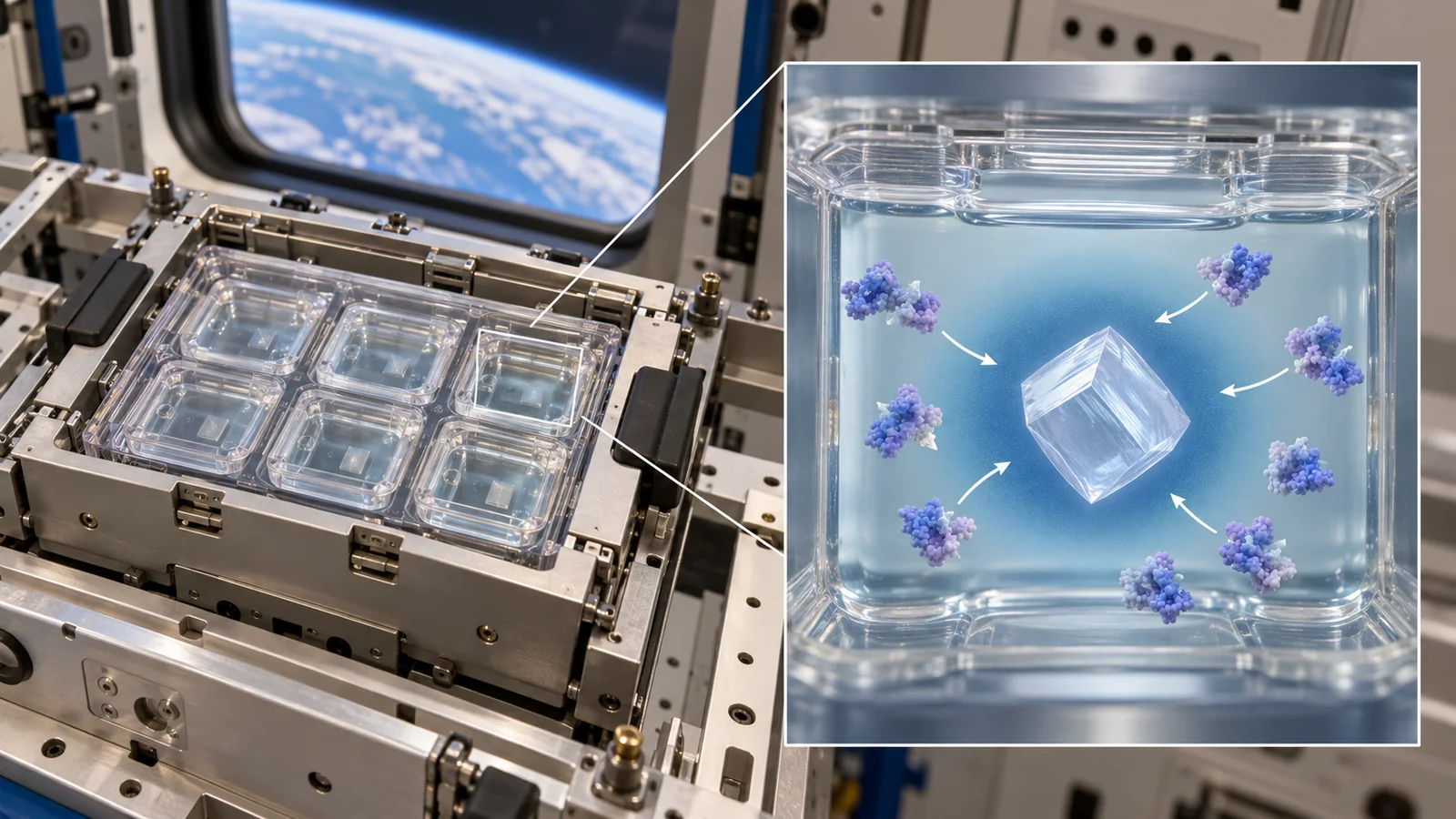
The phrase "making drugs in space" is heard more often, but it mixes three different stories: (1) research that grows protein crystals in space to study their structure (with about 40 years of history); (2) work on making crystals of the drug itself in space; and (3) demonstrations of re-entry capsules that bring orbital processing back to Earth. For materials engineers, this article separates the three and explains what papers and official sources have confirmed.
This article does not assert the efficacy or value of any drug and gives no medical advice. It says nothing about whether any particular drug works or is safe. It distinguishes the stage of research and demonstration (concept, ground test, ISS, free-flyer and recovery, clinical, routine operation) and treats company statements as company claims. Facts were checked on 17 October 2026.
- Summary / before you read / place in the series
- Why crystals are needed: two purposes
- What happens around a crystal in microgravity
- History and results: what about 40 years of experiments showed
- Linking to drug discovery: from structure to drug candidates
- Making crystals of the drug itself in space
- Where re-entry-capsule manufacturing stands
- A materials engineer's view, and what could not be confirmed
- How to read the yardsticks / glossary / references / audit
Sourced = stated in a published source (linked)
Our calculation = a value this article organized or computed from stated assumptions
Not yet confirmed = plans, targets and schedules that are not yet confirmed
Interpretation is marked commentary and inference is shown in bold.
No medical advice, no assertions on the efficacy or safety of drugs, and no assessments of companies or investment advice. Clinical-trial results are stated only as facts in company releases, without interpretation. Crystal quality and particle size are matters of materials, separate from effects on patients.
1. Summary / before you read / place in the series
- "Drugs in space" means three different things: structural analysis of protein crystals (about 40 years), crystals of the drug itself (a few ISS cases) and re-entry capsule demonstrations (since 2024). Their stages differ greatly and should not be mixed.
- It works, but not always: in JAXA's well-optimized experiments crystal quality improved in about 70% of cases and did not in about 30%. [Ref. 2] A 2000 US National Research Council assessment found the impact on structural biology "extremely limited." [Ref. 2]
- No example of established manufacturing was found: a drug approved or sold using space-made crystals could not be confirmed. Capsule re-entry and recovery have been repeated, but results of drug processing could not be confirmed apart from one non-peer-reviewed preprint. [Ref. 8, 9]
A "crystal" is a solid in which atoms or molecules are arranged regularly; think of grains of salt or sugar. Proteins also form crystals under the right conditions. When X-rays hit a crystal they are scattered in regular directions (diffraction), and the pattern lets one compute where the atoms are. The physics of microgravity (free fall, the loss of convection) is explained in the series article "In-Space Manufacturing and Microgravity."
This is the article to read after "In-Space Manufacturing and Microgravity." Continuing from ZBLAN and semiconductors, it deals with experiments on more delicate materials, biomolecules and drugs. The mechanics of re-entry (thermal protection) and re-entry licensing are covered in the series articles on thermal protection systems and on national space strategies and regulation.
2. Why crystals are needed: two purposes
(1) Purpose A: to learn the structure of a protein
Inside the body, proteins work as "parts" such as enzymes and receptors. Many drugs are molecules that bind to a specific spot on a protein and change how it works. If the shape of the lock (the protein) is known, it is easier to design a fitting key (a drug candidate molecule); that is the idea behind structure-based drug design (limit of the analogy: not every drug is found this way). The standard way to learn that shape at atomic precision is X-ray crystallography: the protein is crystallized and its X-ray diffraction measured. Advances in instruments and computing have cut analyses that took years to weeks or days. But growing good crystals remains the largest obstacle; the review says hundreds of proteins either cannot be crystallized or give crystals of insufficient quality[Ref. 1]. Sourced
For this purpose one wants a single large, well-ordered crystal (usually about 0.1 mm per side for an X-ray experiment), and quality is judged by diffraction quality (resolution and so on). [Ref. 1, 2]
(2) Purpose B: to make the drug itself crystalline
The other purpose is to make the active ingredient itself as crystals or particles. In pharmaceuticals the same molecule can change properties such as solubility when its crystal packing (the polymorph) differs. A 1998 case is documented in a paper: in capsules of the drug ritonavir (Norvir) a previously unknown less soluble crystal form appeared and threatened supply of the product. [Ref. 7] The international drug-regulation guideline ICH Q6A also asks that, where polymorphs affect product quality or performance, the solid form be specified, and it gives decision trees for monitoring and controlling polymorphs. [Ref. 12] There is also research on making protein drugs such as antibodies into injectable suspensions of small, uniform crystals (Chapter 6).Sourced
Correctly: the review says protein crystals contain from about 30% to over 90% solvent (mostly water) and are so fragile that they can crush at a touch. [Ref. 1] Think of them as different from salt crystals. That is why they are sensitive to growth disturbances (concentration fluctuations from convection), and why microgravity has been studied.
3. What happens around a crystal in microgravity
The meaning of microgravity (free fall, in which the effect of gravity does not show on floors or containers) and the near-absence of convection and settling were explained in "In-Space Manufacturing and Microgravity." Here we focus on protein crystals. As a crystal grows it takes material from the solution near its faces, and the solution there becomes more dilute and lighter. On the ground the lighter solution rises, creating flow (convection) that keeps bringing fresh material to the crystal. In microgravity this convection is absent and material is carried by diffusion alone. [Ref. 1]Sourced
As a result, a depletion zone poor in protein (PDZ) and another poor in impurities (IDZ) are thought to form around the crystal. Lower concentration at the crystal face makes uptake gentler and leads to better growth, the explanation goes. Depletion zones have been observed with interferometry in instruments such as ESA's. [Ref. 1, 2] JAXA's analysis considers that for crystals of around 0.1 mm it is mainly the impurity depletion zone that matters. [Ref. 2]Sourced
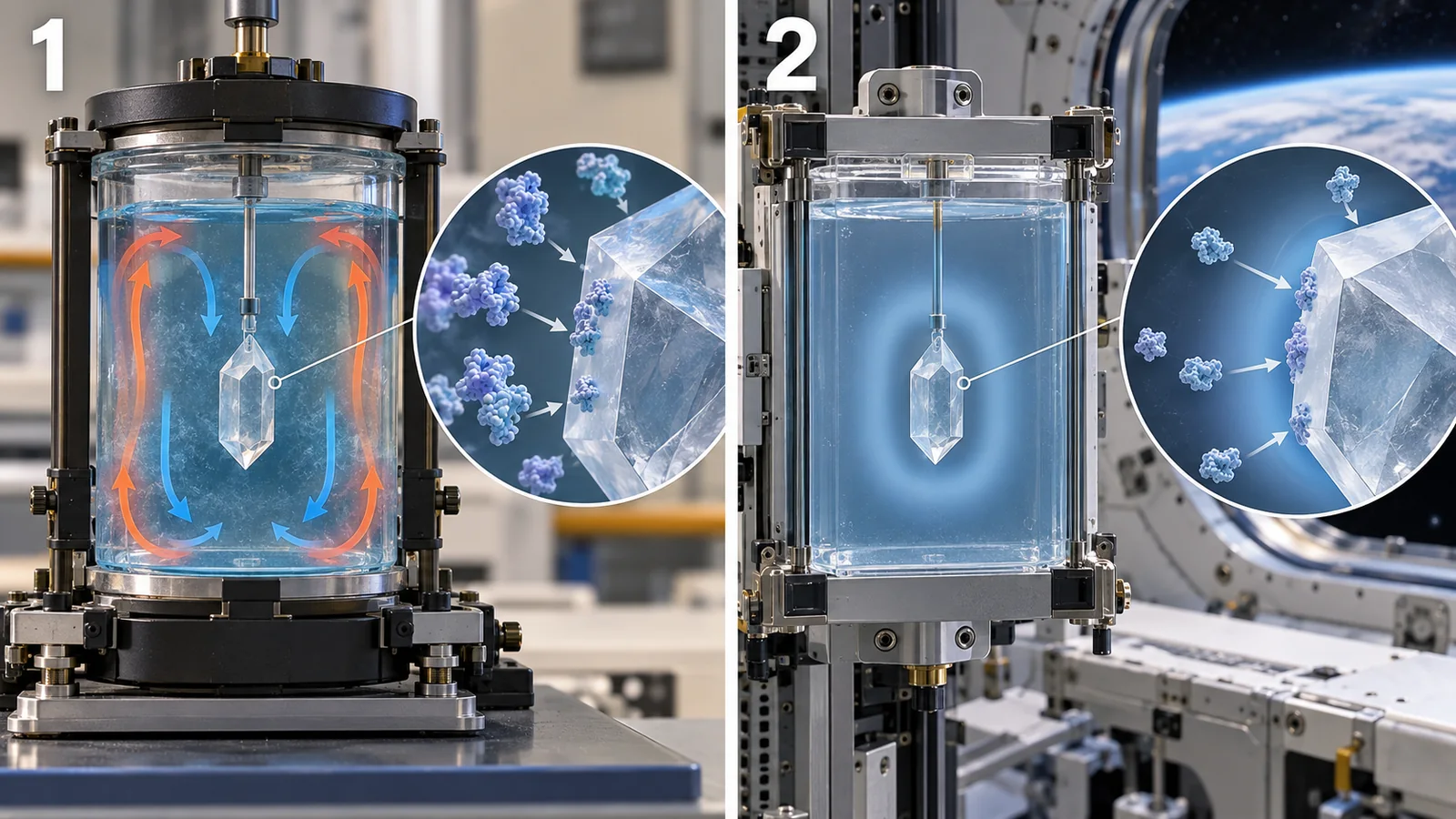
View original SVG, values and sources
Original SVG reference: Conceptual diagram (vector drawing). Left: ground, where convection keeps carrying material and impurities. Right: microgravity, where only diffusion remains and a depletion zone forms. Shading and size are illustrative.
How is crystal "quality" compared?
The review lists four criteria for comparing crystals grown in space with ground-grown ones: (1) visual quality, (2) maximum size and size distribution, (3) morphology and (4) X-ray diffraction quality. [Ref. 1] For (4) the measures include resolution (how fine a detail can be seen), I/σ(I) (signal-to-noise ratio), mosaicity (how much the crystal is split into small blocks) and the B-factor (size of atomic motion). [Ref. 1, 2]Sourced
Resolution is measured in Å (angstroms), 0.1 nanometre (about the length of one atom). "1.06 Å" is finer than "1.30 Å": the smaller the number, the finer the detail that can be seen. It is like fineness of pixels in a photograph, but note that here the smaller number is the better one.
In materials crystal growth it has long been known that weakening convection toward diffusion control reduces compositional variation and defects. Protein samples are often not very pure and can contain impurities such as aggregates, and how much impurity is incorporated governs how perfect the crystal is. [Ref. 1] Microgravity is one tool for reducing that uptake, but it does not help if the sample itself is not pure enough, as the numbers in the next chapter show.
4. History and results: what about 40 years of experiments showed
(1) The 1980s: starting with hand-operated devices
The JAXA paper says Littke and John obtained large crystals of lysozyme (an egg-white enzyme) in space in 1983. [Ref. 2] In the US, from about 1985, experiments began aboard the Space Shuttle with a simple device of syringes in a frame, the vapor diffusion apparatus (VDA). The first version was hand-operated: an astronaut pushed out droplets one by one with a hex key, and there was no temperature control. Even so, crystals of lysozyme, canavalin, serum albumin and others formed; after an interruption by the shuttle accident of January 1986, a temperature-controlled device with 60 experiments was flown once shuttle flights resumed on 26 October 1988. [Ref. 1]Sourced
A 1989 paper in Science is described as the first to show quantitatively, from X-ray analyses, that crystals grown in microgravity had better diffraction quality (I/σ ratio and resolution). [Ref. 1] This is the starting point of research that has lasted about 40 years.Sourced
(2) The ISS era: JAXA's accumulation of experiments
JAXA started high-quality protein crystal growth on the ISS in 2002 and by 2012 had crystallized 580 proteins in total across 14 sessions. Crystallization uses the "counter-diffusion method" (a protein solution and a precipitant solution are brought together from opposite ends of a thin tube and mix by diffusion). The paper says that if conditions were carefully fixed on the ground, good crystals grew on the ISS in many experiments, and a highly pure sample and a viscous crystallization solution were especially effective. [Ref. 2] NASA's page likewise says drug companies and academic researchers had performed more than 500 protein crystal growth experiments on the ISS by 2021. [Ref. 3]Sourced
(3) The numbers: the effect depends on conditions
The JAXA paper says one can predict whether microgravity will help from the diffusion coefficient (D) and an incorporation coefficient (β), and reports that under conditions with D/β below 3 mm, better crystals grew in microgravity for about 70% of proteins. The other 30% did not improve. The main causes were differences between the sample lot used to optimize on the ground and the lot launched, and degradation of crystals from a temperature surge (about 303 K) during the return from the ISS. [Ref. 2] The effect of sample purification was large: good results were obtained for 50% of samples with a good acceptance test, 37% of samples given extra purification, and only 5% of samples that were less than optimal in the test and not further purified. [Ref. 2]Sourced
In individual examples, data-collection resolution is reported as 1.06 Å for space-grown crystals and 1.30 Å for ground-grown ones for lipocalin-type prostaglandin D synthase (L-PGDS), and 1.0 Å in space versus 1.1 Å on the ground for alpha-amylase. [Ref. 2] Another summary says that in US experiments on the Mir space station, 5 of 21 proteins gave results superior to those on the ground. [Ref. 1]Sourced
(4) Assessments have been divided
Assessments are not uniform. The JAXA paper says that in 2000 the US National Research Council reported that the impact of microgravity crystallization on structural biology as a whole was "extremely limited." [Ref. 2] The review says a review by the same body of NASA's microgravity protein crystallization program called results "inconclusive," that many improvements were incremental, and that appropriate control experiments were hard to run. The review itself says there is sufficient evidence of the potential for microgravity to improve crystal quality, but lists as reasons for limited uptake the lack of routine access to microgravity, sample degradation from launch delays, crystal degradation from retrieval delays, heavy paperwork for flight approval and the general uncertainty of spaceflight. [Ref. 1] It also notes that failures and marginal successes often go unpublished, so the record is incomplete. [Ref. 1]Sourced
Correctly: even in JAXA's well-optimized experiments only about 70% improved and about 30% did not, and with insufficient sample purification "good results" fell to 5%. [Ref. 2] The effect depends on the protein, the purity of the sample, the crystallization solution and the history of launch and recovery. NASA's page, on the other hand, says growing crystals in microgravity "significantly improves" their quality, [Ref. 3] so the strength of the assessment differs by author. Read the numbers with their conditions.
What stands out in the JAXA figures is not the microgravity effect but how large the influence is of sample purity (5% versus 37-50%), lot matching and the temperature history during return. As with crystal growth and adhesion evaluation of materials, the effect of microgravity can be stated only when a control that uses the same sample and the same history on the ground and in space is valid. The review also lists the difficulty of controls as an issue. [Ref. 1, 2] For a materials engineer, lot management, recording of temperature history and standardized pretreatment (purification) decide the value of space experiments (our commentary).
5. Linking to drug discovery: from structure to drug candidates
JAXA and NASA describe a case in which the structure of crystals obtained in space was used to design drug candidates. According to a JAXA item dated 10 November 2021, crystals of H-PGDS (hematopoietic prostaglandin D synthase), an enzyme whose expression is enhanced in the muscles of patients with Duchenne muscular dystrophy, were grown in space in Kibo's high-quality protein crystal growth experiment, giving single crystals with a high resolution of 0.95 Å. Selective, potent inhibitors were designed on the basis of that structure, and one went into clinical trials, the item says. [Ref. 4] NASA's page (dated 2022, updated 2023) also says that a University of Tsukuba researcher designed compounds from JAXA's structural work, among them TAS-205. [Ref. 3]Sourced
On the clinical trial of that drug, only facts are stated. In a release of 8 July 2025, Taiho Pharmaceutical presented the results of REACH-DMD, a Phase III study in Japanese males aged 5 and older, and said the primary endpoint (mean change from baseline to week 52 in the time to rise from the floor) showed no significant difference. It said detailed results would be presented at an upcoming academic conference. [Ref. 5] NASA's page had said the Phase III trial began in December 2020 and was scheduled to run until 2027, [Ref. 3] but that predates the release above.Sourced
Correctly: that the structure gave clues for design and whether the resulting drug works in clinical trials are separate questions. The latter is answered by clinical trials, and this article does not state the efficacy or safety of any particular drug. Whether growing the crystals in space helped design much more than growing them on the ground would have (a ground comparison for H-PGDS) could not be confirmed.
6. Making crystals of the drug itself in space
(1) The crystal "form" decides quality: the lesson of ritonavir
In the summer of 1998, supply of Norvir (ritonavir) semi-solid capsules was threatened by the appearance of a new, less soluble crystal form of ritonavir (Form II). The paper characterized the two polymorphs by solid-state NMR, powder and single-crystal X-ray diffraction and other methods, and concluded that Form II is the more stable packing but that nucleating it is energetically unfavorable except in highly supersaturated solutions, so it appeared suddenly when high supersaturation coincided with probable heterogeneous nucleation by a degradation product. [Ref. 7] The lesson is that a crystal form is hard to undo once it appears and is determined by manufacturing control (our commentary).Sourced
(2) Merck's antibody crystallization: bringing ISS results back to the ground
Antibody drugs have been considered hard to crystallize because their molecules are large and flexible. Merck's laboratories, together with the ISS National Laboratory, sent crystallization experiments on the antibody pembrolizumab (Keytruda) to the ISS on SpaceX's resupply mission CRS-10 (launched 19 February 2017). [Ref. 6, 14] The paper reports that on the ISS a crystalline suspension of uniform particles (a single peak at about 39 μm) was obtained in high yield, whereas the ground control showed two peaks, 13 μm and 102 μm. The ISS suspensions were less viscous and sedimented more uniformly. The authors then applied these findings to a ground method using rotating mixers (to reduce sedimentation) and temperature gradients (to control crystallization), making uniform 1-5 μm suspensions with viscosity below 12 cP, giving properties suitable for preparing an injectable formulation. [Ref. 6]Sourced
The value of this case lies not in a product made in space but in having confirmed on the ISS that particles come out uniform when settling is small, and then translating that into ground mixing and temperature conditions. The paper itself says the results were applied to production on Earth. [Ref. 6] Space worked as a place to learn the direction of design by removing a variable (settling) that is hard to separate on the ground. The paper does not discuss approval or sale of a product, and none could be confirmed (our commentary).
(3) Making crystals in orbit and returning them: the ritonavir preprint
A 2024 preprint (not peer reviewed) by authors including Varda researchers reports successful recovery of the metastable "Form III" of ritonavir generated in orbit. Test samples containing Forms I, II and III and amorphous material, along with ground controls, all showed excellent stability, the abstract says. What this study tests is survivability against vibration, acceleration, radiation and temperature; it does not claim that orbit-made crystals are better than ground-made ones. [Ref. 8]Sourced
7. Where re-entry-capsule manufacturing stands
The ISS offers limited experiment opportunities because of crew and cargo constraints (a point made by the review in Chapter 4). So a different approach appeared: run orbital processing on a small free-flying spacecraft and return only a capsule to Earth. Varda Space Industries (US) describes its W-Series spacecraft on its web page as free flyers independent of any station that can safely return materials, and lays out the flow as (1) launch on a commercial rocket, (2) processing in orbit such as heating, mixing and cooling, (3) separation of the capsule, (4) re-entry at more than 18,000 miles per hour (about 29,000 km/h) and above Mach 25, and (5) parachute landing, recovery and post-flight analysis. [Ref. 9]Sourced
The mission list on the same page records W-1 re-entering on 21 February 2024 at the Utah Test and Training Range, W-2 on 27 February 2025 and W-3 on 13 May 2025 at Australia's Koonibba Test Range, and W-4 to W-6 as also re-entered. W-7 is "scheduled" and described as "a pharmaceutical mission to explore whether microgravity can help overcome one of pharmaceutical manufacturing's biggest limitations: poor solubility." [Ref. 9] A company release of 1 October 2026 says W-8 and W-9 were launched together on SpaceX's Transporter-18 rideshare and that the company has safely re-entered six capsules since 2024. What W-8 and W-9 carry is mainly tests under hypersonic re-entry, such as thermal protection materials and a navigation system, not drug processing. [Ref. 11]SourcedNot yet confirmed
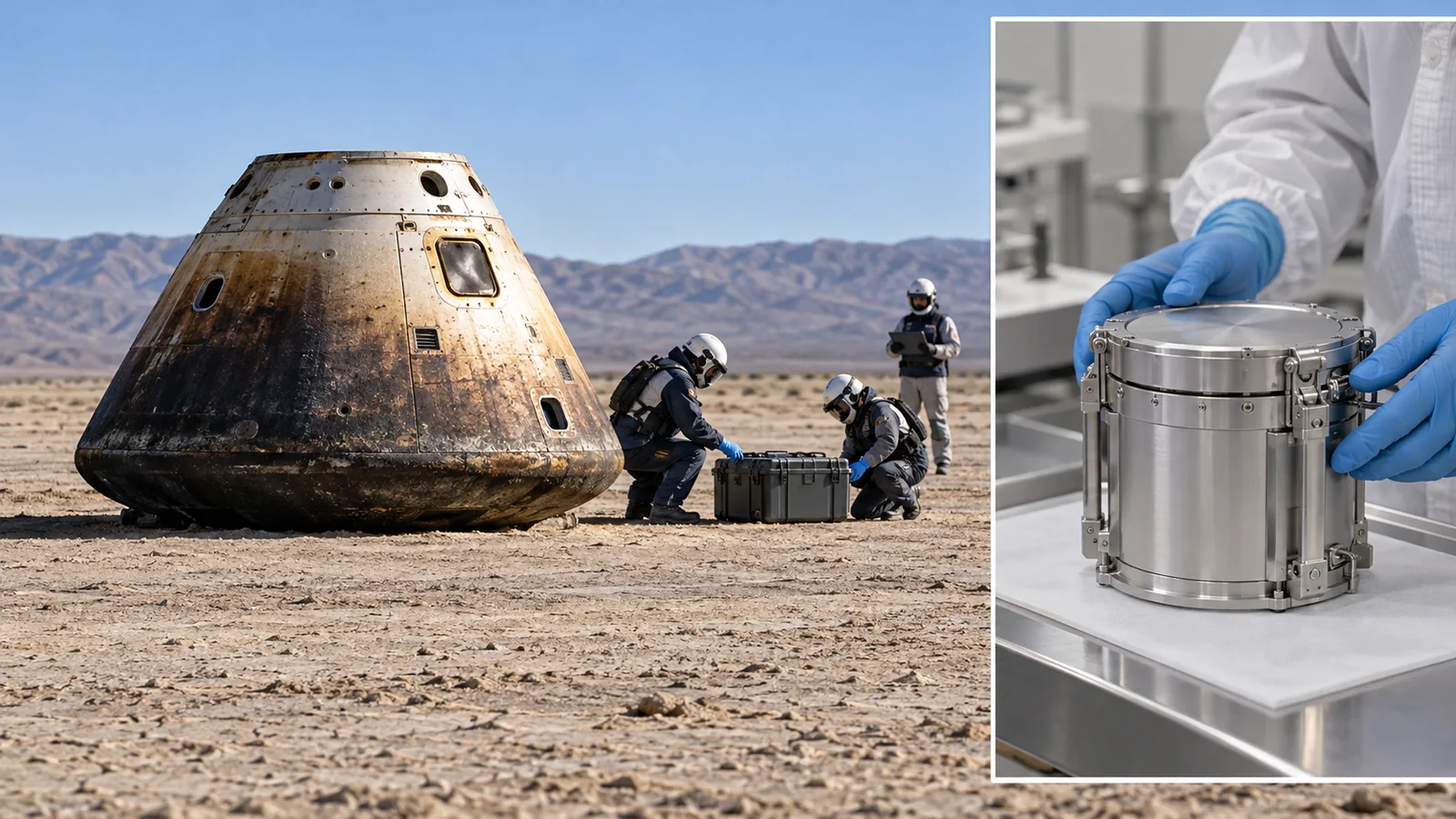
Company claims and what was confirmed
On its web page Varda says that microgravity suppresses convection, buoyancy and sedimentation, that crystals become more uniform, and that the effects stay "locked" into the material, which returns to Earth for manufacturing. It also describes a development funnel in which a ground-based hypergravity (centrifuge) platform is used first to study how particle size and polymorph ratio depend on gravity, narrowing the candidates sent to space. [Ref. 10] These are company claims and plans. In the summary of its 30 September 2026 financing announcement (on the company's media page) the company says it will scale toward producing the first pharmaceuticals made in space for patients on Earth, but this is Not yet confirmed.[Ref. 15]SourcedNot yet confirmed
What this check confirmed is two things: (1) capsule re-entry and recovery have been repeated (company web page and release) and (2) a preprint, not peer reviewed, shows that crystals made in orbit survive launch and re-entry. What it could not confirm is (1) a peer-reviewed paper showing improved drug quality, (2) approval or sale of a drug made from space-processed material and (3) drug-processing results of W-4 to W-6 (W-7 is planned).
Correctly: the technology to bring a capsule safely back to Earth, an improvement in the quality of the material it carried, and approval by a regulator of a drug made with it are three separate stages. In this check only the first has been shown repeatedly (company sources). Licensing and regulation of re-entry itself are covered in the series article on national space strategies and regulation.
8. A materials engineer's view, and what could not be confirmed
(1) A crystal is a product of its history. The ritonavir case shows that crystal form is set by manufacturing history such as degree of supersaturation, impurities and trace nuclei. [Ref. 7] Orbital processing also changes histories other than gravity (launch vibration, temperature, time until recovery). (2) Control design. Unless the same sample, equipment and temperature history are matched in space and on the ground, the effect of microgravity cannot be stated (the JAXA and Merck papers). [Ref. 2, 6] (3) A path back to the ground. The Merck case shows knowledge from space translated into a ground process. [Ref. 6] The value of manufacturing in space itself, in cost, volume, repeatability and regulatory acceptance, is not yet confirmed (our commentary).
What could not be confirmed
- Any case of a drug approved or sold that uses space-processed material
- Detailed figures in the full text and supplementary material of the Varda ritonavir preprint (only the abstract and company page were checked); no peer-reviewed version was found
- The results of drug processing on W-4 to W-6, and the date of W-7
- A comparison with ground-grown H-PGDS crystals (the JAXA item gives only 0.95 Å in space)
- Detailed REACH-DMD results (the release says they will be presented at a future conference; none were found by the date checked)
- A unified statistic for the rate of crystal-quality improvement by microgravity (reports differ by criteria and denominator: 70%, 60%, 5 of 21 and so on)
Summary
Protein crystallization in space has about 40 years of history, and JAXA's ISS experiments and others show that, with conditions set up well, crystal quality improves in many cases. Assessments are nevertheless divided, and the effect depends greatly on sample purity and history. Work on crystals of the drug itself has promising cases in the form of "learn in space, return to the ground," as in Merck's case, but manufacturing in re-entry capsules is, within what could be confirmed, at the demonstration stage; approved drugs and peer-reviewed results showing improved drug quality could not be confirmed.
9. How to read the yardsticks and standards
This field mixes different kinds of yardsticks: crystal quality, drug crystal form, the space environment and clinical results. Behind the phrase "made in space" it matters to tell which yardstick is being discussed. Checked on 17 October 2026.
| What is evaluated | Typical test or evaluation method (name, source) | Standard or guideline (name, edition, source checked) | How to read it |
|---|---|---|---|
| Crystal quality (for structure) | X-ray diffraction: resolution (Å), I/σ(I), mosaicity, B-factor, crystal shape and size (the review's four criteria). [Ref. 1, 2]Sourced | wwPDB validation reports (reports assessing the quality of structure data; produced in OneDep and part of the archive on release). [Ref. 13]SourcedNo standard for crystal quality itself was found | Compare with a ground control using the same sample lot and temperature history. The improvement rate changes with criteria and denominator |
| Quality of the space environment (microgravity) | Accelerometer measurements and so on; covered in the series article on in-space manufacturing and microgravity | not found (within this article) | Look at level, duration and vibration. Levels on re-entry capsules and free flyers could not be confirmed |
| Drug crystal form (polymorph) | Solid-state NMR, near-infrared, powder and single-crystal X-ray diffraction (the ritonavir study); Varda lists XRPD, DSC, TGA, SCXRD, Raman, microscopy and others. [Ref. 7, 10]Sourced | ICH Q6A (Step 4, 6 October 1999): where polymorphs affect product quality or performance, specify the solid state, with decision tree #4 for monitoring and control. [Ref. 12]Sourced | This is guidance for drugs in general on the ground; no standard specific to space-processed material was found |
| Particle size and viscosity (preparing injectables) | Particle-size distribution (Merck: 39 μm; 13 and 102 μm; 1-5 μm), viscosity (below 12 cP) and syringeability. [Ref. 6]Sourced | not found | Values are for one study and one antibody; do not generalize to other molecules |
| Survivability of orbital processing (launch and re-entry) | Study the effects of vibration, acceleration, radiation and temperature on samples (Varda preprint, not peer reviewed). [Ref. 8]Sourced | not found | A preprint is not peer reviewed. That recovered samples "do not degrade" is different from "quality improves" |
| Clinical results | Primary endpoints of clinical trials (example: "time to rise from the floor" in REACH-DMD). Taiho's release says "no significant difference." [Ref. 5]Sourced | not found (outside this article; no medical advice) | Crystal quality and structure are a different stage from clinical results of a drug. Do not read them together |
| Manufacturing viability and regulatory acceptance | Examples of approval and sale, production record | not found; no standard or regulator guidance specific to drug manufacturing in space was found | Read company goals as Not yet confirmed |
The arrangement of the table is Our calculation (organization). No applicable ASTM standard was found.
Reading notes (for materials engineers)
- Tell which yardstick is meant: "resolution improved" (crystal quality), "particles became uniform" (formulation), "the capsule re-entered" (transport) and "no significant difference clinically" (the drug's result) are different stages.
- Pre-review and peer review differ: the ritonavir orbital study is a preprint before peer review. The Merck and JAXA papers are peer-reviewed.
- The improvement rate depends on its definition: reported rates such as about 70%, 60% and 5 of 21 differ in criteria, denominator and conditions. Check definitions before comparing.
10. Glossary
- Crystal
- A solid in which atoms or molecules are arranged regularly.
- Protein
- A large molecule that works in the body as an enzyme, receptor and so on.
- X-ray crystallography
- A method that finds atomic positions from the pattern of X-rays diffracted by a crystal.
- Diffraction
- The scattering of X-rays by regularly arranged atoms in specific directions.
- Resolution (Å)
- How fine a detail can be seen; smaller is finer. 1 Å is 0.1 nm.
- I/σ(I)
- The ratio of diffraction signal to noise.
- Mosaicity
- How much a crystal is split into small blocks; smaller means more ordered.
- B-factor
- A number expressing the size of atomic motion.
- Structure-based drug design
- Designing fitting molecules after learning the shape of a protein.
- Polymorph
- Different crystal packings of the same molecule; solubility and other properties change.
- Amorphous
- A solid without regular arrangement.
- Supersaturation
- A state of holding more dissolved material than equilibrium allows; the driving force for crystallization.
- Nucleation
- Formation of the first tiny seed of a crystal.
- Depletion zone
- The region around a crystal where protein or impurity concentration has fallen.
- Diffusion
- The spreading of molecules down a concentration difference.
- Counter-diffusion method
- Crystallizing by bringing protein and precipitant solutions together from opposite sides so that they mix by diffusion.
- Vapor diffusion
- A method in which water leaves a droplet through vapor to a reservoir, concentrating it until it crystallizes.
- H-PGDS
- Hematopoietic prostaglandin D synthase; one of the targets of JAXA crystallization.
- Antibody drug
- A drug made from an antibody protein; molecules are large and hard to crystallize.
- Suspension
- Solid particles dispersed in a liquid.
- Viscosity (cP)
- Stickiness of a liquid, in centipoise (cP); water is about 1 cP.
- Re-entry capsule
- A capsule that re-enters the atmosphere from orbit, lands by parachute and is recovered.
- Preprint
- A paper made public before peer review.
- ICH Q6A
- An international harmonised guideline on setting specifications for new drug substances and products.
- wwPDB validation report
- A Protein Data Bank report that assesses the quality of structure data.
11. References
- npj Microgravity McPherson A. and DeLucas L. J. "Microgravity protein crystallization" (review, 2015, DOI 10.1038/npjmgrav.2015.10; PMC version) — pmc.ncbi.nlm.nih.gov/articles/PMC5515504/
- Journal of Synchrotron Radiation Takahashi S. et al. "JAXA protein crystallization in space: ongoing improvements for growing high-quality crystals" (2013, DOI 10.1107/S0909049513021596; PMC version) — pmc.ncbi.nlm.nih.gov/articles/PMC3795566/
- NASA Crystallizing proteins, helping identify treatments (ISS research benefits page; dated 23 July 2022, updated 29 September 2023) — nasa.gov/mission_pages/station/research/benefits/crystallizing-proteins-helping-iden
- JAXA JAXA news item on drug discovery to slow muscular dystrophy progression by targeting H-PGDS (results of Kibo use; dated 10 November 2021) — humans-in-space.jaxa.jp/en/biz-lab/news/detail/001832.html
- Taiho Pharmaceutical News release on the results of REACH-DMD, the Phase III study of TAS-205 (8 July 2025) — www.taiho.co.jp/en/release/2025/20250708.html
- npj Microgravity Reichert P. et al. "Pembrolizumab microgravity crystallization experimentation" (2019, DOI 10.1038/s41526-019-0090-3) — doi.org/10.1038/s41526-019-0090-3
- Pharmaceutical Research Bauer J. et al. "Ritonavir: an extraordinary example of conformational polymorphism" (2001, DOI 10.1023/A:1011052932607; abstract) — doi.org/10.1023/A:1011052932607
- ChemRxiv (preprint) Bauser H. C. et al. "Return of the Ritonavir: A Study on the Stability of Pharmaceuticals Processed in Orbit and Returned to Earth" (20 March 2024, version 3; not peer reviewed) — doi.org/10.26434/chemrxiv-2024-vb20g-v3
- Varda Space Industries Platform (W-Series, mission list with re-entry dates, capsule flow; company web page) — varda.com/platform
- Varda Space Industries Biopharma (development funnel using microgravity and hypergravity; company claims) — varda.com/biopharma
- PR Newswire (Varda release) Varda Space Industries Launches Two Vehicles to Orbit at the Same Time (1 October 2026; W-8 and W-9, Transporter-18) — www.prnewswire.com/news-releases/varda-space-industries-launches-two-vehicles-to-orb
- ICH Q6A "Specifications: Test Procedures and Acceptance Criteria for New Drug Substances and New Drug Products: Chemical Substances" (Step 4, 6 October 1999; polymorphism decision trees) — database.ich.org/sites/default/files/Q6A%20Guideline.pdf
- Structure Gore S. et al. "Validation of Structures in the Protein Data Bank" (2017, DOI 10.1016/j.str.2017.10.009; wwPDB validation reports) — doi.org/10.1016/j.str.2017.10.009
- NASA LIFTOFF of CRS-10! (19 February 2017; launch of SpaceX's tenth commercial resupply mission) — blogs.nasa.gov/spacex/2017/02/19/liftoff-of-crs-10/
- Varda Space Industries Media Center (list of company announcements, including the summary of the 30 September 2026 financing announcement; checked 17 October 2026) — varda.com/media
12. Claim-to-source audit
| Claim in the text | Basis | Type |
|---|---|---|
| Review: good crystals the largest obstacle in X-ray crystallography, hundreds of proteins cannot be crystallized or give insufficient quality; protein crystals contain about 30% to over 90% solvent and are fragile; convection versus diffusion, depletion zones, four comparison criteria (visual, size, shape, X-ray diffraction), diffraction indicators (I/σ, resolution, B-factor, mosaicity) | McPherson and DeLucas (npj Microgravity, 2015) Reference 1 https://pmc.ncbi.nlm.nih.gov/articles/PMC5515504/ | Sourced |
| History: US shuttle experiments from about 1985 (hand-operated VDA, four flights, the January 1986 accident, resumption on 26 October 1988, the 60-experiment device), the 1989 Science paper, 5 of 21 proteins on Mir, the NRC review (inconclusive, incremental, controls difficult), five reasons uptake stayed limited, failures going unpublished | Same Reference 1 https://pmc.ncbi.nlm.nih.gov/articles/PMC5515504/ | Sourced |
| JAXA PCG: started 2002, 14 sessions and 580 proteins by 2012, counter-diffusion, pure samples and viscous solutions effective, about 70% improved and about 30% not at D/β < 3 mm (causes: lot differences, a temperature surge to about 303 K during return), purification and share of good results (50%, 37%, 5%), L-PGDS 1.06/1.30 Å, alpha-amylase 1.0/1.1 Å, Littke and John in 1983, the 2000 NRC "extremely limited," Snell and Helliwell's 60% (proteins flown four or more times) | Takahashi et al. (J. Synchrotron Rad., 2013) Reference 2 https://pmc.ncbi.nlm.nih.gov/articles/PMC3795566/ | Sourced |
| More than 500 PCG experiments on the ISS by 2021. TAS-205 is one of the compounds designed from JAXA's structural work. Phase III began in December 2020 and was scheduled to 2027 (as stated in the page dated 2022 and updated 2023) | NASA page Reference 3 https://nasa.gov/mission_pages/station/research/benefits/crystallizing-proteins-helping-identify-treatments | Sourced |
| H-PGDS: single crystals grown in space in Kibo, 0.95 Å, structure-based inhibitor design, one going into Phase III (statement dated 10 November 2021) | JAXA item Reference 4 https://humans-in-space.jaxa.jp/en/biz-lab/news/detail/001832.html | Sourced |
| REACH-DMD (Phase III of TAS-205): release of 8 July 2025, no significant difference in the time to rise from the floor at 52 weeks, details to be presented at a future conference | Taiho release Reference 5 https://www.taiho.co.jp/en/release/2025/20250708.html | Sourced |
| Merck and ISS National Lab pembrolizumab: CRS-10, a single peak of about 39 μm on the ISS, 13 and 102 μm in the ground control, lower viscosity and more uniform settling, ground application giving 1-5 μm and viscosity below 12 cP | Reichert et al. (npj Microgravity, 2019) Reference 6 https://doi.org/10.1038/s41526-019-0090-3 | Sourced |
| CRS-10 launched on 19 February 2017 | NASA blog Reference 14 https://blogs.nasa.gov/spacex/2017/02/19/liftoff-of-crs-10/ | Sourced |
| Ritonavir: the summer 1998 supply threat to Norvir capsules, the less soluble Form II, characterization of two polymorphs, the discussion of Form II nucleation | Abstract of Bauer et al. (Pharm. Res., 2001) Reference 7 https://doi.org/10.1023/A:1011052932607 | Sourced |
| Recovery of metastable ritonavir Form III generated in orbit, stability of test samples and controls, effects of vibration, acceleration, radiation and temperature; not peer reviewed | ChemRxiv preprint (2024) Reference 8 https://doi.org/10.26434/chemrxiv-2024-vb20g-v3 | Sourced |
| Varda: the W-Series flow (above 18,000 mph and Mach 25), re-entry dates for W-1 to W-3, W-4 to W-6 re-entered, W-7 a scheduled pharmaceutical mission | Varda web page (company material) Reference 9 https://varda.com/platform | SourcedNot yet confirmed |
| Varda: microgravity makes crystals more uniform and the effects are locked into the material, hypergravity pre-screening, list of analysis methods (company claims) | Varda web page Reference 10 https://varda.com/biopharma | SourcedNot yet confirmed |
| Simultaneous launch of W-8 and W-9 (Transporter-18), six capsules re-entered, payloads of thermal protection and navigation | Varda release (1 October 2026) Reference 11 https://www.prnewswire.com/news-releases/varda-space-industries-launches-two-vehicles-to-orbit-at-the-same-time-302896502.html | Sourced |
| ICH Q6A: Step 4, 6 October 1999, specification where polymorphs affect product quality or performance, decision tree #4 | ICH guideline Reference 12 https://database.ich.org/sites/default/files/Q6A%20Guideline.pdf | Sourced |
| wwPDB validation reports: reports assessing the quality of structures, which become part of the archive on release | Gore et al. (Structure, 2017) Reference 13 https://doi.org/10.1016/j.str.2017.10.009 | Sourced |
| Summary of Varda's 30 September 2026 announcement (scaling toward the first pharmaceuticals made in space) | Varda media page Reference 15 https://varda.com/media | Not yet confirmed |
| 18,000 mph = about 29,000 km/h (approximate conversion); the charts of shares in Fig. 5 and the distribution sketch in Fig. 6 | Our calculation (charting of figures from the sources) | Our calculation |
| The table layout, the materials engineer's views, reading notes, the stage ladder and the split into "three different stories" | Commentary in this article | Commentary |
| Approval or sale of drugs from space-processed material, drug results for W-4 to W-6, comparison with ground H-PGDS crystals, a peer-reviewed orbital ritonavir paper, ASTM standards, standards specific to drug manufacturing in space, efficacy or safety of drugs, medical advice | This article does not state them (could not be confirmed, or outside its scope) | Commentary |
| Figures 1 and 9 are frames for AI-generated images; Figures 2-8 are conceptual diagrams or our own charts | Note by this article | Commentary |
Last updated: 17 October 2026. Sources are limited to primary materials (peer-reviewed papers, reviews, official materials of JAXA, NASA, Taiho and Varda, ICH and wwPDB). Approval or sale of drugs from space-processed material, drug results for W-4 to W-6, a peer-reviewed orbital ritonavir paper and ASTM standards could not be confirmed and are not stated. Company materials are treated as company claims, and the preprint is marked as not peer reviewed. This article does not assert the efficacy, safety or value of any drug and gives no medical or investment advice.