TECHNOLOGY EXPLAINER
Quantum Key Distribution and Quantum Communication
— what "sharing a key safely" means, and how far a key made from light can be trusted
Encryption lets only the holder of a "key" read a message. But how do two people far apart share that key safely in the first place? Quantum key distribution (QKD) is a way to make a key from the quantum properties of light. An eavesdropper disturbs the light, and the disturbance shows up as errors.
Assuming no knowledge of quantum mechanics, this article covers: (1) the basics of keys and encryption, (2) the arrow analogy for light, (3) the flow of the best-known scheme, BB84, (4) what happens when someone eavesdrops, (5) the limits in distance, speed and device "holes", (6) standards and the views of national agencies, and (7) how QKD differs from post-quantum cryptography (PQC). We also check, with figures, why "unbreakable by the laws of physics" cannot be said without qualification.
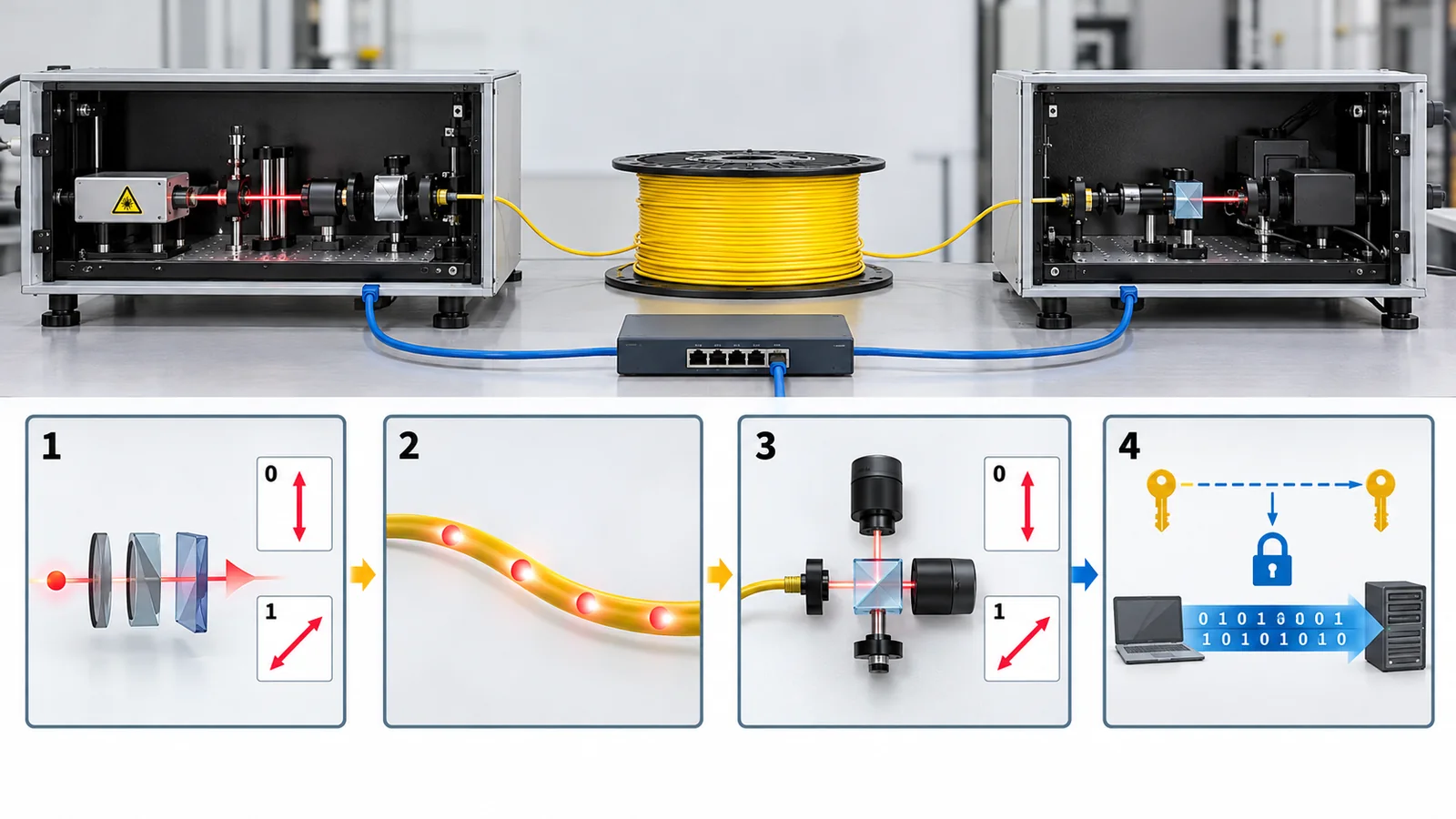
- The short version / before you read / where this fits in the series
- What "sharing a key" means: the basics of encryption and keys
- Arrows of light: three properties that QKD needs
- Following BB84 step by step
- What happens when someone eavesdrops
- After the raw key: error correction, compression, authentication
- Practical limits: distance, speed and device holes
- Beating the distance wall: trusted relays, satellites, twin-field
- Standards and the views of national agencies
- QKD and PQC: differences and how they fit together
- How to read the yardsticks and standards / glossary / references / claim-to-source audit
Sourced = content stated in published material (with source links)
Our calculation = values we computed from stated assumptions
Not yet confirmed = drafts, work in progress, plans and other unsettled matters
Our own interpretation is labelled "Commentary". Inference is shown in bold.
The BB84 examples (the 12-pulse table and the error-rate table) are small simulations we generated with random numbers (fixed seeds). They are not measurements of a real device. The distance-and-loss calculation assumes a loss of 0.2 dB/km as an illustrative assumption. Key rates from experiments are quoted as reported in the papers, together with their conditions (distance, scheme, asymptotic or finite-size). This article does not explain how to carry out attacks or how to exploit weaknesses in devices. It does not rank products, companies or countries.
1. The short version / before you read / where this fits in the series
- QKD is not a way to send ciphertext; it is a way to make a key: two distant parties build the same secret random string (the key) using single pulses of light. The key is then used in ordinary encryption (such as shared-key ciphers)[Ref. 2, 3]
- Eavesdropping disturbs the light and raises the error rate: a quantum state changes when measured and cannot be copied. If there are too many errors, the parties assume someone may have been listening and throw the key away[Ref. 1, 4, 2]
- But it is not "unbreakable by the laws of physics": the guarantee holds for ideal devices under stated assumptions. Because real devices have holes, distance is a wall, authentication is needed separately, and dedicated optical links are required, the US NSA, the UK NCSC and four agencies of France, Germany, the Netherlands and Sweden (ANSSI, BSI, NLNCSA and the Swedish NCSA) have published positions that do not recommend QKD for important national communications, or that put PQC first[Ref. 29, 30, 31]
No prior knowledge is needed. Cryptographic terms (key, encryption, eavesdropping) are explained as we go. Quantum mechanics is covered only as far as needed, through the "arrow of light" analogy (the same analogy as in our quantum computing fundamentals explainer).
A good reading order is: quantum computing fundamentals, then this article, then "Quantum Networks and Quantum Repeaters" (the future route past the distance wall), "Post-Quantum Cryptography" (protecting with mathematics) and "Migrating to Post-Quantum Cryptography". This article can also be read on its own.
2. What "sharing a key" means: the basics of encryption and keys
Before any quantum physics, let us check the basics of encryption. Once these are clear, it becomes obvious what problem QKD is trying to solve.
(1) Encryption is a lock, and the key is the key
Imagine sending a letter in a locked box. Anyone may inspect how the box is built; only the key is secret. Modern encryption works the same way: the procedure (the algorithm) is public, and the only secret is a string of random digits called the key. In widely used shared-key ciphers (AES and others) the sender and the receiver hold the same key: they lock (encrypt) with it and unlock (decrypt) with it. These ciphers are fast and suit large volumes of data (our commentary).
(2) The weak point: how to hand over the key in the first place
Shared-key ciphers raise a question that cannot be avoided: how do two people far apart share the very first key without anyone listening in? This is the "key distribution problem". If the key is sent over an ordinary channel, anyone who listens in obtains it and can read every later message.
(3) Public-key encryption: the padlock analogy and its weakness
In the 1970s a new answer appeared. Diffie and Hellman presented the idea of a "public key"[Ref. 7], and Rivest, Shamir and Adleman presented a concrete scheme (RSA)[Ref. 8]. In the padlock analogy, the receiver hands out padlocks (public keys) to anyone, and the sender snaps a padlock on the box and sends it. Anyone can close a padlock, but only the receiver, who holds the secret key, can open it. Now no key has to be delivered in advance.
Limit of the analogy: real public-key encryption relies not on a physical padlock but on the hardness of mathematical problems. For example, multiplying two large primes is easy, but finding the original primes from the product (factoring) is believed to be extremely hard. If that belief fails, the padlock is useless. Quantum computers are known to solve this type of problem quickly (Shor's algorithm), which is why cryptography that resists them (PQC) is needed. Our explainer on post-quantum cryptography covers this in detail.
The "distribution" in the name is the distribution of the key. What QKD sends is not the content of the message but the light used to make the random digits for a key. Once the key exists, encrypting the message is done by ordinary computers with shared-key ciphers and the like. Hence the security QKD offers concerns "the key-making part" only.
(4) Two ways to use a key: the one-time pad and a fast cipher
In 1949 Shannon showed that a completely random key as long as the message, used once, makes a cipher unbreakable in principle (the one-time pad)[Ref. 9]. But this needs as much key as the amount of data sent. Shared-key ciphers such as AES protect large volumes of data with a short key (a few hundred bits, for example), but their safety rests on the computational argument that the cipher is hard to break. QKD keys can be combined with the one-time pad, or handed to a fast encryption device that refreshes its key at short intervals[Ref. 2].
3. Arrows of light: three properties that QKD needs
QKD uses light one particle (photon) at a time. We describe the state of a photon with the series' common "arrow": picture an arrow from the centre of a sphere to its surface. An arrow pointing north is "0" and one pointing south is "1". An arrow pointing east lies midway between north and south (a superposition).
BB84 uses four arrows. North and south are the two arrows of "way A"; east and west are the two of "way B" (the technical term for a way of measuring is a "basis"). East is "0" and west is "1".
The three rules in Fig. 4 are the foundation of QKD's safety.
- Right way is certain, wrong way is a coin toss: when the measurer asks "north or south?", a north or south arrow gives the right answer. An east or west arrow gives north or south at random (the probability is set by the tilt of the arrow; exactly sideways means 50/50).
- Measuring changes the arrow: after the measurement the arrow points along the result and the original direction is gone.
- It cannot be copied: an unknown quantum state cannot, in principle, be duplicated without destroying the original (the no-cloning theorem; Wootters and Zurek, 1982)[Ref. 4].
Ordinary signals (electricity, or strong light) can be copied and split. But a single quantum photon cannot be copied, by rule 3. To learn anything, the eavesdropper has to measure, and by rule 2 measuring changes the arrow. Also, the eavesdropper does not know which way (A or B) the sender used, so sometimes measures the wrong way and each time disturbs the arrow (Chapter 5). The original BB84 paper rests its security on this[Ref. 1, 2].
Asking an east-pointing arrow "north or south?" is like asking a sideways rod "does it point up or down?". You do get an answer, but nothing in that answer records that the arrow was east. That is what "a wrong way of measuring gives no information and also destroys the state" means (limit of the analogy: a rod does not change when examined, but a quantum arrow does).
More detail: how arrows are made from photons
In real devices, four directions of light polarisation (the direction in which the light vibrates) can stand for the four arrow directions; other devices use differences in arrival time or phase. They are described by the same mathematics as the arrow analogy. It is hard to build a source that emits truly one photon at a time, so very faint laser pulses are often used instead; Chapter 7 returns to this[Ref. 2].
4. Following BB84 step by step
BB84 is the first QKD scheme, proposed by Bennett and Brassard in 1984[Ref. 1]; the name comes from their surnames and the year. By convention the sender is called Alice, the receiver Bob and the eavesdropper Eve.
A small worked example
We trace 12 pulses with our own simulation (A = north/south, B = east/west; for Alice's bit 0/1, way A sends a north/south arrow and way B an east/west arrow). The right-hand columns show what Bob obtained with the way he chose at random. In the rows where the ways did not match (keep = no), Bob's result is random and means nothing.
| No. | Alice's bit | Arrow Alice sent | Bob's way | Bob's result | Keep? |
|---|---|---|---|---|---|
| 1 | 0 | B (east) | B | 0 | yes |
| 2 | 1 | A (south) | A | 1 | yes |
| 3 | 1 | B (west) | A | 0 | no |
| 4 | 1 | B (west) | A | 1 | no |
| 5 | 0 | A (north) | B | 1 | no |
| 6 | 0 | A (north) | B | 0 | no |
| 7 | 1 | B (west) | A | 0 | no |
| 8 | 1 | B (west) | B | 1 | yes |
| 9 | 0 | B (east) | B | 0 | yes |
| 10 | 0 | B (east) | B | 0 | yes |
| 11 | 1 | B (west) | B | 1 | yes |
| 12 | 1 | A (south) | B | 1 | no |
Our calculation. Simulated with Python random numbers (seed 4), with no eavesdropper. The six remaining bits "011001" are the seed of the key that Alice and Bob share (error correction and compression are omitted in this small example).
The key point: in the comparison step only "which way was used" is made public, never the bit values. Knowing the list of ways does not reveal the bits (the eavesdropper did not know whether Alice used A or B at the moment the light passed).
Bob chooses his way at random, without knowing Alice's choice. On average half of the two choices match. In the half that does not match, Bob's result is random and meaningless, so it is discarded. This is not waste: it is the procedure that creates an agreement between Alice and Bob that the eavesdropper does not share.
More detail: an alternative that uses entanglement (E91)
In 1991, Ekert proposed a scheme, separate from BB84, that uses a pair of entangled photons[Ref. 6]. Instead of the sender choosing an arrow to send, Alice and Bob each receive one photon of an entangled pair and measure it. Entanglement means two qubits behave as one unit (neither can be described alone). Such schemes connect with the satellite experiments of Chapter 8 and with our next article on quantum networks and repeaters.
5. What happens when someone eavesdrops
Using the three rules of Chapter 3, let us think about what an eavesdropper, Eve, can do. The simplest eavesdropping is "intercept-resend": Eve catches the light on its way, measures it, and sends Bob a fresh arrow that matches her result[Ref. 2]. Eve does not know which way (A or B) Alice used, so she can only choose A or B at random and measure.
| Eve's choice | Chance | Arrow Eve resends | Bob's result (when his way equals Alice's) | Chance of an error |
|---|---|---|---|---|
| Same as Alice's | 1/2 | The original arrow (no disturbance) | Correct | 0 |
| Different from Alice's | 1/2 | An arrow in the other way (original information lost) | 50/50 | 1/2 |
| Overall | 1/2 x 1/2 = 1/4 (25%) |
If every pulse is intercepted and re-sent, 25% of the bits that survive sifting disagree[Ref. 2]. Our calculation (multiplying the probabilities above).
Using the same 12-pulse example as in Chapter 4, here is what happens when Eve intercepts and re-sends every pulse (same simulation method).
| The six surviving bits | |
|---|---|
| Alice | 1 0 1 0 1 1 |
| Bob | 1 0 1 1 0 1 |
| Mismatch | 2 of 6 (the 4th and 5th) |
Our calculation. Simulation (seed 2, intercept-resend on every pulse). With only six bits, 2/6 (about 33%) differs from 25%. With a large number of pulses it approaches 25% (next table).
| Fraction p intercepted | Simulation (200,000 pulses each) | |
|---|---|---|
| 0% | 0% | 0.00% |
| 10% | 2.5% | 2.61% |
| 25% | 6.25% | 6.39% |
| 50% | 12.5% | 12.68% |
| 100% | 25% | 25.17% |
Our calculation. The theory column follows Scarani et al.: intercept-resend on a fraction p of the pulses gives an error rate Q = p/4[Ref. 2]. The simulation used Python (seed 7); about 100,000 bits survived in each row.
Errors cannot be told apart: eavesdropping or noise?
In real devices, even with no eavesdropper, imperfect optics and detector noise produce an error rate of a few per cent. You cannot tell whether an error came from eavesdropping or from noise. So in security assessments the measured error rate is used to bound how much the eavesdropper may know: the higher the error rate, the more information is assumed to have leaked, and that much is erased later by "compression" (Chapter 6). If the error rate exceeds the limit, the key is discarded. Under ideal conditions (a source emitting exactly one photon, an infinitely long key, one-way post-processing) the BB84 limit has been calculated to be an error rate of about 11%[Ref. 2, 5].
QKD does not physically prevent eavesdropping; it cannot stop someone from touching an optical fibre. What QKD does is to detect eavesdropping as errors and remove from the key any information that may have been obtained. Because a detected key is thrown away, encrypting with a key that was eavesdropped is avoided. The flip side is that anyone who merely disturbs the line can stop keys from being made (denial of service), which the NSA lists as one weakness[Ref. 29].
6. After the raw key: error correction, compression, authentication
The bit string left after step 3 of Chapter 4 (the "raw key") cannot be used as a key yet: Alice's and Bob's bits still differ slightly, and an eavesdropper may know part of them. So three post-processing steps are carried out over the public channel (steps 4-7 of Fig. 5).
- Error correction: fixes the mismatches. For example, the bit string is split into small blocks, only whether each block holds an even or odd number of 1s is compared in public, and the mismatching blocks are narrowed down to find the errors (one example of a method; our commentary). What is made public reaches the eavesdropper too, so the key is shortened by that much later.
- Compression (privacy amplification): turns a long string into a shorter one by "mixing" it with a fixed procedure. Even if an eavesdropper knows part of the original string, the mixed, shorter string can be made one about which she knows almost nothing. Scarani et al. summarise that the provable method today uses "two-universal hash functions"[Ref. 2].
- Authentication: confirms that the public messages of steps 3-6 were not altered on the way and that the other party is genuine (explained next).
Here is the final key length as a fraction of the sifted bits, from the formula for the ideal case. For ideal BB84 with true single photons the fraction that becomes key is written approximately 1 − 2h(Q)[Ref. 2], where Q is the error rate and h(Q) is a function (the binary entropy) measuring the "uncertainty of errors". h(Q) is about 0.081 for Q = 1%, 0.286 for 5% and 0.5 for 11%.
| Error rate Q | h(Q) | Fraction kept 1 − 2h(Q) | Bits kept (out of 10,000) |
|---|---|---|---|
| 1% | 0.081 | 83.8% | 8384 |
| 2% | 0.141 | 71.7% | 7171 |
| 5% | 0.286 | 42.7% | 4272 |
| 8% | 0.402 | 19.6% | 1956 |
| 11% | 0.500 | 0.0% | 2 |
Our calculation. The formula 1 − 2h(Q) is a guide for single photons, ideal devices and an infinitely long key[Ref. 2]. Real devices (faint laser pulses, finite key length) give less. As the error rate nears 11%, the fraction left falls steeply to zero.
Authentication: QKD alone cannot confirm "who you are talking to"
QKD theory assumes that Alice and Bob are linked by a public channel that is authenticated and cannot be tampered with[Ref. 2]. Without authentication Eve could pose as Alice to Bob and as Bob to Alice, making a key with each of them (a "man in the middle"). So QKD does not provide authentication, and a separate mechanism is needed; both the NSA and the UK NCSC point this out[Ref. 29, 30].
There are two ways to authenticate. According to the NCSC they are (1) authenticating with post-quantum cryptography (PQC) and (2) authenticating with a pre-shared secret key[Ref. 30]. For (2), information-theoretically secure authentication with a short pre-shared key is known (Wegman and Carter, 1981)[Ref. 10], and part of each newly made QKD key is set aside for the next round of authentication. The NCSC adds that (2) can work in some controlled environments, but distributing and managing those keys makes it hard to scale, so it is not for general-purpose use[Ref. 30].
Exactly. QKD can be seen as key growing: a short secret is shared first, and part of each new QKD key is set aside for the next authentication, so the pool of usable keys increases. Using PQC for the first short secret saves the trouble of delivering it physically. So rather than being opposed to PQC, QKD depends on PQC or similar methods for authentication[Ref. 30, 2].
7. Practical limits: distance, speed and device holes
So far we have assumed ideal devices. Building a real system meets three walls.
(1) The distance wall: light fades exponentially in the fibre
Light is gradually lost in an optical fibre through absorption and scattering. With a loss of 0.2 dB per km (an illustrative figure; for the record-low loss of current fibre see our optical fibre explainer), only 1% of the light arrives after 100 km, one part in ten thousand after 200 km and one in a million after 300 km. A quantum state cannot be amplified and regenerated on the way like an ordinary signal (because of no-cloning). That is a major difference from ordinary optical communication.
So when a fraction η of the light arrives, how much key can be made? Pirandola et al. derived the fundamental upper limit on the key rate for schemes without quantum repeaters (just two end points). At high loss the limit is about 1.44 × η bits per light pulse[Ref. 11]. Real devices fall well below this limit because of detector efficiency and noise.
| Distance | Loss | Fraction arriving η | Upper limit (bits per pulse) | If 10^9 pulses per second (bits per second) |
|---|---|---|---|---|
| 50 km | 10 dB | 1e-01 | 1.52e-01 | 1.5e+08 |
| 100 km | 20 dB | 1e-02 | 1.45e-02 | 1.4e+07 |
| 200 km | 40 dB | 1e-04 | 1.44e-04 | 1.4e+05 |
| 300 km | 60 dB | 1e-06 | 1.44e-06 | 1442.7 |
| 400 km | 80 dB | 1e-08 | 1.44e-08 | 14.4 |
| 500 km | 100 dB | 1e-10 | 1.44e-10 | one bit per about 7 s |
| 600 km | 120 dB | 1e-12 | 1.44e-12 | one bit per about 693 s |
Our calculation. The limit is −log2(1 − η) (about 1.44η at high loss)[Ref. 11]. A loss of 0.2 dB/km and 109 pulses per second (1 GHz) are illustrative assumptions. Detector efficiency and noise are ignored, so this is an ideal upper limit. It indicates how high the "wall" is for schemes without repeaters, not the key actually obtained.
To get beyond this wall, besides quantum repeaters (our next article) there are the approaches of Chapter 8: trusted relays, satellites and twin-field QKD.
(2) The speed wall: the farther, the closer to "one bit an hour"
Key rate falls steeply with distance. Lucamarini et al. cite earlier experiments of 1.26 megabits per second over 50 km of standard fibre and 1.16 bits per hour over 404 km of ultralow-loss fibre (in a measurement-device-independent configuration)[Ref. 12]. The same "QKD" differs by many orders of magnitude with distance. Boaron et al. reported 6.5 bits per second over 405 km, and key generation up to 421 km, at a repetition rate of 2.5 GHz[Ref. 19] (table in Chapter 8).
Why does speed matter? Because the amount of key needed depends on how it is used (Chapter 2, part 4). A one-time pad needs as much key as the data, so a few bits per second can carry almost nothing; used to refresh the short key of a shared-key cipher often, even a few to a few thousand bits per second can be useful in some cases (our commentary).
(3) Device holes: the gap between theory's "ideal" and real devices
The third wall is the most fundamental. Security proofs assume that the devices behave as the theory says. When a real device departs from the assumptions of the theory, the departure becomes a "hole".
- Source holes: the theory assumes exactly one photon, but real systems often use faint laser pulses, and a pulse may contain two or more photons. With several photons, an eavesdropper has room to take the spare ones (a photon-number-splitting attack). The countermeasure is the decoy-state method: pulses of different intensity are mixed in so that the eavesdropper's activity can be spotted. It was proposed by Hwang and by Lo and colleagues[Ref. 14]. With decoys the key rate scales with the channel transmission t as t1; without them it scales as t2 and degrades rapidly[Ref. 2].
- Detector holes: the detector that receives the light can respond in unintended ways to unintended inputs. In 2010 Lydersen et al. showed experimentally that the detectors of two commercially available QKD systems could be controlled from outside with specially tailored bright light, and reported that the key could be stolen without being noticed[Ref. 13]. This is an example where the hole lay in the implementation, and the theory was not at fault. Countermeasures (changes to the device, and the schemes below) have since been studied.
There are levels of ways to close such holes.
| Approach | Idea | Representative report | Caution |
|---|---|---|---|
| Decoy-state method | Mix pulses of different intensity to estimate the effect of multi-photon pulses | Hwang 2003; Lo et al. 2005[Ref. 14] | Addresses source holes; detector holes need other measures |
| Measurement-device-independent QKD (MDI-QKD) | Detection is delegated to a middle device that need not be trusted, removing detector holes | Lo et al. 2012[Ref. 15] | The sources at both ends must still behave as assumed |
| Device-independent QKD (DIQKD) | Measures violation of a Bell inequality to certify security without trusting the devices | Nadlinger et al. 2022 (trapped ions); Zhang et al. 2022 (atoms, buildings 400 m apart)[Ref. 17, 18] | Laboratory demonstrations; the amount of key is small (below) |
Xu et al.'s review sets out where each approach stands[Ref. 16]. Sourced
Scale of DIQKD experiments: Nadlinger et al. report obtaining 95,628 bits of key from 1.5 million Bell pairs made in eight hours, from entanglement between two trapped ions over an optical fibre link[Ref. 17]. Zhang et al. used two rubidium atoms in buildings 400 m apart and report a key rate of 0.07 bits per entanglement-generation event in the asymptotic limit[Ref. 18]. These are laboratory demonstrations that handle individual quantum bits; they are not at speeds or distances usable in a network. In 2026 Liu et al., using trapped-ion memories, reported a proof-of-principle device-independent QKD demonstration over 10 km of fibre (with finite-size analysis) and a positive key rate over 101 km in the asymptotic limit; the authors say both distances exceed previous work by more than two orders of magnitude[Ref. 44] (only the abstract was checked; part of the work on repeater building blocks covered in our next article on quantum networks and repeaters).
In long-distance QKD the light that arrives is extremely faint, so a detector that never misses a photon and does not mistake noise for one is decisive. Hadfield's review organises the types and performance of single-photon detectors for optical quantum information[Ref. 26]. Among detectors that use a thin superconducting wire (SNSPDs), Marsili et al. reported a system detection efficiency of 93% near 1550 nm with tungsten silicide (WSi) nanowires[Ref. 27], and Reddy et al. later reported 98.0 ± 0.5%[Ref. 28] (all laboratory values at cryogenic temperature).
This efficiency is the result of engineering the material (an amorphous superconducting film), the shape of the nanowire, the layered optical stack that collects the light (dielectric multilayers) and the coupling to the fibre. The roughly 1000 km experiment (Chapter 8) also reportedly used ultra-low-noise superconducting detectors[Ref. 21]. At ordinary telecom wavelengths, InGaAs avalanche photodiodes (see our photodetector explainer) are also used, and dark counts (signals that appear without light) are a source of noise (our commentary).
Device holes arise not from the theory but from the actual characteristics of the components. ETSI GS QKD 011 sets out specifications and procedures for characterising the optical components used in QKD, giving particular attention to light sources and single-photon detectors[Ref. 40]. The quantities measured include the mean number of photons per pulse, the long-term stability of the source intensity, and variations in detection efficiency and timing jitter[Ref. 40]. The materials and the build quality of the fibre, laser, modulator and detector therefore feed directly into "how big the hole is" (our commentary; for the materials of each component see our explainers on optical fibre, semiconductor lasers, thin-film lithium niobate and photodetectors).
The accurate statement is: "under ideal devices and explicitly stated assumptions, security can be proved mathematically"[Ref. 2, 16]. But the NSA says the security actually delivered is not that of the laws of physics themselves but the more limited security achievable by hardware and engineering design[Ref. 29]. ETSI also specifies, for QKD modules, physical tamper detection (on detecting penetration, plaintext secret parameters are immediately erased)[Ref. 41]. "Guaranteed by physics" only has meaning together with checks on the device.
8. Beating the distance wall: trusted relays, satellites, twin-field
Three approaches have been tried to get past the wall of Chapter 7.
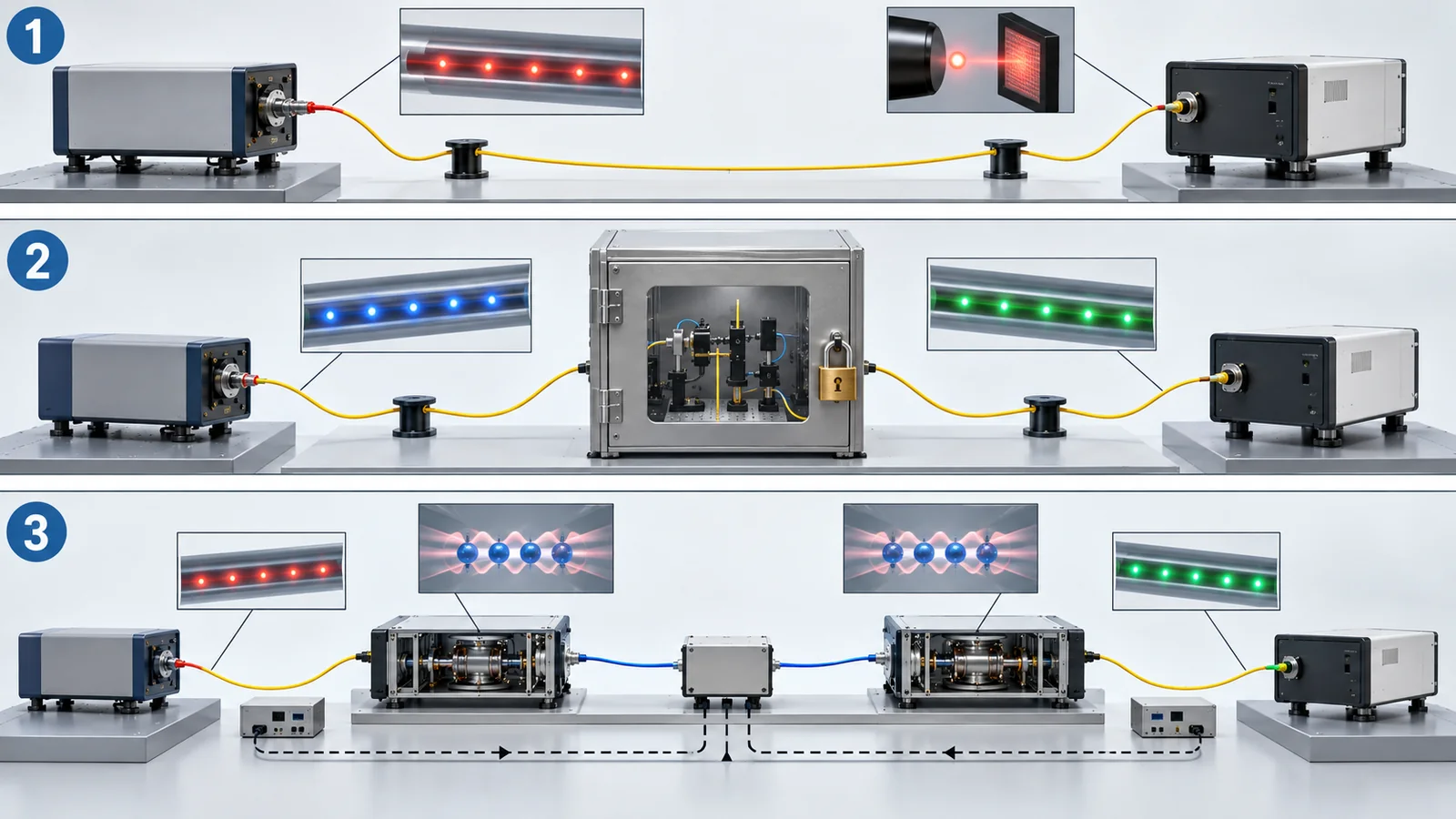
View original SVG, values and sources
Original SVG reference: Conceptual diagram (vector drawing). Three routes to longer range. See the table below for experiments and deployments.
- Trusted relays (trusted nodes): a key is made for every hop by QKD, and at each relay site keys are handed on so that a key reaches from end to end. QKD networks often take this form. But if a relay site is taken over by an attacker, the key leaks. Yin et al. state that relays pose security risks[Ref. 23], and the NSA says trusted relays raise cost and insider threat[Ref. 29]. In Japan, a field test of the Tokyo QKD Network has been reported (Sasaki et al.)[Ref. 25].
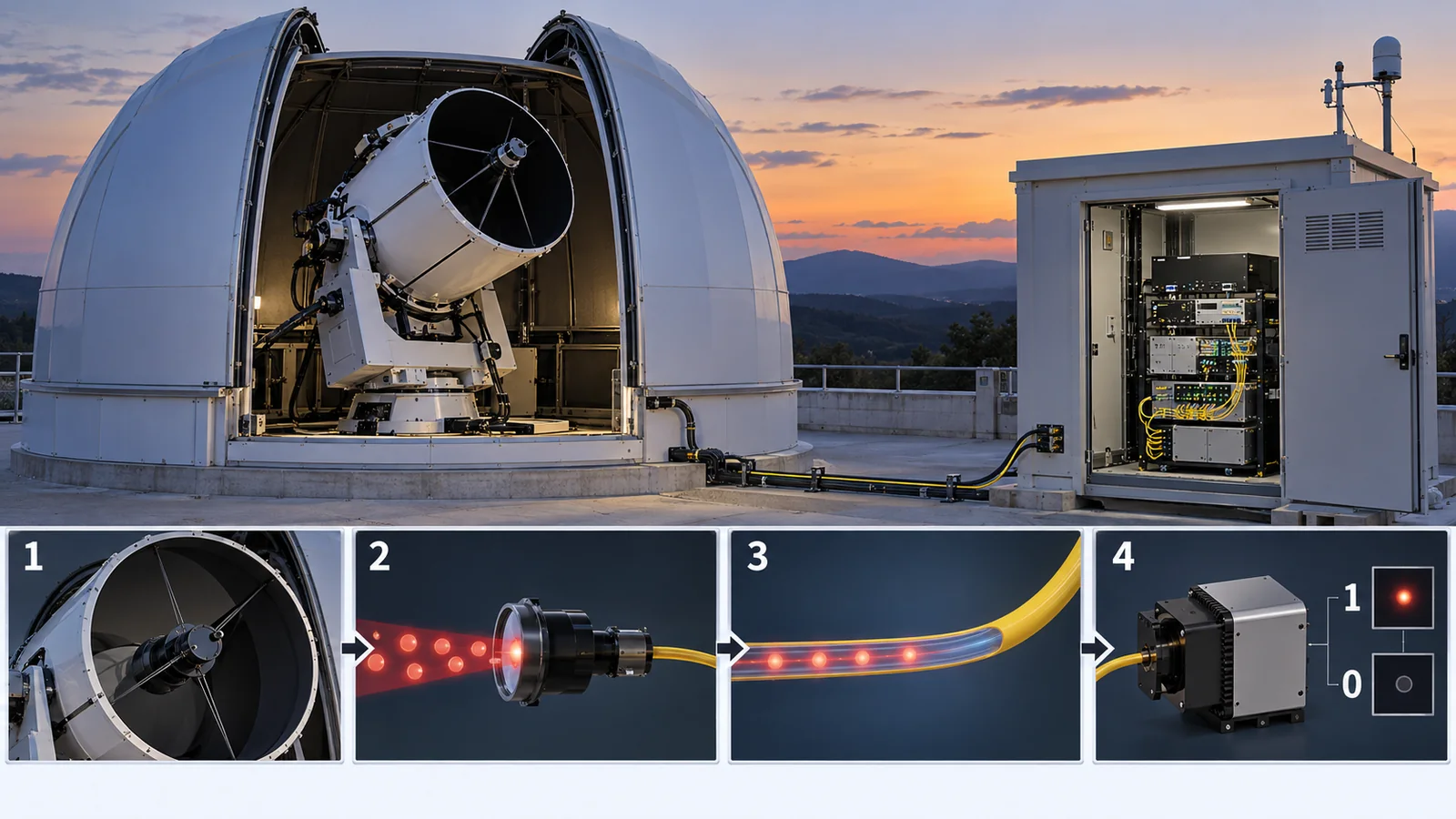
- Satellites: space has very little optical loss, so a satellite delivers light to the ground. Experiments with China's Micius satellite since 2017 report key generation from satellite to ground up to 1,200 km[Ref. 22], an experiment sending entangled photons from the satellite to two ground stations to make a key between ground stations 1,120 km apart[Ref. 23], and an integrated network of ground fibre and satellite links[Ref. 24].
- Twin-field QKD (TF-QKD): faint light is sent from both ends to a middle measuring station where it interferes, and the key rate falls with distance following the √η trend rather than η. Lucamarini et al. proposed it in 2018 and argued it can exceed the limit for two end points without quantum repeaters[Ref. 12]. A feature is that security holds whoever controls the middle station[Ref. 12].
Here are the main experiments, each with what the number is. The schemes and conditions differ, so key amounts cannot be used to rank them.
| Experiment (year) | Scheme | Distance / scale | Reported key rate (conditions) | Reading caution |
|---|---|---|---|---|
| Boaron et al. (2018)[Ref. 19] | Three-state time-bin with one decoy; ultralow-loss fibre; 2.5 GHz repetition | Up to 421 km | 6.5 bit/s over 405 km | Point-to-point QKD; a laboratory fibre value |
| Chen et al. (2020)[Ref. 20] | Twin-field (sending-or-not-sending); two independent lasers | 509 km | No absolute value in the abstract; reported as "more than seven times the relative bound for repeaterless QKD" | Includes finite-key effects. A comparison with the bound, not bits per second |
| Liu et al. (2023)[Ref. 21] | Twin-field (SNS); superconducting detectors | 1002 km | 9.53×10⁻¹² per pulse (asymptotic, 1002 km); with finite-size effects 8.75×10⁻¹² at 952 km | A per-pulse value, not per second. If the repetition rate were 1 GHz it would be about 0.01 bit/s (our assumption; the experiment's rate is not confirmed) |
| Liao et al. (2017)[Ref. 22] | Satellite to ground; decoy states | Up to 1,200 km | Kilohertz-class key rate | Only during a satellite pass; ground station trusts the satellite |
| Yin et al. (2020)[Ref. 23] | Entanglement from a satellite to two ground stations | 1,120 km | 0.12 bit/s (finite key) | Notable for needing no trusted relay; the key amount is small |
| Chen et al. (2021)[Ref. 24] | Ground fibre network plus two satellite links (trusted relays) | Over 700 fibre QKD links, over 2,000 km on the ground, 4,600 km in total | Average 47.8 kbit/s in a typical satellite pass | A trusted-relay structure; a demonstration of network scale in which relay sites are trusted |
Sourced. All values are those reported in the paper abstracts. Schemes, distances and conditions (asymptotic or finite; per pulse or per second) differ, so the numbers in the table cannot be used to rank the experiments.
The 1002 km experiment shows that a key can in principle be extracted; its per-pulse value is about 10−11. Converting this to per second needs the repetition rate; at 1 GHz, say, it would be under one bit per 100 seconds (a calculation under our assumption). A distance record says "it was done"; the key rate says "whether it is usable": they are different numbers.
As the table in Chapter 7 shows, light falls by a factor of 100 every 100 km. Merely lowering fibre loss by 0.01 dB per km cuts the loss at 500 km by 5 dB (to about one third; Our calculation). The 500 km experiment (Chen et al.) also reportedly used ultralow-loss fibre[Ref. 20]. The purity, defects and interfaces of the glass (see our optical fibre explainer) and the material quality of superconducting detectors (low dark counts) feed directly into how far one can reach. This is materials work that will not go away in the age of quantum repeaters (our commentary).
9. Standards and the views of national agencies
QKD has two kinds of "yardsticks": technical standards, and the views of national security agencies. Do not confuse them. Standards define how devices and networks are built, connected and tested; agency views are judgements on whether QKD should be used to protect a nation's important information.
(1) Technical standards (checked 16 October 2026)
- ITU-T (the standardisation sector of the International Telecommunication Union): recommendations for QKD networks have been developed in sequence: Y.3800 (overview, October 2019), Y.3801 (functional requirements), Y.3802 (functional architecture), Y.3803 (key management), Y.3804 (control and management; the April 2025 edition is in force) and X.1710 (security framework for QKD networks) and X.1711 (framework of QKD protocols in QKD networks, March 2026). All are shown as "in force"[Ref. 32, 33, 34, 35, 36, 37, 45].
- ETSI (the European Telecommunications Standards Institute): its QKD industry specification group publishes specifications (GS) and reports (GR). Examples are GS QKD 014 (a REST API through which an application receives keys from a QKD network, February 2019)[Ref. 39], GS QKD 011 (how to characterise optical components, May 2016)[Ref. 40], GS QKD 008 (security specification for QKD modules, December 2010)[Ref. 41], GS QKD 016 (a Common Criteria protection profile, V2.1.1, January 2024), GR QKD 007 (vocabulary, V1.2.1, January 2026) and GS QKD 020 (a REST API for interoperable key management systems, V1.1.1, June 2026)[Ref. 38].
- ISO/IEC: ISO/IEC 23837-1:2023 (security requirements, test and evaluation methods for QKD, Part 1: requirements; August 2023) and 23837-2:2023 (Part 2: evaluation and testing methods; September 2023). They set out a framework for QKD security evaluation using Common Criteria (the ISO/IEC 15408 series)[Ref. 42, 43]. The texts are paid, so we checked only titles and abstracts. Separately, the joint ISO/IEC committee on quantum technologies (IEC/ISO JTC 3) includes quantum communications in its scope and has a working group, WG 16 "Quantum Communication" (checked 16 October 2026)[Ref. 46].
A standard is a recommendation or specification, not a guarantee that "conforming means safe". For example GS QKD 014 specifies the interface through which keys are received; how a QKD network shares keys is outside its scope (its scope states that how a QKD network generates key material between distant nodes is beyond the scope)[Ref. 39].
(2) Views of national agencies
| Agency | View (as stated in the official document) | Document checked and date |
|---|---|---|
| US NSA | Does not recommend QKD or quantum cryptography to protect communications in national security systems (NSS). Reasons: no authentication, need for special equipment, higher cost and insider risk (trusted relays), difficulty of validating implementations, and denial-of-service risk. Regards PQC as more cost-effective and easier to maintain. Does not anticipate certifying or approving QKD products for NSS unless these limitations are overcome | NSA web page. The live page was not reachable from our environment; we read the Internet Archive copy dated 3 January 2026[Ref. 29] |
| UK NCSC | Will not support the use of QKD for government or military applications. Names PQC as the best mitigation; for other sectors, QKD should not be solely relied upon for generating and distributing keys. QKD use should not count as evidence in assessments of data-in-transit security | NCSC white paper (version 1.0, published 5 August 2025)[Ref. 30] |
| France ANSSI, Germany BSI, Netherlands NLNCSA, Swedish NCSA | QKD requires a dedicated communications infrastructure and has significant functional limitations, so it is suitable only for niche use cases; its security maturity is not yet sufficient. To move to a quantum-resistant environment, priority should go to PQC, which is much more compatible with existing cryptographic systems | Joint position paper of the four agencies (ANSSI page, published 25 January 2024)[Ref. 31] |
| European Commission (EuroQCI) | A programme that promotes it. It builds a quantum communication infrastructure across the EU with a fibre terrestrial segment and a satellite segment. In the first phase (2023-2025) national networks and industrial projects advanced. Since January 2024 a four-year project (NOSTRADAMUS) has also set up a test and evaluation infrastructure to assess and validate QKD technologies and services with a view to certification | European Commission EuroQCI page (checked 16 October 2026)[Ref. 47] |
Sourced. The agencies' views are judgements mainly about protecting government, military and nationally important communications; they do not deny the value of research, or of QKD in other uses. EuroQCI is a promotional programme with a different purpose from the agencies' views (our commentary).
The agencies' views are in fact the opposite. The NCSC calls PQC the "primary mitigation"[Ref. 30], and the four agencies including ANSSI say PQC deployment should take priority[Ref. 31]. The picture is that QKD needs dedicated optical links, needs authentication separately and cannot replace the cryptography of the Internet.
On the other hand, the ETSI page describes QKD as a technique complementary to PQC that can add protection against residual risks[Ref. 38]. There is a view of "complementing" rather than "replacing", with its value depending on use and operation: that is the current picture (our commentary).
10. QKD and PQC: differences and how they fit together
QKD and PQC both aim to keep key sharing safe even when quantum computers arrive, but they protect in different ways.
| Point of comparison | QKD | PQC |
|---|---|---|
| Basis of safety | Quantum properties of light; the theory assumes ideal devices[Ref. 2] | Confidence in the hardness of new mathematical problems (next article) |
| Authentication | Not provided; needs another method (PQC or pre-shared keys)[Ref. 29, 30] | Signature schemes are standardised (FIPS 204, 205 and others; next article) |
| Deployment | Dedicated optical links and hardware; cannot be deployed as software[Ref. 29] | Mostly software updates (can run on existing equipment) |
| Distance | Limited by loss; needs trusted relays, satellites and so on (Chapters 7-8) | No distance limit (runs over ordinary networks) |
| Updates and patches | Being hardware, it is hard to update or patch[Ref. 29] | Can be updated as software |
| Standards | ITU-T Y.3800 series, ETSI GS QKD, ISO/IEC 23837 (Chapter 9) | NIST FIPS 203, 204, 205 and others (next article) |
Sourced / Our calculation (organisation of the table). The PQC column is checked against primary sources in our next article on post-quantum cryptography.
We do not rank approaches or advise on which to use. Setting side by side only what the official documents say: NCSC: PQC is the best mitigation; do not rely on QKD alone for generating and distributing keys[Ref. 30]. The four agencies: QKD is niche; PQC first[Ref. 31]. NSA: not recommended for NSS[Ref. 29]. ETSI: QKD is complementary to PQC and can be part of layered protection[Ref. 38]. What decides it is the information protected, distance, cost and operations.
"Quantum communication" other than QKD
"Quantum communication" is a broader term than QKD. The NCSC divides what is called "quantum networking" into three classes: (1) replacing classical security functions with quantum technology (QKD is an example), (2) extending classical networks with functions only quantum components can provide (such as networks of quantum sensors), and (3) inherently quantum networks that distribute entangled quantum states between quantum devices[Ref. 30]. Quantum random number generators (QRNGs), which use quantum unpredictability, are also being researched as a source of the random numbers from which keys are made[Ref. 30]. Class 3 could also become a future foundation for linking distant quantum computers. We cover it in the next article on quantum networks and repeaters.
11. How to read the yardsticks and standards
QKD's progress is measured by four yardsticks: (1) how fast and how far a key can be made (key rate and distance), (2) theoretical security (the assumptions of the security proof), (3) implementation security (checking device holes) and (4) operation as a network. (1) is reported as experimental numbers, but distance, scheme, "asymptotic or finite" and "per pulse or per second" differ from number to number. The meaning of (2) depends on the assumptions. (3) has begun to be handled by standards and evaluation schemes (Common Criteria and others). Checked 16 October 2026.
| What is assessed | Representative benchmark or method (name, source) | Standards and guidance (ITU-T, ETSI, ISO/IEC and others) | Caution in reading |
|---|---|---|---|
| Key rate and distance | Key rate (bits per second or per pulse) with loss and distance; the repeaterless upper bound (Pirandola et al., 2017)[Ref. 11]Sourced | Could not be confirmed (no standard setting a common pass level for key rate was found) | Compare like with like: per pulse or per second, asymptotic or finite, and scheme (point-to-point, twin-field, satellite) |
| Theoretical security | Security proofs (Shor and Preskill, 2000) and reviews of the security of practical devices (Scarani et al., 2009; Xu et al., 2020)[Ref. 5, 2, 16]Sourced | ISO/IEC 23837-1:2023 (security functional requirements for QKD within the Common Criteria framework)[Ref. 42]Sourced | Proofs carry assumptions (trusted sources, detectors, random numbers). Whether they hold in an implementation is a separate question |
| Implementation security (device holes) | Experiments on attacks against detectors and so on, with countermeasures (Lydersen et al., 2010 and others); measurement-device-independent QKD (Lo et al., 2012); device-independent experiments (Nadlinger et al., Zhang et al., 2022)[Ref. 13, 15, 17, 18]Sourced | ETSI GS QKD 008 (module security, December 2010), 011 (optical component characterisation, May 2016), 016 (Common Criteria protection profile, V2.1.1, January 2024); ISO/IEC 23837-2:2023 (evaluation and testing methods)[Ref. 41, 40, 38, 43]Sourced | Where a standard's text is paid, we checked titles and scope only and do not state requirements. "Conforms to the standard" needs a check of which requirements |
| Network architecture and operation | Could not be confirmed (no common benchmark was found) | ITU-T Y.3800 (overview), Y.3801 (requirements), Y.3802 (architecture), Y.3803 (key management), Y.3804 (control and management, April 2025), X.1710 (security framework)[Ref. 32, 33, 34, 35, 36, 37]Sourced | We did not check the recommendation texts (title and status only). Trust in relay sites is not guaranteed by a standard |
| Application interface | Could not be confirmed | ETSI GS QKD 014 V1.1.1 (February 2019): REST API over HTTPS with JSON; how keys are made is out of scope[Ref. 39]Sourced | A specification for the receiving side; it does not assess the safety of keys |
| Whether a nation adopts it | — (not an assessment but an agency judgement) | Views of the NSA, the NCSC (August 2025), and ANSSI, BSI, NLNCSA and the Swedish NCSA (January 2024) (Chapter 9). They are not standards, and whether they bind legally differs case by case[Ref. 29, 30, 31]Sourced | Judgements for their own governments' use; they do not necessarily carry over to other countries or uses |
The organisation of the table is Our calculation (arrangement). Numbers, titles and status checked on the official ITU-T, ETSI and ISO pages (checked 16 October 2026).
Cautions in reading (for materials engineers)
- "Safe by the laws of physics" and "this device is safe" are different statements: the first concerns theory, the second the verification of the device. The material quality of what builds the device (source, detector, fibre) decides the second (Chapter 7).
- Read key-amount numbers with matching conditions: "success over 1000 km", "a few bits per second" and "10−11 per pulse" are different quantities (table in Chapter 8).
- Standards and agency views differ in how binding they are: ITU-T, ETSI and ISO/IEC standards generally bind only when cited in law or contract (our commentary). Agency views bear on that country's government procurement and operations but do not necessarily bind other organisations directly.
- Separate plans from achievements: networks under construction or planned, such as EuroQCI, are to be read as "Not yet confirmed".
12. Glossary
- QKD (quantum key distribution)
- Making a shared secret key between two distant parties using the quantum properties of light.
- Key
- The secret random string used to encrypt and decrypt.
- Shared-key (symmetric) cipher
- A cipher where sender and receiver hold the same key, such as AES. Fast.
- Public-key cipher
- A cipher using a pair of a public key (padlock) and a secret key; its safety rests on computational hardness.
- Key distribution problem
- The problem of how to share a shared key the first time without anyone listening in.
- One-time pad
- A cipher using a random key as long as the message, once. Unbreakable in principle, but consumes a lot of key.
- Photon
- The smallest unit of light.
- Basis (way of measuring)
- The direction in which a quantum state is measured. Here "way A (north/south)" and "way B (east/west)".
- BB84
- The first QKD scheme, proposed by Bennett and Brassard in 1984.
- No-cloning
- The principle that an unknown quantum state cannot be copied without destroying the original.
- Intercept-resend
- The simplest eavesdropping: measure the light on the way and send fresh light matching the result.
- Sifting
- The step that keeps only the pulses where the ways matched.
- Error rate (QBER, quantum bit error rate)
- The fraction of surviving bits on which Alice and Bob disagree.
- Error correction
- Fixing mismatches in the bit strings through public communication.
- Privacy amplification
- Mixing the key into a shorter one to erase whatever an eavesdropper may know.
- Authentication
- Confirming that the partner is genuine and the messages were not altered. QKD itself does not provide it.
- Decoy-state method
- Mixing pulses of different intensity to detect holes caused by multi-photon pulses.
- MDI-QKD
- Measurement-device-independent QKD: detection is delegated to a middle device, removing detector holes.
- DIQKD
- Device-independent QKD: security is certified by violation of a Bell inequality without trusting the devices.
- Trusted relay (trusted node)
- Extending distance by handing keys on at relay sites; relay sites must be trusted.
- Twin-field QKD (TF-QKD)
- A scheme sending light from both ends to a middle station; the key rate falls following a √η trend.
- Quantum repeater
- A future device that links quantum states over long distances using entanglement (next article).
- SNSPD (superconducting nanowire single-photon detector)
- A device that detects a single photon with a superconducting nanowire; operated at cryogenic temperature.
- PQC (post-quantum cryptography)
- Cryptography based on new mathematics believed to resist quantum computers.
- QRNG (quantum random number generator)
- A device that makes random numbers using quantum unpredictability.
13. References (primary sources)
- Bennett C. H., Brassard G. "Quantum cryptography: Public key distribution and coin tossing", Theor. Comput. Sci. 560, 7–11 (2014), DOI 10.1016/j.tcs.2014.05.025 (reprint of the 1984 conference paper; arXiv:2003.06557) — doi.org/10.1016/j.tcs.2014.05.025
- Scarani V. et al. "The security of practical quantum key distribution", Rev. Mod. Phys. 81, 1301–1350 (2009), DOI 10.1103/RevModPhys.81.1301 (arXiv:0802.4155) — doi.org/10.1103/RevModPhys.81.1301
- Gisin N., Ribordy G., Tittel W., Zbinden H. "Quantum cryptography", Rev. Mod. Phys. 74, 145–195 (2002), DOI 10.1103/RevModPhys.74.145 — doi.org/10.1103/RevModPhys.74.145
- Wootters W. K., Zurek W. H. "A single quantum cannot be cloned", Nature 299, 802–803 (1982), DOI 10.1038/299802a0 — doi.org/10.1038/299802a0
- Shor P. W., Preskill J. "Simple Proof of Security of the BB84 Quantum Key Distribution Protocol", Phys. Rev. Lett. 85, 441–444 (2000), DOI 10.1103/PhysRevLett.85.441 — doi.org/10.1103/PhysRevLett.85.441
- Ekert A. K. "Quantum cryptography based on Bell's theorem", Phys. Rev. Lett. 67, 661–663 (1991), DOI 10.1103/PhysRevLett.67.661 — doi.org/10.1103/PhysRevLett.67.661
- Diffie W., Hellman M. "New directions in cryptography", IEEE Trans. Inf. Theory 22, 644–654 (1976), DOI 10.1109/TIT.1976.1055638 — doi.org/10.1109/TIT.1976.1055638
- Rivest R. L., Shamir A., Adleman L. "A method for obtaining digital signatures and public-key cryptosystems", Commun. ACM 21, 120–126 (1978), DOI 10.1145/359340.359342 — doi.org/10.1145/359340.359342
- Shannon C. E. "Communication Theory of Secrecy Systems", Bell Syst. Tech. J. 28, 656–715 (1949), DOI 10.1002/j.1538-7305.1949.tb00928.x — doi.org/10.1002/j.1538-7305.1949.tb00928.x
- Wegman M. N., Carter J. L. "New hash functions and their use in authentication and set equality", J. Comput. Syst. Sci. 22, 265–279 (1981), DOI 10.1016/0022-0000(81)90033-7 — doi.org/10.1016/0022-0000(81)90033-7
- Pirandola S., Laurenza R., Ottaviani C., Banchi L. "Fundamental limits of repeaterless quantum communications", Nat. Commun. 8, 15043 (2017), DOI 10.1038/ncomms15043 — nature.com/articles/ncomms15043
- Lucamarini M., Yuan Z. L., Dynes J. F., Shields A. J. "Overcoming the rate–distance limit of quantum key distribution without quantum repeaters", Nature 557, 400–403 (2018), DOI 10.1038/s41586-018-0066-6 — nature.com/articles/s41586-018-0066-6
- Lydersen L. et al. "Hacking commercial quantum cryptography systems by tailored bright illumination", Nat. Photon. 4, 686–689 (2010), DOI 10.1038/nphoton.2010.214 — nature.com/articles/nphoton.2010.214
- Lo H.-K., Ma X., Chen K. "Decoy State Quantum Key Distribution", Phys. Rev. Lett. 94, 230504 (2005), DOI 10.1103/PhysRevLett.94.230504 (see also Hwang W.-Y., Phys. Rev. Lett. 91, 057901 (2003), DOI 10.1103/PhysRevLett.91.057901) — doi.org/10.1103/PhysRevLett.94.230504
- Lo H.-K., Curty M., Qi B. "Measurement-Device-Independent Quantum Key Distribution", Phys. Rev. Lett. 108, 130503 (2012), DOI 10.1103/PhysRevLett.108.130503 — doi.org/10.1103/PhysRevLett.108.130503
- Xu F., Ma X., Zhang Q., Lo H.-K., Pan J.-W. "Secure quantum key distribution with realistic devices", Rev. Mod. Phys. 92, 025002 (2020), DOI 10.1103/RevModPhys.92.025002 — doi.org/10.1103/RevModPhys.92.025002
- Nadlinger D. P. et al. "Experimental quantum key distribution certified by Bell's theorem", Nature 607, 682–686 (2022), DOI 10.1038/s41586-022-04941-5 — nature.com/articles/s41586-022-04941-5
- Zhang W. et al. "A device-independent quantum key distribution system for distant users", Nature 607, 687–691 (2022), DOI 10.1038/s41586-022-04891-y — nature.com/articles/s41586-022-04891-y
- Boaron A. et al. "Secure Quantum Key Distribution over 421 km of Optical Fiber", Phys. Rev. Lett. 121, 190502 (2018), DOI 10.1103/PhysRevLett.121.190502 — doi.org/10.1103/PhysRevLett.121.190502
- Chen J.-P. et al. "Sending-or-Not-Sending with Independent Lasers: Secure Twin-Field Quantum Key Distribution over 509 km", Phys. Rev. Lett. 124, 070501 (2020), DOI 10.1103/PhysRevLett.124.070501 — doi.org/10.1103/PhysRevLett.124.070501
- Liu Y. et al. "Experimental Twin-Field Quantum Key Distribution over 1000 km Fiber Distance", Phys. Rev. Lett. 130, 210801 (2023), DOI 10.1103/PhysRevLett.130.210801 — doi.org/10.1103/PhysRevLett.130.210801
- Liao S.-K. et al. "Satellite-to-ground quantum key distribution", Nature 549, 43–47 (2017), DOI 10.1038/nature23655 — nature.com/articles/nature23655
- Yin J. et al. "Entanglement-based secure quantum cryptography over 1,120 kilometres", Nature 582, 501–505 (2020), DOI 10.1038/s41586-020-2401-y — nature.com/articles/s41586-020-2401-y
- Chen Y.-A. et al. "An integrated space-to-ground quantum communication network over 4,600 kilometres", Nature 589, 214–219 (2021), DOI 10.1038/s41586-020-03093-8 — nature.com/articles/s41586-020-03093-8
- Sasaki M. et al. "Field test of quantum key distribution in the Tokyo QKD Network", Opt. Express 19, 10387–10409 (2011), DOI 10.1364/OE.19.010387 — doi.org/10.1364/OE.19.010387
- Hadfield R. H. "Single-photon detectors for optical quantum information applications", Nat. Photon. 3, 696–705 (2009), DOI 10.1038/nphoton.2009.230 — doi.org/10.1038/nphoton.2009.230
- Marsili F. et al. "Detecting single infrared photons with 93% system efficiency", Nat. Photon. 7, 210–214 (2013), DOI 10.1038/nphoton.2013.13 (arXiv:1209.5774) — arxiv.org/abs/1209.5774
- Reddy D. V., Nerem R. R., Nam S. W., Mirin R. P., Verma V. B. "Superconducting nanowire single-photon detectors with 98% system detection efficiency at 1550 nm", Optica 7, 1649–1653 (2020), DOI 10.1364/OPTICA.400751 — doi.org/10.1364/OPTICA.400751
- NSA (National Security Agency) "Quantum Key Distribution (QKD) and Quantum Cryptography (QC)" (web page). The live page was not reachable from our environment on 16 October 2026; the text was read from an Internet Archive copy of the same URL — nsa.gov/Cybersecurity/Quantum-Key-Distribution-QKD-and-Quantum-Cryptography-QC/
- NCSC (UK National Cyber Security Centre) "Quantum networking technologies" (white paper, version 1.0, published 5 August 2025) — ncsc.gov.uk/whitepaper/quantum-security-technologies
- ANSSI, BSI, NLNCSA, Swedish NCSA "Position Paper on Quantum Key Distribution" (ANSSI page, published 25 January 2024) — cyber.gouv.fr/en/publications/jointly-led-international-publications/position-pa
- ITU-T Recommendation Y.3800 (10/2019) "Overview on networks supporting quantum key distribution" (status: in force) — itu.int/rec/T-REC-Y.3800/en
- ITU-T Recommendation Y.3801 (04/2020) "Functional requirements for quantum key distribution networks" (status: in force) — itu.int/rec/T-REC-Y.3801/en
- ITU-T Recommendation Y.3802 (12/2020) "Quantum key distribution networks – Functional architecture" (status: in force; Amendment 1, 11/2023) — itu.int/rec/T-REC-Y.3802/en
- ITU-T Recommendation Y.3803 (12/2020) "Quantum key distribution networks – Key management" (status: in force; Amendment 1, 11/2023) — itu.int/rec/T-REC-Y.3803/en
- ITU-T Recommendation Y.3804 (04/2025) "Quantum key distribution networks – Control and management" (status: in force; supersedes the 09/2020 edition) — itu.int/rec/T-REC-Y.3804/en
- ITU-T Recommendation X.1710 (10/2020) "Security framework for quantum key distribution networks" (status: in force) — itu.int/rec/T-REC-X.1710/en
- ETSI Quantum Key Distribution (QKD) committee page, listing of ETSI group specifications and group reports (checked 16 October 2026) — etsi.org/committee/qkd
- ETSI GS QKD 014 V1.1.1 (2019-02) "Quantum Key Distribution (QKD); Protocol and data format of REST-based key delivery API" — etsi.org/deliver/etsi_gs/QKD/001_099/014/01.01.01_60/gs_qkd014v010101p.pdf
- ETSI GS QKD 011 V1.1.1 (2016-05) "Quantum Key Distribution (QKD); Component characterization: characterizing optical components for QKD systems" — etsi.org/deliver/etsi_gs/QKD/001_099/011/01.01.01_60/gs_QKD011v010101p.pdf
- ETSI GS QKD 008 V1.1.1 (2010-12) "Quantum Key Distribution (QKD); QKD Module Security Specification" — etsi.org/deliver/etsi_gs/QKD/001_099/008/01.01.01_60/gs_qkd008v010101p.pdf
- ISO/IEC ISO/IEC 23837-1:2023 "Information security — Security requirements, test and evaluation methods for quantum key distribution — Part 1: Requirements" (ISO page; published 2023-08, ISO/IEC JTC 1/SC 27) — iso.org/standard/77097.html
- ISO/IEC ISO/IEC 23837-2:2023 "… — Part 2: Evaluation and testing methods" (ISO page; published 2023-09) — iso.org/standard/77309.html
- Liu W.-Z. et al. "Long-lived remote ion–ion entanglement for scalable quantum repeaters", Nature 652, 51 (2026; published online 2 February 2026), DOI 10.1038/s41586-026-10177-4 — nature.com/articles/s41586-026-10177-4
- ITU-T Recommendation X.1711 (03/2026) "Framework of quantum key distribution (QKD) protocols in QKD networks" (status: in force; checked 16 October 2026) — itu.int/rec/T-REC-X.1711/en
- IEC/ISO JTC 3 "Quantum technologies" committee page on iso.org (scope includes quantum communications; working groups include WG 16 Quantum Communication; checked 16 October 2026) — iso.org/committee/10138914.html
- European Commission "European Quantum Communication Infrastructure - EuroQCI" (Shaping Europe's digital future) — digital-strategy.ec.europa.eu/en/policies/european-quantum-communication-infrast
14. Claim-to-source audit
| Claim in the text | Basis | Category |
|---|---|---|
| BB84 is the first QKD scheme, proposed by Bennett and Brassard in 1984, and the original paper cites no-cloning as the reason for security | Reprint of the BB84 paper; Scarani et al.'s review Reference 1 https://doi.org/10.1016/j.tcs.2014.05.025 Reference 2 https://doi.org/10.1103/RevModPhys.81.1301 | Sourced |
| An unknown quantum state cannot be cloned (no-cloning) | Wootters and Zurek (1982) Reference 4 https://doi.org/10.1038/299802a0 | Sourced |
| The QKD setting (quantum channel plus authenticated classical channel); Q = p/4 for intercept-resend; sifting; two-universal hashing for privacy amplification; a BB84 limit of about 11% for single photons with one-way post-processing; key fraction 1−2h(Q) | Scarani et al.'s review (Chapters I, III, IV) Reference 2 https://doi.org/10.1103/RevModPhys.81.1301 | Sourced |
| A simple proof of the security of BB84 exists (Shor and Preskill) | Abstract of Shor and Preskill (2000) Reference 5 https://doi.org/10.1103/PhysRevLett.85.441 | Sourced |
| Ekert proposed in 1991 a QKD scheme using entangled photon pairs | Title and bibliography of Ekert (1991) Reference 6 https://doi.org/10.1103/PhysRevLett.67.661 | Sourced |
| Titles and bibliographic data of the public-key idea (Diffie and Hellman, 1976) and RSA (Rivest et al., 1978) | Bibliographic data of both papers (confirmed through Crossref) Reference 7 https://doi.org/10.1109/TIT.1976.1055638 Reference 8 https://doi.org/10.1145/359340.359342 | Sourced |
| Shannon set out the theory of secrecy systems in 1949 (perfect secrecy of the one-time pad) | Title and bibliography of Shannon (1949); the description in Scarani et al. Reference 9 https://doi.org/10.1002/j.1538-7305.1949.tb00928.x Reference 2 https://doi.org/10.1103/RevModPhys.81.1301 | Sourced |
| Information-theoretically secure authentication with a short pre-shared key exists (Wegman and Carter) | Title and bibliography of Wegman and Carter (1981); the description in Scarani et al. Reference 10 https://doi.org/10.1016/0022-0000(81)90033-7 Reference 2 https://doi.org/10.1103/RevModPhys.81.1301 | Sourced |
| The repeaterless upper bound on key rate is about 1.44η bits per use at high loss | Body of Pirandola et al. (2017) Reference 11 https://www.nature.com/articles/ncomms15043 | Sourced |
| The twin-field proposal: the key rate scales with √η whoever controls the measuring station; earlier experimental values (1.26 Mbit/s at 50 km; 1.16 bits per hour at 404 km) | Abstract of Lucamarini et al. (2018) Reference 12 https://www.nature.com/articles/s41586-018-0066-6 | Sourced |
| Experiments showed that the detectors of two commercial QKD systems could be controlled from outside with tailored bright light | Abstract of Lydersen et al. (2010) Reference 13 https://www.nature.com/articles/nphoton.2010.214 | Sourced |
| The decoy-state proposals (Hwang; Lo et al.); MDI-QKD (Lo et al., 2012); the review of QKD with realistic devices (Xu et al., 2020) | Titles and bibliographic data of the papers (confirmed through Crossref) Reference 14 https://doi.org/10.1103/PhysRevLett.94.230504 Reference 15 https://doi.org/10.1103/PhysRevLett.108.130503 Reference 16 https://doi.org/10.1103/RevModPhys.92.025002 | Sourced |
| DIQKD experiments: 95,628 bits from 1.5 million Bell pairs over eight hours with trapped ions; 0.07 bits per entanglement-generation event (asymptotic) with rubidium atoms in buildings 400 m apart; in 2026, 10 km (finite) and 101 km (asymptotic) with trapped-ion memories | Abstracts of Nadlinger et al. and Zhang et al. (2022) and Liu et al. (2026) Reference 17 https://www.nature.com/articles/s41586-022-04941-5 Reference 18 https://www.nature.com/articles/s41586-022-04891-y Reference 44 https://www.nature.com/articles/s41586-026-10177-4 | SourcedNot yet confirmed |
| 421 km; 6.5 bit/s over 405 km (2.5 GHz, three-state time-bin with one decoy) | Abstract of Boaron et al. (2018) Reference 19 https://doi.org/10.1103/PhysRevLett.121.190502 | Sourced |
| Twin-field over 509 km (SNS, two independent lasers, finite-key included), more than seven times the relative repeaterless bound | Abstract of Chen et al. (2020) Reference 20 https://doi.org/10.1103/PhysRevLett.124.070501 | Sourced |
| Twin-field over 1002 km with 9.53×10⁻¹² per pulse (asymptotic), and 8.75×10⁻¹² at 952 km with finite-size effects | Abstract of Liu et al. (2023) (APS page) Reference 21 https://doi.org/10.1103/PhysRevLett.130.210801 | Sourced |
| Satellite-to-ground key up to 1,200 km at kilohertz rate | Abstract of Liao et al. (2017) Reference 22 https://www.nature.com/articles/nature23655 | Sourced |
| Entanglement from a satellite gives 0.12 bit/s between ground stations 1,120 km apart without trusted relays; relays are noted to pose security risks | Abstract of Yin et al. (2020) Reference 23 https://www.nature.com/articles/s41586-020-2401-y | Sourced |
| An integrated network of over 700 fibre QKD links and two satellite links; an average of 47.8 kbit/s in a typical satellite pass; a trusted-relay structure; 4,600 km in total | Abstract of Chen et al. (2021) Reference 24 https://www.nature.com/articles/s41586-020-03093-8 | Sourced |
| A field test of a QKD network was carried out in Tokyo | Title and bibliography of Sasaki et al. (2011) Reference 25 https://doi.org/10.1364/OE.19.010387 | Sourced |
| A review of single-photon detectors; system detection efficiency of 93% near 1550 nm with WSi nanowires, later 98.0±0.5% | Hadfield (2009); Marsili et al. (2013, arXiv); Reddy et al. (2020) Reference 26 https://doi.org/10.1038/nphoton.2009.230 Reference 27 https://arxiv.org/abs/1209.5774 Reference 28 https://doi.org/10.1364/OPTICA.400751 | Sourced |
| The NSA does not recommend QKD or quantum cryptography for protecting NSS communications, citing lack of authentication, special equipment, cost and insider threat, validation difficulty and denial of service; it says the real security is the more limited one achievable by hardware and design | NSA official page (read through an Internet Archive copy; checked 16 October 2026) Reference 29 https://www.nsa.gov/Cybersecurity/Quantum-Key-Distribution-QKD-and-Quantum-Cryptography-QC/ | Sourced |
| The NCSC will not support QKD for government or military use, calls PQC the best mitigation and says QKD should not be solely relied on; the two ways to authenticate; the three classes of quantum networking; QRNG | NCSC white paper (version 1.0, 5 August 2025) Reference 30 https://www.ncsc.gov.uk/whitepaper/quantum-security-technologies | Sourced |
| ANSSI, BSI, NLNCSA and the Swedish NCSA state that QKD suits only niche use cases, its security maturity is not sufficient and PQC should take priority | ANSSI page introducing the joint position paper (25 January 2024) Reference 31 https://cyber.gouv.fr/en/publications/jointly-led-international-publications/position-paper-on-quantum-key-distribution/ | Sourced |
| Numbers, titles and status (in force) of ITU-T Y.3800, Y.3801, Y.3802, Y.3803, Y.3804 (April 2025 edition), X.1710 and X.1711 (March 2026) | ITU-T recommendation pages Reference 32 https://www.itu.int/rec/T-REC-Y.3800/en Reference 33 https://www.itu.int/rec/T-REC-Y.3801/en Reference 34 https://www.itu.int/rec/T-REC-Y.3802/en Reference 35 https://www.itu.int/rec/T-REC-Y.3803/en Reference 36 https://www.itu.int/rec/T-REC-Y.3804/en Reference 37 https://www.itu.int/rec/T-REC-X.1710/en Reference 45 https://www.itu.int/rec/T-REC-X.1711/en | Sourced |
| IEC/ISO JTC 3 includes quantum communications in its scope and has a working group, WG 16 "Quantum Communication" | ISO committee page (checked 16 October 2026) Reference 46 https://www.iso.org/committee/10138914.html | Sourced |
| ETSI's list of QKD specifications and reports (including GS QKD 016 V2.1.1, GR QKD 007 V1.2.1 and GS QKD 020 V1.1.1) and the description of QKD as complementary to PQC | ETSI QKD committee page Reference 38 https://www.etsi.org/committee/qkd | Sourced |
| Title and scope of GS QKD 014 V1.1.1 (February 2019): REST, HTTPS, JSON; how keys are made is out of scope | ETSI specification PDF Reference 39 https://www.etsi.org/deliver/etsi_gs/QKD/001_099/014/01.01.01_60/gs_qkd014v010101p.pdf | Sourced |
| GS QKD 011 V1.1.1 (May 2016) sets out how to characterise optical components, with particular attention to sources and single-photon detectors; quantities measured (mean photon number, intensity stability, jitter and so on) | ETSI specification PDF Reference 40 https://www.etsi.org/deliver/etsi_gs/QKD/001_099/011/01.01.01_60/gs_QKD011v010101p.pdf | Sourced |
| GS QKD 008 V1.1.1 (December 2010) requires detection of physical penetration and zeroization of plaintext secret parameters | ETSI specification PDF (scope) Reference 41 https://www.etsi.org/deliver/etsi_gs/QKD/001_099/008/01.01.01_60/gs_qkd008v010101p.pdf | Sourced |
| Numbers, titles, publication dates and abstracts of ISO/IEC 23837-1:2023 (August 2023) and -2:2023 (September 2023) | ISO pages (the paid texts were not checked) Reference 42 https://www.iso.org/standard/77097.html Reference 43 https://www.iso.org/standard/77309.html | Sourced |
| EuroQCI consists of terrestrial (fibre) and space (satellite) segments, went through a first phase in 2023-2025, and since January 2024 a four-year testing infrastructure project (NOSTRADAMUS) is under way | European Commission EuroQCI page (checked 16 October 2026) Reference 47 https://digital-strategy.ec.europa.eu/en/policies/european-quantum-communication-infrastructure-euroqci | SourcedNot yet confirmed |
| The intercept-resend tables (the 12-pulse example with seed 2, the 200,000-pulse simulation with seed 7), the 12-pulse example of Chapter 4 (seed 4), the key-fraction table (1−2h(Q)), and the distance-and-loss table and Fig. 8 (assuming 0.2 dB/km and 10^9 pulses per second) | Our calculation (Python; fixed random seeds; assumes ideal single photons, an infinite key and loss only; not values of a real device) | Our calculation |
| Converting 1002 km's roughly 10⁻¹¹ per pulse to per second at an assumed 1 GHz repetition gives about 0.01 bit/s | Our calculation (the experiment's repetition rate could not be confirmed, so 1 GHz is an assumption) | Our calculation |
| Lowering fibre loss by 0.01 dB/km reduces the loss at 500 km by 5 dB | Our calculation (500 km × 0.01 dB/km) | Our calculation |
| The explanation of shared-key ciphers (AES and others), the padlock analogy, the point that errors cannot be told apart as eavesdropping or noise, the one-time pad versus fast ciphers, the view of QKD as "key growing", the block example of error correction, the organisation of trusted relays, standards and agency views, and the materials viewpoints (detectors, fibre, components) | Our organisation and commentary based on published material; not views stated by the bodies concerned | Commentary |
| Rankings among QKD standards, countries, schemes or companies; advice on whether to use QKD or PQC; procedures for breaking cryptography or exploiting device weaknesses | This article does not state these (we only set out what official documents say) | Commentary |
| Figures 2-9 and 11 are explanatory diagrams, not observations of real data; Figures 1 and 10 are ImageGen-generated conceptual illustrations | Note by this article | Commentary |
Last updated: 16 October 2026. Sources are limited to primary material (peer-reviewed papers; official pages of ITU-T, ETSI and ISO; official pages of the NSA, NCSC, ANSSI and the European Commission). The texts of standards are paid or were not checked, so we confirmed only titles and scope. The NSA's official page was not reachable from our environment, and we read an Internet Archive copy. Numerical examples are our own calculations, not measurements of a real device. We could not confirm, and therefore do not state: a standard setting a common pass level for key rate, a common benchmark for network operation, the repetition rate of the 1002 km experiment, or the contents of the requirements of each standard. All figures are explanatory concept diagrams or charts including our calculation; Figures 1 and 10 are ImageGen-generated conceptual illustrations. This article is neither legal nor investment advice, and not an explanation of how to carry out attacks.