TECHNOLOGY EXPLAINER
Rocket Basics
— the rocket equation, made easy with figures and numerical examples
A rocket is a vehicle that burns propellant and gets lighter as it goes. Why does a giant rocket carry such a small payload? Why are stages dropped? What is specific impulse, the propellant "fuel economy"? This article explains the rocket equation by checking it with concrete numbers rather than memorizing it. It also looks at the stated values of a real vehicle (Falcon 9) and the flow of a launch, and connects it all to why a single kilogram of mass weighs so heavily for a materials engineer.
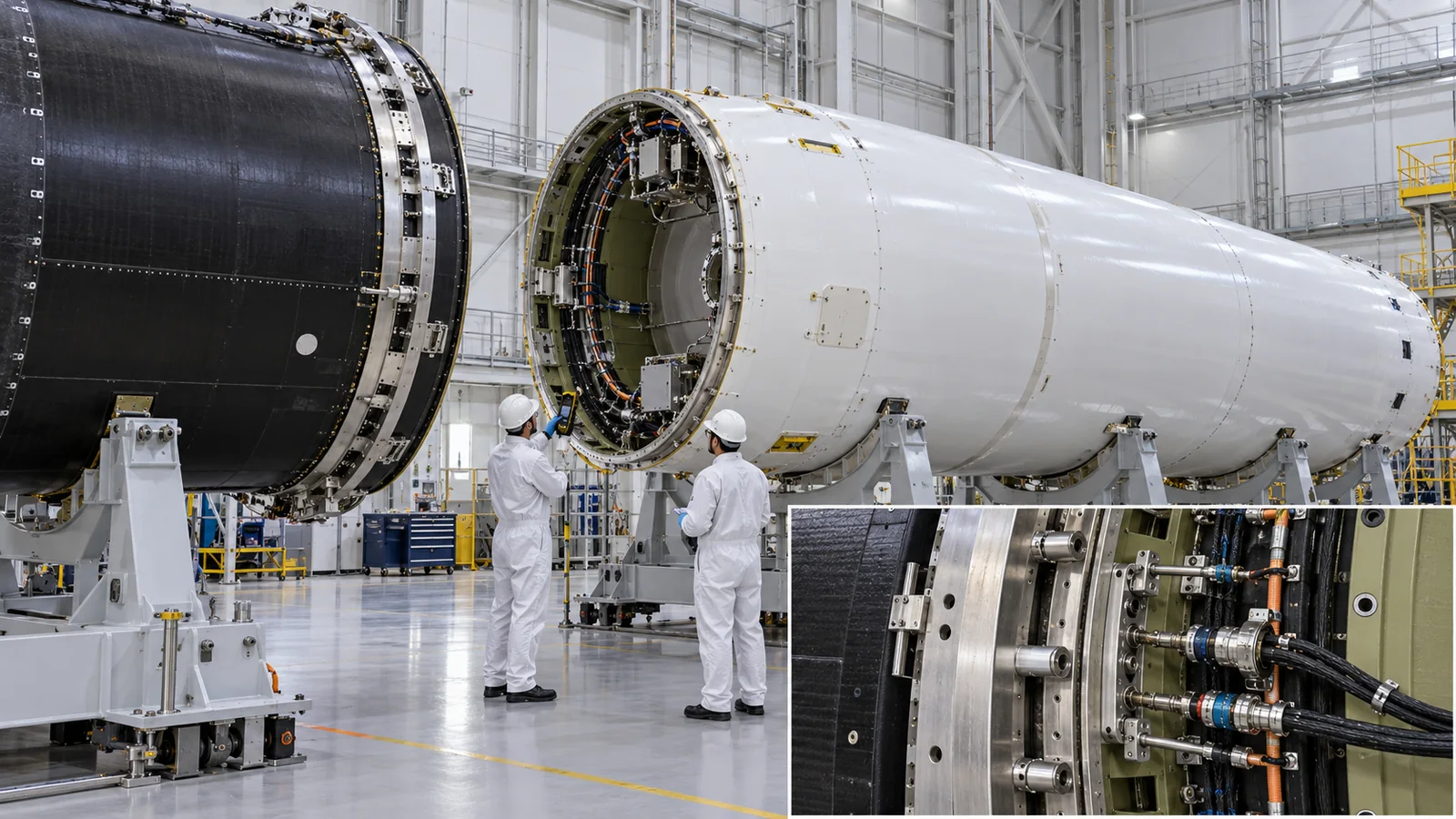
- The short version / what to know first / where this sits in the series
- How a rocket moves: the reaction to what it expels
- Specific impulse: the propellant "fuel economy"
- The speed needed to reach orbit
- The rocket equation: checked with numbers
- Why stages: a calculation of payload share
- A real vehicle: Falcon 9's stated values
- The flow of a launch
- A materials engineer's view: the value of lightness differs by stage
- How to read the yardsticks and standards / limits / glossary / references / claim-to-source audit
Sourced = stated in a public document (source linked)
Our calculation = a value we derived from stated assumptions
Not yet confirmed = plans, targets and other unsettled matters
Our reading for materials is marked Commentary. Inference is shown in bold. Every analogy comes with its limits.
The "required speed of 9.4 km/s", "structure share of 8 %" and "specific impulses of 300, 350 and 450 s" in sections 4 to 6 are assumed values set for explanation, not those of any real vehicle. For real vehicles we use only Falcon 9's manufacturer-stated values (SpaceX) and JAXA's introduction page for H3, with conditions (vehicle, orbit, date). We do not rank vehicles by putting their numbers side by side. The checked date is 17 October 2026.
1. The short version / what to know first / where this sits in the series
- A rocket moves by the reaction to what it expels. Thrust is the product of the exhaust mass flow and the exhaust speed. It does not push on air, so it works in vacuum [Ref. 1]Sourced.
- To reach orbit, most of the mass must be propellant. Assuming a required speed of 9.4 km/s and a specific impulse of 350 s, the mass ratio is about 15.5: about 94 % of the liftoff mass is propellant, leaving about 6.5 % for payload and structure Our calculation.
- That is why stages are dropped. With the same assumptions and a structure share of 8 %, one stage cannot reach orbit even with no payload, while two stages give a payload of about 3.6 % Our calculation. For the real Falcon 9, the stated payload to low Earth orbit is about 4.2 % of the liftoff mass [Ref. 5]SourcedOur calculation.
No prior knowledge is needed. The idea of an orbit ("falling while moving sideways") and the speed in low Earth orbit (about 7.7 km/s) are explained in the entry article, the introduction to the space industry. There are only two equations (thrust and the rocket equation); each is explained in words and checked with numbers.
This article connects best when read after the entry article, the introduction to the space industry. Next come the articles on reusable rockets (what recovery and reuse change), on rocket engines and propellants (real values such as the specific impulse of each engine), on liquid hydrogen, on lightweight structural materials, and on CFRP and composites for space; the point about the value of lightness here leads into those materials.
2. How a rocket moves: the reaction to what it expels
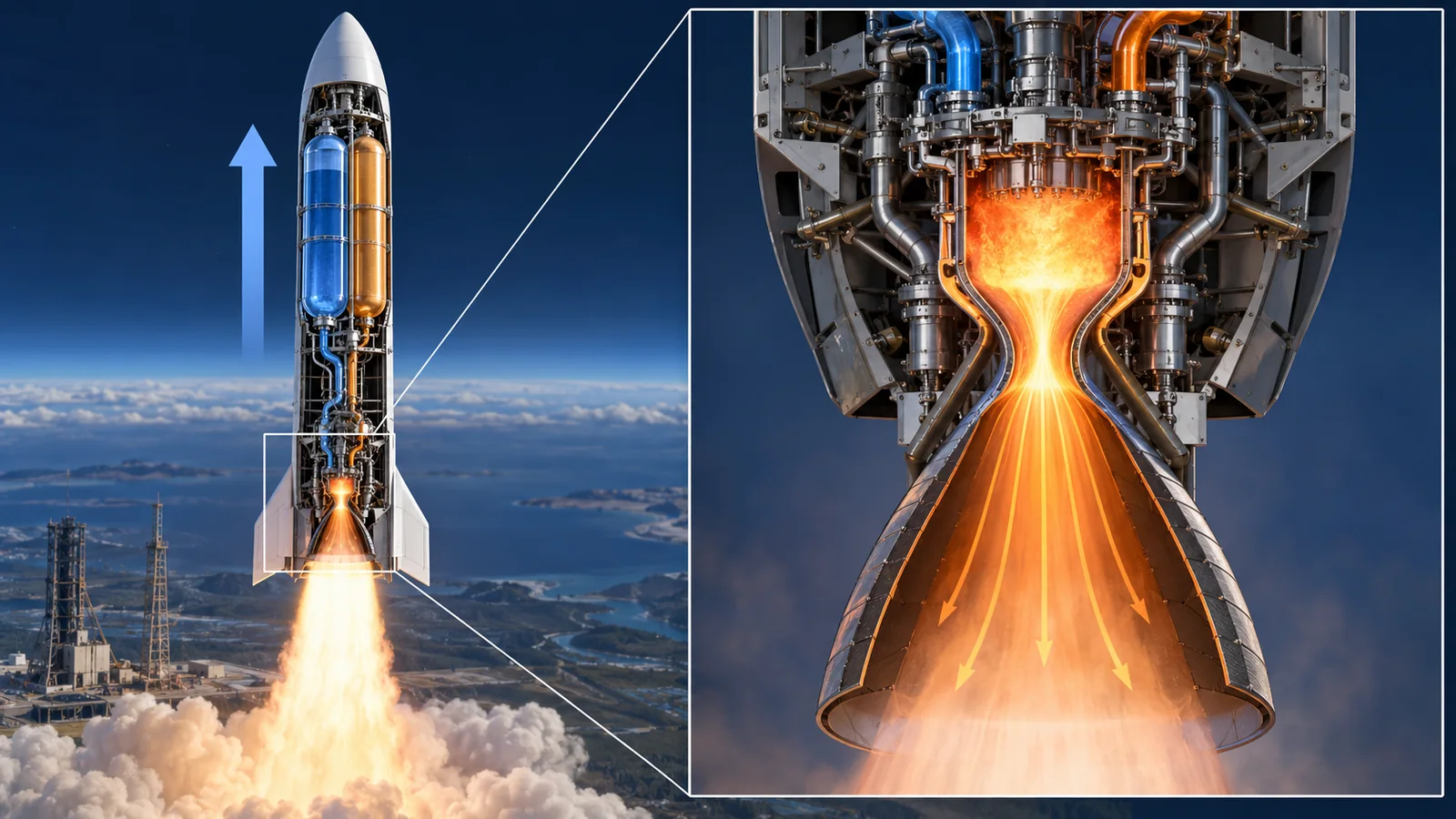
Stand on a skateboard and throw a heavy ball backward, and you roll forward. The heavier the ball and the faster you throw it, the harder you are pushed. A rocket does the same thing by expelling hot exhaust gas backward continuously.
View original SVG, values and sources
Original SVG reference: Concept diagram (vector drawing). It moves by the reaction to what it expels. Left: a familiar case; right: a rocket (concept). The thrust equation follows NASA Glenn Research Center's teaching page [Ref. 1].
NASA Glenn Research Center's teaching page writes rocket thrust as F = ṁ × V_eq. Here ṁ ("m-dot") is how much exhaust mass leaves per second (mass flow) and V_eq is the equivalent exhaust velocity (the exhaust speed plus the effect of pressure at the nozzle exit) [Ref. 1]Sourced. To raise thrust, then, expel a lot of exhaust, fast.
What a rocket pushes against is not air but the exhaust it expels itself. It moves by the reaction to that exhaust, so it works in vacuum [Ref. 1]. In the skateboard case, the thrown ball, not the floor, is what you push against. Limits of the analogy: the ball runs out after a few throws, whereas a rocket expels exhaust in huge amounts every second, so its mass keeps falling (section 5).
3. Specific impulse: the propellant "fuel economy"
A rocket that needs less propellant can carry more payload. The quantity that expresses this efficiency is the specific impulse (I_sp). NASA Glenn Research Center's teaching page defines I_sp = F ÷ (ṁ × g₀), that is I_sp = V_eq ÷ g₀, where g₀ is the standard gravitational acceleration (9.80665 m/s²) [Ref. 1]Sourced.
The unit is seconds. An engine with a larger specific impulse is a more efficient engine that gives more thrust from the same amount of propellant [Ref. 1]Sourced. Check with numbers: for 300 s the equivalent exhaust velocity is 300 × 9.80665 ÷ 1000 ≈ 2.94 km/s, for 350 s about 3.43 km/s and for 450 s about 4.41 km/s Our calculation.
One example of a real engine: Rocket Lab states a specific impulse of 311 s for the first stage of Electron (sea level) and 343 s for the second stage (vacuum engine) (manufacturer's stated values) [Ref. 7]Sourced. The 300 to 350 s used as examples in this article were set with this order of magnitude in mind. A real engine's specific impulse differs between sea level and vacuum, so check the conditions when reading a number.
Specific impulse is efficiency (the work per kilogram of propellant), not the size of thrust. Thrust depends on the size of the engine and how much propellant it flows (ṁ). In the "fuel economy" picture, specific impulse is the economy and thrust is like horsepower. Limits of the analogy: a car's economy is "distance ÷ amount of fuel", a different thing from the unit of specific impulse (seconds). Specific impulse also differs between sea level and vacuum (the pressure effect at the nozzle exit enters V_eq [Ref. 1]). When reading a figure, always check whether it is sea level or vacuum.
4. The speed needed to reach orbit
The sideways speed needed to circle in low Earth orbit is about 7.67 km/s, as calculated in the entry article (a circular orbit at 400 km altitude; the ISS circles in about 90 minutes [Ref. 4, 3]Our calculation). A rocket must accelerate from standing still on the ground to this speed.
The total speed needed, however, is larger than 7.67 km/s. Earth's rotation helps (launching eastward from the equator, the ground already moves at about 0.47 km/s, from 2π × 6,378 km ÷ the 86,164 s sidereal day [Ref. 3]Our calculation), but climbing against gravity and losses to air drag add to it. The size of these losses varies with vehicle, orbit and day, and we could not confirm an official figure for a real vehicle. So this article assumes losses of about 2.2 km/s, making a total of about 9.4 km/s, and carries the example forward.
Hearing "space begins around 100 km", one might think going 100 km straight up is enough. But stop there and you fall back. A spacecraft does not fall to Earth because it is "moving sideways fast enough" (see the entry article). Most of a rocket's energy goes into making sideways speed, not height (our commentary).
5. The rocket equation: checked with numbers
When a rocket expels propellant it gets lighter by that amount, and the lighter it is, the more easily the same thrust accelerates it. The equation that accounts for this "moving while getting lighter" effect is the rocket equation (the Tsiolkovsky equation). NASA Glenn Research Center's teaching page derives the speed gain, neglecting gravity and drag, as Δv = V_eq × ln(m₀ ÷ m₁) [Ref. 2]Sourced. Here m₀ is the total mass before burning, m₁ the mass after the propellant is used up, and ln the natural logarithm.
Inverting it, a required speed Δv needs a mass ratio of m₀ ÷ m₁ = e(Δv ÷ V_eq). For Δv = 9.4 km/s, the mass ratios are about 24.4 for 300 s (V_eq ≈ 2.94 km/s), about 15.5 for 350 s (≈ 3.43 km/s) and about 8.4 for 450 s (≈ 4.41 km/s) Our calculation.
Read the 350 s example (mass ratio about 15.5) as masses. If the liftoff mass is 100, what remains after the propellant is used up is 100 ÷ 15.5 ≈ 6.5. About 94 is propellant, and the rest is the payload plus all the structure, such as the emptied tanks and engines Our calculation. If the structure is not lighter than this 6.5, no payload can be carried.
It is not. Putting the "ln" into the exponent, doubling the speed squares the mass ratio. For example, if the mass ratio for 4.7 km/s is about 3.9, then at double the speed, 9.4 km/s, it is about 15.5 (3.9 squared) Our calculation. This is why most of a rocket's mass is propellant. Limits of the analogy: in a real ascent, the effects of gravity and drag also change as the vehicle gets lighter, so the equation is an ideal guide (NASA's page too derives it neglecting them [Ref. 2]).
6. Why stages: a calculation of payload share
Even if the mass ratio is about 15, the trouble is the weight of the emptied tanks and engines. After the propellant is gone, the tanks and engines keep being accelerated as a heavy "empty box". So the burnt-out part is dropped, the rest is lighter, and the next stage continues the acceleration. These are the stages.
Let us check by calculation. For one stage, let ε (epsilon) be the structure share (structure mass ÷ (structure + propellant)) and R the stage mass ratio. The share of "mass above" (payload plus next stage) that the stage can carry is λ = (1 ÷ R − ε) ÷ (1 − ε) (our derivation). With ε = 0.08 (assumed), comparing one stage and two stages (Δv = 4.7 km/s each) gives the table below Our calculation.
| Isp (s, assumed) | V_eq (km/s) | Mass ratio, one stage | Payload share, one stage | Mass ratio per stage, two stages | Payload share, two stages |
|---|---|---|---|---|---|
| 300 | 2.94 | 24.4 | impossible (cannot reach orbit even with no payload) | 4.94 | 1.8 % |
| 350 | 3.43 | 15.5 | impossible (cannot reach orbit even with no payload) | 3.93 | 3.6 % |
| 450 | 4.41 | 8.4 | 4.2 % | 2.90 | 8.3 % |
Our calculationΔv = 9.4 km/s (includes an assumption), ε = 0.08 (assumed); two stages each provide Δv = 4.7 km/s with the same Isp and structure share per stage. Payload share = λ (one stage) and λ² (two stages).
As the table shows, the structure share ε decides the payload share. If ε rose from 8 % to 10 %, the payload share for 350 s with two stages would be λ = (1 ÷ 3.93 − 0.10) ÷ 0.90 ≈ 0.171, and its square, about 2.9 %, down from about 3.6 %, a loss of about 18 % Our calculation. Thinner tank walls or lighter materials, improvements in materials, connect directly to payload (our commentary). The articles on lightweight structural materials and on CFRP and composites for space cover this.
7. A real vehicle: Falcon 9's stated values
What are the numbers for a real rocket? SpaceX's product page (manufacturer's stated values, checked 17 October 2026) gives Falcon 9 as 70 m tall, 3.7 m in diameter, 549,054 kg in mass, with a payload of 22,800 kg to low Earth orbit and 8,300 kg to geostationary transfer orbit (GTO) [Ref. 5]Sourced. Dividing the payload by the liftoff mass gives 22,800 ÷ 549,054 ≈ 4.2 % Our calculation, the same order as the assumed calculation of sections 5 and 6 (about 3.6 % for two stages at 350 s).
The same page says the first stage has nine Merlin engines (845 kN each at sea level) and aluminum-lithium alloy tanks (liquid oxygen and RP-1), the second stage a single Merlin Vacuum (981 kN thrust, 397 s burn time), and the fairing is carbon composite, jettisoned at about 3 minutes [Ref. 5]Sourced. The first-stage thrust is 9 × 845 = 7,605 kN, and the user's guide gives the same value [Ref. 6]. The weight (549,054 kg × 9.80665) is about 5,384 kN, so thrust ÷ weight is about 1.41 Our calculation. Unless it exceeds 1, the rocket cannot lift off.
As a second example, JAXA's introduction page for Japan's H3 rocket gives the standard H3-24L as 63 m long with a total mass of 574 tons (without payloads), and says the first-stage LE-9 engine uses the expander bleed cycle and that 3D printing was introduced to simplify the engine structure [Ref. 8]Sourced. Numbers for different vehicles are not ranked side by side, because their conditions differ.
8. The flow of a launch
Let us line the story up in time order. SpaceX's user's guide (May 2025) has two sample timelines, for GTO and LEO. The engines start 3 seconds before liftoff; liftoff is T+0; maximum dynamic pressure (max Q, when the force from the air on the vehicle peaks) is at 67 to 74 seconds; first-stage engine cutoff (MECO) at 145 to 147 seconds; stage separation at 148 to 151 seconds; second-stage ignition at 156 to 158 seconds; fairing separation at 195 to 222 seconds; and the first second-stage cutoff (SECO-1) at 484 to 514 seconds [Ref. 6]Sourced. The guide notes that each flight profile is unique and will differ from these examples.
The faster a vehicle goes, the stronger the force from the air; but the higher it rises, the thinner the air. Balancing the two, there is a moment when the force from the air (dynamic pressure) peaks: max Q (our commentary). It is one of the times when the structure is most heavily loaded, and the material's strength is tested.
9. A materials engineer's view: the value of lightness differs by stage
It is often said that "a kilogram saved on the vehicle is a kilogram of extra payload", but that is true only for the upper stage. In our model (two stages each providing half the speed, Isp 350 s, propellant masses and required speed held fixed), cutting 1 kg from the second stage's dry (empty) mass adds 1 kg of payload. Cutting 1 kg from the first stage adds only about 0.25 kg Our calculation. The gain is small for the first stage because the payload is only a small part of the mass that remains after the first stage (our commentary).
The calculation shows that the upper-stage tanks and structure, the fairing that wraps the payload, and the satellite itself are parts where saving mass is especially valuable (our commentary). On a real vehicle, Falcon 9 is said to use aluminum-lithium alloy for the first-stage tanks and carbon composite for the fairing [Ref. 5]Sourced. The first stage, on the other hand, is where strength, durability and reuse count, and lightness alone does not decide (see the article on reusable rockets). The choice of material is set by the value of lightness at each stage, and by cost and reliability.
10. How to read the yardsticks and standards
A rocket's performance is told with a few numbers: thrust (sea level or vacuum), specific impulse (seconds; sea level or vacuum), liftoff mass, payload mass (to which orbit and inclination, reused or expended) and launch success rate. Putting bare numbers side by side invites misreading because of differing conditions. Distinguish whether a number for a real vehicle is the manufacturer's stated value (payload user's guide), an agency's official page or a third-party record (checked 17 October 2026).
| What is evaluated | Typical numbers and source | Standards and guidelines | How to read it |
|---|---|---|---|
| Thrust and specific impulse | F = ṁ × V_eq and I_sp = V_eq ÷ g₀ (NASA Glenn Research Center teaching page) [Ref. 1]Sourced | ISO 16694:2024 "Space systems — Measured parameters at firing bench and flight tests of liquid rocket engines" [Ref. 9]Sourced | Values differ between sea level and vacuum. Check whether the figure is a stated value or a measurement from a firing test |
| Payload mass | SpaceX Falcon User's Guide (9 May 2025; manufacturer's stated values) [Ref. 6]Sourced. Stated performance varies with orbit, inclination and conditions | ISO 14303:2026 "Space systems — Launch-vehicle-to-spacecraft interfaces" / ISO 17401:2023 "Space systems — Spacecraft interface requirements document for launch vehicle services" [Ref. 9]Sourced | "X kg to LEO" varies with orbit, inclination and whether reused or expended. Check the stated conditions |
| Structure, loads and testing | Vehicle loads (max Q and so on) and static qualification tests | ISO 14622:2025 "Space systems — Structural design — Loads and induced environment" / ISO 14953:2024 "Structural design — Determination of loading levels for static qualification testing of launch vehicles" / ISO 24917:2020 "General test requirements for launch vehicles" [Ref. 9]Sourced | A standard is a framework of requirements, not a guarantee of safety for a particular vehicle |
| Safety and licensing | JAXA's rocket-payload safety standard (JMR-002), launch-site operation safety technical standard (JERG-1-007) and the space debris mitigation design and operation manual for rockets (JMR-003-HB002) (titles in Japanese; titles only confirmed) [Ref. 10]Sourced | 14 CFR Part 450 "Launch and Reentry License Requirements" (US requirements for launch and reentry licenses; existence confirmed in the current eCFR) [Ref. 11]Sourced | We did not check the contents of the regulation or licenses. This is not legal advice |
| Success rate and track record | Manufacturer's stated figures (SpaceX product page, checked 17 October 2026: 693 completed missions) [Ref. 5]Sourced | Not found (we could not identify a standard that defines how to compute a success rate) | "Completed missions" is not a count of successes; failures and partial successes must be checked separately in official investigation reports and authority statements |
Our calculationThe table is organized by us. ISO numbers, titles, years and status were checked in the catalogue of standards (checked 17 October 2026; ISO 14303:2026 and ISO 14622:2025 are published (60.60) and ISO 24917:2020 is confirmed). For JAXA only titles in the list were checked, and for the FAA only the existence of the title in the eCFR. The texts of the standards and regulation were not checked and no requirements are stated. No ASTM standards are treated.
Cautions in reading (for materials engineers)
- Ground calculations differ from real vehicles: the rocket equation is an ideal equation that neglects gravity and drag [Ref. 2]. The size of the losses varies with vehicle, orbit and day.
- A manufacturer's stated value differs from third-party verification: payload masses and flight counts are the manufacturer's stated values. Read them with third-party records and agency documents.
- Check whether a standard is a recommendation or a requirement: ISO standards are not legally binding. Launch licensing (such as the FAA's 14 CFR Part 450) is permission under regulation [Ref. 11].
- Plans and achievements are different: the performance of new vehicles, reuse plans and launch cadence can change. This series marks plans as Not yet confirmed.
11. Limits, and what could not be confirmed
- We could not confirm an official figure for the speed lost to ascent and drag: 9.4 km/s is a total set for explanation, not a value for a real vehicle.
- Specific impulse and structure share are assumptions: 300, 350, 450 s and ε = 0.08 are illustrative. Differences of real designs, such as the bulk of hydrogen tanks, are not included. Real engine values are in the article on rocket engines and propellants.
- Falcon 9 stage masses and the speed at stage separation could not be confirmed: within the product page and user's guide we did not confirm the propellant mass of each stage or the speed at stage separation.
- Which sample timeline is GTO and which LEO follows the order of the table titles: the text gives the range across both, so it does not depend on the mapping.
- No comparison with other vehicles: for H3 we have only the length and mass from JAXA's page and place no performance numbers beside others.
12. Glossary
- Rocket
- A vehicle that expels propellant backward and moves by the reaction.
- Propellant
- The material a rocket expels; fuel and oxidizer together.
- Thrust
- The force that pushes the rocket: F = ṁ × V_eq.
- Mass flow (ṁ)
- How much exhaust mass leaves per second.
- Equivalent exhaust velocity (V_eq)
- The exhaust speed plus the effect of pressure at the nozzle exit.
- Specific impulse (I_sp)
- F ÷ (ṁ × g₀). Unit: seconds. The propellant "fuel economy".
- g₀
- Standard gravitational acceleration, 9.80665 m/s².
- Δv (delta-v)
- The required change in speed.
- Rocket equation
- Δv = V_eq × ln(m₀ ÷ m₁), the Tsiolkovsky equation.
- Mass ratio
- Mass before burning ÷ mass after burnout.
- Structure share (ε)
- Mass of structure such as empty tanks and engines ÷ (structure + propellant).
- Dry mass
- The empty mass of the vehicle without propellant.
- Stage
- A section of the rocket that can be dropped after burnout.
- MECO
- Main Engine Cutoff: shutdown of the first stage's main engines.
- SECO
- Second-stage Engine Cutoff.
- Max Q
- The moment when the force from the air on the vehicle (dynamic pressure) peaks.
- Fairing
- The nose covering that protects the payload from air; dropped during ascent.
- Payload
- The cargo a rocket carries (such as a satellite).
- LEO and GTO
- Low Earth orbit / geostationary transfer orbit (an elliptical orbit toward geostationary).
- Thrust ÷ weight
- Must exceed 1 to lift off.
- Manufacturer's stated value
- A value given by the manufacturer itself; distinct from third-party verification.
13. References
- NASA Glenn Research Center "Specific Impulse" — www.grc.nasa.gov/www/k-12/airplane/specimp.html
- NASA Glenn Research Center "Ideal Rocket Equation" — www1.grc.nasa.gov/beginners-guide-to-aeronautics/ideal-rocket-equation/
- NASA NSSDC "Earth Fact Sheet" — nssdc.gsfc.nasa.gov/planetary/factsheet/earthfact.html
- NASA "Space Station Facts and Figures" — www.nasa.gov/international-space-station/space-station-facts-and-figures/
- SpaceX "Falcon 9" product page (manufacturer's stated values; checked 17 October 2026) — www.spacex.com/vehicles/falcon-9
- SpaceX "Falcon User's Guide" (9 May 2025) — content.spacex.com/cms-assets/assets/falcon-users-guide-2025-05-09.pdf
- Rocket Lab "Electron" product page (manufacturer's stated values; checked 17 October 2026) — www.rocketlabcorp.com/launch/electron/
- JAXA "H3 Launch Vehicle" introduction page (checked 17 October 2026) — global.jaxa.jp/projects/rockets/h3/
- ISO/TC 20/SC 14 Catalogue of standards (titles, years and status of ISO 14303:2026, ISO 17401:2023, ISO 24917:2020, ISO 14622:2025, ISO 14953:2024 and ISO 16694:2024 checked) — www.iso.org/committee/46614/x/catalogue/p/1/u/0/w/0/d/0
- JAXA JAXA Safety and Mission Assurance Department, list of JAXA common technical documents (JERG and JMR) — sma.jaxa.jp/techdoc.html
- U.S. Government Publishing Office / eCFR 14 CFR Part 450 "Launch and Reentry License Requirements" — www.ecfr.gov/current/title-14/chapter-III/part-450
14. Claim-to-source audit
| Claim in the text | Basis | Type |
|---|---|---|
| Thrust F = ṁ × V_eq, specific impulse I_sp = F ÷ (ṁ × g₀) = V_eq ÷ g₀, unit seconds, higher means more efficient, g₀ = 9.8 m/s² | NASA Glenn teaching page "Specific Impulse" Reference 1 https://www.grc.nasa.gov/www/k-12/airplane/specimp.html | Sourced |
| The rocket equation Δv = V_eq × ln(m₀/m₁) (derived neglecting gravity and drag), definition of V_eq | NASA Glenn teaching page "Ideal Rocket Equation" Reference 2 https://www1.grc.nasa.gov/beginners-guide-to-aeronautics/ideal-rocket-equation/ | Sourced |
| Earth's equatorial radius 6,378.137 km and GM (basis of the orbital speed calculation) | NASA NSSDC Earth data Reference 3 https://nssdc.gsfc.nasa.gov/planetary/factsheet/earthfact.html | Sourced |
| The ISS circles in about 90 minutes | NASA ISS facts Reference 4 https://www.nasa.gov/international-space-station/space-station-facts-and-figures/ | Sourced |
| Falcon 9: 70 m tall, 3.7 m diameter, 549,054 kg, 22,800 kg to LEO, 8,300 kg to GTO, nine Merlin engines (845 kN at sea level) on the first stage with aluminum-lithium alloy tanks and liquid oxygen with RP-1, a single Merlin Vacuum (981 kN, 397 s burn) on the second stage, carbon-composite fairing jettisoned at about 3 minutes, 693 completed missions (checked 17 October 2026) | SpaceX product page (manufacturer's stated values) Reference 5 https://www.spacex.com/vehicles/falcon-9 | Sourced |
| First-stage thrust 7,605 kN, sample timelines (max Q 67 to 74 s, MECO 145 to 147 s, stage separation 148 to 151 s, second-stage start 156 to 158 s, fairing separation 195 to 222 s, SECO-1 484 to 514 s), "each flight profile is unique" | SpaceX Falcon User's Guide (9 May 2025) Reference 6 https://content.spacex.com/cms-assets/assets/falcon-users-guide-2025-05-09.pdf | Sourced |
| Electron: specific impulse 311 s for the first stage (sea level) and 343 s for the second (vacuum) | Rocket Lab product page (manufacturer's stated values) Reference 7 https://www.rocketlabcorp.com/launch/electron/ | Sourced |
| H3-24L: 63 m long, total mass 574 tons (without payloads), LE-9 expander bleed cycle, introduction of 3D printing | JAXA H3 introduction page Reference 8 https://global.jaxa.jp/projects/rockets/h3/ | Sourced |
| Numbers, titles, years and status of ISO 14303:2026, ISO 17401:2023, ISO 14622:2025, ISO 14953:2024, ISO 24917:2020 and ISO 16694:2024 | ISO/TC 20/SC 14 catalogue Reference 9 https://www.iso.org/committee/46614/x/catalogue/p/1/u/0/w/0/d/0 | Sourced |
| Titles of JAXA common technical documents: JMR-002, JERG-1-007, JMR-003-HB002 | JAXA S&MA list (titles only) Reference 10 https://sma.jaxa.jp/techdoc.html | Sourced |
| That 14 CFR Part 450 "Launch and Reentry License Requirements" exists in the Code of Federal Regulations | eCFR (current) Reference 11 https://www.ecfr.gov/current/title-14/chapter-III/part-450 | Sourced |
| Mass ratios (at 9.4 km/s: 24.4 for 300 s, 15.5 for 350 s, 8.4 for 450 s), propellant share, payload share with two stages (1.8, 3.6 and 8.3 % at a structure share of 8 %), payload share with one stage (4.2 % at 450 s), λ = (1/R − ε)/(1 − ε), the decrease at a structure share of 10 %, rotation speed 0.47 km/s, payload ÷ mass (4.2 %), thrust ÷ weight 1.41, the value of saving mass by stage (1 kg versus about 0.25 kg), breakdown of 9.4 km/s (losses of 2.2 km/s are assumed) | Our calculation (using sourced values and assumptions); assumptions are not values of real vehicles | Our calculation |
| The skateboard analogy, "speed is the problem", the explanation of max Q, the materials-engineer views (the weight of structure share, upper stages, fairings and tanks as a contest of lightness, the first stage also weighing reuse and durability), and that no official loss figure was confirmed | Our organization and commentary based on public information | Commentary |
| Figures 1 to 9 are explanatory drawings, not measurements; Figure 1 is a slot for an AI-generated image | Note by this article | Commentary |
Last updated: 17 October 2026. Sources are limited to NASA Glenn Research Center teaching pages, SpaceX's product page and user's guide (manufacturer's stated values), and official pages of JAXA, ISO and the FAA (eCFR). Worked examples (required speed, specific impulse, structure share, mass ratio, payload share) are our own illustrative calculations, not values of real vehicles. Official figures for real ascent and drag losses, the stage masses and separation speed of Falcon 9, and the texts of the standards and regulation could not be checked and are not stated.