TECHNOLOGY EXPLAINER
Shape Memory Alloys
— transformation temperatures are numbers about how an alloy was made and measured, not numbers about “the material”
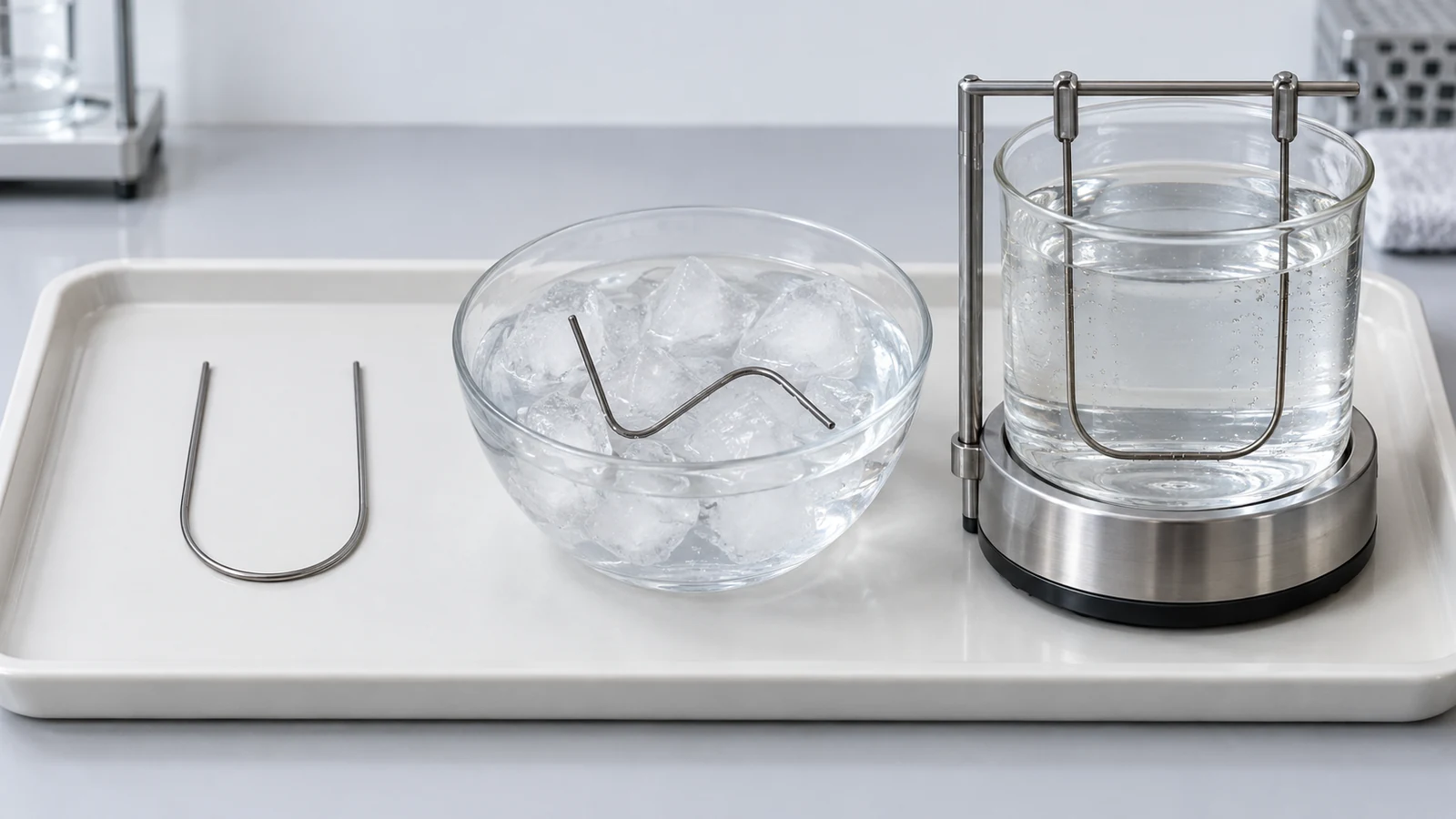
Nitinol (Ni–Ti) is an alloy with two linked abilities: the shape memory effect, in which it recovers its shape when heated, and superelasticity, in which it springs back after large strain under load. The FDA’s guidance on nitinol notes that its transformation temperatures are sensitive to small variations in temperature or heating time during manufacture, and recommends measuring them on the final finished form, from at least three production lots where possible. In a NiTi-20Zr alloy, changing the Ni content by only ±0.2 at.% gave very different transformation temperatures and very different responses to aging. This article sets out, from primary sources, the mechanism of the transformation, what moves the transformation temperature and the superelastic stress, fatigue, Cu-based, Fe-based and high-temperature alloys, uses in medical devices, aerospace and actuators, and how to read the evaluation standards. It gives no medical advice.
- What shape memory alloys are (the short version)
- Mechanism — a reversible transformation between two crystal structures
- What moves the transformation temperatures — composition, processing, aging, cycling, measurement
- How superelastic stress changes with temperature
- Fatigue — read it with strain amplitude and number of cycles
- Cu-based, Fe-based and high-temperature shape memory alloys
- Applications and how they are evaluated — medical devices, aerospace, actuators
- Limits, and what we could not confirm
- How to read the evaluation standards
- Glossary / References / Claim-to-source audit
Sourced = stated in a published source (with a link)
Our calculation = a value this article computed from stated assumptions
Not yet confirmed = plans or intentions with no confirmed results
Readings of materials design are marked as commentary. Inference is shown in bold.
The transformation temperatures, stresses, strains and lifetimes here are results that specific papers or documents obtained for a specific composition, heat treatment, test temperature and test method. They do not describe mass-produced products or other alloys. For medical devices that use nitinol we only explain the position of regulatory documents and standards; we give no medical advice and no judgment on the safety or ranking of any product.
1. What shape memory alloys are (the short version)
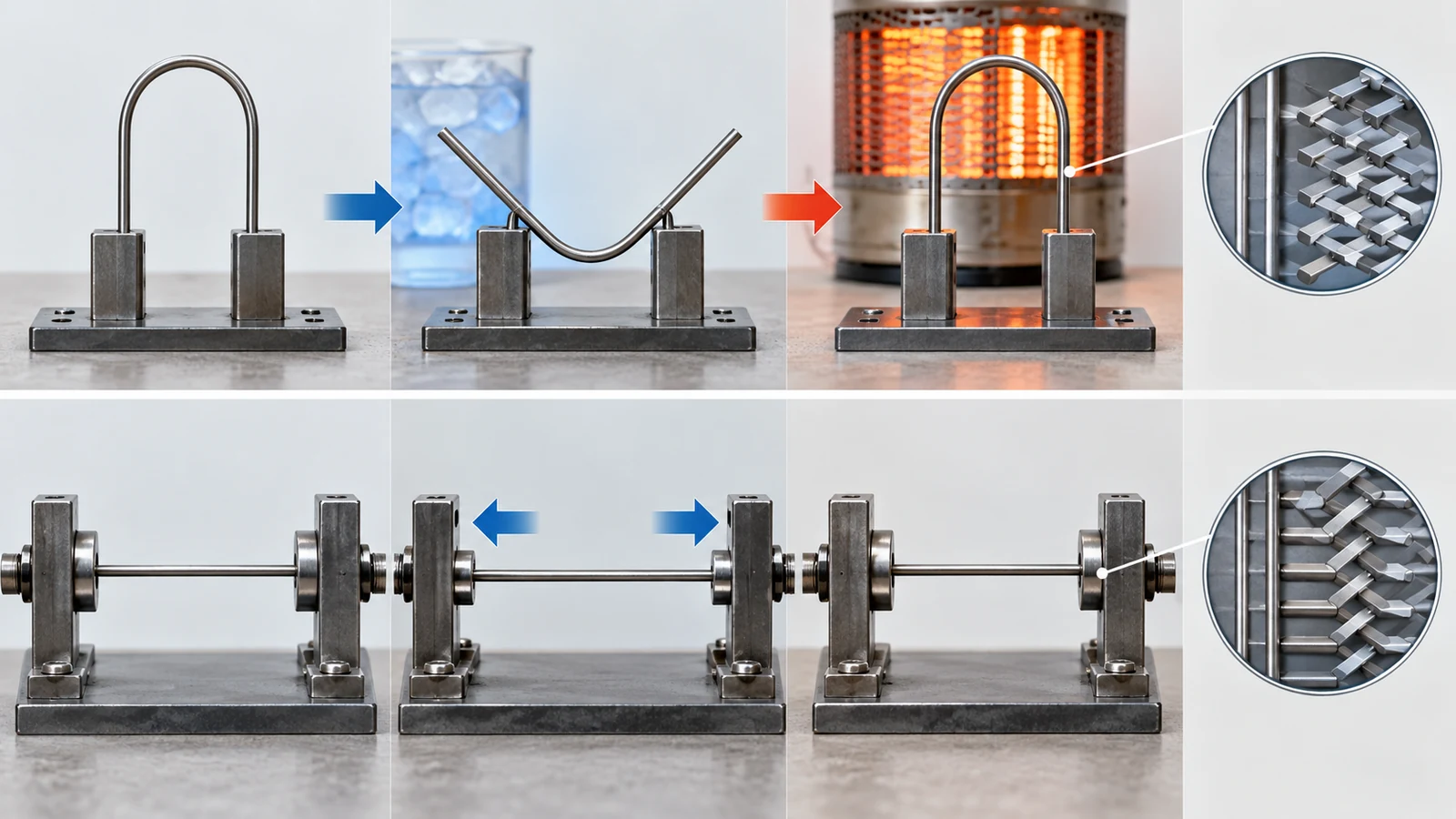
- An alloy that moves between two crystal structures: nitinol is an alloy of nickel and titanium in nearly equal atomic proportions, and it undergoes a reversible transformation between a high-temperature phase (austenite) and a low-temperature phase (martensite). Driven by temperature it gives the shape memory effect; driven by stress it gives superelasticity (pseudoelasticity) Sourced [Ref. 1]
- The transformation temperatures move with composition, processing, heat treatment and cycling: the introduction of a review states that in shape memory alloys in general a composition change of 1 at.% can shift the transformation temperature by about 100 K. In Ni–Ti too, aging and thermal cycling move the values Sourced [Ref. 8, 6, 9]
- Evaluation standards are mainly JIS H 7xxx and the ASTM F series; ISO, IEC and IEEE standards could not be confirmed: even for the transformation temperature alone, thermal analysis and bend-and-free-recovery need not give the same value Sourced [Ref. 1, 32]
A number such as “Af is 20 °C” means something only when it states which composition and heat treatment, which method (thermal analysis or bend and free recovery), and whether it was measured on the final finished form or on the raw material.
2. Mechanism — a reversible transformation between two crystal structures
Nitinol is a nearly equiatomic Ni–Ti alloy. The FDA guidance explains that its properties come from reversible transformations between austenite and martensite, which can be induced by temperature (shape memory) or by stress (pseudoelasticity) Sourced [Ref. 1]. As for crystal structures, the review by Wang et al. says that, depending on thermal or mechanical conditions, the alloy can be B2 austenite, B19′ martensite (monoclinic) or the rhombohedral R-phase Sourced [Ref. 10]. Shamimi et al. likewise treat transformations in which the R-phase appears between the B2 parent phase and B19′ martensite [Ref. 6].
The transformation temperatures are defined separately for cooling and heating. On cooling, the temperature at which the high-temperature phase starts to turn into martensite is Ms and the temperature at which it finishes is Mf. On heating, the temperature at which martensite starts to revert is As and the temperature at which it finishes is Af. For two-stage transformations with an R-phase in between, the definitions are given in terms of the R-phase (the FDA guidance reproduces the definitions) Sourced [Ref. 1].
View the original SVG schematic and exact annotations
Superelasticity is the phenomenon in which, above Af, applying a force triggers the transformation and a large deformation, and removing the force makes the reverse transformation return the original shape. In the stress-strain curve a “plateau”, over which the stress is nearly constant, appears while the transformation proceeds, and the plateau on unloading is lower than on loading (Fig. 3). The FDA guidance also notes that the region of near-constant stress is why mechanical testing is commonly done under displacement control Sourced [Ref. 1].
The strain that can be recovered depends strongly on conditions. The review by Wang et al. cites recovery from deformations of up to about 10% in Ni-Ti [Ref. 10]. Tanaka et al. describe a superelastic strain of more than 13% in an iron-based alloy as “almost twice the maximum superelastic strain obtained in the Ni-Ti alloys” [Ref. 13]. A review of actuators, on the other hand, says that straight wires give predictable cyclic durability at moderate strain levels of 3–4% or less [Ref. 23]. Even the same “recovery strain” means different things for a single recovery or repeated recovery, and with or without load Sourced.
Superelasticity is taught as a property above Af. Shamimi et al. argue, however, that in the conditions used for real superelastic parts (cold-worked and aged Ni-Ti), martensite usually reverts not directly to austenite but to the R-phase, and that what sets the unloading plateau is the reverse transformation of martensite, so that Af is irrelevant to the superelastic properties. They show conditions with an Af well above 37 °C (above 45 °C) that still give satisfactory superelasticity at 37 °C Sourced [Ref. 6].
The FDA guidance, too, recommends that when superelasticity is used, either Af (or the R-phase finish temperature R′f where an R-phase is present) or mechanical test data at the temperature of use be provided [Ref. 1]. The practical reading for a materials engineer is to read a transformation temperature together with mechanical tests at the temperature of use (our commentary).
3. What moves the transformation temperatures — composition, processing, aging, cycling, measurement
The transformation temperature is not a constant of an alloy. Fig. 4 shows six factors that the sources confirm.
(1) Composition: a small difference in Ni content makes a large difference
In their introduction, Beke and Azim state the known fact that in shape memory alloys a composition change of 1 at.% can shift the transformation temperature by about 100 K. They also note that in Ti–Pd-based alloys this slope varies by about a factor of four, between −15 K/at.% and −60 K/at.%, depending on the third alloying element Sourced [Ref. 8]. This is a statement about shape memory alloys in general, not a value for NiTi alone. In a NiTi-20 at.% Zr high-temperature shape memory alloy, varying Ni by just ±0.2 at.% (49.8, 50.0 and 50.2 at.%) gave very different transformation temperatures, and different responses to aging at 550 °C and 600 °C. In the solutionized state the Ni-lean alloy had the highest transformation temperatures; with aging, those of the Ni-lean alloy kept falling while those of the Ni-rich alloy rose Sourced [Ref. 9].
Taking atomic masses of 58.69 for Ni and 47.87 for Ti, we convert the atomic percentage of Ni to a mass percentage Our calculation. Ni 50.0 at.% = 55.08 wt.%, 50.8 at.% = 55.87 wt.% and 51.0 at.% = 56.07 wt.%. In this composition range, 1 at.% is about 1 wt.%.
If a sensitivity of about 100 K per at.% also applied in this range, an error of ±0.05 at.% in the composition analysis would correspond to ±5 K of transformation temperature, and ±0.2 at.% to ±20 K.
Assumptions and limits: about 100 K per at.% is a statement about shape memory alloys in general (the introduction of Beke et al.), not a value for NiTi. We could not show, from the primary sources we confirmed, how much the transformation temperature of NiTi changes per at.% of Ni. The calculation only illustrates the direction: the accuracy of the composition analysis sets the accuracy of the transformation temperature.
(2) Cold work and aging: setting the shape, strengthening, and tuning the temperature
According to Shamimi et al., the medical device industry uses a combination of cold work and aging on Ni-rich Ni–Ti to shape-set, strengthen and adjust the transformation temperatures. These three aims conflict. Accurate shape setting is promoted by longer times at higher temperatures, whereas maximum strength requires keeping the cold work, hence low temperatures and short times. Controlling the transformation temperatures requires precise control of the heat-treatment temperature, which sets the amount of Ni4Ti3 precipitation and the Ni/Ti ratio of the matrix. The commonly used aging and shape-setting range is 350–575 °C Sourced [Ref. 6].
The effect of heat treatment is also shown in a separate study of a similar composition. When a rapidly solidified Ti49Ni51 alloy was heat-treated at 723, 773 and 823 K, the microstructure (B2 phase, Ti3Ni4, Ti2Ni and so on) and the transformation path (such as the number of stages A→R→M) changed, and at 773 K the thermal hysteresis became small Sourced [Ref. 11]. A NASA report found that for nitinol ribbon the room-temperature tensile behavior depends strongly on the thermomechanical history before the test, and that the amount and stress state (twinned or detwinned) of the R-phase decide the critical stress of the first plateau Sourced [Ref. 18].
Even low-temperature aging changes the values. Shamimi et al. aged Ni 50.8 at.% Ni–Ti, after solution treatment and after ordinary cold work plus aging, at a further 25–250 °C for 1 hour to 1 month (720 hours). Even at 100 °C they saw nickel clustering and nanometre-scale Ni4Ti3 precipitation, and the transformation temperatures moved (in a solution-treated sample aged at 100 °C for 105 hours, precipitates of about 5 nm were seen by transmission electron microscopy). The paper points out that many medical devices specify transformation temperature ranges as tight as ±3 °C, and that temperatures in this range occur in processing steps such as co-extrusion and the application and curing of coatings Sourced [Ref. 6].
(3) Repeated thermal cycling: values move until they settle
For their NiTi-20Zr alloys, Carl et al. followed Af and Ms over ten thermal cycles and defined a transformation as “stable” when it dropped by less than 0.5 °C between consecutive cycles. The Ni-lean and equiatomic alloys were nearly stable after three heating cycles in the solutionized state, but the Ni-rich alloy needed eight, and the difference in Af between the first and tenth cycles was 39.5 °C in the solutionized state and about 25 °C after heat treatment Sourced [Ref. 9]. A value measured on the first cycle differs from the value after the alloy has settled in use.
(4) How it is measured: the same sample gives different values by method
The FDA guidance recommends giving the transformation temperatures for the final finished form (after all manufacturing steps, including sterilization), and where possible from samples of at least three production lots, because the transformation temperatures are sensitive to small variations in temperature or heating time. As methods it names thermal analysis (ASTM F2004), bend and free recovery (ASTM F2082) or an equivalent method, and notes that these test methods do not necessarily measure the same Af temperature for a given material or device Sourced [Ref. 1].
NASA researchers tested 55NiTi on specimens from the same heat and the same batch, changing only the test procedure. Under constant stress and thermal cycling, the test procedure changed the transformation strain by 0.005–0.01 mm/mm, which translates to a difference in work output of about 2 J/cm3. The transformation temperatures were less affected than the transformation and irreversible strains, and differed only with respect to the applied external stress. The authors also state that, although shape memory alloys have been around for almost five decades, apart from some standards for transformation temperatures no real standards exist for the mechanical and thermomechanical properties (a statement from 2008) Sourced [Ref. 17].
Writing the work W as stress σ times strain ε Our calculation, σ = W/ε. Since 1 J/cm3 = 1 MPa, W = 2 J/cm3 = 2 MPa, and dividing by the difference in transformation strain, ε = 0.005 and 0.01, gives about 400 MPa and about 200 MPa. The test can thus be taken to have been run at a stress of roughly 200–400 MPa.
Assumptions and limits: this is a simple estimate with work = stress × strain at constant stress, and we have not checked the stress values in the paper. It gives the scale: a change of 0.005–0.01 in transformation strain from the test method alone changes the work by about 2 J/cm3.
The sources so far say the same thing from different angles. The transformation temperature is a function of the final composition (the Ni/Ti ratio and additions), the processing history (the amount of cold work), the thermal history (aging temperature and time, down to low-temperature aging), the service history (thermal cycling) and how it is measured. When Ni4Ti3 precipitates, the matrix loses Ni and Ms rises: the straightforward direction. At low temperature, however, the pre-precipitation stage (nickel clustering) and the pinning of interfaces instead suppress the transformation, an effect in the opposite direction [Ref. 6]. Because the direction reverses with conditions, no one-directional rule of thumb can predict it (our commentary).
In practice, the composition control that fixes the transformation temperature of the raw material and the history of heat and surface treatments after a part is made must be managed separately, and the temperatures measured again on the final form (consistent with the approach of the FDA guidance) [Ref. 1].
4. How superelastic stress changes with temperature
Superelastic stress is tightly linked to temperature. Shamimi et al. express the height of the plateau (the stress at which the transformation starts) as the difference between the test temperature T and Ms, multiplied by the slope of stress against temperature (the Clausius–Clapeyron coefficient) dσ/dT.
σ = ( T − Ms ) × dσ/dT
In systems without an R-phase, dσ/dT is about 6–7 MPa/°C, a value for wire or tube measured in tension (the paper notes that it depends on the deformation mode and the texture). When an R-phase is involved and the A/R/M triple point lies above room temperature, it is the 3.5–4.0 MPa/°C of R→M Sourced [Ref. 6]. For the iron-based Fe–Mn–Al–Ni alloys, Omori et al. report a superelastic stress that varies by only 0.53 MPa/°C (from −196 to 240 °C) for one composition, which they explain by a small transformation entropy change brought about by a magnetic contribution Sourced [Ref. 12].
Using dσ/dT = 6.5 MPa/°C (the middle of 6–7) Our calculation, at a use temperature of 37 °C and Ms = 0 °C the plateau is (37 − 0) × 6.5 = about 240 MPa, and with Ms = −10 °C about 305 MPa. A 10 °C difference in Ms changes the plateau stress by about 60–70 MPa. If the tolerance on the transformation temperature is ±3 °C, the scatter in plateau stress is ±18–21 MPa.
For the same ±3 °C, Fe–Mn–Al–Ni (0.53 MPa/°C) gives only about ±1.6 MPa. For a 100 °C rise above the reference temperature, the stress increases by about 600–700 MPa for NiTi (A→M), about 350–400 MPa for NiTi (R→M) and about 53 MPa for Fe–Mn–Al–Ni (Fig. 5).
Assumptions and limits: this extrapolates the slopes as constants over the whole range. For NiTi, as temperature rises the stress reaches the limit of yielding (slip), so the lines for 100 °C do not exist in practice. Omori et al. point out that the rise of superelastic stress with temperature limits practical use over a wide temperature range [Ref. 12]. The calculation is for comparing slopes.
The shape of the superelastic plateau also needs care. Shamimi et al. say that strain localization such as the “Lüders bands” seen in uniaxial tension (the transformation spreading in bands) shows up as a drop in stress on unloading (a reverse yield drop) and a flat plateau, and that the unloading plateau can be higher than predicted from the transformation temperatures of a stress-free thermal test [Ref. 6]. The transformation temperature from thermal analysis and the plateau stress from tensile tests must be measured separately and then related to each other.
5. Fatigue — read it with strain amplitude and number of cycles
Fatigue of shape memory alloys has two meanings. “Structural fatigue” is failure by cracks that start and grow under repeated loading. “Functional fatigue” is the gradual change, before failure, of functions such as the transformation temperatures, the plateau stress and the residual strain. The title of the review by Eggeler et al., “Structural and functional fatigue of NiTi shape memory alloys”, reflects this distinction [Ref. 26]. The fall in Af during thermal cycling in Carl et al. (Section 3) is an example of a change in function [Ref. 9].
On structural fatigue, an FDA regulatory science tool explains that several studies have associated low-cycle fatigue (less than approximately 10 million cycles) with cyclic phase transformation in nitinol, that load levels without cyclic phase transformation would be expected to survive to approximately 10 million cycles, and that fatigue fractures beyond 10 million cycles may still occur. It applies only to pseudoelastic nitinol Sourced [Ref. 2]. The FDA guidance recommends fatigue testing in a liquid close to the service environment rather than in air, because tests in air are sensitive to test frequency through heating effects. It says that a constant-life diagram of mean versus alternating strain, rather than stress, has been found to model fatigue life well, that fatigue life is sensitive to composition and processing, and that the effect of pre-strain (such as crimping a stent) should be considered Sourced [Ref. 1].
A recent study shows a large extension of bending-fatigue life by surface treatment. With a surface treatment called pre-strain warm laser shock peening (a method that works the surface layer by the impact of laser pulses), the bending fatigue life exceeded 5 million cycles at a maximum surface tensile strain of 1.94%, more than 3000 times that of untreated nanocrystalline NiTi (the authors’ claim, for a specific NiTi and specific conditions) Sourced [Ref. 25]. For temperature, Lin et al. found in dynamic mechanical analysis tests that above Af the fatigue life becomes shorter as temperature rises and the energy dissipation decreases [Ref. 24].
Taking the roughly 10 million cycles (107) given by the FDA regulatory science tool as a guide Our calculation, at 1 Hz the test takes 107 ÷ 86,400 s/day = about 116 days. At 50 Hz it is about 55.6 hours and at 60 Hz about 46 hours.
Assumptions and limits: a simple calculation for a machine that runs continuously. A higher frequency speeds up the test, but as the FDA guidance says, tests in air become sensitive to test frequency because of heating from the transformation, and the result can change [Ref. 1]. The number of cycles must be read together with frequency and environment.
A statement such as “it lasts 10 million cycles” means something only when it says at what strain amplitude and mean strain, in what temperature and environment, with what surface and on what specimen (a wire or a part cut from a product). The FDA guidance asks for the constant-life diagram to be built experimentally on samples representative of the final form because fatigue life is sensitive to composition and processing [Ref. 1]. That surface treatment can change life by orders of magnitude [Ref. 25], and that life changes depending on whether the test temperature exceeds Af [Ref. 24], are reasons why fatigue data for a wire cannot be carried over to other shapes or heat treatments (our commentary).
6. Cu-based, Fe-based and high-temperature shape memory alloys
Ni–Ti is at the centre of practical use, but other alloy systems have their own features. Tanaka et al. state that, as of 2010, the Ni-Ti-based alloy, which exhibits some ductility and excellent superelastic strain, was the only superelastic material available for practical applications Sourced [Ref. 13]. The table summarizes what we could confirm, including later systems.
| Alloy system | What we could confirm | What we could not confirm |
|---|---|---|
| Ni–Ti (nitinol) | Nearly equiatomic. B2, B19′ and R-phase. A principal material for medical devices [Ref. 1]. Recovery from deformation of up to about 10% (cited value) and tensile elongation above 30% (cited value) [Ref. 10] | Like-for-like performance comparison with other systems |
| Cu–Al–Mn | Polycrystals with a low degree of order of the β (L21) phase are ductile and show superelasticity and the one-way and two-way memory effects. Controlling grain size and texture by thermomechanical treatment greatly improves the properties. An application to a medical guidewire is presented [Ref. 15] | Numbers for transformation temperature, fatigue and cost |
| Cu–Zn–Al | Tanaka et al. state that Ni-Ti and Cu-Zn-Al show reversible strains of more than several percent [Ref. 13] | Individual properties and durability |
| Fe–Mn–Al–Ni | A polycrystalline ferrous alloy with a superelastic strain above 13% and a tensile strength above 1 GPa (almost twice the maximum superelastic strain of Ni-Ti), and a large damping capacity [Ref. 13]. A small temperature dependence of the superelastic stress (0.53 MPa/°C, one example from −196 to 240 °C) [Ref. 12] | Fatigue life, components of practical size, cost |
| High-temperature shape memory alloys (Ni–Ti–Pd, Ni–Ti–Pt, Ni–Ti–Hf, Ni–Ti–Zr and others) | Three groups by Ms: I = 100–400 °C, II = 400–700 °C, III = above 700 °C. The criteria are recoverable strain, long-term stability, resistance to plastic deformation and creep, and environmental resistance; poor workability and material cost are the problems. Applications have been demonstrated in Ti–Ni–Pd and Ti–Ni–Pt [Ref. 14]. The Af of binary Ni-Ti is about 115 °C at most and rises with Au, Pt, Pd, Hf or Zr (the authors state that, apart from Hf and Zr, these additions raise cost greatly) [Ref. 9] | Mass production; long-term thermal-cycling stability of each system (beyond the results of Carl et al.) |
All Sourced (statements in the abstracts and introductions of the papers). The arrangement of the table is our commentary. Values for different systems come from different test conditions and sample forms, so they are not ranked against each other.
The NASA report by Noebe et al. shows that “having a high transformation temperature” and “being able to do work” are different things. Ni30Pt20Ti50 (20Pt) has transformation temperatures above 230 °C and Ni20Pt30Ti50 (30Pt) above 530 °C. Both, deformed at room temperature, showed 100% no-load strain recovery for strain levels up to their fracture limit (3–4%). Under constant load and thermal cycling, however, the 20Pt alloy behaved like conventional binary NiTi, with a maximum work output of nearly 9 J/cm3 limited by its tensile ductility. The 30Pt alloy, in contrast, had an austenite yield strength similar to or lower than that of martensite, so its transformation strain under load was essentially zero and its work output was zero Sourced [Ref. 16].
The problem with high-temperature shape memory alloys is not only raising the transformation temperature. In the 30Pt alloy of Noebe et al., if the high-temperature phase is not stronger than the low-temperature phase, the alloy cannot do work against a load [Ref. 16]. Ma et al. organize the criteria as recoverable strain, long-term stability, resistance to plastic deformation and creep, and environmental resistance, which become harder to satisfy at higher operating temperatures (more thermally activated mechanisms are involved) [Ref. 14]. In the Ni-rich NiTi-20Zr of Carl et al., Af fell by about 40 °C over ten thermal cycles [Ref. 9]. The height of the transformation temperature, the stability under repeated cycling and the order of strengths must be checked separately (our commentary).
7. Applications and how they are evaluated — medical devices, aerospace, actuators
(1) Medical devices: what regulatory documents ask of the material
The FDA guidance says that nitinol is used in cardiovascular devices such as stents, heart valves, guidewires and vena cava filters, and in a growing number of products for minimally invasive procedures. It adds that nitinol’s thermomechanical behavior and processing sensitivity raise special considerations compared with conventional metals such as stainless steel, titanium or cobalt-chrome, and it sets out technical considerations for non-clinical assessment. The guidance contains nonbinding recommendations; the version issued on 9 July 2021 is the current one Sourced [Ref. 1].
From the materials side, the guidance’s items correspond to the earlier sections of this article (our commentary).
| Item in the guidance (Section IV) | What is requested (summary) | Section of this article |
|---|---|---|
| A-1 Material composition | State conformity to a recognized consensus standard (for example ASTM F2063); if the nitinol does not conform, give its composition and properties | Section 3 (1) |
| A-2 Manufacturing | A flow of processes from raw material to final form, with detail on thermal processes (laser cutting, annealing, shape setting) and surface processing | Section 3 (2) |
| A-3 Pseudoelasticity / shape memory | State which behavior is used, or that neither is | Section 2 |
| A-4 Transformation temperatures | On the final finished form, from three or more lots where possible. For pseudoelasticity, Af (or R′f) or mechanical data at the temperature of use; for shape memory, also As, Ms and Mf. F2004, F2082 or an equivalent method | Section 3 (4) |
| B Mechanical testing | Displacement control, preconditioning, testing at the relevant temperature, fatigue in a liquid, a constant-life diagram, pre-strain. Material-model parameters from F2516 and similar | Sections 4 and 5 |
| C Corrosion testing | Pitting corrosion (following the F2129 procedure), nickel ion release and galvanic corrosion; dependent on the surface finish | Section 9 (standards) |
| D, E Biocompatibility and labeling | Evaluation of biocompatibility and warning labeling | Not covered here |
All Sourced (a summary of the items of the FDA guidance [Ref. 1]). The guidance ties the details of each item to the conditions of each product. This article does not assess any particular product and gives no medical advice.
(2) Aerospace: actuation, weight saving and high temperature
The review by Hartl and Lagoudas covers aerospace applications of shape memory alloys, for both atmospheric flight and space flight, including past and present examples and design challenges [Ref. 22]. NASA technical reports give concrete examples.
- Variable geometry chevron: chevrons, the serrated trailing edges of a jet engine’s exhaust nozzle, reduce noise at takeoff. Cabell et al. tested a full-scale variable geometry chevron (VGC) fan nozzle incorporating shape memory alloy actuators under representative flow conditions in Boeing’s Nozzle Test Facility. A proportional-integral control system that regulates the heating of the actuators controlled the chevron’s tip immersion, and controllable immersion was demonstrated Sourced [Ref. 19].
- For hot exhaust: a 2011 NASA Tech Brief explains that high-temperature shape memory alloy technology enables adaptive chevron devices to operate in both the low-temperature fan flow and the high-temperature core flow Sourced [Ref. 20].
- Superelastic spring tire: NASA Glenn Research Center and Goodyear developed a compliant, non-pneumatic tire made of woven coil springs for Martian and Lunar rover vehicles. The version with superelastic shape memory alloy springs is described as able to undergo approximately 30 times more reversible deformation than a steel spring, and large-scale finite element analysis that includes the complex interaction of the springs is used in its design Sourced [Ref. 21].
(3) Actuators: response is set by cooling more than by heating
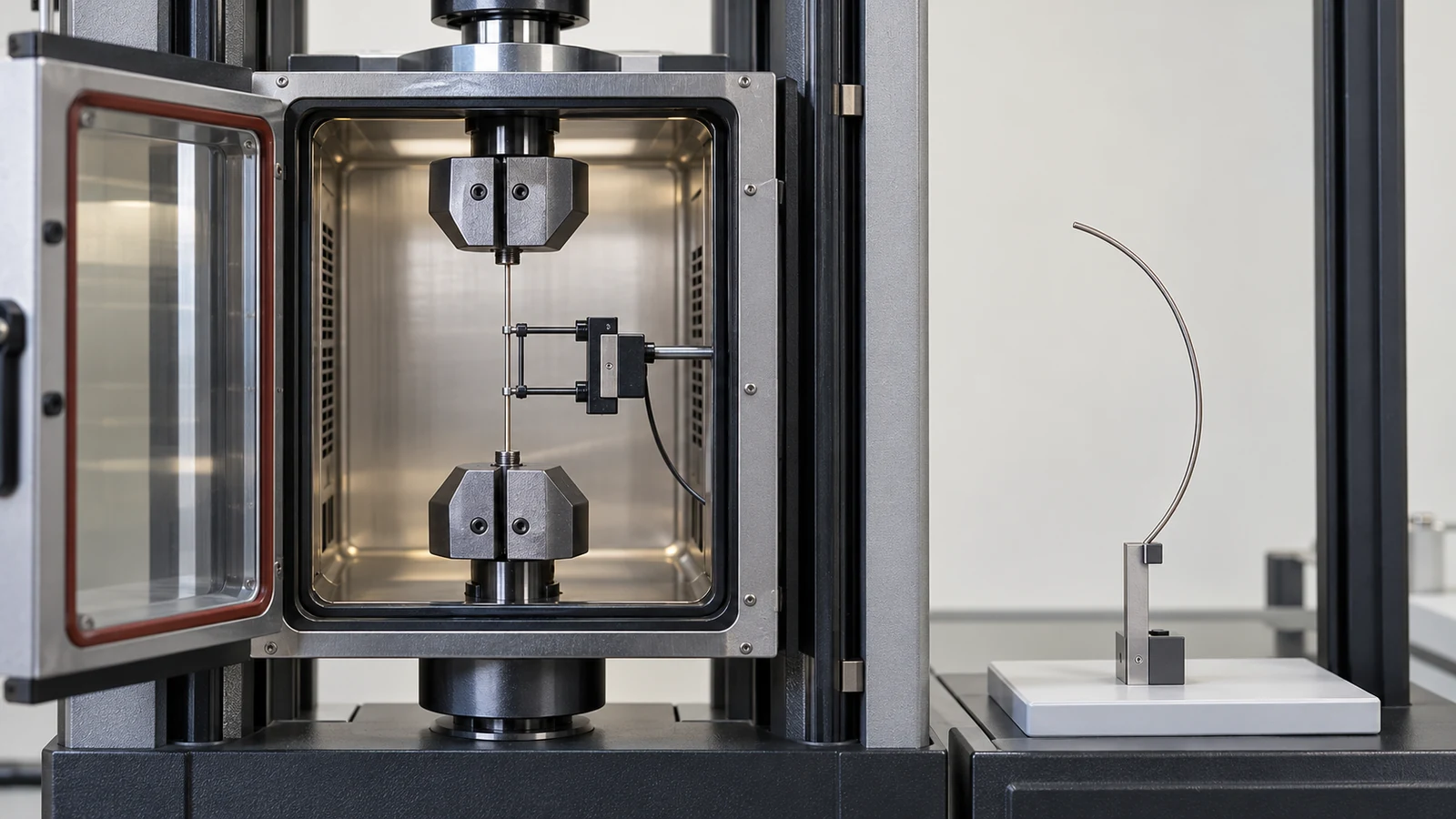
A 2026 review by Romančík et al. says that shape memory alloy actuators are most commonly cooled by heat dissipation to the room-temperature surroundings, and that faster operation needs forced cooling such as forced air convection, heat sinks, cooling liquids or Peltier elements. The response time is governed by the heating and, in particular, the cooling rate, and one motion cycle usually takes several seconds; this is among the most significant limitations. Straight wires give high recovery stress and predictable cyclic durability at moderate strain (3–4% or less), but their usable stroke is limited. Coils amplify displacement at the expense of mechanical bandwidth and fatigue life, and multi-wire bundles accumulate heat, which reduces the achievable cycle frequency Sourced [Ref. 23]. The same review states that the energy density of SMA actuators is reported at 5000–25,000 kJ/m3, far above the 40–70 kJ/m3 of human skeletal muscle Sourced [Ref. 23].
An upper estimate of work is stress times strain Our calculation. For 200 MPa and 4% strain (illustrative values), 200 MPa × 0.04 = 8 MPa = 8 J/cm3 (= 8000 kJ/m3). This lies within the 5000–25,000 kJ/m3 reported by the review above and is of the same order as the maximum work output of the 20Pt alloy of Noebe et al. (about 9 J/cm3 = 9000 kJ/m3) [Ref. 16]. Against skeletal muscle’s 40–70 kJ/m3 the ratio is 8000 ÷ 70 = about 114 to 8000 ÷ 40 = 200 times.
Assumptions and limits: an idealization in which the stress is constant over the whole strain. The value is per volume of alloy, not for a complete actuator including the heating and cooling hardware, the bias spring and the wiring. In the NASA test of Section 3, the test method alone moved the work by about 2 J/cm3, roughly a quarter of this example [Ref. 17]. Output figures must be read with matched conditions.
(4) Fabrication and processing
Wang et al. say that NiTi has poor workability, which makes complex-shaped components difficult, and that additive manufacturing such as selective laser melting (SLM) offers freedom to build complex structures. Their review summarizes the distinctive microstructure that SLM produces and the transformation behavior and mechanical properties reported for various build conditions Sourced [Ref. 10]. The transformation temperatures and function of built parts are likely to depend on build conditions and heat treatment (our commentary), but a quantitative comparison is outside the scope of our research.
8. Limits, and what we could not confirm
(1) The quantitative link between composition and transformation temperature
We could not show, from the primary sources we confirmed, how much the transformation temperature of NiTi changes per at.% of Ni. The “about 100 K per at.%” in Section 3 is a statement about shape memory alloys in general.
(2) How the papers were read
We read the full texts of Shamimi et al., the FDA guidance, the FDA regulatory science tool page, the introduction and results of Carl et al., the introduction of Beke et al. and the introduction of Wang et al. For Tanaka et al., Omori et al., Ma et al. and Sutou et al. we checked the publisher abstracts only, and for the NASA reports the abstracts on the NASA Technical Reports Server only. For the reviews of Eggeler et al. and of Otsuka and Ren, we confirmed only existence and bibliographic details. The Elsevier (ScienceDirect) pages state that AI and similar uses are prohibited, so we did not retrieve their contents.
(3) The text of the standards
We have not read the text of JIS H 7001 to 7107 or of ASTM F2004, F2063, F2082, F2516, F2005, F2633, F3211, E2948 and F2129. We confirmed only numbers, titles, years, FDA recognition status and the dates of establishment and revision of the JIS. The ASTM International website states that AI use is prohibited, so we did not open any ASTM site.
(4) International standards (ISO, IEC, IEEE)
A search of the ISO catalogue (10 October 2026) found no standards for “shape memory alloy” or “nitinol”. We could not confirm any applicable IEC or IEEE standard either. Application-specific standards, such as those for orthodontic wires, may cover NiTi, but we did not check this.
(5) Regulation and markets
The FDA guidance is a US document. We have not checked how Japanese or EU medical device regulation treats nitinol, nor prices and supply in any country. We do not rank any company’s products.
(6) Differences between sources
The role of Af differs between sources (Shamimi et al. argue that it can be an unsuitable indicator of superelasticity, whereas the FDA asks for Af, R′f or mechanical data). This article shows both and does not unify them.
9. How to read the evaluation standards
The evaluation of shape memory alloys divides into (a) transformation temperatures (As, Af, Ms, Mf and the R-phase temperatures), (b) tensile properties (plateau stress, recovery strain, residual strain), (c) behavior under repetition (changes of transformation temperature in thermal cycling, mechanical fatigue), (d) composition and specification, and (e) corrosion and release. Japan has a dedicated group of JIS H 7xxx standards for shape memory alloys, and the US has the ASTM F series (a group of nitinol standards for medical devices and surgical implants). We could not confirm international standards (ISO, IEC, IEEE) within the scope of our research.
Table of corresponding standards
JIS titles are our translations from the Japanese.
| Evaluation item | ISO | IEC / IEEE | JIS | ASTM | What changes the value with the test conditions |
|---|---|---|---|---|---|
| Transformation temperatures (thermal analysis; bend and free recovery) Sourced | Could not be confirmed | Could not be confirmed | JIS H 7101 (method for determining the transformation temperature of shape memory alloys; established 1 March 1989, latest revision 20 March 2002, confirmed 20 October 2021) | F2004 “Standard Test Method for Transformation Temperature of Nickel-Titanium Alloys by Thermal Analysis” (-24); F2082/F2082M “Determination of Transformation Temperature of Nickel-Titanium Shape Memory Alloys by Bend and Free Recovery” (-23) | Thermal analysis and bend and free recovery need not give the same Af (FDA). Final form or raw material, number of lots, composition and heat treatment all change the value |
| Tensile properties (superelastic and shape memory) Sourced | ISO 6892-1:2019 (room-temperature tensile testing of metals in general; not specific to superelastic alloys) | Could not be confirmed | JIS H 7103 (tensile test method for Ti-Ni shape memory alloys; established 1 September 1991, revised 22 October 2012, confirmed 20 October 2022); JIS Z 2241 (metallic materials in general) | F2516 “Standard Test Method for Tension Testing of Nickel-Titanium Superelastic Materials” (-22) | Test temperature (the plateau rises with temperature), strain rate, specimen form (wire, tube) and pre-treatment |
| Constant-strain and thermal-cycle tests of coil springs (actuators) Sourced | Could not be confirmed | Could not be confirmed | JIS H 7105 (constant-strain test method for Ti-Ni shape memory alloy coil springs; revised 22 October 2012, confirmed 20 October 2022); JIS H 7106 (constant-strain thermal-cycle test method for shape memory alloy coil springs; revised 20 March 2002, confirmed 20 October 2021) | Could not be confirmed | Size of the strain, number of cycles, heating and cooling conditions |
| Material specification (composition, properties, form) Sourced | Could not be confirmed | Could not be confirmed | JIS H 7107 (Ti-Ni shape memory alloy wire, strip and tube; established 20 October 2003, revised 20 April 2009, confirmed 21 October 2024) | F2063 “Standard Specification for Wrought Nickel-Titanium Shape Memory Alloys for Medical Devices and Surgical Implants” (-18); F2633 “Standard Specification for Wrought Seamless Nickel-Titanium Shape Memory Alloy Tube for Medical Devices and Surgical Implants” (-19) | Conforming to the specification does not remove the need to check transformation temperature and fatigue on the final form (the approach of the FDA guidance) |
| Terminology Sourced | Could not be confirmed | Could not be confirmed | JIS H 7001 (shape memory alloy terminology; established 1 March 1989, revised 20 April 2009, confirmed 21 October 2024) | F2005 “Standard Terminology for Nickel-Titanium Shape Memory Alloys” (-21) | As, Af, Ms and Mf are defined to include the R-phase in two-stage transformations |
| Fatigue Sourced | Could not be confirmed | Could not be confirmed | Could not be confirmed | F3211 “Standard Guide for Fatigue-to-Fracture (FtF) Methodology for Cardiovascular Medical Devices” (-17); E2948 “Standard Test Method for Conducting Rotating Bending Fatigue Tests of Solid Round Fine Wire” (-24); F2477 “Standard Test Methods for in vitro Pulsatile Durability Testing of Vascular Stents and Endovascular Prostheses” (-23, -24) | Strain amplitude and mean strain, frequency, liquid or air, pre-strain and surface (FDA guidance and regulatory science tool) |
| Corrosion and nickel release Sourced | ISO 10993-15:2019 “Biological evaluation of medical devices — Part 15: Identification and quantification of degradation products from metals and alloys” (2nd edition) | Could not be confirmed | Could not be confirmed | F2129 “Standard Test Method for Conducting Cyclic Potentiodynamic Polarization Measurements to Determine the Corrosion Susceptibility of Small Implant Devices” (-24) | Surface finish (electropolishing, chemical etching and so on), geometry and environment (FDA guidance) |
Numbers, titles and editions were confirmed as follows: ISO on the ISO catalogue pages; JIS in the JISC database; ASTM in the FDA database of recognized consensus standards (last updated 28 September 2026); we did not open any ASTM site [Ref. 29, 28, 32, 33, 3, 4, 5]. The arrangement of the table is our commentary. The ASTM editions (-24, -23, -18 and so on) are those listed in the FDA database and are not necessarily the latest.
The number, title, edition and date of each standard are Sourced (confirmed on the official pages of the standards bodies, the Japanese Industrial Standards Committee and the FDA). Which standard goes in which cell is our own arrangement (Our calculation). We found no revision or draft in progress, so no row falls under Not yet confirmed.
Cautions when reading standards
- Many of the JIS standards for shape memory alloys were last revised long ago. H 7101 and H 7106 were revised in 2002, H 7001 and H 7107 in 2009, and H 7103 and H 7105 in 2012, and all have been confirmed in recent years (2021 to 2024) [Ref. 33, 32]. The ASTM F series, on the other hand, has had its editions updated in recent years for medical devices (FDA recognition status) [Ref. 3]. JIS and ASTM assume different objects of measurement (laboratory evaluation of a raw material versus a component of a medical device), so their numbers cannot be compared directly.
- Standards for transformation temperature can give different values depending on the method. The FDA notes that F2004 and F2082 need not give the same Af [Ref. 1]. Read a reported value together with the method, the state of the sample (raw material or final form) and the heating rate.
- We found no standard that directly specifies fatigue of superelastic alloys. Fatigue is planned by combining F3211 (a guide to fatigue-to-fracture methodology for cardiovascular devices), E2948 (rotating-bending fatigue of fine wire) and others, following the approach of the FDA regulatory science tool [Ref. 2, 5, 4]. A standard is a method, not a guarantee of life.
- NASA researchers stated in 2008 that standards for the mechanical and thermomechanical properties were not in place. That F2516 and others have since been put in place can be seen from FDA recognition [Ref. 3], but we could not confirm an international standard that directly specifies actuator use (thermal cycling under load, work output) [Ref. 17].
- A shape memory alloy undergoes a reversible transformation between two crystal structures, driven by temperature or by stress. The temperatures are Ms, Mf, As and Af, and an R-phase may intervene Sourced
- The transformation temperatures move with composition, processing, aging (even at low temperature), thermal cycling and measurement. In NiTi-20Zr, Ni ±0.2 at.% made a large difference, and in the Ni-rich alloy Af moved by about 40 °C over ten thermal cycles Sourced
- Superelastic stress rises in proportion to temperature. About 6–7 MPa/°C for NiTi, 3.5–4.0 when an R-phase is involved and 0.53 MPa/°C for Fe–Mn–Al–Ni Sourced. A 10 °C difference in Ms corresponds to about 60–70 MPa of plateau stress Our calculation
- Read fatigue with strain amplitude, mean strain, cycles, environment and surface. Low-cycle fatigue below about 10 million cycles is associated with cyclic phase transformation Sourced
- For high-temperature shape memory alloys, a high transformation temperature is not the same as the ability to do work. Ni20Pt30Ti50 gave zero work output under load Sourced
- The evaluation standards are mainly JIS H 7xxx and the ASTM F series; we could not confirm dedicated ISO, IEC or IEEE standards.
10. Glossary
- Shape memory effect
- The recovery of the original shape on heating after deformation at low temperature.
- Superelasticity (pseudoelasticity)
- Above Af, a large deformation caused by a stress-induced transformation that recovers on unloading.
- Austenite / martensite
- The high-temperature phase (B2 structure in Ni-Ti) and the low-temperature phase (B19′ structure, monoclinic).
- R-phase
- An intermediate (rhombohedral) phase that can appear between austenite and martensite.
- Ms, Mf, As, Af
- The start and finish temperatures of the transformation on cooling, and of the reverse transformation on heating.
- Plateau
- The range over which stress is nearly constant while the transformation proceeds.
- Clausius–Clapeyron coefficient
- The rate at which the transformation stress rises with temperature (dσ/dT).
- Ni4Ti3
- A phase that precipitates on aging Ni-rich Ni-Ti and changes the Ni content of the matrix.
- Aging
- A heat treatment, after solution treatment or cold work, that holds the alloy at a moderate temperature to cause precipitation and similar changes.
- Structural / functional fatigue
- Failure by cracks / changes of function such as transformation temperature and stress.
- HTSMA
- High-temperature shape memory alloy: one whose transformation temperatures exceed 100 °C.
- DSC
- Differential scanning calorimetry; one way of finding transformation temperatures by measuring heat absorbed or released as temperature is varied.
11. References (primary sources)
- U.S. Food and Drug Administration (FDA) “Technical Considerations for Non-Clinical Assessment of Medical Devices Containing Nitinol — Guidance for Industry and FDA Staff” (issued 9 July 2021; first issued 15 October 2020; draft 19 April 2019; docket FDA-2019-D-1261; states that it contains nonbinding recommendations) — www.fda.gov/regulatory-information/search-fda-guidance-documents/te…
- U.S. FDA, Center for Devices and Radiological Health (CDRH) “Strategy to Estimate Low to High Cycle Fatigue Transition of Nitinol for Fatigue to Fracture Test Planning” (Catalog of Regulatory Science Tools) — cdrh-rst.fda.gov/strategy-estimate-low-high-cycle-fatigue-transitio…
- U.S. Food and Drug Administration (FDA) “Recognized Consensus Standards: Medical Devices” database, search results for titles containing nickel-titanium (database page last updated 28 September 2026) — www.accessdata.fda.gov/scripts/cdrh/cfdocs/cfStandards/results.cfm?…
- U.S. Food and Drug Administration (FDA) “Recognized Consensus Standards: Medical Devices” database, search results for titles containing nitinol (page last updated 28 September 2026) — www.accessdata.fda.gov/scripts/cdrh/cfdocs/cfStandards/results.cfm?…
- U.S. Food and Drug Administration (FDA) “Recognized Consensus Standards: Medical Devices” database, search results for reference number F3211 — www.accessdata.fda.gov/scripts/cdrh/cfdocs/cfStandards/results.cfm?…
- Shamimi A. et al. “The Effect of Low Temperature Aging and the Evolution of R-Phase in Ni-Rich NiTi”, Shap. Mem. Superelasticity 4, 417–427 (2018), DOI 10.1007/s40830-018-0193-9 (full text hosted on a Confluent Medical Technologies page) — doi.org/10.1007/s40830-018-0193-9
- Confluent Medical Technologies Full-text PDF of the paper by Shamimi et al. above (company document page; we read this full text) — confluentmedical.com/wp-content/uploads/2023/05/5851cb2c40d9a5258e0…
- Beke D. L., Azim A. A. “On the Strong Composition Dependence of the Martensitic Transformation Temperature and Heat in Shape Memory Alloys”, Materials 17, 4116 (2024), DOI 10.3390/ma17164116 (open access) — doi.org/10.3390/ma17164116
- Carl M. et al. “Effect of Ni-Content on the Transformation Temperatures in NiTi-20 at. % Zr High Temperature Shape Memory Alloys”, Metals 7, 511 (2017), DOI 10.3390/met7110511 (open access) — doi.org/10.3390/met7110511
- Wang X. et al. “A Short Review on the Microstructure, Transformation Behavior and Functional Properties of NiTi Shape Memory Alloys Fabricated by Selective Laser Melting”, Materials 11, 1683 (2018), DOI 10.3390/ma11091683 (open access) — doi.org/10.3390/ma11091683
- Li S. et al. “Effect of Heat Treatment Temperature on Martensitic Transformation and Superelasticity of the Ti49Ni51 Shape Memory Alloy”, Materials 12, 2539 (2019), DOI 10.3390/ma12162539 (open access) — doi.org/10.3390/ma12162539
- Omori T. et al. “Superelastic Effect in Polycrystalline Ferrous Alloys”, Science 333, 68–71 (2011), DOI 10.1126/science.1202232 — doi.org/10.1126/science.1202232
- Tanaka Y. et al. “Ferrous Polycrystalline Shape-Memory Alloy Showing Huge Superelasticity”, Science 327, 1488–1490 (2010), DOI 10.1126/science.1183169 — doi.org/10.1126/science.1183169
- Ma J., Karaman I., Noebe R. D. “High temperature shape memory alloys”, Int. Mater. Rev. 55, 257–315 (2010), DOI 10.1179/095066010X12646898728363 — doi.org/10.1179/095066010X12646898728363
- Sutou Y. et al. “Ductile Cu–Al–Mn based shape memory alloys: General properties and applications”, Mater. Sci. Technol. 24, 896–901 (2008), DOI 10.1179/174328408X302567 — doi.org/10.1179/174328408X302567
- Noebe R. et al. (NASA) “Properties and Potential of Two (Ni,Pt)Ti Alloys for Use as High-Temperature Actuator Materials”, Proc. SPIE (16 May 2005), NASA Technical Reports Server 20050185200 — ntrs.nasa.gov/citations/20050185200
- Padula S. A. II et al. (NASA) “Influence of Test Procedures on the Thermomechanical Properties of a 55NiTi Shape Memory Alloy” (conference paper, March 2008), NASA Technical Reports Server 20080047419 — ntrs.nasa.gov/citations/20080047419
- Lach C. L. et al. (NASA) “Effects of Thermomechanical History on the Tensile Behavior of Nitinol Ribbon” (2002), NASA Technical Reports Server 20030014802 — ntrs.nasa.gov/citations/20030014802
- Cabell R. H. et al. (NASA) “Feedback Control of a Morphing Chevron for Takeoff and Cruise Noise Reduction” (2004), NASA Technical Reports Server 20040139184 — ntrs.nasa.gov/citations/20040139184
- Quackenbush T. R., McKillip R. M. Jr. (NASA) “High-Temperature Smart Structures for Engine Noise Reduction and Performance Enhancement” (NASA Tech Briefs, February 2011), NASA Technical Reports Server 20110012201 — ntrs.nasa.gov/citations/20110012201
- Naghipour P. et al. (NASA) “Development of the Shape Memory Alloy Spring Tire for Martian Temperatures” (NASA Technical Reports Server 20260008869, released September 2026) — ntrs.nasa.gov/citations/20260008869
- Hartl D. J., Lagoudas D. C. “Aerospace applications of shape memory alloys”, Proc. Inst. Mech. Eng. G 221, 535–552 (2007), DOI 10.1243/09544100JAERO211 — doi.org/10.1243/09544100JAERO211
- Romančík J. et al. “Shape Memory Alloy Actuators in Robotics”, Actuators 15, 162 (2026), DOI 10.3390/act15030162 (open access) — doi.org/10.3390/act15030162
- Lin Y. et al. “Experimental Study on Temperature Effects on NiTi Shape Memory Alloys under Fatigue Loading”, Materials 13, 573 (2020), DOI 10.3390/ma13030573 (open access) — doi.org/10.3390/ma13030573
- Yan et al. “Bending-fatigue-resistant hierarchical NiTi shape memory alloy”, Nat. Commun. 17, 6376 (2026), DOI 10.1038/s41467-026-72857-z (open access) — doi.org/10.1038/s41467-026-72857-z
- Eggeler G. et al. “Structural and functional fatigue of NiTi shape memory alloys”, Mater. Sci. Eng. A 378, 24–33 (2004), DOI 10.1016/j.msea.2003.10.327 — doi.org/10.1016/j.msea.2003.10.327
- Otsuka K., Ren X. “Physical metallurgy of Ti–Ni-based shape memory alloys”, Prog. Mater. Sci. 50, 511–678 (2005), DOI 10.1016/j.pmatsci.2004.10.001 — doi.org/10.1016/j.pmatsci.2004.10.001
- ISO “ISO 10993-15:2019 Biological evaluation of medical devices — Part 15: Identification and quantification of degradation products from metals and alloys” (ISO catalogue page) — www.iso.org/standard/68937.html
- ISO “ISO 6892-1:2019 Metallic materials — Tensile testing — Part 1: Method of test at room temperature” (ISO catalogue page) — www.iso.org/standard/78322.html
- Japanese Industrial Standards Committee (JISC) JISC database entry for “JIS Z 2241” (tensile testing method for metallic materials; established 22 July 1952, latest revision 21 August 2023 [Amendment 1]) — www.jisc.go.jp/app/jis/general/GnrJISNumberNameSearchList?show&jisS…
- Japanese Standards Association (JSA) Preview pages of JIS Z 2241:2022 (the foreword names ISO 6892-1:2019 as the corresponding international standard, degree of correspondence MOD) — webdesk.jsa.or.jp/preview/pre_jis_z_02241_000_000_2022_j_ed10_ch.pdf
- Japanese Industrial Standards Committee (JISC) JISC JIS search, list of JIS numbers starting with H 7 (including the JIS for shape memory alloys) — www.jisc.go.jp/app/jis/general/GnrJISNumberNameSearchList?show&jisS…
- Japanese Industrial Standards Committee (JISC) JIS search (by number or title). JIS Z 2255, C 2501, K 7121, K 7122, R 1611, H 7801, R 3257, R 1703-1, H 7101 and others were confirmed (number, title, dates of establishment and revision) on the JIS list and detail pages — www.jisc.go.jp/app/jis/general/GnrJISSearch.html
12. Claim-to-source audit
| Claim in the text | Basis | Type |
|---|---|---|
| That nitinol is a nearly equiatomic Ni–Ti alloy and that the reversible transformation between austenite and martensite is induced by temperature (shape memory) or stress (pseudoelasticity). The definitions of As, Af, Ms, Mf, the R-phase and R′ (including two-stage transformations). Use in medical devices (stents, heart valves, guidewires, vena cava filters and others). The issue date of the guidance (9 July 2021; first issued 15 October 2020; draft 19 April 2019) and that it contains nonbinding recommendations. Dependence on composition, thermal history, surface processing and preconditioning. Transformation temperatures on the final form, from three or more lots. That F2004 and F2082 need not give the same Af. Displacement control, preconditioning, fatigue testing in liquid, the constant-life diagram, pre-strain, the use of F2516, and the corrosion and nickel-release items | Full text of the FDA guidance Reference 1 https://www.fda.gov/regulatory-information/search-fda-guidance-documents/technical-considerations-non-clinical-assessment-medical-devices-containing-nitinol | Sourced |
| The relation between low-cycle fatigue (below about 10 million cycles) and cyclic phase transformation; load levels without phase transformation expected to survive about 10 million cycles; applicability only to pseudoelastic nitinol; use of F3211 | FDA regulatory science tool Reference 2 https://cdrh-rst.fda.gov/strategy-estimate-low-high-cycle-fatigue-transition-nitinol-fatigue-fracture-test-planning | Sourced |
| Low-temperature aging of Ni 50.8 at.% Ni–Ti (25–250 °C, 1–720 hours); about 5 nm Ni4Ti3 precipitates and nickel clustering after 105 hours at 100 °C; the usual temperature range of cold work plus aging (350–575 °C) and the conflict of the three aims; a tolerance of ±3 °C on the transformation temperature; control by Ni4Ti3 and the matrix Ni/Ti ratio; the role of the R-phase and Af (the claim that Af is irrelevant; superelasticity at 37 °C with Af above 45 °C); dσ/dT (6–7, and 3.5–4.0 MPa/°C for R→M); σ = (T − Ms) dσ/dT; Lüders bands and the reverse yield drop | Full text of Shamimi et al. (2018) Reference 6 https://doi.org/10.1007/s40830-018-0193-9 Reference 7 https://confluentmedical.com/wp-content/uploads/2023/05/5851cb2c40d9a5258e08682b2ad73354.pdf | Sourced |
| That in shape memory alloys in general 1 at.% of composition can shift the transformation temperature by about 100 K. That in Ti–Pd systems the slope varies by about a factor of four, −15 to −60 K/at.%, with the third element | Introduction of Beke and Azim (2024) Reference 8 https://doi.org/10.3390/ma17164116 | Sourced |
| Transformation temperatures of NiTi-20 at.% Zr (Ni 49.8, 50.0, 50.2 at.%) and the differing response to aging (550, 600 °C); eight cycles to stabilize for the Ni-rich alloy; the fall of Af of 39.5 °C (solutionized) and about 25 °C (heat-treated); the definition of stability (less than 0.5 °C between consecutive cycles); the Af of binary Ni-Ti of about 115 °C at most and the additions; the authors’ statement that all but Hf and Zr raise cost greatly | Carl et al. (2017) Reference 9 https://doi.org/10.3390/met7110511 | Sourced |
| B2 austenite, B19′ martensite and R-phase; recoverable deformation (up to about 10%, cited), tensile elongation above 30% (cited), poor workability and complex shapes by SLM; the summary of SLM microstructure and transformation behavior | Wang et al. (2018) Reference 10 https://doi.org/10.3390/ma11091683 | Sourced |
| Differences in microstructure and transformation path for rapidly solidified Ti49Ni51 heat-treated at 723, 773 and 823 K; small hysteresis at 773 K | Abstract of Li et al. (2019) Reference 11 https://doi.org/10.3390/ma12162539 | Sourced |
| That the room-temperature tensile behavior of nitinol ribbon depends on thermomechanical history and that the amount and state of R-phase set the first plateau stress | Abstract of NASA, Lach et al. (2002) Reference 18 https://ntrs.nasa.gov/citations/20030014802 | Sourced |
| For 55NiTi specimens from the same heat and batch, the test procedure changes the transformation strain by 0.005–0.01 mm/mm and the work output by about 2 J/cm3; transformation temperatures differed only with external stress; the authors’ statement that standard procedures for mechanical and thermomechanical properties are not in place (2008) | Abstract of NASA, Padula et al. (2008) Reference 17 https://ntrs.nasa.gov/citations/20080047419 | Sourced |
| Superelastic stress of Fe–Mn–Al–Ni varying by 0.53 MPa/°C (−196 to 240 °C, one example) and the magnetic contribution to the small transformation entropy change; that the rise of superelastic stress with temperature limits use over a wide temperature range | Abstract of Omori et al. (2011) Reference 12 https://doi.org/10.1126/science.1202232 | Sourced |
| A superelastic strain of a ferrous alloy above 13%, tensile strength above 1 GPa, almost twice the maximum superelastic strain of Ni-Ti, a large damping capacity. The statement that Ni-Ti was then (2010) the only superelastic material in practical use. That Ni-Ti and Cu-Zn-Al show reversible strains above several percent | Abstract of Tanaka et al. (2010) Reference 13 https://doi.org/10.1126/science.1183169 | Sourced |
| The three groups of high-temperature shape memory alloys (Ms 100–400, 400–700, above 700 °C), the criteria (recoverable strain, long-term stability, resistance to plastic deformation and creep, environmental resistance), the problems (workability and material cost), and applications in Ti-Ni-Pd and Ti-Ni-Pt | Abstract of Ma et al. (2010) Reference 14 https://doi.org/10.1179/095066010X12646898728363 | Sourced |
| Ni30Pt20Ti50 (transformation temperatures above 230 °C) and Ni20Pt30Ti50 (above 530 °C); 100% no-load recovery up to the fracture limit (3–4%); maximum work of the 20Pt alloy of nearly 9 J/cm3; zero work under load for the 30Pt alloy and the reason | Abstract of NASA, Noebe et al. (2005) Reference 16 https://ntrs.nasa.gov/citations/20050185200 | Sourced |
| Ductility of Cu–Al–Mn, superelasticity and the one-way and two-way memory effects, control of grain size and texture, and the medical guidewire application | Abstract of Sutou et al. (2008) Reference 15 https://doi.org/10.1179/174328408X302567 | Sourced |
| The scope of the review of aerospace applications (atmospheric flight and space flight) | Abstract of Hartl and Lagoudas (2007) Reference 22 https://doi.org/10.1243/09544100JAERO211 | Sourced |
| A full-scale variable geometry chevron with shape memory alloy actuators, control of tip immersion by regulating heating, and tests in Boeing’s Nozzle Test Facility | Abstract of NASA, Cabell et al. (2004) Reference 19 https://ntrs.nasa.gov/citations/20040139184 | Sourced |
| Adaptive chevrons using high-temperature shape memory alloys that operate in both the fan and core flows | NASA Tech Briefs (2011) Reference 20 https://ntrs.nasa.gov/citations/20110012201 | Sourced |
| The superelastic spring tire (about 30 times the reversible deformation of a steel spring), NASA Glenn Research Center and Goodyear, finite element analysis | Abstract of NASA, Naghipour et al. (2026) Reference 21 https://ntrs.nasa.gov/citations/20260008869 | Sourced |
| Cooling and response time of actuators (several seconds), forced cooling, the features of wires (3–4% or less), coils and bundles, and the energy density of 5000–25,000 kJ/m3 against 40–70 kJ/m3 for skeletal muscle | Romančík et al. (2026) Reference 23 https://doi.org/10.3390/act15030162 | Sourced |
| Above Af, a shorter fatigue life and lower energy dissipation as temperature rises (DMA) | Abstract of Lin et al. (2020) Reference 24 https://doi.org/10.3390/ma13030573 | Sourced |
| With pre-strain warm laser shock peening, a bending fatigue life above 5 million cycles at a maximum surface tensile strain of 1.94%, more than 3000 times that of untreated nanocrystalline NiTi (the authors’ claim) | Abstract of Yan et al. (2026) Reference 25 https://doi.org/10.1038/s41467-026-72857-z | Sourced |
| That the distinction between structural and functional fatigue appears in a title, and that a review of Ti–Ni-based alloys exists (content not verified) | Bibliographic data confirmed through Crossref Reference 26 https://doi.org/10.1016/j.msea.2003.10.327 Reference 27 https://doi.org/10.1016/j.pmatsci.2004.10.001 | Sourced |
| Numbers, titles and dates of establishment, revision and confirmation of JIS H 7001, H 7101, H 7103, H 7105, H 7106 and H 7107. JIS Z 2241 and ISO 6892-1:2019 (MOD) | JISC, JSA and ISO Reference 32 https://www.jisc.go.jp/app/jis/general/GnrJISNumberNameSearchList?show&jisStdNo=H7 Reference 33 https://www.jisc.go.jp/app/jis/general/GnrJISSearch.html Reference 30 https://www.jisc.go.jp/app/jis/general/GnrJISNumberNameSearchList?show&jisStdNo=Z2241 Reference 31 https://webdesk.jsa.or.jp/preview/pre_jis_z_02241_000_000_2022_j_ed10_ch.pdf Reference 29 https://www.iso.org/standard/78322.html | Sourced |
| Numbers, titles and editions of ASTM F2004, F2082/F2082M, F2063, F2633, F2005, F2516, F2129, E2948, F2477 and F3211 (listed as FDA-recognized consensus standards). The title and 2nd edition of ISO 10993-15:2019 | FDA database and ISO catalogue page Reference 3 https://www.accessdata.fda.gov/scripts/cdrh/cfdocs/cfStandards/results.cfm?title=nickel-titanium&Search=Search Reference 4 https://www.accessdata.fda.gov/scripts/cdrh/cfdocs/cfStandards/results.cfm?title=nitinol&Search=Search Reference 5 https://www.accessdata.fda.gov/scripts/cdrh/cfdocs/cfStandards/results.cfm?referencenumber=F3211&Search=Search Reference 28 https://www.iso.org/standard/68937.html | Sourced |
| Ni 50.0, 50.8 and 51.0 at.% as 55.08, 55.87 and 56.07 wt.%. The ±5 and ±20 K from applying about 100 K per at.% to ±0.05 and ±0.2 at.%. The stress of 200–400 MPa back-calculated from 2 J/cm3. A plateau of about 240 MPa at Ms = 0 °C, 37 °C and 6.5 MPa/°C; about 60–70 MPa per 10 °C difference in Ms; ±18–21 MPa for ±3 °C (±1.6 MPa for the Fe-based alloy). For a 100 °C rise, about 600–700 and 350–400 MPa for NiTi and about 53 MPa for the Fe-based alloy. The time for 10 million cycles (about 116 days at 1 Hz, about 55.6 hours at 50 Hz, about 46 hours at 60 Hz). 200 MPa × 4% = 8 J/cm3, and a ratio to skeletal muscle of about 114 to 200 | Our calculation. All are simplifications (a composition sensitivity for shape memory alloys in general, constant slopes, constant stress, continuous testing) and are not values for real products | Our calculation |
| The change of NiTi’s transformation temperature per at.% of Ni, dedicated ISO, IEC and IEEE standards for shape memory alloys, the JIS-ISO correspondence, the text of the standards, regulation and markets in each country, and a quantitative comparison of built parts | Not confirmed within the scope of our research, so not stated (no standards for “shape memory alloy” or “nitinol” in a search of the ISO catalogue, 10 October 2026; this article’s own note) | Commentary |
| The readings “the transformation temperature is a function of composition and history”, “do not read superelasticity from Af alone”, “the five items of a fatigue number” and “high temperature is a matter of strength reversal and stability”; the correspondence between the guidance items and the sections of this article; the arrangement of the table of standards | Our own organization and commentary based on published material. These are not views stated by any organization or company | Commentary |
| That Figs. 2 to 6 are explanatory drawings and not reproductions of micrographs or measured curves, and that Figs. 1 and 7 are AI-generated images | This article’s own note | Commentary |
Last updated: 10 October 2026. Sources are limited to primary material (peer-reviewed papers, the FDA guidance and regulatory science tool, NASA technical reports, and the databases of the Japanese Industrial Standards Committee, ISO and the FDA). We have not read the text of the standards. Because the article includes organization of structure and readings of materials design, these are marked as “commentary” and kept apart from sourced facts. We could not confirm, and therefore do not state, the change of NiTi’s transformation temperature per at.% of Ni, dedicated ISO, IEC or IEEE standards for shape memory alloys, the text of the standards and the test conditions of ASTM standards, the treatment of nitinol in Japanese and EU medical device regulation, prices and supply in any country, or a quantitative comparison of additively built parts. The values of transformation temperature, stress, strain and life are results for specific alloys, heat treatments and test conditions, and cannot be generalized to other alloys or products. We give no medical advice and no ranking of any product or company. Figs. 2 to 6 are vector drawings and Figs. 1 and 7 are AI-generated images; none of them shows an actual micrograph or a real product.