TECHNOLOGY EXPLAINER
In-Space Manufacturing and Microgravity
— Starting from "it is not zero gravity," and reading the ZBLAN fiber, semiconductor crystal and alloy research
"Make it in space and you get materials you cannot make on Earth" is a common line. This article assumes a materials engineer who knows little about spaceflight and explains (1) what microgravity is (it is not zero gravity), (2) how convection and settling change inside a melt when gravity is nearly gone, and (3) how far papers and official sources have actually confirmed work on ZBLAN fiber, semiconductor crystals and alloys.
Business claims are kept apart as company claims, and the stage of research and demonstration (concept, ground test, short microgravity, ISS, free-flying demonstrator, routine operation) is always stated. Figures keep the conditions of their sources and nothing is ranked. Facts were checked on 17 October 2026.
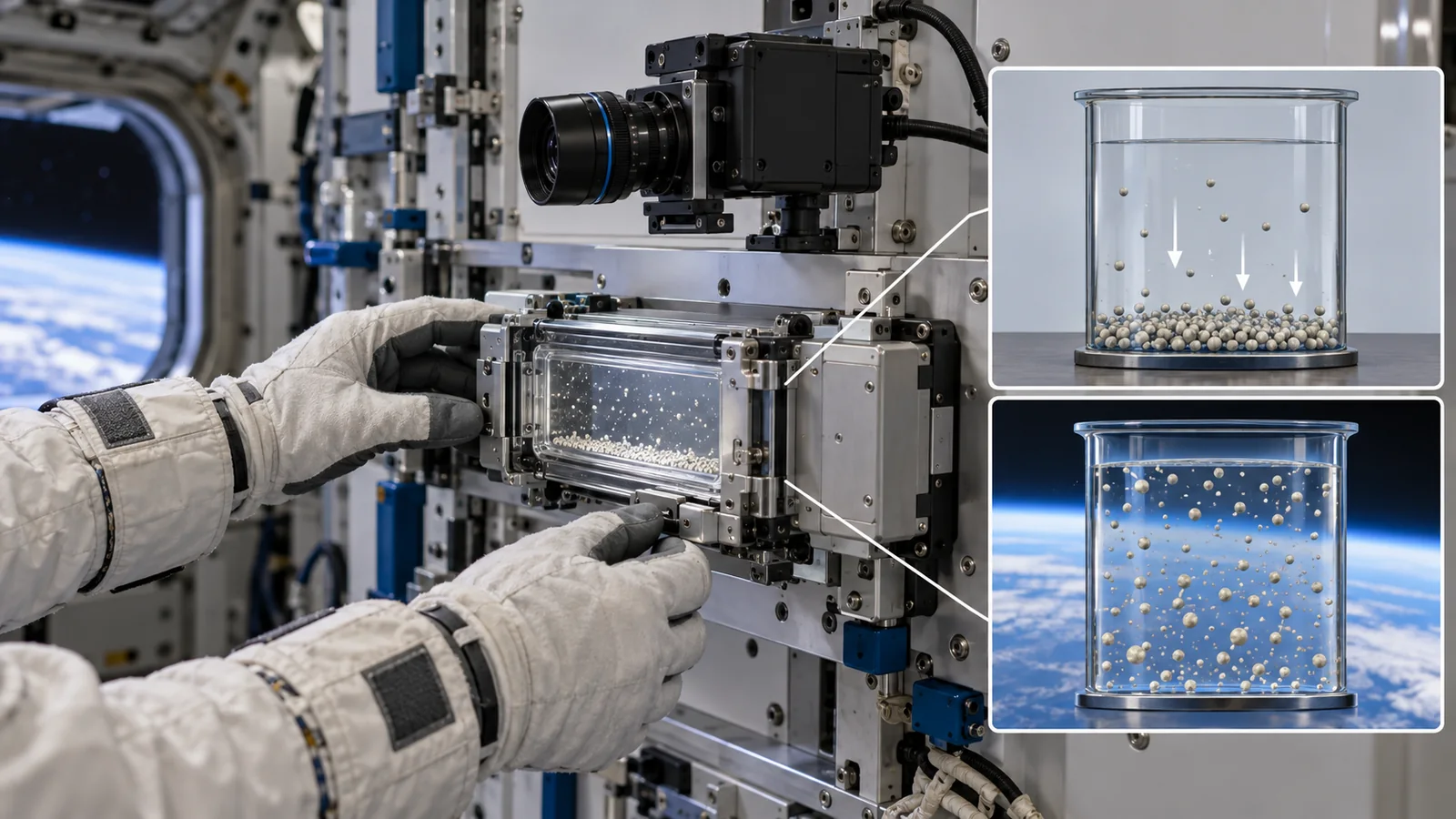
- Summary / before you read / place in the series
- What microgravity is - and is not
- What changes inside a melt when gravity is nearly gone
- How microgravity is obtained
- A research history from Skylab to the ISS
- ZBLAN optical fiber
- Semiconductor crystals, alloys and company demonstrations
- A materials engineer's view, and what could not be confirmed
- How to read the yardsticks / glossary / references / audit
Sourced = stated in a published source (linked)
Our calculation = a value this article computed from stated assumptions
Not yet confirmed = plans, targets, preliminary results and other unsettled matters
Interpretation is marked commentary and inference is shown in bold.
The "level" and "duration" of microgravity differ by method. Read each figure with its conditions (which facility, how many seconds, which year). The ISS ZBLAN results are preliminary on the NASA page and the 2026 paper (July) was checked in full. This article does not say that making things in space always helps, nor that it is pointless. It contains no medical or investment advice.
1. Summary / before you read / place in the series
- Microgravity is not "no gravity" but "continuous free fall": even at the altitude of the International Space Station (ISS), gravity is roughly 90% of its ground value. The station and everything in it fall around the Earth together, so objects appear to float relative to the floor. [Ref. 1]
- With weak gravity, convection and settling in a melt nearly disappear: crystal and alloy growth can potentially be observed and controlled without being stirred by convection. Some effects remain, such as flows driven by surface tension. [Ref. 6, 9]
- Research has run for over 50 years, but "better products at routine scale" has not been confirmed: ZBLAN fiber, SiGe crystals and alloy property measurements are being studied on the ISS and elsewhere. Most results are at the research and demonstration stage; commercial viability could not be confirmed. [Ref. 13, 14]
All you need is the feel that hot liquid rises, cold liquid sinks, heavy particles settle, and crystals form as a melt solidifies. Orbit and gravity formulas are explained where they are needed.
This article treats the fifth of the "five enemies" of the space environment, microgravity, as a tool rather than an enemy. Read "Microgravity Drug Research and Protein Crystallization" next to follow the story through to re-entry capsules.
2. What microgravity is - and is not
(1) A familiar feeling: inside a falling elevator
If an elevator cable snapped and the whole car fell freely, the person inside would stop pressing on the floor, a bathroom scale would read zero, and they would seem to float. Gravity has not gone away; the car and the person fall with the same acceleration, so no force acts between floor and person. Astronauts appear to float for the same reason. (Never try this in a real elevator; it is only a way of thinking.)
(2) An orbit is "falling continuously while moving sideways fast enough"
Then why does the station not hit the ground? Newton's thought experiment answers it. Fire a cannon horizontally from a high mountain: a slow shell lands near, a fast one lands far. If it is fast enough, the ground curves away as fast as the shell falls, and the shell keeps falling without ever hitting the ground. That is an orbit. The ISS travels at about 28,000 km/h. [Ref. 1]Sourced
(3) Gravity does not weaken quickly with altitude
NASA's page says gravity at about 250 miles (about 400 km) is about 88.8% of its ground value. [Ref. 1] Gravity weakens with the square of distance, and 400 km is small next to the Earth's radius of about 6,371 km. The chart uses the same law, calculated by this article. Even at geostationary altitude (35,786 km) about 2% remains, and at the Moon's distance about 0.03%. Leaving the ground does not switch gravity off.SourcedOur calculation
(4) "Micro" means very small, not zero
NASA defines microgravity as the condition of free fall and puts its size at about one millionth of ground gravity. [Ref. 1] "g" is a unit where ground gravity is 1, so 10^-6 g is one millionth of that. This is only a guide. A report from NASA Glenn's measurement group (PIMS) states that weightlessness is an ideal state that cannot be achieved in practice aboard a spacecraft: crew activity, life-support equipment, drag, gravity gradient, rotation and structural resonances all create small accelerations. [Ref. 2] ISS experiments therefore use accelerometers to record the environment and to interpret results.Sourced
Correctly: even at ISS altitude gravity is about 90% of its ground value; the ISS seems to float because it is in free fall around the Earth. Gravity has not gone; its effect simply does not show up on floors or containers. So making microgravity needs not only leaving the ground but keeping a state of free fall (the same principle applies to drop towers and parabolic aircraft).
Microgravity is free fall in which the effect of gravity nearly vanishes. Low gravity (the Moon's surface, for example) means standing on the ground where gravity itself is small. On the Moon the surface still pushes back, so nothing floats. (The Moon is covered in the lunar exploration explainer.)
3. What changes inside a melt when gravity is nearly gone
(1) What gravity does in a melt on the ground
Crystals and alloys form as a molten liquid (the melt) solidifies. On the ground gravity does three things inside a melt. (1) Buoyancy convection: warmer regions are less dense and rise, cooler ones sink, so the melt is stirred. (2) Settling and rising: particles, bubbles and immiscible liquids separate by weight. (3) Contact with a container: the melt rests on a container and takes contamination and stress from the wall. [Ref. 8, 9]Sourced
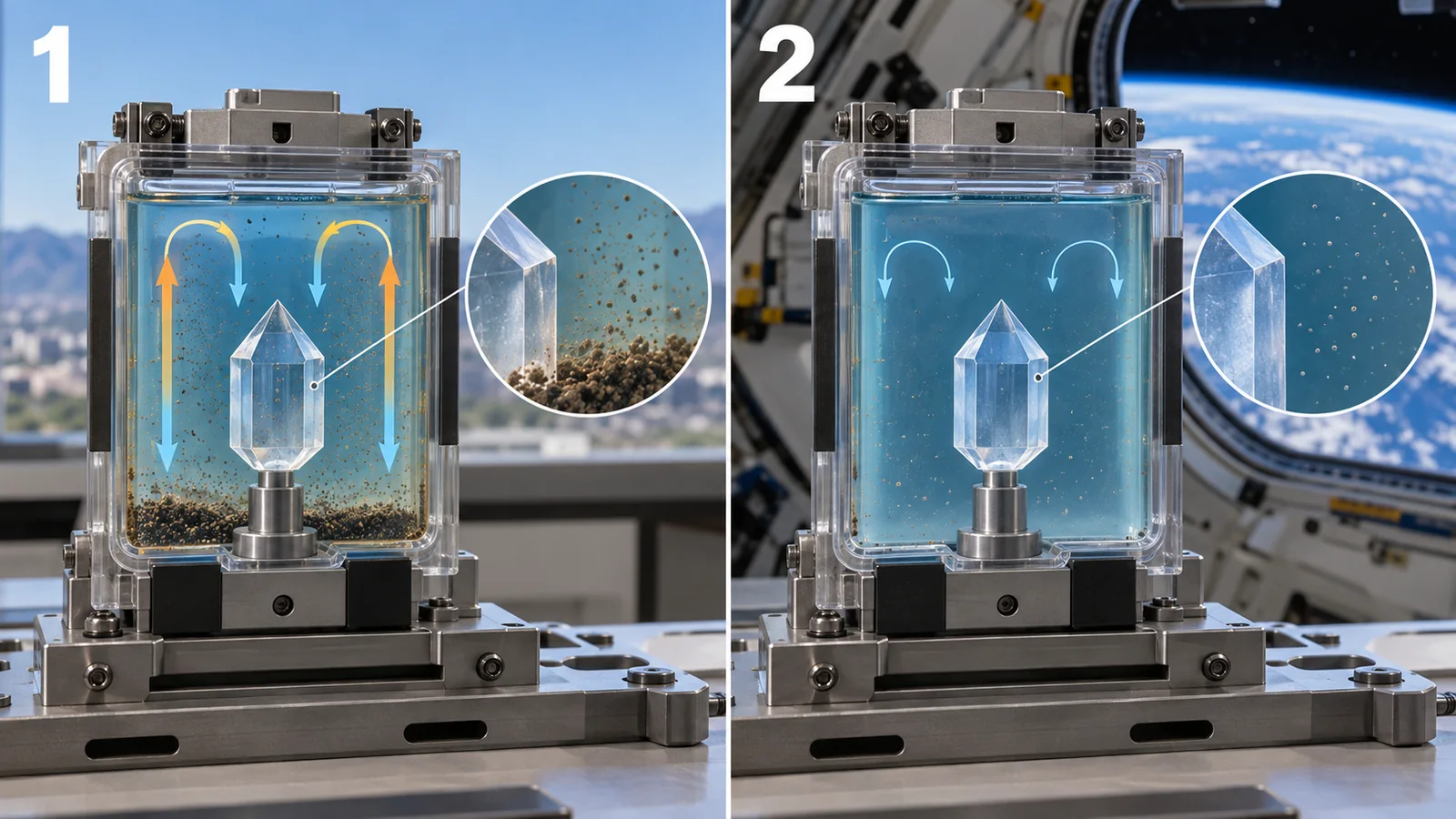
View original SVG, values and sources
Original SVG reference: Conceptual diagram (vector drawing). Melt on the ground (left) and in microgravity (right). Arrows and particles are schematic and do not show real flow sizes.
A paper on the ISS electromagnetic levitator (a device that floats and melts a metal sphere) notes that on the ground the strong electromagnetic fields needed to fight gravity cause turbulent flow that prevents measuring properties such as viscosity. In microgravity the positioning forces are weak, flow becomes close to laminar (non-turbulent), and nearly spherical droplets allow surface tension and viscosity to be measured more precisely. [Ref. 8]Sourced
(2) Checking with numbers: how much slower is settling?
How does "one millionth of gravity" affect settling? The speed at which a small sphere sinks in a liquid is proportional to gravity (Stokes' law: v = Δρ·g·d²/18η, where Δρ is the density difference, g gravitational acceleration, d the particle diameter and η viscosity). Take a 10 μm particle in a water-like liquid as an example.Our calculation
| Case (assumed) | Settling speed | Distance in 1 hour | Brownian spread in 1 hour |
|---|---|---|---|
| Ground (1 g) | 5.4 × 10⁻⁵ m/s | about 0.2 m | about 18 μm |
| Microgravity (10^-6 g) | 5.4 × 10⁻¹¹ m/s | about 0.2 μm | about 18 μm (independent of gravity) |
Assumptions: particle diameter 10 μm, density difference 1,000 kg/m³, viscosity 1 mPa·s, 293 K, g = 9.8 m/s². Brownian spread is the one-direction rms √(2Dt) with D = kT/(3πηd) ≈ 4.3 × 10^-14 m²/s. A rough Our calculation, not a value for a real melt.
Reading: a particle that sinks 20 cm (to the bottom of a container) in an hour on the ground moves only 0.2 μm in microgravity, and its thermal jiggling (about 18 μm) is far larger. Settling effectively ends and particles move only by diffusion. For the same reason bubbles and immiscible liquids separate less readily (our commentary).
More detail: buoyancy convection also weakens in proportion to gravity
The dimensionless number that expresses the strength of buoyancy convection driven by temperature differences (the Rayleigh number) is proportional to gravitational acceleration. If gravity falls to a millionth, so does this number, and the driving force of convection drops by orders of magnitude (a textbook relation; our commentary). A paper on ISS experiments likewise says that in microgravity convection is absent or reduced, so growth is controlled by diffusion alone. %s Flows not driven by buoyancy (next table) remain.
(3) Why this matters for crystal growth
Around the growing face of a crystal (the growth interface), dopants and dissolved components are either taken into the crystal or pushed back into the liquid, so concentration changes. With convection this concentration fluctuates over time and leaves stripe-like compositional variation (striations) in the crystal. In microgravity convection vanishes and matter is carried by diffusion alone, so growth can be compared directly with simple theory. [Ref. 9] What matters scientifically is that gravity becomes a knob that can be turned to isolate the cause of defects.Sourced
(4) What remains
| What remains | What it is | Caution |
|---|---|---|
| Surface-tension-driven flow (Marangoni convection) | Temperature differences along a free surface create surface-tension differences that pull the surface and drive flow; independent of gravity | In Skylab InSb crystals NASA SP-443 reports no evidence of this flow (a thin surface oxide film may have suppressed it, but this is not conclusive). [Ref. 6] |
| Residual acceleration (g-jitter) | Small accelerations from crew motion, equipment vibration, drag and so on | The level changes with time. On the ISS accelerometers measure it for interpreting experiments. [Ref. 2] |
| Diffusion and heat conduction | Occur regardless of gravity | Growth rate and defects still depend on them. "No convection" does not mean "perfect crystal". |
| Walls, gas, impurities | Container material, atmosphere, purity of raw material | Separate problems from gravity that need controlling just as on the ground |
Sources: NASA SP-443 and the PIMS report. The table layout is our commentary.
When a crystal grown on the ground shows striations, it is hard to tell whether convection, temperature-control fluctuations or raw-material impurities are to blame. A low-gravity run works as a control with the convection variable removed. Much ISS research aims first at producing data to test theory and simulation rather than products. [Ref. 9, 10] Whether the knowledge can be fed back into ground processes, or whether making things in space is worth the cost, is a different question (our commentary).
4. How microgravity is obtained
Microgravity exists only while something is in free fall. A short drop gives short times; reaching orbit gives long ones. The method is chosen to suit the experiment.
| Method | Continuous time per run | Level (as stated) | Suited to |
|---|---|---|---|
| Drop tower (ZARM, Bremen) | drop mode 4.7 s; catapult mode up to 9.3 s | below 10^-6 g (ZARM) | short phenomena such as combustion and liquid behavior [Ref. 3] |
| Parabolic flight (A310 aircraft) | about 20 s per parabola; about 31 per flight (ESA) | not stated on the ESA page (could not be confirmed) | instrument tests and short experiments [Ref. 4] |
| Sounding rocket (TEXUS, Sweden) | about 6 min (TEXUS 60: 362 s) | about 10^-4 g (Airbus) | crystal growth and alloy reactions; examples from TEXUS 59 and 60 in 2024 [Ref. 5] |
| International Space Station (ISS) | continuous (hours to months per experiment) | about 10^-6 g as a guide (NASA); varies with time and is measured by accelerometers (PIMS) | crystal growth, solidification imaging, fiber drawing and so on [Ref. 1, 2] |
| Free-flying spacecraft and return capsules | days or longer in orbit (varies by company) | not confirmed in sources | covered in the next explainer, on drug research and protein crystallization |
Sourced Figures as stated by each source. Levels are measured differently, so do not rank methods by them.
Some property measurements (AC calorimetry) need more than five minutes of microgravity. [Ref. 8, 10] Crystal growth can take tens of hours (the SiGe example later). A short phenomenon can be watched in a drop tower. The time needed is set by the time scale of the phenomenon.
5. A research history from Skylab to the ISS
(1) Skylab (1973-1974): the first extensive experiments
NASA's SP-443 (1980) says interest in materials processing in space began in the late 1950s; after limited tests in drop towers and some of the last Apollo flights, the Skylab solidification and crystal-growth experiments were the first extensive demonstration of materials processing in space. [Ref. 6] Skylab was a US space station launched on 14 May 1973; Skylab 3 (from 28 July 1973) and Skylab 4 (16 November 1973 to 8 February 1974) crews stayed aboard. [Ref. 7]Sourced
A representative case is experiment M562 (Witt and Gatos). Crystals of indium antimonide (InSb) doped with tellurium (Te) or tin (Sn) were partly remelted aboard Skylab 3 and 4, held for 60 minutes to reach thermal equilibrium, and solidified in one direction by controlled power reduction. After sectioning and etching, the part grown on the ground showed pronounced dopant striations, while the part grown in space showed no microscopic compositional fluctuations. SP-443 states this shows that growth-rate fluctuations are gravity-related and can be eliminated in low gravity. [Ref. 6]Sourced
Results were not always dramatic. In experiment M557 on immiscible metals, samples solidified in space had a more homogeneous structure, but not the fine, uniformly dispersed structure obtained for gallium-bismuth in drop-tower tests. [Ref. 6] SP-443 also notes that many experiments gave unexpected results. From the start, cases where the benefit was confirmed and cases where it was not both appeared.Sourced
(2) The ISS era: measurement and testing theory
| Study | What was studied | Result (within the source) | Stage |
|---|---|---|---|
| ISS-EML (electromagnetic levitator, ESA, Columbus module) | Float and melt metal spheres without a container; measure surface tension and viscosity (oscillating drop), density, specific heat, thermal conductivity, emissivity and resistivity | The paper explains that properties hard to measure on the ground because of reaction, convection and strong-field turbulence can be measured more precisely. [Ref. 8] | ISS experiment |
| TA and DECLIC-DSI (transparent model alloys, ISS) | Directionally solidify transparent organic alloys while imaging solidification patterns (eutectic, peritectic, cellular, dendritic) with microscopes | The review says that, without convection, growth is purely diffusive and can be compared directly with simulation. Caution: model substances, not real metals, are used. [Ref. 9] | ISS experiment |
| Hicari-II (JAXA, Kibo, SiGe crystals) | Grow silicon-germanium (SiGe) crystals directionally and study the growth rate | Growth in microgravity was 0.15 mm/h, about 20% faster than on the ground, and higher 1.5 and 5 hours after the start. The cause was transient constitutional supercooling, where solute builds up near the seed because there is no convection. After tens of hours the rate settled at 0.12 mm/h, near the ground rate. [Ref. 10, 11] | ISS experiment |
Sourced Hicari-II is as described by JAXA and the paper (Materialia, May 2026). It concerns growth rate; it does not claim crystals better than ground-grown ones.
Correctly: removing convection eliminates some causes of defects (striations, for example), but other phenomena come to the front. In Hicari-II the absence of convection let solute build up near the seed so that growth was faster, and the effect faded within tens of hours. [Ref. 10, 11] Results depend on material, method and time and cannot be generalized.
6. ZBLAN optical fiber: the flagship of microgravity manufacturing research
(1) What ZBLAN is and what is expected of it
ZBLAN is a heavy-metal fluoride glass made of fluorides of zirconium, barium, lanthanum, aluminum and sodium (ZrF4-BaF2-LaF3-AlF3-NaF); the name strings together the element initials. [Ref. 12] It transmits longer infrared wavelengths (mid-infrared, 2-4 μm) than ordinary silica fiber, so it has long been eyed for long-distance links and for infrared sensors and lasers. The 2026 paper states that the theoretical attenuation of ZBLAN in the mid-infrared is up to 20 times lower than the minimum loss of silica (at about 1.55 μm) and that intrinsic loss is below 0.01 dB/km in the 1.5-2.5 μm region. [Ref. 14] A 1994 NASA technical memorandum gives the theoretical loss coefficient as 0.001 dB/km at 2 μm. [Ref. 12] These are theoretical values; as the table below shows, real ZBLAN fibers are still far from them.Sourced
Fiber loss states how much light intensity falls per distance travelled in decibels (dB). A 3 dB loss roughly halves the light. The smaller the number, the farther light travels. Long telecom fibers are quoted in dB/km (per kilometre) and short laboratory fibers often in dB/m (per metre); 1 dB/m = 1,000 dB/km (our calculation). Never compare values without matching the units.
(2) Why it is hard to make: crystals form
According to the 2026 paper, ZBLAN has a higher critical cooling rate (the minimum cooling speed needed to solidify without crystallizing) than silica, so crystals form readily both when the glass is made and when the fiber is drawn. The cooling rate during drawing is set by draw speed and tension, but theory and experiment indicate that avoiding crystallization would need impractical speeds and tensions. Impurities in the raw materials (transition metals, hydroxyl groups, oxides) not only absorb light but can also seed crystals. NASA's page says crystals scatter light and make the fiber brittle. [Ref. 14][Ref. 13]Sourced
(3) Why microgravity slows crystallization
NASA's page says only that crystals grow more slowly in microgravity, but the 2026 paper gives a model-based explanation. Crystals need matter to be transported, either by molecular diffusion or by buoyancy-driven convection. At the drawing temperature ZBLAN has a high viscosity of about 10^5 Pa·s and diffusion coefficients of about 10^-11 to 10^-10 m²/s. Transport over a millimetre by diffusion alone takes hours to a day (the paper's statement). On the ground (1 g), buoyancy convection therefore contributes substantially to transport and speeds crystal growth. In microgravity the convective contribution disappears, transport becomes diffusion-only, and crystallization is suppressed. The paper also says that at higher temperatures viscosity drops, diffusion dominates, and the effect of convection, and hence of microgravity, is negligible. [Ref. 14] This is the "no convection" effect of Chapter 3 at work in a specific case.Sourced
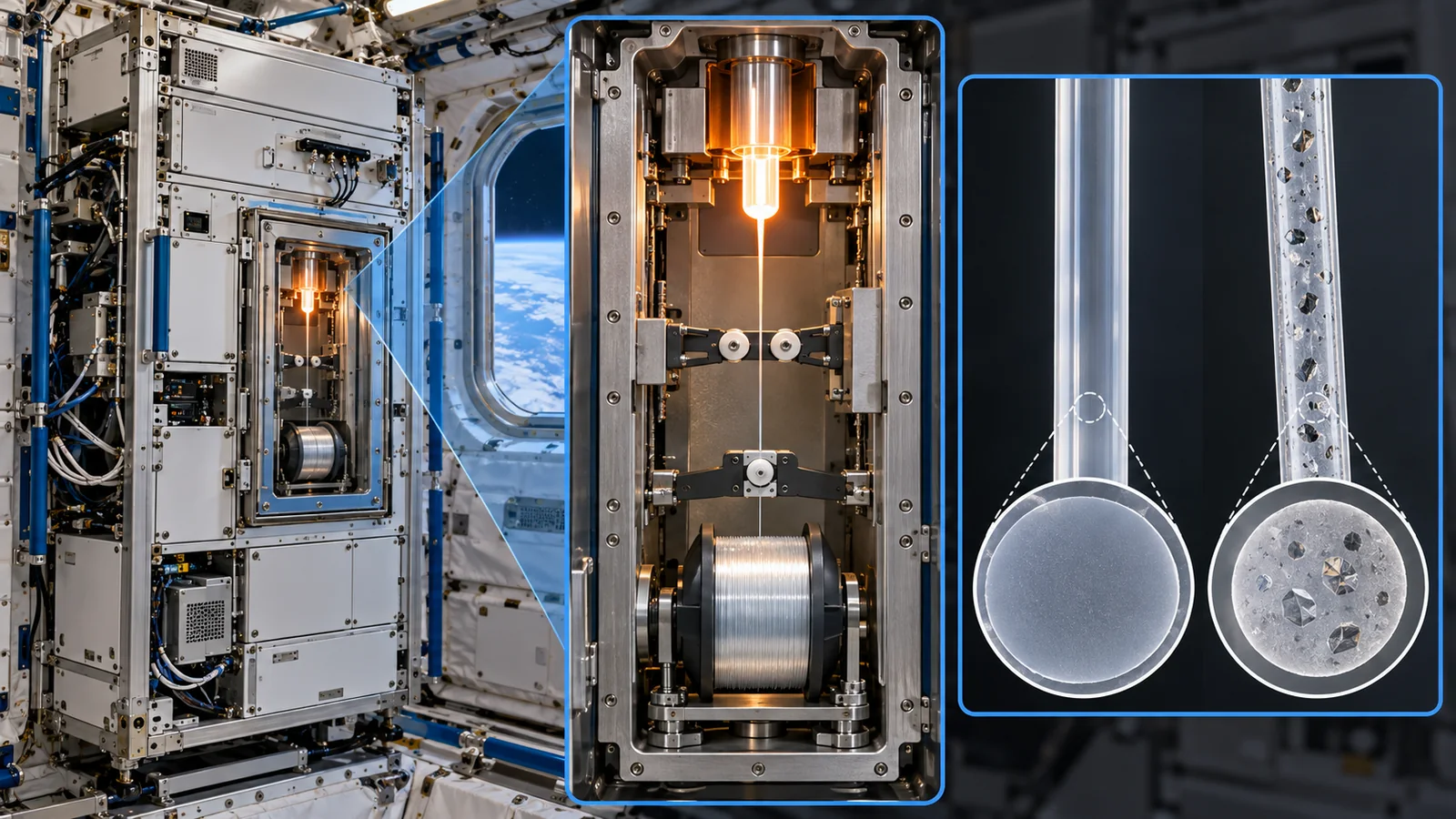
View original SVG, values and sources
Original SVG reference: Conceptual diagram (vector drawing). Left: schematic of fiber drawing. Upper right: schematic of crystallization. Lower right: timeline of key events (as stated on the NASA page and in the paper). Number and size of crystals are illustrative.
(4) What has been tried, from the 1990s to the ISS in 2024
1990s (ground-based aircraft and similar): Heating tests in short microgravity (mostly under two minutes) showed reduced crystallization. A 1994 NASA technical memorandum reports that ZBLAN fiber in evacuated quartz ampoules was heated to the crystallization temperature on the KC-135 aircraft; the 1 g and 2 g samples slumped and crystallized, while the 0 g samples showed no evidence of crystallization. This was a heating test to look for crystallization, not fiber drawing. [Ref. 12][Ref. 14]Sourced
ISS: According to NASA's page, ISS ZBLAN development began in 2014, and work included the first privately funded ZBLAN draw (Made In Space Fiber Optics), FOP-2 (which repeated 20 m draws) and Space Fibers from FOMS Inc. From mid-February to mid-March 2024, Flawless Space Fibers-1 (Flawless Photonics, supported by the ISS National Laboratory) is reported, as a preliminary result, to have made more than seven miles (11.9 km) of optical fiber, run eight draws of more than 700 m and drawn about 1,141 m in one day (the previous space record being 25 m). Three of the four goals of NASA's InSPA program are described as achieved, while the fourth, "ten times better quality than Earth-made fiber," depended on analysis after return and was undetermined at the time of the page. [Ref. 13]SourcedNot yet confirmed
The July 2026 paper (results): From about 12 km, a total of about 2.1 km in the sections with the most uniform diameter was compared with fiber drawn on the ground. Ground and ISS used the same draw-tower design and the same preforms, and on the ISS the fiber was drawn inside the Microgravity Science Glovebox with minimal crew intervention. Loss was measured by several institutions with the cut-back method, in which a fiber is shortened repeatedly. The table gives results at a wavelength of 1,550 nm. [Ref. 14]Sourced
| Fiber type | Ground-drawn (loss) | ISS-drawn (loss) | How the paper reads it |
|---|---|---|---|
| Single-index (whole cross-section is the core; 125 μm) | 0.08-0.25 dB/m (mean 0.16) | 0.08-0.25 dB/m (mean 0.16) | No systematic difference between ground and space. The paper explains that there were no crystal seeds, so crystal-related loss was small to begin with |
| Step-index (core about 57 μm plus a lower-index cladding glass) | 2-7 dB/m (mean 4.50) | 0.3-1.2 dB/m (mean 0.75); 1-2 dB/m in the 2-4 μm mid-infrared | Space-drawn fiber is consistently lower, which the paper attributes to less crystal scattering. It is still up to 1 dB/m above the single-index type because bubbles and core-cladding imperfections remain |
Source: Fig. 1 and Table 1 of Arat et al. (2026), at 1,550 nm. Sourced Units are dB/m (1 dB/m = 1,000 dB/km).
Strength (tensile testing) was compared too. For 421 segments (230 from space, 191 from ground), median breaking strength was +25% for single-index and +80% for step-index fibers, and the Weibull modulus (a number expressing how small the scatter in strength is) was +39% for step-index fibers (-5% for single-index). [Ref. 14]Sourced
(5) The limits the paper itself states, and the company claim
The paper splits loss into five parts: (1) intrinsic loss, (2) absorption by transition-metal and rare-earth impurities, (3) scattering from bubbles and interface imperfections, (4) scattering from crystals formed during drawing and (5) loss in the polymer coating. Of these, only (4) is affected by microgravity. (2) (about 60 dB/km = 0.06 dB/m at 1.5 μm for the raw-material purity of this study) and (3) do not depend on gravity. The paper concludes that microgravity "substantially reduces crystallization-driven loss" but "yields no benefit when attenuation is dominated by impurity or noncrystalline defect contributions," and stresses that improving raw-material purity is important. [Ref. 14]Sourced
External benchmarks are also given. The best ZBLAN value reported in 1992 was 0.65 dB/km at 2.56 μm (about 0.3 dB/km of it scattering); even if all the scattering came from crystals, microgravity could remove at most about 0.3 dB/km, a reduction of total loss by about half. Commercial multimode ZBLAN fibers are said to show more than ten times lower loss than the single-index fibers of this study at 1.5 μm. [Ref. 14] Converted by this article, the mean 0.75 dB/m of the space-drawn step-index fiber is 750 dB/km, more than 1,000 times the value above (a reference only, because the wavelengths differ; our calculation). So this study showed that microgravity reduces crystal-related loss; it did not show that low-loss ZBLAN fiber has been made in space.SourcedOur calculation
Fiber loss is a sum of raw-material purity, preform quality (bubbles, interfaces), crystals formed during drawing and the coating. What matters in this study is that the same raw materials, preforms and equipment were used on the ground and in space, so the comparison isolates gravity. A difference appeared where crystals were the problem (step-index) and none where they were not (single-index). For a materials engineer the reading is that microgravity is no substitute for raw-material purity or careful preform work. [Ref. 14]
The company claim: On its own website, Flawless Photonics states that it is "the only company to successfully manufacture commercially viable lengths of optical fiber in micro-gravity, pulling over 11 kilometers at the International Space Station and returning it to Earth," and lists low attenuation and wide bandwidth as features of its product "SpaceFiber." [Ref. 15] This is a company claim. Note that the five institutions involved in the paper's evaluation include Flawless Photonics itself, which made the fiber. [Ref. 14] Shipments, prices, mass-production plans and customer evaluations could not be confirmed in this check. The paper says future missions are planned to reduce bubbles and crystallization through improved ground casting and in-space glass melting; this is Not yet confirmed. [Ref. 14]SourcedNot yet confirmed
Correctly: "how many kilometres were drawn" is output, not proof of quality. In the paper's comparison the difference appeared against fibers of the same type drawn on the ground from the same preforms, not against commercial products or past best values. Quality can be claimed only with a ground control under the same conditions, loss values with wavelengths, and measurements that include independent parties (our commentary). [Ref. 13][Ref. 14]
7. Semiconductor crystals, alloys and company demonstrations
(1) Semiconductor crystals and alloys: research aims mainly at understanding
For semiconductor crystals, Skylab InSb (where dopant striations disappeared) and current SiGe growth-rate work are representative. [Ref. 6, 10] For alloys, ISS-EML property measurements and observations of transparent model alloys are representative. [Ref. 8, 9] What these studies mainly aim at is to understand growth and solidification without convection and to use the knowledge for ground-process design and for testing simulations. This check found no evidence that semiconductors or alloys made in space are used in ground products.Sourced
(2) Space Forge ForgeStar-1: a plasma demonstration on a free-flying craft
The official page of Space Forge (UK), dated 25 March 2026, says its satellite ForgeStar-1 was launched to low Earth orbit in June 2025 and that, using its in-house growth chamber, it has generated plasma in orbit more than 100 times. The company says this shows that the extreme conditions needed for gas-phase crystal growth, a core building block of semiconductor production, can be created and controlled on an autonomous platform in orbit, and claims it is the "first free-flying commercial semiconductor manufacturing tool" ever operated in space. [Ref. 16] This is a company claim.SourcedNot yet confirmed
What the page states goes as far as "plasma was generated." Growing a crystal in orbit, returning it to Earth and measuring its quality were not stated within what we checked. The stage is therefore "part of the conditions needed for growth were created on a small free-flying craft," not established manufacturing.
Correctly: what matters is who says "first" and by what yardstick. Here "first" refers to generating plasma on a free-flying commercial device. [Ref. 16] That is a different stage from producing crystals that can be sold as products, as the ladder shows.
8. A materials engineer's view, and what could not be confirmed
(1) Is gravity really the cause? Are the effects of convection, settling and containers isolated by comparison with ground controls? (2) Are quantity and repeatability sufficient? Can several kilometres of fiber or millimetre-scale crystals be repeated at the same quality, and what does recovery and analysis cost in effort? (3) Can ground-based improvement not reach the goal? Compare with ground methods such as suppressing convection with magnetic fields or rotation, or levitation without containers. These are general questions for judging any new process, not an assessment of a particular business or company (our commentary).
What could not be confirmed
- The cost, yield and repeatability of ISS ZBLAN drawing (the paper reports one mission; repeated reproduction could not be confirmed)
- Whether the paper's measurements follow IEC 60793-1-40 (the paper says "cutback method" but no standard number appeared in the text; the reference list was not checked)
- Shipments, prices and customer evaluations of ZBLAN fiber; crystal growth, return and quality for Space Forge
- The microgravity level of parabolic flights (not on the ESA page)
- Any case of semiconductors or alloys made in space being used in ground products
Summary
Microgravity is not an absence of gravity but a state of free fall, and it nearly removes convection and settling in a melt. Experiments that turn this "gravity knob" have been used for over 50 years, from Skylab onward, to understand crystals and alloys. Work on ZBLAN fiber, SiGe crystals and alloy properties continues on the ISS, but within what could be confirmed it is at the research and demonstration stage. The value of "making it in space" has to be judged by comparison with controls, by quantity and repeatability, and by comparison with ground methods.
9. How to read the yardsticks and standards
Two kinds of yardstick appear in space manufacturing. One is the quality of the microgravity environment (how small, how long and how quiet); the other is the quality of the material produced (loss, uniformity, growth rate, properties). The environmental yardstick looks at time, level and vibration (frequency). Material yardsticks can use the same measurements as on the ground, but it is essential to compare space and ground under the same conditions. Checked on 17 October 2026.
| What is evaluated | Typical test or evaluation method (name, source) | Standard or guideline (name, edition, source checked) | How to read it |
|---|---|---|---|
| Microgravity environment (level, vibration) | ISS accelerometers: SAMS (vibration, 0.01-300 Hz), MAMS-OSS (quasi-steady, up to about 1 Hz), MAMS-HiRAP (0.01-100 Hz). Processed and archived by NASA Glenn PIMS. [Ref. 2]Sourced | No common standard for the microgravity level was found | "10^-6 g" is a guide; also look at frequency, direction and duration |
| Duration of microgravity | Facility figures: drop tower 4.7 s and 9.3 s (ZARM), parabola about 20 s (ESA), TEXUS about 6 min (Airbus). [Ref. 3, 4, 5]Sourced | not found | Measured differently by method. Check whether time is one continuous run or a total |
| Optical fiber attenuation | Four methods: cut-back, insertion loss, backscattering and modelled spectral attenuation (as the standard lists them). The 2026 paper used the cut-back method at several institutions. [Ref. 14, 17]Sourced | IEC 60793-1-40 "Optical fibres - Part 1-40: Attenuation measurement methods." The 2019 edition (2nd) is withdrawn; the 2024 edition is the current base document (in Europe EN IEC 60793-1-40:2025). [Ref. 17, 18]Sourced | This is a measurement-method standard; whether mid-infrared ZBLAN fibers fall in its scope could not be confirmed (the text was not checked). Quote loss together with wavelength |
| Crystal uniformity (striations, composition) | Cut the crystal, etch it and observe stripes on the section (Skylab M562). [Ref. 6]Sourced | not found | No stripes does not mean no defects |
| Growth rate and solidification pattern | Directional-solidification observation and growth-rate measurement (Hicari-II: 0.15 and 0.12 mm/h); microscope imaging of transparent alloys. [Ref. 9, 10, 11]Sourced | not found | The rate changes with time (it approached the ground rate in tens of hours). Check when the value was taken |
| Thermophysical properties (surface tension, viscosity, specific heat) | Oscillating-drop method (surface tension, viscosity), AC calorimetry (specific heat, thermal conductivity), optical and inductive density measurements. [Ref. 8]Sourced | not found | Containerless measurements differ from ground ones; comparing them needs the uncertainties |
| Output and manufacturing success | NASA preliminary report: 11.9 km total, eight draws above 700 m, about 1,141 m in a day. Company claim: over 11 km. Paper: about 2.1 km compared out of about 12 km. [Ref. 13, 14, 15]SourcedNot yet confirmed | not found | Output is not proof of quality. Look for independent evaluation and ground controls |
The arrangement of the table is Our calculation (organization). No applicable ASTM standard was found.
Reading notes (for materials engineers)
- Ground tests and orbit differ: the 1994 aircraft heating test did not draw fiber and is a different stage from the 2024 ISS drawing.
- Company statements and independent verification differ: the 2026 paper is a joint evaluation by five organizations, but they include Flawless Photonics itself, which made the fiber. "Only" and "commercially viable" are the company's own statements.
- Match units and conditions: ZBLAN loss changes greatly with dB/m versus dB/km, wavelength (1.5 μm versus 2.56 μm) and fiber type (single-index versus step-index). The paper's comparison used the sections of most uniform diameter, not the whole-length average.
- Plans and achievements differ: InSPA's "ten times better quality" was undetermined at the time of the NASA page. Read business plans for manufacturing in space as Not yet confirmed.
10. Glossary
- Microgravity
- A state where the effect of gravity nearly vanishes in free fall; about one millionth of ground gravity is a guide (NASA).
- Free fall
- Falling under gravity alone. Orbiting is a kind of free fall.
- g (unit of acceleration)
- 1 g is ground gravitational acceleration (about 9.8 m/s²); 10^-6 g is a millionth of it.
- ISS (International Space Station)
- A crewed laboratory orbiting at about 400 km.
- Low Earth orbit (LEO)
- Low Earth orbit: an orbit near the Earth, such as the ISS altitude.
- Melt
- A material in the molten state, from which crystals and alloys form.
- Buoyancy convection
- Flow in which warm regions rise and cool ones sink because of density differences from temperature differences.
- Settling (sedimentation)
- The sinking of heavy particles in a liquid.
- Marangoni convection
- Flow driven by surface-tension differences from temperature differences along a free surface; independent of gravity.
- g-jitter (residual acceleration)
- Small fluctuating accelerations inside a spacecraft from crew motion, equipment vibration and so on.
- Quasi-steady / vibratory
- Names for accelerations split into slowly varying (up to about 1 Hz) and rapidly oscillating components.
- Diffusion-controlled
- A state in which transport is governed by diffusion alone, as in growth without convection.
- Striations
- Periodic variations in impurity concentration in a crystal.
- Constitutional supercooling
- A condition in which solute builds up ahead of the growth interface so the liquid is below its freezing point.
- Containerless processing
- Melting a sample held floating by electromagnetic fields so it never touches a container.
- Electromagnetic levitator (EML)
- A device that levitates and melts metal with electromagnetic fields; ESA has one on the ISS.
- Drop tower
- A facility where equipment falls freely in a tower to give short microgravity.
- Parabolic flight
- Flying an aircraft along parabolas to get about 20 s of free fall each.
- Sounding rocket
- A rocket that rises into space and falls back, giving minutes of microgravity.
- ZBLAN
- A heavy-metal fluoride glass (ZrF4-BaF2-LaF3-AlF3-NaF) that transmits into the mid-infrared.
- Preform
- The glass rod from which optical fiber is drawn by heating and stretching.
- Devitrification (crystallization)
- Formation of crystals in glass, which scatter light and cause other problems.
- Loss (attenuation), dB/km
- The rate at which light weakens in a fiber; smaller means light reaches farther.
- Critical cooling rate
- The minimum cooling rate needed to solidify a melt into glass without crystallizing; ZBLAN needs more than silica.
- Cut-back method
- A method that finds loss by measuring transmitted light while repeatedly shortening the fiber.
- Single-index / step-index
- A fiber whose whole cross-section is the core, versus one with a core and a lower-index cladding.
- Weibull modulus
- A number expressing how small the scatter in strength is; larger means more uniform strength.
- SiGe
- A mixed crystal (semiconductor) of silicon and germanium.
- InSPA
- NASA's In Space Production Applications: a program supporting demonstrations of in-space production.
11. References
- NASA What Is Microgravity? (ISS Research: free fall, about one millionth, gravity versus altitude, orbital speed) — www.nasa.gov/missions/station/iss-research/what-is-microgravity/
- NASA Glenn (PIMS) Principal Investigator Microgravity Services, ISS Increment-2 Quick Look Report (May to June 2001) (accelerometers SAMS and MAMS, quasi-steady and vibratory regimes, "weightlessness is an ideal state") — gipoc.grc.nasa.gov/pims/pimsdocs/public/PIMS%20Report/PIMSOuickLook.pdf
- ZARM (University of Bremen) Drop Tower Bremen: General information (drop mode 4.7 s, catapult mode up to 9.3 s, below 10^-6 g) — www.zarm.uni-bremen.de/en/drop-tower/general-information.html
- ESA Airbus A310 Zero-G (parabolic flights: about 31 parabolas per flight, about 20 s of free fall) — www.esa.int/Our_Activities/Human_Spaceflight/Research/Airbus_A310_Zero-G
- Airbus Airbus-built TEXUS sounding rockets take to the skies (TEXUS 59 and 60, 2024: about 6 min, 362 s, about 10^-4 g) — www.airbus.com/en/newsroom/news/2024-03-airbus-built-texus-sounding-rockets-take-to-
- NASA NASA SP-443 "Materials Processing in Space: Early Experiments" (Naumann and Herring, 1980: Skylab M562, M557 and others) — ntrs.nasa.gov/citations/19810007559
- NASA Skylab (launched 14 May 1973; Skylab 3 and 4 dates) — www.nasa.gov/history/skylab/
- npj Microgravity Mohr M. et al. "Electromagnetic levitation containerless processing of metallic materials in microgravity: thermophysical properties" (2023, 9:34, DOI 10.1038/s41526-023-00281-4) — doi.org/10.1038/s41526-023-00281-4
- npj Microgravity Akamatsu S. et al. "Microgravity studies of solidification patterns in model transparent alloys onboard the International Space Station" (2023, DOI 10.1038/s41526-023-00326-8) — doi.org/10.1038/s41526-023-00326-8
- Materialia Arai Y. et al. "Increasing SiGe crystal growth rate utilizing microgravity" (May 2026, DOI 10.1016/j.mtla.2026.102709) — doi.org/10.1016/j.mtla.2026.102709
- JAXA JAXA news item on the first Hicari-II paper (12 June 2026: 0.15 mm/h, about 20%, 0.12 mm/h) — humans-in-space.jaxa.jp/en/biz-lab/news/detail/005790.html
- NASA Tucker D. S. "Effect of Microgravity on Crystallization of ZBLAN Fibers", NASA TM-108461 (June 1994) — ntrs.nasa.gov/citations/19950003911
- NASA Optical Fiber Production (ISS Research: Flawless Space Fibers-1, February to March 2024, preliminary results) — www.nasa.gov/humans-in-space/optical-fiber-production/
- Space: Science & Technology Arat et al. "Space-Based Fabrication of ZBLAN Optical Fibers: A Breakthrough in Microgravity Manufacturing" (23 July 2026, Vol. 6, 0572, DOI 10.34133/space.0572) — spj.science.org/doi/10.34133/space.0572
- Flawless Photonics Company website (SpaceFiber; the company's own claim to be the only one to make commercially viable lengths in microgravity) — www.flawlessphotonics.com/
- Space Forge ForgeStar-1 mission page (dated 25 March 2026: plasma generated more than 100 times; company claims) — www.spaceforge.com/missions/forgestar-1
- IEC IEC 60793-1-40 "Optical fibres - Part 1-40: Attenuation measurement methods" (IEC webstore page for the 2019 edition: four methods including cut-back; the 2019 edition is withdrawn) — webstore.iec.ch/en/publication/60732
- EVS (Estonian Centre for Standardisation) EVS-EN IEC 60793-1-40:2025 (base document IEC 60793-1-40:2024; valid from 3 February 2025) — www.evs.ee/en/evs-en-iec-60793-1-40-2025
12. Claim-to-source audit
| Claim in the text | Basis | Type |
|---|---|---|
| Microgravity is the state of free fall at about one millionth of ground gravity; gravity is about 88.8% at about 250 miles; the ISS travels at about 17,500 mph (28,000 km/h) | NASA explanatory page Reference 1 https://www.nasa.gov/missions/station/iss-research/what-is-microgravity/ | Sourced |
| Calculation in Fig. 3 (g/g0 = (R/(R+h))^2 with R = 6,371 km: 100% on the ground, 88.5% at 400 km, 74.7% at 1,000 km, 2.3% at geostationary altitude, 0.03% at the Moon distance) | Our calculation (formula and assumptions given in the text) | Our calculation |
| Weightlessness cannot be achieved in practice; crew, equipment, drag, gravity gradient, rotation and structural resonances create accelerations. SAMS covers 0.01-300 Hz, MAMS-OSS up to about 1 Hz, MAMS-HiRAP 0.01-100 Hz | NASA Glenn PIMS report Reference 2 https://gipoc.grc.nasa.gov/pims/pimsdocs/public/PIMS%20Report/PIMSOuickLook.pdf | Sourced |
| Drop tower: 4.7 s (drop mode), up to 9.3 s (catapult mode), below 10^-6 g | ZARM page Reference 3 https://www.zarm.uni-bremen.de/en/drop-tower/general-information.html | Sourced |
| Parabolic flight: about 31 parabolas per flight, about 20 s of free fall | ESA page Reference 4 https://www.esa.int/Our_Activities/Human_Spaceflight/Research/Airbus_A310_Zero-G | Sourced |
| TEXUS 59 and 60 (2024): about 6 min, 362 s for TEXUS 60, about 10^-4 g, example experiments | Airbus news item Reference 5 https://www.airbus.com/en/newsroom/news/2024-03-airbus-built-texus-sounding-rockets-take-to-the-skies-to-conduct-experiments | Sourced |
| NASA SP-443: Skylab as the first extensive demonstration; M562 (InSb, Te and Sn, Skylab III and IV, 60 min hold, stripes in the ground part and no microscopic fluctuations in the space part); M557 (more homogeneous but not as fine as drop-tower Ga-Bi); no evidence of Marangoni flow (possible oxide film) | NASA SP-443 Reference 6 https://ntrs.nasa.gov/citations/19810007559 | Sourced |
| Skylab launched 14 May 1973; Skylab 3 from 28 July; Skylab 4 from 16 November 1973 to 8 February 1974 | NASA Skylab page Reference 7 https://www.nasa.gov/history/skylab/ | Sourced |
| ISS-EML: containerless processing, turbulence in ground levitation, laminar flow, spherical droplets, properties measured, more than five minutes of microgravity | Mohr et al. (npj Microgravity, 2023) Reference 8 https://doi.org/10.1038/s41526-023-00281-4 | Sourced |
| TA and DECLIC-DSI: transparent model alloys, absent or reduced convection, diffusion-controlled growth, studies of eutectic, peritectic, cellular and dendritic patterns | Akamatsu et al. (npj Microgravity, 2023) Reference 9 https://doi.org/10.1038/s41526-023-00326-8 | Sourced |
| Hicari-II (Kibo, Gradient Heating Furnace): 0.15 mm/h, about 20% above ground, at 1.5 and 5 hours, transient constitutional supercooling, 0.12 mm/h after tens of hours | Arai et al. (Materialia, 2026) and JAXA news item Reference 10 https://doi.org/10.1016/j.mtla.2026.102709 Reference 11 https://humans-in-space.jaxa.jp/en/biz-lab/news/detail/005790.html | Sourced |
| ZBLAN composition (ZrF4-BaF2-LaF3-AlF3-NaF), theoretical loss 0.001 dB/km at 2 μm, narrow working range and low viscosity, KC-135 results at 0 g, 1 g and 2 g | NASA TM-108461 (1994) Reference 12 https://ntrs.nasa.gov/citations/19950003911 | Sourced |
| A loss of 0.001 dB/km gives 1 dB over 1,000 km | Our calculation (multiplication) | Our calculation |
| Flawless Space Fibers-1 (February-March 2024): more than 11.9 km, eight draws above 700 m, about 1,141 m in a day, previous record 25 m, three of four InSPA goals achieved and one undetermined (preliminary); the history of ISS ZBLAN work | NASA Optical Fiber Production page Reference 13 https://www.nasa.gov/humans-in-space/optical-fiber-production/ | SourcedNot yet confirmed |
| The ZBLAN paper (23 July 2026): about 12 km made and about 2.1 km (most uniform sections) compared; theoretical loss (up to 20 times lower than the minimum of silica; intrinsic loss below 0.01 dB/km); critical cooling rate; diffusion coefficients and viscosity; the convective contribution and its negligibility at higher temperatures; same preforms and same-design equipment; cut-back method; five institutions | Arat et al. (Space: Science & Technology, 2026) Reference 14 https://spj.science.org/doi/10.34133/space.0572 | Sourced |
| Loss results (1,550 nm): single-index 0.08-0.25 dB/m (mean 0.16) on both ground and space; step-index 2-7 dB/m (mean 4.50) on the ground and 0.3-1.2 dB/m (mean 0.75) in space, 1-2 dB/m in the 2-4 μm mid-infrared; tensile tests on 421 segments (230 space, 191 ground): strength +25% and +80%, Weibull modulus -5% and +39%, Young's modulus -42% and +13% | Fig. 1, Fig. 2 and Table 1 of Arat et al. (2026) Reference 14 https://spj.science.org/doi/10.34133/space.0572 | Sourced |
| The five-part loss breakdown (intrinsic, impurity absorption, scattering from bubbles and interfaces, scattering from crystals, coating) with only crystal scattering affected by microgravity; impurity absorption about 60 dB/km at 1.5 μm; the 1992 best value 0.65 dB/km at 2.56 μm; commercial multimode fibers below one tenth of the single-index fibers; the paper's conclusion on raw-material purity; plans for future flights | Discussion and Conclusion of Arat et al. (2026) Reference 14 https://spj.science.org/doi/10.34133/space.0572 | SourcedNot yet confirmed |
| 0.75 dB/m = 750 dB/km, 1 dB/m = 1,000 dB/km, more than 1,000 times the 0.65 dB/km best value (a reference only, wavelengths differ) | Our calculation (unit conversion) | Our calculation |
| Flawless Photonics' claim (the only company to make commercially viable lengths in microgravity, over 11 km) | Company website (company claim) Reference 15 https://www.flawlessphotonics.com/ | SourcedNot yet confirmed |
| ForgeStar-1: launched June 2025, plasma generated more than 100 times, claimed as the first free-flying commercial semiconductor manufacturing tool (company claim) | Space Forge mission page (dated 25 March 2026) Reference 16 https://www.spaceforge.com/missions/forgestar-1 | SourcedNot yet confirmed |
| IEC 60793-1-40: title, four measurement methods, withdrawal of the 2019 edition, 2024 edition as base document (EN IEC 60793-1-40:2025) | IEC webstore and EVS pages Reference 17 https://webstore.iec.ch/en/publication/60732 Reference 18 https://www.evs.ee/en/evs-en-iec-60793-1-40-2025 | Sourced |
| Settling example (Stokes law; 10 μm, 1,000 kg/m³, 1 mPa·s, 293 K): 5.4×10^-5 m/s, about 0.2 m in one hour, about 0.2 μm at 10^-6 g, Brownian spread about 18 μm | Our calculation (assumptions stated in the table note) | Our calculation |
| The Rayleigh number being proportional to gravity, settling effectively ending, the "gravity knob" view, the materials engineer's view, the evaluation table layout and reading notes | Commentary in this article | Commentary |
| ASTM standards, a common standard for microgravity levels, the cost and yield of ISS ZBLAN drawing, shipments and prices, Space Forge crystal growth, return and quality, the parabolic-flight level | This article does not state them (could not be confirmed) | Commentary |
| Figure 1 is a frame for an AI-generated image; Figures 2-9 are conceptual diagrams or figures including our calculations | Note by this article | Commentary |
Last updated: 17 October 2026. Sources are limited to primary materials (NASA, ESA, JAXA, ZARM, Airbus, NASA SP-443, peer-reviewed papers, IEC and EVS, company pages). The cost, yield and repeatability of ISS ZBLAN drawing, crystal growth, return and quality for Space Forge, a common standard for microgravity levels, and ASTM standards could not be confirmed and are not stated. Company claims of "first" and "only" are treated as company claims, and all figures are conceptual diagrams or figures including our own calculations. This is not medical or investment advice.