TECHNOLOGY EXPLAINER
Nuclear Power for Space
— how an RTG works, how its output fades, plans for fission reactors, and how to read safety rules and launch approval
Where sunlight is weak, or where the night lasts two weeks as on the Moon, solar cells and batteries alone cannot supply enough electricity. That is where nuclear power sources come in. But the nuclear sources in question are mostly not power-plant reactors: the one with by far the longest record in space is the RTG, which turns the heat that plutonium-238 gives off by natural decay into electricity. This article is written for readers who know nothing about spaceflight. With figures and small calculations it covers: (1) why nuclear power is chosen; (2) how an RTG works, and why its output declines with time; (3) the research stage of Stirling-engine versions and of fission reactors for the Moon; (4) how safety is approached and how launch approval works. It neither declares nuclear sources safe nor tries to alarm. It sets out what public documents say, separating what was confirmed, what is only planned, and what could not be confirmed. For the safety of any individual mission, consult the environmental assessment and safety analysis that the mission itself publishes.
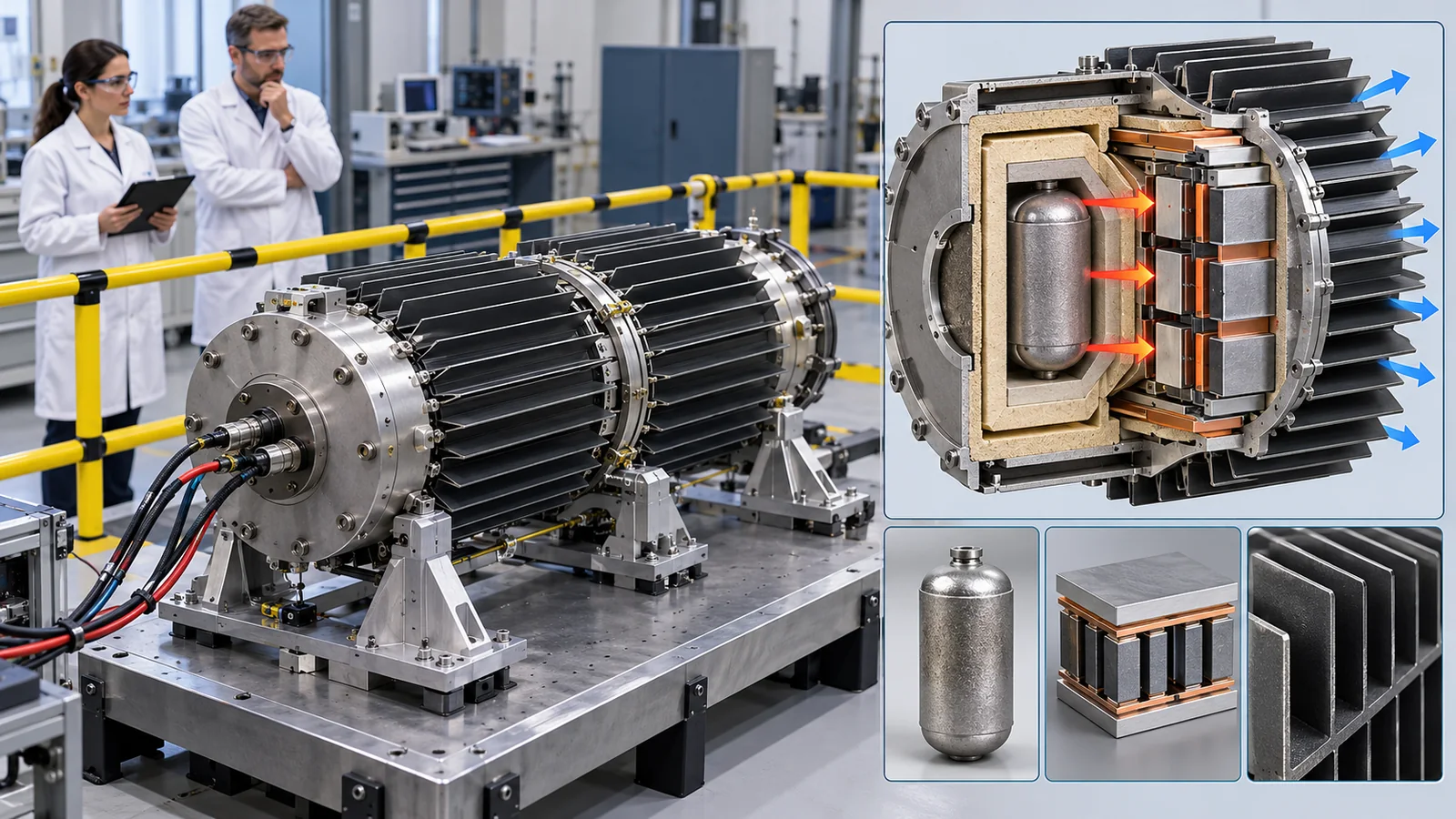
- The short version / what to know first / where this sits in the series
- Why nuclear power is chosen: distance and long nights
- How an RTG works: turning the heat of plutonium-238 into electricity
- Output declines: the Voyager example
- Stirling engines and fission reactors for the Moon: the research stage
- How to think about safety: layers of design, and the history of accidents
- Launch approval and international frameworks
- Where things stand now (checked 17 October 2026)
- How to read the yardsticks and standards
- Glossary / References / Claim-to-source audit
Sourced = stated in published material (link given)
Our calculation = a value this article calculated or organized, with the assumptions stated
Not yet confirmed = a plan, design study or research under way with no confirmed track record
Structural readings and materials-design interpretations are marked separately as Commentary. Inference is shown in bold. Every analogy comes with a "limit of the analogy".
Power and efficiency figures are given only together with whether they refer to launch, the present, a design study or a test. "NASA states ..." is NASA's own claim, kept apart from third-party verification. On safety, this article does not say "safe" or "dangerous". NASA itself records that radioactive material could be released in an accident and that a release could raise long-term cancer risk, and also records the layers of design, review and numerical guidelines. This article is a general explanation, not legal advice and not a safety assessment of any facility or mission. This field changes fast, so the status of plans and rules carries a checking date (17 October 2026).
1. The short version / what to know first / where this sits in the series
- An RTG is an "atomic battery", not a "reactor": an RTG (radioisotope thermoelectric generator) turns the heat given off as plutonium-238 decays into electricity with thermoelectric elements. It uses no chain reactionSourced[Ref. 2, 5]. NASA says RTGs have flown on 27 missions, 46 RTGs in all [Ref. 2].
- Output falls with time: each of Voyager's RTGs gave about 158 W at launch (1977), and by November 2023 the whole spacecraft was down to 225 WSourced[Ref. 3, 4]. The half-life of the fuel is 88 years [Ref. 5].
- Fission reactors for the Moon are at the plan and design-study stage: a 2024 NASA Glenn presentation shows a lunar fission power design study of 40 kWe and a 10-year lifeNot yet confirmed[Ref. 8]. A ground demonstration of a small reactor (KRUSTY, 2018) has been completed [Ref. 9]. An operating record on the Moon could not be confirmed in the sources used here.
You need no prior knowledge. "Heat can be turned into electricity" and "radioactive material decays naturally and gives off heat" are enough. The materials of thermoelectric elements (Bi2Te3, PbTe and so on) are in this series' explainer on thermoelectric materials. That solar cells are at a disadvantage far out, and that batteries carry the eclipse, are in our explainers on solar cells for space and on batteries for space (the necessary points are repeated briefly here). For units of radiation dose, read 1 Sv = 100 rem (1 rem = 10 mSv).
Among the "five enemies" of the space environment, nuclear power sources are strong against distance (weak sunlight) and long nights (large temperature swings). They carry other challenges: the radiation the fuel itself gives off and launch safety. Reading this article after the ones on solar cells and batteries gives a view of all three options: generation, storage and nuclear. Power for Moon bases ties in with our explainers on the Moon and Artemis and on lunar resources and ISRU, and international rules for space with our explainer on national space strategies and regulation.
2. Why nuclear power is chosen: distance and long nights
The weak points of solar cells are places where light is weak and times when there is no light. As the explainer on solar cells for space shows, at Jupiter, five times as far from the Sun, light is 25 times weaker. A JPL release (13 January 2016) says Juno was the first spacecraft to reach Jupiter on solar power, and that the eight spacecraft that had gone to Jupiter before it all used nuclear power sourcesSourced[Ref. 6].
The other factor is the length of the night. A NASA Glenn presentation (April 2024) says a lunar night can last up to 14.5 Earth days, with night temperatures of about 50–100 K (about −220 to −170 °C) depending on locationSourced[Ref. 8]. The same presentation says ISS eclipses last about 35 minutes and need 24 lithium-ion batteries (about 4,735 kg in total, 197 kg each), and that simply scaling this to a lunar night would give a battery mass of about 3.2 million kg [Ref. 8]. Checking the same idea here: 14.5 days (348 hours) is about 597 times 35 minutes (0.583 h), and 4,735 kg x 597 = about 2.8 million kgOur calculation (the difference from NASA's estimate probably comes from differing assumptions). NASA's point is that carrying a long night on batteries alone is impractical in mass terms.
The reason nuclear sources deliver "long life from little mass" is that the energy per kilogram is vastly larger. The NASA Glenn presentation gives 1.35 x 10⁷ J/kg for the chemical energy of liquid oxygen and liquid hydrogen and 8.2 x 10¹³ J/kg for fission of uranium-235 [Ref. 8]. The ratio is about 6 millionOur calculation. But these are theoretical values for the fuel itself; real devices do not use up all the fuel and add the mass of shielding and heat exchangers (commentary).
The NASA Glenn presentation itself says that, for solar power, there are good reasons it is typically chosen: technical maturity, experience and cost [Ref. 8]. The UN's "Principles Relevant to the Use of Nuclear Power Sources in Outer Space" (1992) go further and restrict the use of nuclear power sources to space missions that cannot reasonably be operated by non-nuclear energy sourcesSourced[Ref. 12]. Nuclear power is used where it is needed, such as where the Sun does not reach or the night is long.
3. How an RTG works: turning the heat of plutonium-238 into electricity
An RTG has two main parts: a heat source and thermoelectric elements that turn heat into electricity. According to NASA's fact sheet, the heat source contains plutonium-238 (Pu-238), and the elements use the Seebeck effect (discovered about 150 years ago by the German scientist Seebeck): a voltage appears when two dissimilar conductors are joined in a closed circuit and the two junctions are held at different temperaturesSourced[Ref. 2]. The materials and ZT of thermoelectric elements are covered in our explainer on thermoelectric materials.
(1) The fuel: plutonium oxide in ceramic form
According to NASA, the fuel of an RPS (radioisotope power system) is plutonium oxide, which emits alpha particles, a radiation that material as thin as a sheet of paper can stop. Pu-238 is not the kind of plutonium used for nuclear weapons, and would not work well as reactor fuelSourced[Ref. 5]. For a space isotope NASA lists these requirements: insoluble, little chemical toxicity, low neutron, beta and gamma emission, stable at high temperature, a long enough half-life (15 to 100 years), and high power density; it says that only Pu-238 (half-life 88 years) has consistently met them [Ref. 5].
It is not. An RTG does not sustain a chain reaction. It simply converts into electricity the heat Pu-238 gives off as it decays naturally; it cannot be switched off or turned up (heat always keeps coming). NASA says Pu-238 would not work well as reactor fuel [Ref. 5]. A fission reactor, by contrast, makes heat by controlling the chain reaction of fission of uranium or similar fuel, and its output can be controlled (Chapter 5). The two differ in fuel, in mechanism and in the way safety is thought about.
(2) Structure and numbers: the MMRTG example
For the MMRTG (Multi-Mission RTG) on the Mars rovers Curiosity and Perseverance, NASA's fact sheet states the followingSourced[Ref. 2]. The heat source is eight GPHS (General Purpose Heat Source) modules holding a total of 4.8 kg (10.6 lb) of plutonium dioxide, and it gives about 2,000 W of heat and about 110 W of electricity at launch. The thermoelectric materials are PbSnTe, TAGS and PbTe, the same kinds as on the two Viking landers that touched down on Mars in 1976. It measures about 64 cm across (fin tip to fin tip) and 66 cm tall, weighs about 45 kg, and the design goal is a minimum life of 14 years.
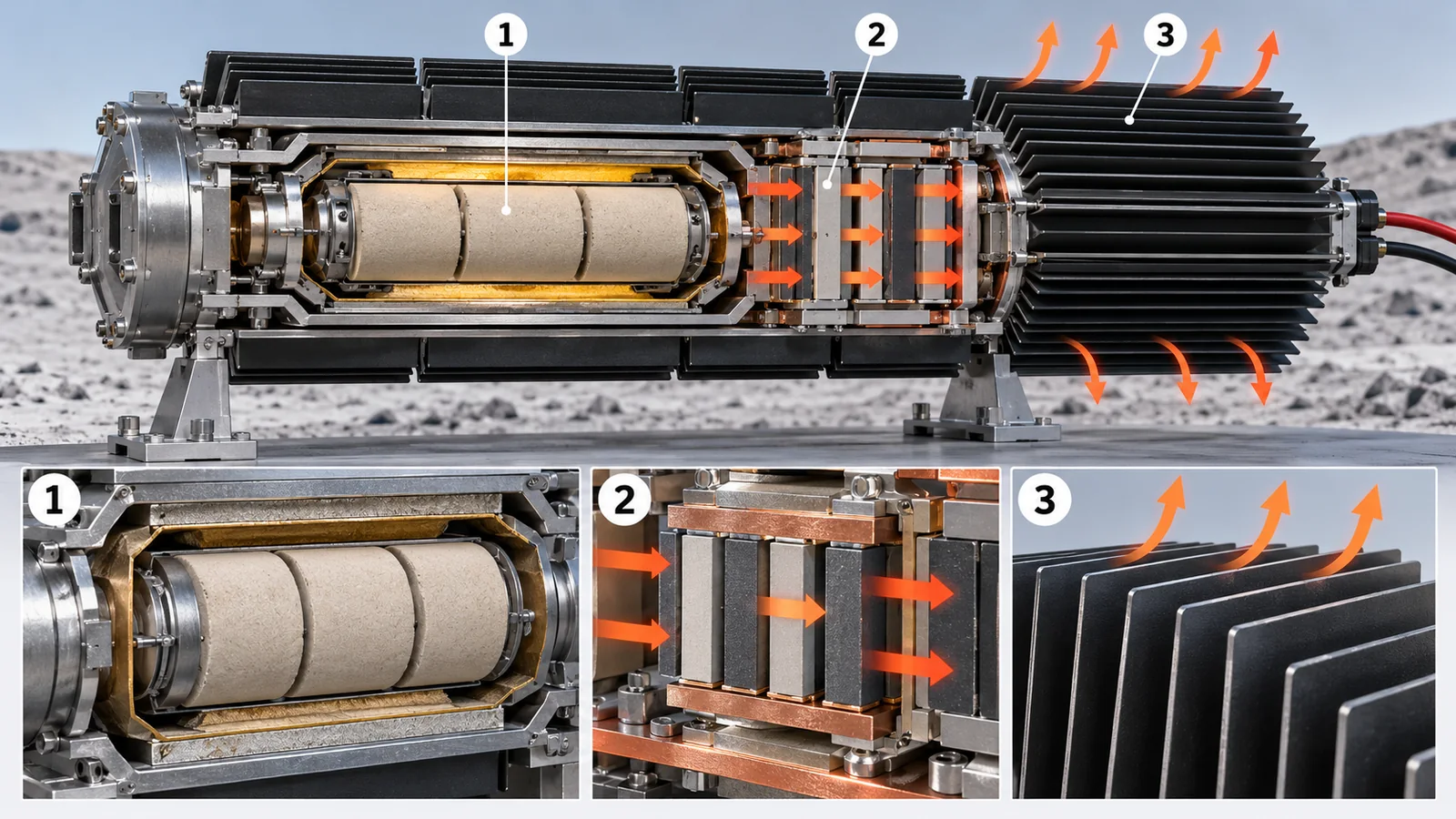
View original SVG, values and sources
Original SVG reference: Drawing that includes our calculation (vector drawing). The structure is a schematic, not a real design or dimension. That an MMRTG gives about 2,000 W of heat and about 110 W of electricity at launch and uses eight GPHS modules as its heat source comes from NASA's fact sheetSourced [Ref. 2]. The 5.5% (110 / 2000) and about 1,890 W are our calculationOur calculation.
110 / 2000 = about 5.5%: most of the heat does not become electricity and leaves as heatOur calculation. The heat that does not become electricity is also used to keep the rover warm (NASA describes Curiosity and Perseverance as "powered and warmed" by an MMRTG [Ref. 3]). Output per weight is 110 W / 45 kg = about 2.4 W/kgOur calculation. That is lower than the specific power of solar arrays in the explainer on solar cells for space (flown arrays cluster near 30 W/kg), but where the Sun does not reach, that comparison does not hold at all.
NASA's safety explanation says the fuel is made in ceramic form (NASA likens it to the material of a coffee mug) so that, when it breaks, it tends to give large pieces rather than inhalable fine particles; that the fuel is poorly soluble in water; that in the GPHS the fuel is surrounded by several protective layers including a tough material that withstands the heat of re-entry; and that the MMRTG's heat-source modules carry additional protective material against ground impact and re-entrySourced[Ref. 5, 11]. Commentary: in materials terms, the design makes the radioactive material in a form hard to break, hard to turn into particles and hard to dissolve, and wraps it in containers that withstand heat and impact. The assessment here is less about generating performance (ZT, efficiency) than about the material's reliability in whether it will be contained in an accident.
(3) Heat only: the RHU
A small heat source that uses only the heat, not electricity, is the RHU (radioisotope heater unit). NASA explains that RHUs are used to warm spacecraft in the cold of deep space [Ref. 3]. Voyager is warmed by nine RHUs [Ref. 3]. The early Apollo experiment package (EASEP) that the Apollo 11 astronauts left on the Moon ran on solar power and was kept warm by an RHU, which let it work in the harsh lunar environment [Ref. 3].
4. Output declines: the Voyager example
An RTG's output falls with time, for two main reasons we can think of: the fuel dwindles (Pu-238 decays with a half-life of 88 years, so the heat falls) and thermoelectric elements and other parts degrade. According to NASA material, Voyagers 1 and 2 were launched in 1977; their MHW-RTGs (multi-hundred-watt RTGs) gave about 158 W each at launch, and three RTGs supply the electricitySourced[Ref. 3, 4]. NASA says the power was in stable operation at 225 W in November 2023 [Ref. 3]. It also says that as power falls, loads are turned off in turn so that demand does not exceed supply [Ref. 4].
The total at launch is 158 W x 3 = about 474 W. Considering fuel decay alone, after 46.2 years the output would be 0.5^(46.2/88) = about 0.695 times, or about 329 WOur calculation. The actual 225 W is about 104 W lower. Inference: degradation of the thermoelectric elements and other parts probably also contributes to the loss of output (the NASA material did not let us confirm the breakdown).
A half-life of 88 years means "the heat of the fuel halves in 88 years". But electrical output depends not only on the amount of heat but on how much of the temperature difference the thermoelectric elements can turn into electricity. If the element materials change slowly over the years, the same heat gives less electricity (see our explainer on thermoelectric materials). Limit of the analogy: the picture of "a hand-warmer cooling little by little" shows the fuel running down but not the degradation of the elements.
Securing fuel is a challenge too
According to NASA, US production of Pu-238 stopped in the late 1980s and purchases from Russia have ended. Since 2011, with funds from Congress, the Department of Energy (DOE) has resumed domestic production. Plutonium oxide is made at Oak Ridge National Laboratory, processed into heat-source pellets at Los Alamos National Laboratory and stored at Idaho National LaboratorySourced[Ref. 5]. DOE owns the nuclear material and the RPS and directly manages their design and development [Ref. 17].
5. Stirling engines and fission reactors for the Moon: the research stage
(1) Dynamic RPS: an engine in place of thermoelectric elements
To raise on the RTG's efficiency (about 5.5% for the MMRTG), "dynamic RPS" that turn heat into electricity with a Stirling engine are being studied. As NASA explains, a free-piston Stirling converter heats a gas so it expands and moves a piston, and an alternator turns the motion into electricity. Because it has moving parts, structures that avoid friction (gas bearings, flexure bearings and so on) are used to aim for long life. There is also a Brayton type that uses a small turbine. NASA says it is maturing several concepts for a possible future dynamic RPSNot yet confirmed[Ref. 14].
(2) A fission reactor: KRUSTY (2018)
A fission reactor makes heat by controlling the chain reaction of uranium fission. According to NASA material, the only reactor the United States has flown in space is SNAP-10A in 1965, a thermoelectric design [Ref. 8, 11]. Later NASA and DOE ran KRUSTY, a ground demonstration of a small space reactor called "Kilopower". According to the paper by Poston and co-workers, KRUSTY was a prototypic nuclear test of a 5 kW (thermal) Kilopower reactor, run for 28 consecutive hours at thermal power of 1.5 to 5.0 kW with fuel up to 880 °C. Each Stirling converter rated at 80 W (electric) produced about 90 W, with a component efficiency of about 35% and an overall system efficiency of about 25%Sourced[Ref. 9]. The test was completed on 21 March 2018 at a Nevada facility, and Gibson and co-workers say it was the first space-reactor test for fission power systems in over 50 years [Ref. 16]. The Kilopower project began in fiscal year 2015 with the aim of demonstrating small space fission power at technology readiness level 5 (TRL 5) [Ref. 15].
(3) A lunar fission reactor: the design-study stage
The NASA Glenn presentation (April 2024) says NASA is working with DOE and its laboratories to establish a lunar fission surface power (FSP) system. The main design-study features are 40 kWe (electric) at 120 V DC, a size that fits on a lander, being carried and set up and sending power up to 1 km to users, and a 10-year life (the first year as a demonstration), with a design that can extend to Mars. But it states plainly that the requirements are for design studies and may change for flightNot yet confirmed[Ref. 8]. The same presentation records a solicitation released in November 2021, three Phase 1 design contracts, completion of Phase 1 in October 2023, and Phase 2 (development of a flight system) awards still to be decided (TBD) [Ref. 8]. The situation after April 2024 could not be confirmed here, because NASA's official page was caught in a redirect loop when we checked.
kWe is electric output and kWt is thermal output. KRUSTY's "5 kW (thermal)" is an amount of heat; at about 25% efficiency, that means electricity on the scale of about 1.3 kW (Our calculation: 5 x 0.25 = 1.25 kW; though the test ran over a range of 1.5 to 5.0 kW thermal). The lunar "40 kWe" is electric output, so do not compare it with KRUSTY by the bare numbers.
KRUSTY's fuel reached up to 880 °C [Ref. 9]. The NASA Glenn presentation says DOE is working on metal-hydride moderators, shielding and instrumentation and controls, and that NASA is working on power conversion, radiation hardening of electronics and power distribution [Ref. 8]. Commentary: a reactor's materials have to withstand three conditions together: high temperature, neutrons and long duration. On the Moon there is also the swing between the 14.5-day night (about 50–100 K) and the day. The radiation tolerance of reactor materials and surrounding electronics relates to our explainer on radiation and electronic components.
6. How to think about safety: layers of design, and the history of accidents
The safety of an RTG is considered in two parts: "the radiation the fuel gives off" and "accidents at launch or re-entry". NASA says RPS are designed and tested to contain their nuclear fuel under normal operating conditions and under a range of potential accident conditions [Ref. 11].
(1) History of accidents (as NASA records it)
NASA says three missions carrying an RPS were aborted early because of failures unrelated to the power source, and that in each case the power source performed as designedSourced[Ref. 11].
- April 1964: the launch of the navigation satellite Transit 5-BN-3 was aborted during ascent. Its RTG burned up on re-entry, as designed, and dispersed its plutonium fuel in the upper atmosphere.
- May 1968: the launch of the weather satellite Nimbus B-1 was aborted. Its RTG contained the fuel; the fuel container was recovered intact and the fuel was reused on Nimbus III.
- April 1970: Apollo 13. The lunar module carrying an RTG for experiments on the Moon returned to Earth and fell into deep water in the Pacific. No release of radiation from this incident has been detected.
NASA also says no member of the public or NASA employee has ever been injured by any previous use of an RPS or related launchSourced[Ref. 11]. This is NASA's statement.
(2) What NASA acknowledges
The same NASA page states plainly that an accident is unlikely, but that fuel could be released and dispersed and people could be exposed, and that this could raise the long-term chance of certain cancers. It then explains that the ceramic form, which breaks into large pieces (not inhalable fine particles), the low solubility and the protective layers reduce the potential for releaseSourced[Ref. 11]. It also says that before a launch NASA coordinates with federal, state and county emergency agencies, deploys radiation-monitoring teams and prepares a Radiological Contingency Plan [Ref. 11].
Information on this subject tends to lean to "absolutely safe" or "a dangerous poison". Public documents say neither. They say, in effect, "there are layers of design and review that lower the probability of accidents, and numerical guidelines are published; at the same time, the possibility of a release is not zero." When you read, check for each mission (1) which layers of design exist, (2) which reviews it passes, and (3) which published criteria apply. This article neither guarantees nor denies the safety of any particular mission.
7. Launch approval and international frameworks
(1) The United States: environmental review and the three tiers of NSPM-20
According to NASA, any mission that proposes to use an RPS, an RHU or a reactor undergoes a comprehensive environmental review under the National Environmental Policy Act (NEPA). In addition, National Security Presidential Memorandum 20 (NSPM-20), signed on 20 August 2019, requires launch authorization based on a three-tier safety reviewSourced[Ref. 11]. The text of NSPM-20 sets the policy that the United States shall develop and use space nuclear systems when they safely enable or enhance exploration or operational capabilities, and that the Secretary of Energy maintains the capability, including safety analysis [Ref. 10].
NSPM-20 gives, as targets to seek to ensure in mission planning, upper limits on the probability of public exposure in an accident: not exceeding 1 in 100 for 25 millirem to under 5 rem, 1 in 10,000 for 5 to 25 rem, and 1 in 100,000 above 25 rem [Ref. 10]. These are targets to "seek to ensure", not observed probabilities. Since 1 rem is 10 mSv, 25 rem is 250 mSv and 5 rem is 50 mSvOur calculation. The text also says that additional safety guidelines may be appropriate for the non-terrestrial operation of fission systems, and asks NASA to report within a year on guidelines for safe non-terrestrial operation (orbit and planetary surface) [Ref. 10]. The content of that report and later changes to the system could not be confirmed here.
(2) The United Nations: principles (1992) and a safety framework (2009)
The "Principles Relevant to the Use of Nuclear Power Sources in Outer Space", adopted as UN General Assembly resolution 47/68 (1992), restrict the use of nuclear power sources to missions that cannot reasonably be operated by non-nuclear sources; require a thorough safety assessment before launch and that its results be made publicly available prior to each launch (Principle 4); require that normal operation give no significant exposure to the public; and require that designs restrict exposure in accidents to the principal limit of 1 mSv a year, among other thingsSourced[Ref. 12]. For reactors, they set conditions such as operation on interplanetary missions or in sufficiently high orbits, not making the reactor critical before reaching its operating orbit, and use of highly enriched uranium-235 only as fuel; for radioisotope generators, they call for a containment system that withstands the heat and aerodynamic forces of re-entry and, on impact, ensures no radioactive material is scattered into the environment [Ref. 12]. The resolution also says the principles will require future revision in view of emerging nuclear power applications [Ref. 12].
In 2009 the UN's Scientific and Technical Subcommittee and the International Atomic Energy Agency (IAEA) jointly produced the "Safety Framework for Nuclear Power Source Applications in Outer Space" (A/AC.105/934). The document itself says it is voluntary guidance and not legally binding under international law [Ref. 13]. Inference: the difference between the 1992 principle ("highly enriched uranium only" for reactors) and the provisions in NSPM-20 that handle reactors with low-enriched uranium (under 20%) suggests rules are still evolving to suit new reactor designs, but an official reconciliation of the two could not be confirmed here.
8. Where things stand now (checked 17 October 2026)
This field changes quickly, so we set out what could be confirmed from primary sources, with a checking date. Plans are written apart from achieved facts.
| Item | What was confirmed | Class |
|---|---|---|
| RTG track record | The US Navy launched the first RPS in 1961, and 24 NASA missions have flown with an RPS since 1969. Curiosity and Perseverance operate on MMRTGs, and New Horizons and Voyagers 1 and 2 are in flight (NASA page) [Ref. 3] | Sourced |
| The next RTG mission | Dragonfly, to Saturn's moon Titan, is planned to use an MMRTG, with launch given as around 2028 and the mission listed as a future mission in development (NASA page; checked 17 October 2026) [Ref. 3] | Not yet confirmed |
| Supply of Pu-238 | Domestic US production resumed from 2011 under DOE: produced at Oak Ridge, processed at Los Alamos, stored at Idaho [Ref. 5] | Sourced |
| Dynamic RPS | NASA is maturing several concepts for a possible future dynamic RPS [Ref. 14] | Not yet confirmed |
| Ground demonstration of a small reactor | KRUSTY (5 kW thermal) was completed in March 2018: 28 hours of operation, system efficiency about 25% [Ref. 9, 16] | Sourced |
| A lunar fission reactor | NASA Glenn presentation (April 2024): design study of 40 kWe and a 10-year life; Phase 1 completed in October 2023; Phase 2 contracts to be decided. The situation after April 2024 could not be confirmed [Ref. 8] | Not yet confirmed |
| The rules | NSPM-20 (20 August 2019) is described on NASA's page as the present launch-authorization framework. The UN principles date from 1992 and the safety framework from 2009 (voluntary guidance) [Ref. 10, 11, 12, 13] | Sourced |
Checked 17 October 2026. Dates and power levels of plans may change. NASA's official page on fission surface power could not be opened when we checked, because of a redirect loop.
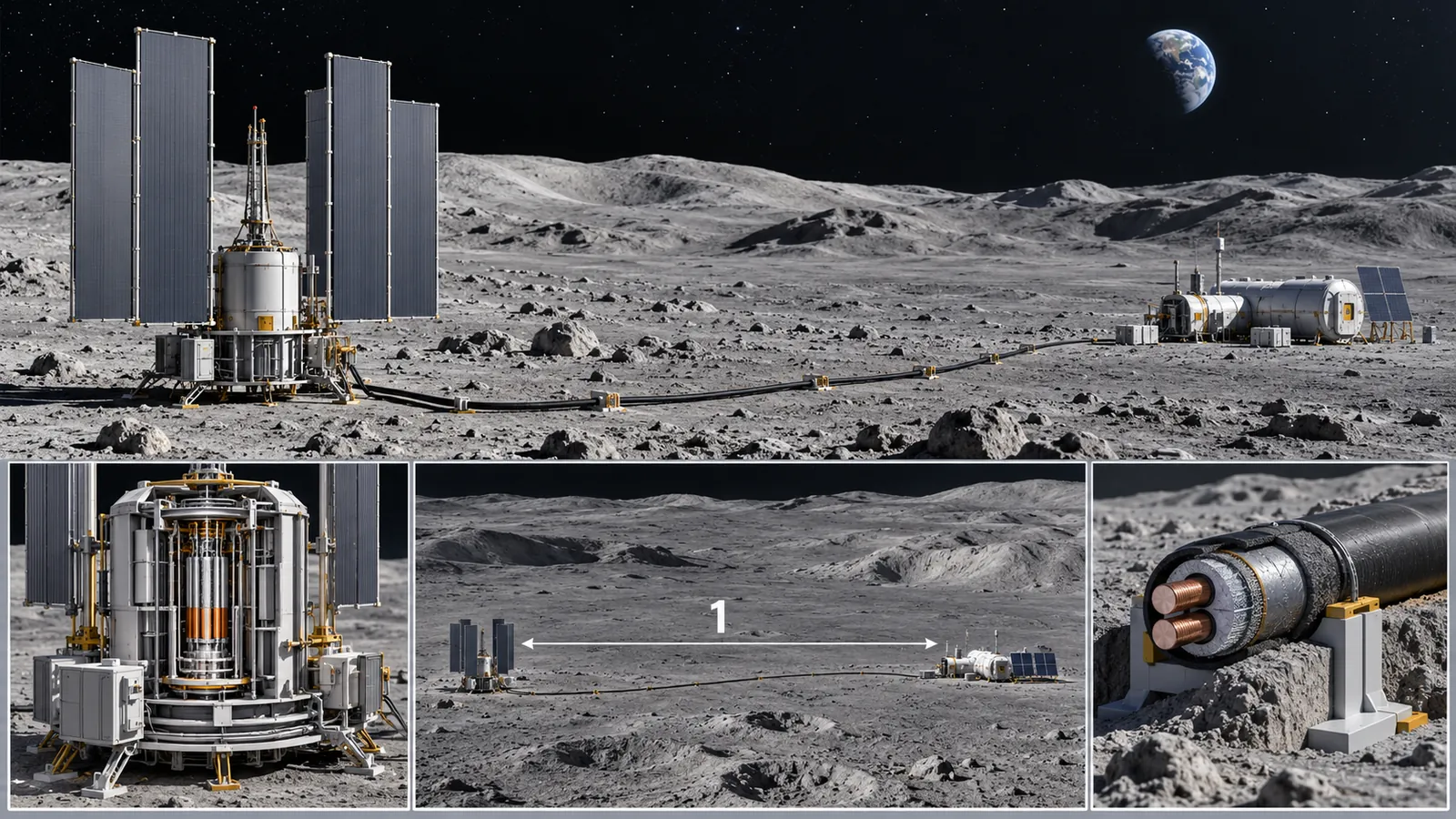
Space nuclear power is centered on the RTG, which has a long record and supports distant places and long nights. Its output declines with time. Higher-efficiency dynamic types and lunar fission reactors are at the research and design-study stage, and an operating record on the Moon has not yet been confirmed. Safety is treated in layers of fuel form, design, review and published criteria, and NASA also acknowledges that the possibility of a release is not zero. Rather than judging safety in one sweep, check each mission's published documents.
9. How to read the yardsticks and standards
The quality of a nuclear power source cannot be captured by one number. "Output (W)": at launch, or now? "Efficiency" is the ratio of electricity to heat. "Specific power (W/kg)" means something different where the Sun reaches and where it does not. "Safety" is read through design, tests and review, and through the probability guidelines for accidents. And "will it really work?" is judged by actual flight record. The table sets out what each yardstick measures and does not measure, as far as could be confirmed.
| Item assessed | Representative test or method (name, source) | Standards and guidance (NSPM-20, UN, IAEA and others) | Cautions in reading |
|---|---|---|---|
| Output and efficiency | The ratio of electric output (W) to thermal output (W). An MMRTG gives about 110 W (electric) and about 2,000 W (thermal) at launch [Ref. 2]Sourced. KRUSTY: Stirling converter efficiency about 35%, system about 25% (ground test) [Ref. 9]Sourced | Could not be confirmed (no standard that defines efficiency or output was found) | Values "at launch". Distinguish electric from thermal (kWe and kWt). Ground tests and flight values differ |
| Decline of output | Voyager measurements (158 W each at launch; 225 W in November 2023) [Ref. 3]Sourced. Fuel half-life 88 years [Ref. 5]. The MMRTG design goal is a minimum of 14 years [Ref. 2] | Could not be confirmed | Not only fuel decay but element degradation contributes (inference). A design goal and a record are different |
| Output per weight | MMRTG: about 110 W / about 45 kg = about 2.4 W/kg (our calculation) [Ref. 2]Our calculation | Could not be confirmed | Do not compare directly with the specific power of solar arrays. Where the Sun does not reach, the comparison means something else |
| Containment in an accident | NASA: RPS are designed and tested to contain fuel in normal operation and in accident conditions; GPHS protective layers; ceramic fuel [Ref. 5, 11]Sourced. Details of the tests could not be confirmed | UN principles (resolution 47/68, 1992), Principle 3: radioisotope generators protected by a containment system that withstands the heat and aerodynamic forces of re-entry and does not scatter radioactive material on impact [Ref. 12]Sourced | A design requirement, not a result of compliance for a given device. Compliance is examined in each mission's safety analysis |
| Public exposure in an accident | Each mission's safety analysis (probabilistic assessment). NASA says it conducts a comprehensive environmental review and a three-tier review [Ref. 11]Sourced | NSPM-20 (20 August 2019): probability targets (1 in 100 for 25 millirem to under 5 rem; 1 in 10,000 for 5 to 25 rem; 1 in 100,000 above 25 rem) and three tiers based on A2 values of IAEA SSR-6 (2018 edition) [Ref. 10]Sourced | NSPM-20 is a US presidential memorandum (policy), not an international standard. The numbers are targets, not observed probabilities |
| Launch authorization | NEPA environmental review; NSPM-20's three tiers (agency head for Tiers I and II, the President for Tier III) [Ref. 10, 11]Sourced | NSPM-20. Licensing of commercial launches rests with the Secretary of Transportation (as the memorandum states) [Ref. 10] | An approval does not relieve other legal obligations (as the memorandum states) |
| International safety guidance | Public release of the safety assessment before launch (Principle 4) [Ref. 12]Sourced | Principles in UN General Assembly resolution 47/68 (1992). The "Safety Framework for Nuclear Power Source Applications in Outer Space" A/AC.105/934 (2009) is voluntary guidance and not legally binding [Ref. 12, 13]Sourced | The principles and the framework are not treaties. The UN principles themselves say they will need future revision |
| Evaluation of materials | Evaluation of the ZT of thermoelectric elements is in our explainer on thermoelectric materials. Details of tests of heat-source materials could not be confirmed | Could not be confirmed (no applicable ISO or IEEE standard was found) | Materials evaluation for generation and for containment in an accident are different things |
The arrangement of the table is Our calculation (organization). Numbers, dates and content of the rules were checked on the text of the memorandum (White House archive), on UNOOSA pages and on NASA pages (checked 17 October 2026). This article is not legal advice. The ASTM International website and its standards were not consulted.
Cautions in reading (for materials engineers)
- Ground tests and on-orbit records are different: KRUSTY was a ground test, not operation on the Moon. The decades-long record of RTGs also consists of results in each mission's own design and environment.
- NASA's statements and third-party verification are different: "an outstanding safety record" is NASA's statement. The same NASA page also acknowledges the possibility of a release in an accident.
- Policy and guidance are different from binding rules: NSPM-20 is a US policy document, the UN principles are annexed to a resolution, and the safety framework is voluntary guidance. When you read "approved", check which approval, at which tier and by which body.
- Plans and achievements are different: the 40 kWe and 10 years of a lunar fission reactor are design-study requirements and may change for flight.
10. Glossary
- RPS
- Radioisotope Power System: a collective name for power sources and heat sources that use the heat of a radioisotope.
- RTG
- Radioisotope Thermoelectric Generator: turns the decay heat of an isotope into electricity with thermoelectric elements.
- MMRTG
- Multi-Mission RTG, used on Mars rovers and others. About 110 W at launch.
- RHU
- Radioisotope Heater Unit: a heater that uses only the heat, not electricity.
- GPHS
- General Purpose Heat Source: a general-purpose heat-source module that holds the fuel; the basic unit of the safety design.
- Plutonium-238 (Pu-238)
- An isotope that decays by emitting alpha particles and gives off heat. Half-life 88 years.
- Half-life
- The time for the amount of a radioactive material (and its heat) to fall by half.
- Alpha particle
- A kind of radiation. Stopped by about a sheet of paper, but a concern if taken into the body.
- Seebeck effect
- A voltage appears when the junctions of two dissimilar conductors are at different temperatures.
- Stirling engine
- An engine that moves a piston by repeatedly heating and cooling a gas, and generates electricity.
- Dynamic RPS
- An RPS using a converter with moving parts (Stirling or Brayton). Efficient, but long life is the challenge.
- Fission reactor
- A device that makes heat by controlling the chain reaction of fission of uranium or similar fuel. Not the same as an RTG.
- Uranium-235 / low-enriched uranium (LEU)
- The uranium isotope used for fission. Enrichment under 20% is called low-enriched.
- Criticality
- The state in which a fission chain reaction sustains itself.
- KRUSTY
- Kilopower Reactor Using Stirling TechnologY: a ground demonstration of a small reactor (2018).
- FSP
- Fission Surface Power: the plan for a fission power source for use on the Moon and elsewhere.
- kWe / kWt
- kW electric / kW thermal. Distinguishes electric output from thermal output.
- NEPA
- The US National Environmental Policy Act: federal actions are reviewed for environmental impact.
- NSPM-20
- The US presidential memorandum (20 August 2019) that sets launch authorization for space nuclear systems.
- A2 value (IAEA SSR-6)
- A quantity benchmark set for each isotope in the transport regulations for radioactive material. Used for the tiers of NSPM-20.
- rem / Sv
- Units of radiation dose. 1 Sv = 100 rem, 1 rem = 10 mSv.
- SNAP-10A
- The US space reactor launched in 1965 (thermoelectric type).
11. References (primary sources)
- NASA "State-of-the-Art of Small Spacecraft Technology, 3.0 Power" (version of 7 May 2026; checked 17 October 2026) — nasa.gov/smallsat-institute/sst-soa/power-subsystems/
- NASA "Multi-Mission Radioisotope Thermoelectric Generator (MMRTG)" NASA Facts — nasa.gov/sites/default/files/files/MMRTG.pdf
- NASA "Radioisotope Power Systems Missions" (list of RPS missions; checked 17 October 2026) — science.nasa.gov/radioisotope-power-systems-missions/
- NASA / JPL "Voyager: Spacecraft" (spacecraft overview; the power description was checked) — science.nasa.gov/mission/voyager/spacecraft/
- NASA "About Plutonium-238" (NASA RPS program; checked 17 October 2026) — science.nasa.gov/about-plutonium-238/
- NASA / JPL "NASA's Juno Spacecraft Breaks Solar Power Distance Record" (13 January 2016) — jpl.nasa.gov/news/nasas-juno-spacecraft-breaks-solar-power-distance-record
- NASA "New Solar Arrays to Power NASA's International Space Station Research" (11 January 2021; checked 17 October 2026) — nasa.gov/missions/station/new-solar-arrays-to-power-nasas-international-space-station-research/
- Kaldon L., Presby A. (NASA Glenn) "Fission Surface Power Project" (presentation at the Space Power Workshop, 23–25 April 2024) — ntrs.nasa.gov/citations/20240003580
- Poston D. I. et al. "Results of the KRUSTY Nuclear System Test", Nucl. Technol. 206 (2020), DOI 10.1080/00295450.2020.1730673 — doi.org/10.1080/00295450.2020.1730673
- The White House "Presidential Memorandum on Launch of Spacecraft Containing Space Nuclear Systems" (NSPM-20, 20 August 2019; White House archive) — trumpwhitehouse.archives.gov/presidential-actions/presidential-memorandum-launch-spacecraft-containing-space-nuclear-systems/
- NASA "Radioisotope Power Systems: Safety and Reliability" (checked 17 October 2026) — science.nasa.gov/planetary-science/programs/radioisotope-power-systems/radioisotope-power-systems-safety-and-reliability/
- United Nations General Assembly Resolution 47/68 "Principles Relevant to the Use of Nuclear Power Sources in Outer Space" (1992; UNOOSA page) — unoosa.org/oosa/en/ourwork/spacelaw/principles/nps-principles.html
- UN COPUOS Scientific and Technical Subcommittee and IAEA "Safety Framework for Nuclear Power Source Applications in Outer Space" (A/AC.105/934, 2009; PDF on the UNOOSA site) — unoosa.org/unoosa/uploads/documents/pdf/publications/iaea-nps-sfrmwrkE.pdf
- NASA "Dynamic Radioisotope Power" (NASA RPS program; checked 17 October 2026) — science.nasa.gov/planetary-science/programs/radioisotope-power-systems/dynamic-power/
- McClure P. R. et al. "Kilopower Project: The KRUSTY Fission Power Experiment and Potential Missions", Nucl. Technol. 206 (2020), DOI 10.1080/00295450.2020.1722554 — doi.org/10.1080/00295450.2020.1722554
- Gibson M. A. et al. "The Kilopower Reactor Using Stirling TechnologY (KRUSTY) Nuclear Ground Test Results and Lessons Learned", 2018 International Energy Conversion Engineering Conference, DOI 10.2514/6.2018-4973 — doi.org/10.2514/6.2018-4973
- NASA "About the Program" (NASA's Radioisotope Power Systems Program; checked 17 October 2026) — science.nasa.gov/about-the-radioisotope-power-systems-program/
12. Claim-to-source audit
| Claim in the text | Basis | Class |
|---|---|---|
| An example specific energy for a lithium-ion cell (250 Wh/kg) | NASA, State-of-the-Art of Small Spacecraft Technology (version of 7 May 2026), table (manufacturer's stated value) Reference 1 https://www.nasa.gov/smallsat-institute/sst-soa/power-subsystems/ | Sourced |
| MMRTG: heat source of eight GPHS modules, 4.8 kg of plutonium dioxide, about 2,000 W (thermal) and about 110 W (electric) at launch, PbSnTe, TAGS and PbTe, about 64 cm by about 66 cm and about 45 kg, a design goal of at least 14 years, RTGs on 27 missions and 46 units, the explanation of the Seebeck effect | NASA fact sheet Reference 2 https://www.nasa.gov/sites/default/files/files/MMRTG.pdf | Sourced |
| The US Navy launched the first RPS in 1961, and 24 NASA missions have flown with an RPS since 1969; Voyager's MHW-RTGs at about 158 W each, nine RHUs, 225 We in November 2023; MMRTGs on Curiosity and Perseverance; Dragonfly planned to use an MMRTG (around 2028); the use of RHUs; Apollo 11's EASEP | NASA's RPS missions page Reference 3 https://science.nasa.gov/radioisotope-power-systems-missions/ | Sourced |
| That Voyager's electricity is supplied by three RTGs, and that loads are turned off as power falls | NASA's Voyager spacecraft page Reference 4 https://science.nasa.gov/mission/voyager/spacecraft/ | Sourced |
| Pu-238: ceramic oxide, alpha particles, not weapons plutonium and not suited as reactor fuel, the requirements, a half-life of 88 years, the layers of safety (ceramic form), the restart of production (from 2011, Oak Ridge, Los Alamos, Idaho) | NASA's About Plutonium-238 Reference 5 https://science.nasa.gov/about-plutonium-238/ | Sourced |
| Light at Jupiter 25 times weaker, and the eight spacecraft before Juno that used nuclear power sources | JPL release (13 January 2016) Reference 6 https://www.jpl.nasa.gov/news/nasas-juno-spacecraft-breaks-solar-power-distance-record | Sourced |
| That the original eight ISS arrays give up to about 160 kW | NASA article Reference 7 https://www.nasa.gov/missions/station/new-solar-arrays-to-power-nasas-international-space-station-research/ | Sourced |
| A lunar night of up to 14.5 days and temperatures of about 50–100 K, ISS eclipses of about 35 min and 24 batteries (about 4,735 kg), the estimated battery mass for a lunar night (about 3.2 million kg), 1.35 x 10⁷ J/kg for liquid oxygen and hydrogen and 8.2 x 10¹³ J/kg for uranium-235 fission, SNAP-10A (1965), the design study for FSP (40 kWe, 120 V, 10 years, requirements may change), the solicitation of November 2021, three Phase 1 contracts, completion in October 2023, Phase 2 to be decided, the shares of work between DOE and NASA | NASA Glenn presentation (April 2024) Reference 8 https://ntrs.nasa.gov/citations/20240003580 | Sourced |
| The 40 kWe design study for a lunar fission reactor and the plans from Phase 2 onward (may change for flight; nothing after April 2024 could be confirmed) | Same (NASA Glenn presentation; a plan, not an achieved fact) Reference 8 https://ntrs.nasa.gov/citations/20240003580 | Not yet confirmed |
| KRUSTY: a 5 kW (thermal) prototype reactor, 28 consecutive hours, 1.5 to 5.0 kW (thermal), fuel up to 880 °C, about 90 W per Stirling converter, about 35% converter efficiency and about 25% system efficiency | Abstract of Poston et al. (2020) Reference 9 https://doi.org/10.1080/00295450.2020.1730673 | Sourced |
| NSPM-20 (20 August 2019): the policy, the safety-guideline probabilities (1 in 100, 1 in 10,000, 1 in 100,000), the three tiers of authorization, the A2 values of IAEA SSR-6, licensing of commercial launches by the Secretary of Transportation, that approval does not relieve other obligations, and the request that NASA report on safety guidelines for non-terrestrial fission reactors | Text of the memorandum (White House archive) Reference 10 https://trumpwhitehouse.archives.gov/presidential-actions/presidential-memorandum-launch-spacecraft-containing-space-nuclear-systems/ | Sourced |
| The safety design and tests of RPS, that the United States has flown more than two dozen RPS missions and one reactor system, three aborted missions (Transit 5-BN-3 in 1964, Nimbus B-1 in 1968, Apollo 13 in 1970), NASA's statement that neither the public nor employees have been injured, the possibility of a release in an accident and of a higher long-term cancer chance, NEPA and the three tiers of NSPM-20, contingency plans | NASA's Safety and Reliability page Reference 11 https://science.nasa.gov/planetary-science/programs/radioisotope-power-systems/radioisotope-power-systems-safety-and-reliability/ | Sourced |
| The UN principles (1992): use of nuclear power sources limited to missions that cannot reasonably be operated by non-nuclear sources, Principle 4 (public release of safety assessments), the conditions for reactors, the containment of radioisotope generators, the need for future revision | UN General Assembly resolution 47/68 (UNOOSA page) Reference 12 https://www.unoosa.org/oosa/en/ourwork/spacelaw/principles/nps-principles.html | Sourced |
| That the Safety Framework (A/AC.105/934, 2009) is voluntary guidance and not legally binding under international law | PDF on the UNOOSA site Reference 13 https://www.unoosa.org/unoosa/uploads/documents/pdf/publications/iaea-nps-sfrmwrkE.pdf | Sourced |
| How dynamic RPS (Stirling, Brayton) work, and that NASA is maturing concepts for a future dynamic RPS | NASA's Dynamic Radioisotope Power page Reference 14 https://science.nasa.gov/planetary-science/programs/radioisotope-power-systems/dynamic-power/ | Not yet confirmed |
| The Kilopower project (begun in fiscal year 2015, a goal of demonstration at TRL 5, a 1 kW electric class ground demonstrator) | Abstract of McClure et al. (2020) Reference 15 https://doi.org/10.1080/00295450.2020.1722554 | Sourced |
| That the KRUSTY test was completed on 21 March 2018 and was the first reactor test for space fission power systems in over 50 years | Abstract of Gibson et al. (2018) Reference 16 https://doi.org/10.2514/6.2018-4973 | Sourced |
| That DOE owns the nuclear material and the RPS and directly manages their design and development, and the structure of NASA's RPS program | NASA's About the Program Reference 17 https://science.nasa.gov/about-the-radioisotope-power-systems-program/ | Sourced |
| Where the heat goes (110 / 2000 = about 5.5%, about 1,890 W), 2.4 W/kg (110 / 45), about 474 W and about 329 W with a gap of about 104 W, about 6 million times (8.2 x 10¹³ / 1.35 x 10⁷), about 2.8 million kg (4,735 kg x 597), 250 Wh/kg = 9.0 x 10⁵ J/kg, 1 rem = 10 mSv, the guide figure of about 1.25 kW (electric) for KRUSTY | Calculated from published values; assumptions stated in the text and figures Our calculation | Our calculation |
| The situation of a lunar fission reactor after April 2024, the content of NASA's official fission surface power page, the content of the report on safety guidelines for non-terrestrial fission reactors requested in NSPM-20, an official reconciliation of the 1992 principle ("highly enriched uranium only") with NSPM-20's treatment of low-enriched uranium, plans for RTGs and reactors outside the United States such as ESA's, and details of accident tests on RTG heat sources | Could not be confirmed in the primary sources reachable for this article, and so are not stated | Commentary |
| The readings "the heat source combines a form hard to break and hard to particulate with a container", "a reactor's materials must withstand high temperature, neutrons and long duration" and "element degradation contributes to the loss of output", the hand-warmer analogy with its limit, and the inference about the 1992 principle versus NSPM-20 | Commentary and inference in this article (readings based on sourced facts) | Commentary |
| That Figs. 1 to 9 are explanatory drawings and not observations of real data, and that Figs. 1 and 9 are frames for AI-generated concept images | A note by this article | Commentary |
Last updated 17 October 2026. Sources are limited to primary material (NASA and JPL material, a NASA Glenn presentation, peer-reviewed papers, the text of a presidential memorandum and United Nations documents). "NASA states ..." is written as NASA's statement and kept apart from third-party verification. The worked examples (efficiency, decay, mass estimates) are explanatory calculations made for this article and are not design values for any particular mission. A lunar fission reactor is a plan and design study, not an established fact. This article is a general explanation, not legal advice and not a safety assessment of any particular mission. The situation of a lunar fission reactor after April 2024, the content of NASA's official fission surface power page, the content of the report on safety guidelines for non-terrestrial fission reactors, and plans outside the United States could not be confirmed and are not stated here. All figures are explanatory conceptual drawings or drawings that include our own calculation; Figs. 1 and 9 are frames for AI-generated images (images not yet placed). They do not show any real facility, equipment or appearance.