TECHNOLOGY EXPLAINER
Space-Grade Semiconductors and COTS
— how to think about radiation-hardened and commercial parts, the promise and challenges of SiC and GaN, and computers that run in space
"Space-grade semiconductor" may bring to mind a chip that is specially tough against radiation. In practice, though, "space-grade" mixes two separate meanings: a level of quality assurance, and how strong a part is against radiation. In recent years, moreover, the use of commercial off-the-shelf (COTS) parts, which excel in performance, power and price, combined with countermeasures, has been spreading. This article is written for readers who know nothing about spaceflight or semiconductors. With figures and small calculations it covers: (1) how parts "assurance levels" are divided; (2) that quality assurance and radiation assurance are separate; (3) how to think about commercial parts, and the evaluation scheme NASA is building; (4) the promise and challenges of wide-bandgap semiconductors such as SiC and GaN; and (5) the options for computers that run in space. It ranks no company or product. It sets out what public standards and NASA material confirm, separating what was confirmed, what is only planned, and what could not be confirmed.
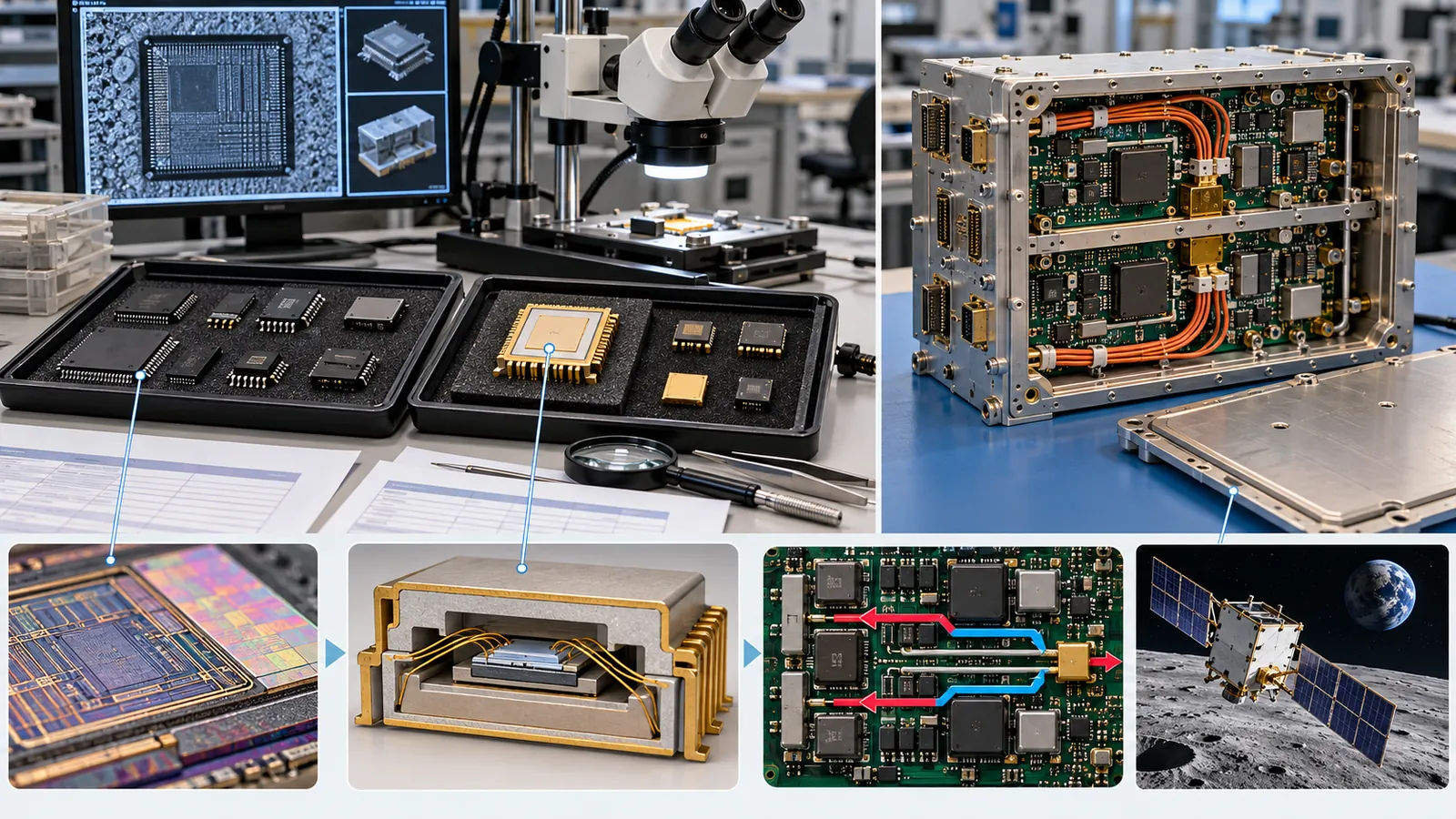
- The short version / what to know first / where this sits in the series
- What a "space" part is: levels of assurance
- Quality assurance and radiation assurance are separate
- How to think about commercial parts (COTS): NASA's evaluation scheme
- Radiation-tolerant design: protect by circuit, process and system
- SiC and GaN: promise, and challenges in space
- Options for computers that run in space
- Where things stand now (checked 17 October 2026)
- How to read the yardsticks and standards
- Glossary / References / Claim-to-source audit
Sourced = stated in published material (link given)
Our calculation = a value this article calculated or organized, with the assumptions stated
Not yet confirmed = a draft, a pilot or a development plan that is not settled
Structural readings and materials-design interpretations are marked separately as Commentary. Inference is shown in bold. Every analogy comes with a "limit of the analogy".
NASA itself notes that the performance of products in its tables has not been independently verified, so these are treated as manufacturers' stated values. Company and product names are used only to show examples found in NASA material, and nothing is ranked. We read the openly published text of the ECSS standards; for ESCC, MIL-PRF, JAXA-QTS, AEC, JEDEC and similar documents we checked only titles, numbers and scope, not the texts. Numerical examples are illustrative and are not values for any particular part. This field changes fast, so the status of standards, schemes and plans carries a checking date (17 October 2026).
1. The short version / what to know first / where this sits in the series
- "Space-grade" has two meanings: quality and process assurance of the part (made, screened and tested to standards such as ESCC and MIL-SPEC) and strength against radiation. NASA states plainly that choosing a parts level does not imply any radiation hardness or mitigationSourced[Ref. 3].
- Commercial (COTS) parts are used under conditions: NASA's Engineering and Safety Center (NESC) judges that top-tier commercial manufacturers can now supply parts as reliable as or more reliable than MIL-SPEC parts when used within datasheet limits. But radiation tolerance is not part of that assessmentSourced[Ref. 5, 6].
- SiC and GaN are promising, but have challenges in space: Pearton and co-workers say in a review that susceptibility to permanent degradation and catastrophic failure from heavy ions hinders their adoption for spaceSourced[Ref. 7].
You need no prior knowledge. "A semiconductor chip comes in many kinds and sits in a package (container)" is enough. How radiation affects electronic parts (TID, SEE and so on) is in this series' explainer on radiation and electronic components (the necessary points are briefly explained here too). If a radiation term is unfamiliar, see that article.
This article is the one to read after the explainer on radiation and electronic components; it covers "knowing about radiation, how to choose parts". Running computers in space continues in our explainer on computing in orbit, and running AI at the edge in our explainer on edge and on-device AI. The power uses of SiC and GaN also relate to the power systems in our explainers on batteries for space and solar cells for space.
2. What a "space" part is: levels of assurance
Electronic parts for spacecraft are usually chosen by "level of assurance". The stronger the assurance, the stricter the control of the part's manufacturing process, its screening (tests to remove early failures) and its lot-by-lot testing, and the higher the price. How the levels are divided differs by organization.
- ECSS (the European space standards): ECSS-Q-ST-60C Rev. 4 (30 April 2025) divides EEE components (electrical, electronic and electromechanical parts) into three classes. Class 1 gives the highest assurance and lowest risk and class 3 the lowest assurance and highest risk; procurement cost is typically highest for class 1 and lowest for class 3Sourced[Ref. 1]. As quality levels for class 1, its table lists for hermetic integrated circuits, for example, ESCC 9000, MIL-PRF-38535 class V and JAXA-QTS-2010 [Ref. 1].
- NASA: NASA-STD-8739.10 "Electrical, Electronic, and Electromechanical (EEE) Parts Assurance Standard" (13 June 2017, active) defines four assurance levels. NASA's presentation sums up level 1 as the strictest process control and screening and level 4 as commercial (COTS) parts with the least screening [Ref. 2, 3]. NASA says the standard does not dictate which level is used for a given application; it is a risk-based selection from how critical the function is and from failure analysis [Ref. 3].
- EEE-INST-002 of NASA Goddard: published in 2003, with an addendum in 2008, it covers 18 part types and divides parts into three quality levels (level 1 for long missions, level 2 intermediate, level 3 for commercial parts with no standardized testing) [Ref. 3]. It is said to be going to be replaced by NASA-[TBD]-8739.11 (a draft, approval in process)Not yet confirmed[Ref. 3].
NASA divides missions into classes A to D by importance, lifetime, complexity and so on (NPR 8705.4B), and lets a high-priority class A mission use assurance level 1 and a technology-demonstration class D mission use level 4. It also says that higher-level parts already on hand can be used without added testing, but that upgrading unnecessarily is discouraged [Ref. 3]. Limit of the analogy: "grades of insurance" captures the link between strength of assurance and cost, but not what is assured (whether radiation is included). The next chapter explains this.
3. Quality assurance and radiation assurance are separate
This is the most important point in this article. A NASA Goddard presentation (June 2026) sums up as followsSourced[Ref. 3].
- The parts levels in EEE-INST-002 and similar documents do not indicate the level of radiation tolerance. Choosing level 1, 2 or 3 does not imply radiation hardness or mitigation of radiation effects.
- MIL-SPEC parts may or may not carry a radiation designator for TID performance (an RHA marking) and may be sensitive to SEE.
- Parts without RHA (radiation hardness assurance) often have radiation tolerance that was not designed or optimized, and lot-to-lot variation may be larger.
- RHA mitigation must not rely only on part-level strength and must include system-level techniques.
Not necessarily. Most parts called "space-grade" first of all signify quality and process assurance (screening, lot tests, hermetic sealing and so on), and strength against radiation is something confirmed separately. Conversely, even a commercial part, if its radiation response is tested and characterized, gives material for a judgment on how to use it. What matters is not the name "space-grade or commercial", but whether, for that part, you hold the quality data and the radiation data, each (radiation testing and margin are covered in our explainer on radiation and electronic components).
4. How to think about commercial parts (COTS): NASA's evaluation scheme
Commercial parts (COTS: commercially available off-the-shelf parts) excel in performance, power efficiency and price and let designers use state-of-the-art technology, but they tend to be susceptible to radiation. NASA's small-spacecraft material (2026) says COTS components typically offer superior performance, energy efficiency and affordability compared with radiation-hardened alternatives, but COTS devices tend to be highly susceptible to radiationSourced[Ref. 4]. It also says that in small satellites a traditional approach has been commercial parts first, combined with radiation-hardened support electronics (ECC, watchdog timers, scrubbing and redundancy) [Ref. 4].
(1) The European view: justify use with numbers
ECSS-Q-ST-60-13C Rev. 2 (30 April 2025) is the standard that sets requirements for selecting, controlling, procuring and using commercial EEE parts, and it is used together with ECSS-Q-ST-60C. It says it applies only to commercial components that meet technical parameters which, at system application level, are demonstrated to be unachievable with existing space components or achievable only with qualitative and quantitative penalties. It requires those penalties to be specified in quantifiable parameters such as functional capability, parts count, power dissipation, frequency of operation, data and signal processing efficiency, interconnect complexity, mass and volumeSourced[Ref. 13]. The families covered are ceramic capacitor chips, solid-electrolyte tantalum capacitor chips, discrete parts (transistors, diodes, optocouplers), fuses, magnetic parts, microcircuits, resistor chips and thermistors [Ref. 13].
(2) The NASA view: the NESC proposal, and ILPM
NASA's NESC compiled proposals on how to use commercial EEE parts in 2020 (Phase I) and 2022 (Phase II). The Phase II report says that NASA has historically treated certain classes of MIL-SPEC parts as "standard" and used them without further testing, and subjected everything else, COTS included, to screening and lot acceptance testing; that top-tier commercial manufacturers have since developed manufacturing, statistical control and technology to the point where their parts can be as reliable or more reliable than MIL-SPEC parts when used within datasheet limits; and that the needs of space science and exploration call for technology not available in MIL-SPEC partsSourced[Ref. 6, 14].
In response NASA's Electronic Parts and Packaging (NEPP) Program has been building a list of ILPMs (Industry Leading Parts Manufacturers) and "Established COTS Parts"Sourced[Ref. 5, 17]. The criteria for an Established COTS Part are in the figure below.
NASA's ILPM page says that additional MIL-SPEC screening can be more detrimental than beneficial when test parameters exceed datasheet limits, and states that the terms ILPM and Established COTS Part are not intended for certification by NASA [Ref. 5]. The list page notes that part tolerance to ionizing radiation is not part of the ILPM assessment process [Ref. 17]. According to the NASA Goddard presentation, the first manufacturer was added in 2024, pilot programs ran in 2025 and 2026, and in fiscal 2026 work is under way with 22 or more manufacturersNot yet confirmed[Ref. 3]. The same pilot (PEAL) is described as characterizing the reliability and radiation performance of automotive-grade and enhanced plastic commercial parts (chip resistors, capacitors, MOSFETs, more than 30 microcircuits, DC-DC converters and others) [Ref. 3].
Automotive electronic-parts standards include AEC-Q100 (stress-test qualification for integrated circuits, based on failure mechanisms), AEC-Q101 (discrete semiconductors) and AEC-Q200 (passive components) of the Automotive Electronics Council (AEC) [Ref. 15]. A NASA poster (2024) notes that automotive-grade parts have stringent qualification requirements, but users do not have insight into all of a manufacturer's practices, and that they have begun to be used as alternatives to MIL-SPEC counterparts [Ref. 16]. An automotive qualification is not a radiation test. For the same reason that radiation is outside the ILPM assessment, an automotive grade does not by itself mean a part is strong against space radiation.
The NASA Goddard presentation notes that requirements for space parts have historically included hermetic packaging, resistance to flammability and outgassing, strict visual inspection, conservative derating and radiation tolerance, and that supply-chain changes in the 2000s brought tin-whisker mitigation under lead-free (RoHS) electronics, non-hermetic microcircuit packaging, the question of COTS and automotive-grade parts in space, and copper bond wires as issuesSourced[Ref. 3]. The class 1 table of ECSS-Q-ST-60C likewise divides integrated circuits into "hermetic" and "non-hermetic", with different standards for the non-hermetic ones (ESCC 9030 class P, MIL-PRF-38535 class Y and others) [Ref. 1]. Commentary: most commercial parts are sealed in resin, and behave differently from hermetic metal or ceramic packages in moisture, outgassing, stress under thermal cycling and material purity. For a materials engineer, it is not only the "chip" but the molding resin, solder, metal wiring and board that decide reliability against space's thermal cycling and vacuum (see our explainer on the space environment and materials).
5. Radiation-tolerant design: protect by circuit, process and system
There are three broad ways to raise strength against radiation: make the manufacturing process tough, make the circuit and layout tough (RHBD), and protect at system level.
- By process: the review by Schwank and co-workers (2008) says that, in advanced commercial technologies, total-dose hardness is often set by charge buildup in parasitic field oxides or SOI buried oxidesSourced[Ref. 18]. So how the oxides and isolation are made (the process) changes tolerance.
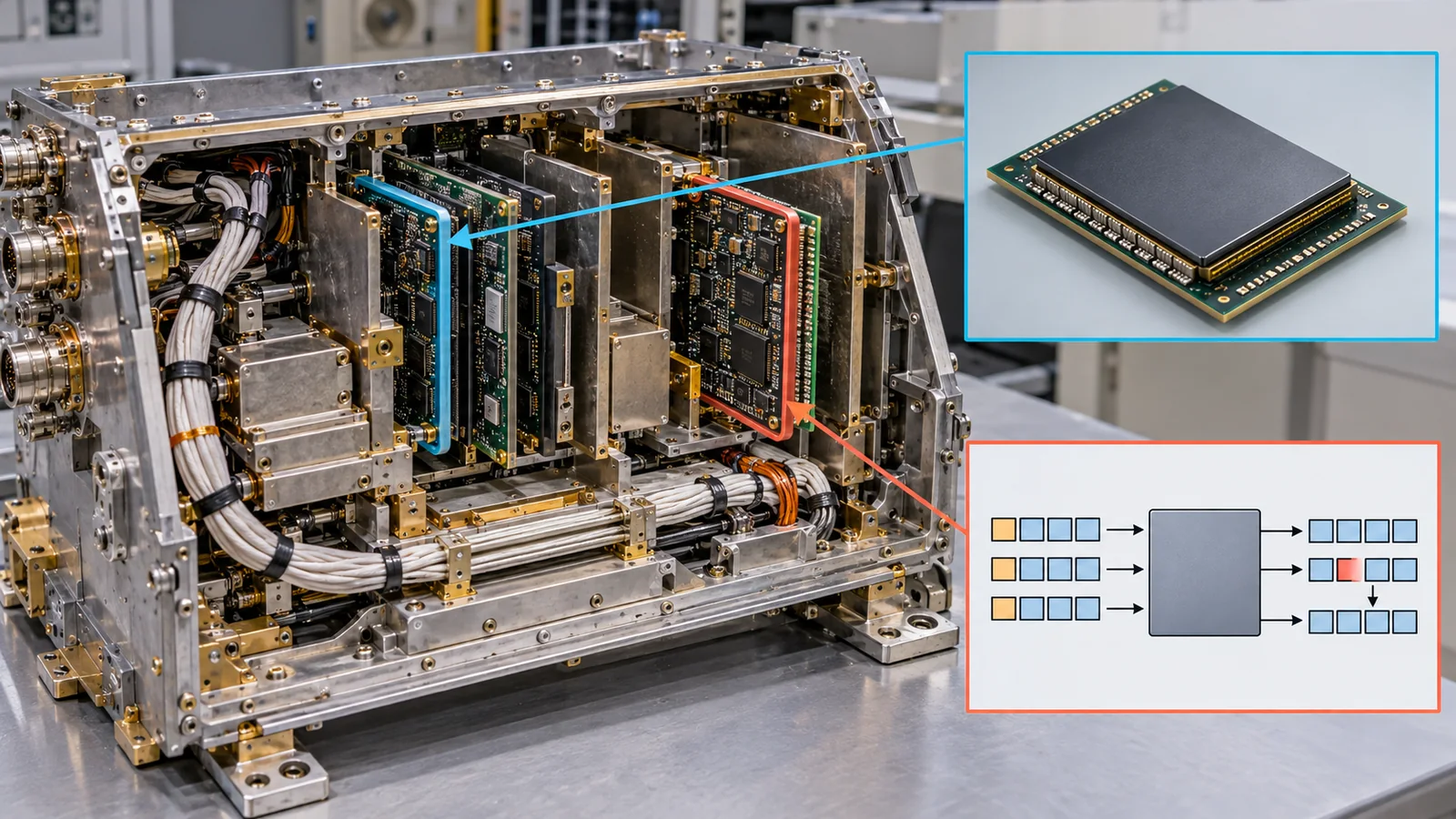
- By design (RHBD): NASA's material says RHBD, which modifies the transistors, gates and physical layout so that the chip itself is more resistant to radiation, is spreading within commercial semiconductor processes. Specialized circuit topologies, hardened standard-cell libraries and radiation-aware layout protect against SEUs, SET-induced logic glitches, functional upsets and latch-up. High-performance processors increasingly harden only the most vulnerable blocks and use architectural redundancy only where neededSourced[Ref. 4].
- By system: error-correcting code (ECC), watchdog timers, scrubbing (reading memory regularly and correcting it), redundancy, selective power cycling and software fault isolation [Ref. 4]. The NASA Goddard presentation also says RHA mitigation must not depend solely on part-level robustness [Ref. 3].
6. SiC and GaN: promise, and challenges in space
SiC (silicon carbide) and GaN (gallium nitride) are wide-bandgap semiconductors, with a bandgap (the energy gap needed to move electrons) wider than silicon's, and are regarded as suited to high voltages and high temperatures. The review by Pearton and co-workers (2021) says SiC and GaN are already commercialized for automotive, wireless and industrial power, but their adoption into space and avionic applications is hindered by susceptibility to permanent degradation and catastrophic failure from heavy ionsSourced[Ref. 7].
(1) Record and challenges in space-like environments
As an example of promise, Neudeck and co-workers at NASA Glenn exposed 4H-SiC JFET integrated circuits (two chips of 175 transistors each) directly, for 60 days with no cooling and no protective packaging, to a high-fidelity reproduction of the Venus surface in a test chamber (about 460 °C and about 9.3 MPa, chemically reactive), and confirmed operationSourced[Ref. 8]. That is a result in a ground chamber, not a test against space radiation.
As an example of challenge, Pearton and co-workers state that, in space-simulated conditions, GaN and SiC transistors showed failure susceptibility at about 50% of nominal rated voltage, and that in SiC Schottky diodes catastrophic SEB and other SEE were observed at about 40% of rated operating voltage and unacceptable leakage-current degradation at about 20% [Ref. 7]. ECSS-Q-ST-60-15C Rev. 1 also lists SiC and GaN diodes, SiC MOSFETs and GaN FETs among the part families needing SEE assessment, and asks that LET thresholds be recalculated for materials other than silicon [Ref. 9].
Turning "percent of rating" into volts: for a 650 V-rated device, about 50% is 325 V, about 40% is 260 V and about 20% is 130 V; for a 1200 V-rated device they are 600 V, 480 V and 240 V (ratings are illustrative; the volts are Our calculation). ECSS-Q-ST-30-11C Rev. 2 (23 June 2021) is the standard on derating of EEE parts (using them at loads below their ratings); it limits the drain-to-source voltage of FETs to "80% of rated, or the SEE safe operating area, whichever is lower" and says that only MOSFETs characterized for SEE shall be used in space applicationsSourced[Ref. 10]. In other words, high-voltage devices are designed on the premise that they cannot be used up to their rating.
Pearton and co-workers say that the ultra-wide-bandgap Ga2O3 appears more resistant to displacement damage than GaN and SiC, as expected from average bond strengths, and that diamond is a highly radiation-resistant material considered nearly ideal for radiation detection [Ref. 7]. Commentary: a wide bandgap helps with high voltage and temperature, but under SEB conditions, in which "a heavy ion passes through a high electric field", operating under a large electric field can itself be the weakness. SiC MOSFETs also have a MOS structure and so need attention to charge in oxides under total dose (see our explainer on radiation and electronic components). ECSS-Q-ST-60-15 lists MOS (Si, SiC) and GaN power devices among the families needing TID assessment [Ref. 9]. Crystal defects, interfaces and insulator quality tie directly to radiation strength.
That cannot be said across the board. Even for materials expected to be strong against total dose or displacement damage, power devices have been reported to suffer catastrophic failures such as SEB from heavy ions (Pearton et al.). Strength also differs with device type, structure, voltage and ion species. Rather than calling SiC and GaN "strong" or "weak" as a group, it matters to check SEE test data and operating-voltage margin for each device.
7. Options for computers that run in space
There are several options for a spacecraft computer. NASA's small-spacecraft material (2026) sorts them as followsSourced[Ref. 4].
- Radiation-hardened microcontrollers: modest in processing capability, but robust and with predictable real-time behavior. Suited to housekeeping, sensor interfacing and control.
- High-performance processors: greater capacity and efficiency, and suited to image processing, compression and decision-making. Radiation-tolerant multicore devices are among them.
- SoCs (systems on chip): CPUs, accelerators, memory controllers and programmable logic integrated on one piece of silicon, giving high computing capability in small size, mass and power.
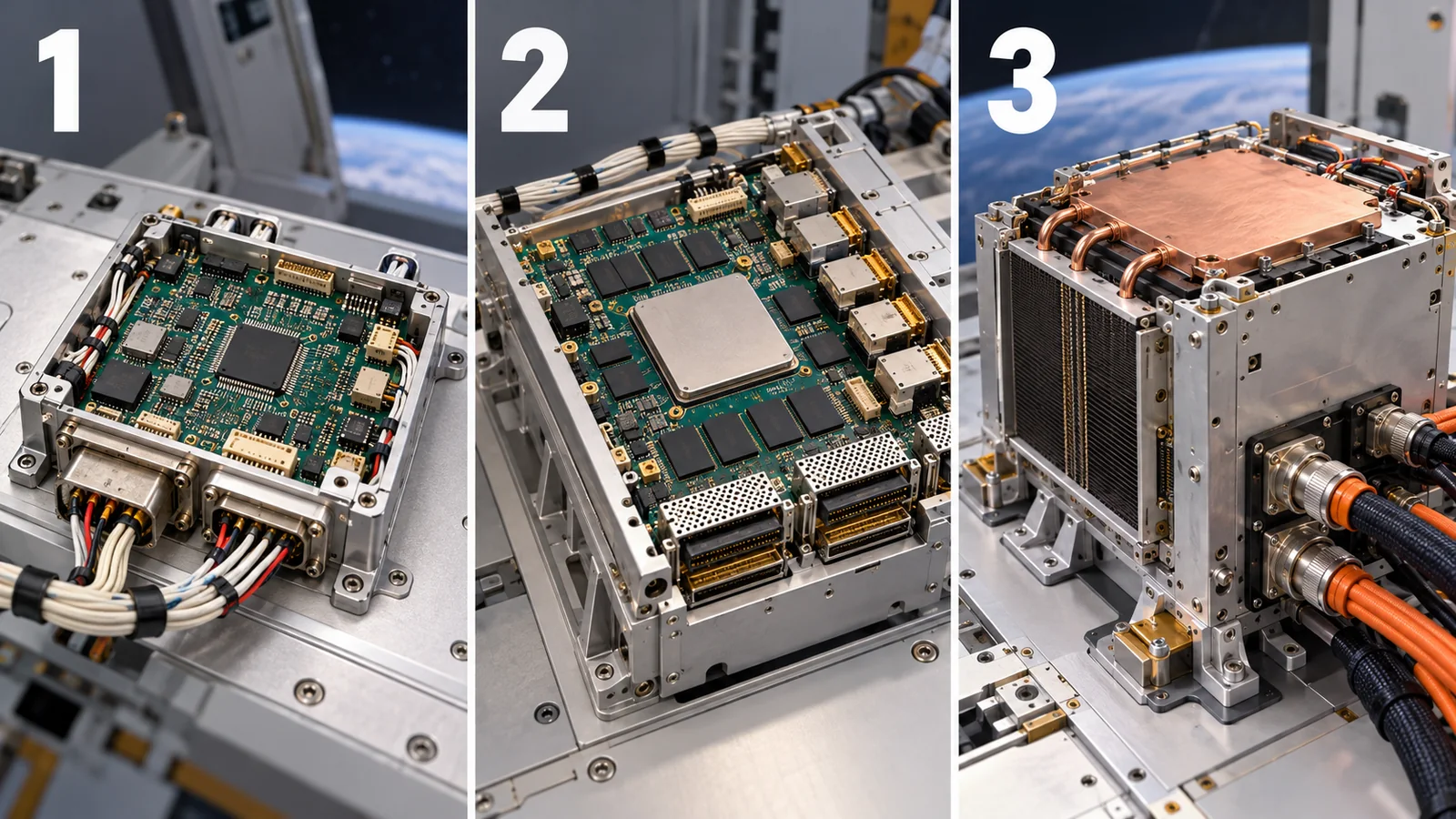
View original SVG, values and sources
Original SVG reference: Conceptual diagram (vector drawing). The radiation-hardened microcontrollers, COTS SoC plus mitigation and TID listings are from NASA's small-spacecraft technology material (2026), the RAD750 specifications from NASA's Perseverance page, and the HPSC goal from NASA material of 2018Sourced [Ref. 4, 11, 12]. HPSC is a development plan; an operating record could not be confirmedNot yet confirmed.
As a representative example, NASA's Mars rover Perseverance has a radiation-hardened BAE RAD750 (PowerPC 750 architecture) as its central processor, running at up to 200 MHz, 10 times the speed of the computers in the earlier rovers Spirit and Opportunity, with 2 GB of flash memory, 256 MB of DRAM and 256 kB of EEPROM. It carries two identical computers so there is "always a spare brain"Sourced[Ref. 11]. For the next generation, a 2018 NASA document says its High-Performance Spaceflight Computing (HPSC) is developing a radiation-hardened multicore processor (a chiplet) aiming at nearly two orders of magnitude over the current state of the art, funded by NASA's STMD and SMD and the US Air Force, managed by JPL, with Boeing developing prototypesNot yet confirmed[Ref. 12]. An operating record for HPSC could not be confirmed here.
NASA says that, farther from Earth, the greater onboard computing capability will have high sensitivity to radiation, and that watchdog timers, selective power cycling and software fault isolation improve robustness [Ref. 4]. NASA's product table also includes values from a few krad to 100 krad of system TID and entries marked "COTS with SEE mitigation", and notes that these are manufacturers' stated values, not independently verified by NASA [Ref. 4]. Limit of the analogy: "a craftsman doing fine work is hurt by shaking" shows the fragility of fine-feature devices but not what redundancy and correction can protect.
8. Where things stand now (checked 17 October 2026)
This field changes quickly, so we set out what could be confirmed from primary sources, with a checking date. A company's claim is written as that company's claim.
| Item | What was confirmed | Class |
|---|---|---|
| ECSS part standards | ECSS-Q-ST-60C Rev. 4 (30 April 2025) defines three classes of EEE components. ECSS-Q-ST-60-13C Rev. 2 (30 April 2025) governs use of commercial EEE parts, limited to cases where existing space parts cannot achieve the conditions and the penalties are shown quantitatively [Ref. 1, 13] | Sourced |
| NASA part standards | NASA-STD-8739.10 (13 June 2017, active) defines four assurance levels. EEE-INST-002 is to be replaced by NASA-[TBD]-8739.11 (before final decision; 24 sections, four assurance levels) [Ref. 2, 3] | Not yet confirmed |
| NASA taking in commercial parts | The ILPM scheme: first manufacturer added in 2024; pilots in 2025 (SMD) and 2026 (ESDMD); work with 22+ manufacturers in fiscal 2026; radiation tolerance is not part of the ILPM assessment [Ref. 3, 17] | Not yet confirmed |
| SiC and GaN | Commercialized on the ground. Adoption for space is reported to be hindered by susceptibility to permanent degradation and catastrophic failure from heavy ions (2021 review). SiC ICs ran for 60 days in a simulated Venus environment (ground chamber) [Ref. 7, 8] | Sourced |
| Computers in space | Perseverance uses a RAD750 (up to 200 MHz). HPSC is a development plan. In small satellites the traditional approach is commercial parts combined with hardened support parts and countermeasures, and RHBD is spreading [Ref. 4, 11, 12] | Sourced |
| Pass or fail of an individual product | Which product can be used in space is decided by each mission's specification and by quality and radiation data. A guarantee or ranking of any individual product could not be confirmed in this article | Commentary |
Checked 17 October 2026. The number NASA-[TBD]-8739.11 appears as "TBD" in the presentation. Check each organization's official page for the edition of a standard.
A "space-grade" part is first of all quality and process assurance; strength against radiation is confirmed separately. NASA is formalizing the idea that commercial parts, from reliable manufacturers and used within datasheet limits, can be used, but radiation tolerance needs separate confirmation. SiC and GaN are promising, but heavy-ion susceptibility is a challenge, and designs assume the operating voltage is held down. For computers, radiation-hardened processors and commercial SoCs with countermeasures exist side by side.
9. How to read the yardsticks and standards
Whether a semiconductor part can be used in space cannot be captured by one number. Instead of the name "space-grade", check separately the level of assurance (quality), the radiation data, the margin in use (derating) and the track record. The table sets out what each yardstick measures and does not measure, as far as could be confirmed.
| Item assessed | Representative test or method (name, source) | Standards and guidance (ECSS, NASA, AEC and others) | Cautions in reading |
|---|---|---|---|
| Part assurance level (quality) | Screening (tests that remove early failures), lot acceptance tests, evaluation tests [Ref. 1, 3]Sourced | ECSS-Q-ST-60C Rev. 4 "Electrical, electronic and electromechanical (EEE) components" (30 April 2025; three classes; quality levels for class 1 include ESCC 9000, MIL-PRF-38535 class V and JAXA-QTS-2010) [Ref. 1]Sourced. NASA-STD-8739.10 "EEE Parts Assurance Standard" (13 June 2017, four assurance levels) [Ref. 2]Sourced. EEE-INST-002 (2003, addendum 2008, three quality levels) [Ref. 3]Sourced | The schemes differ by organization and do not map one to one. None of the classes means strength against radiation |
| Assessment of commercial parts | The NESC proposal (reliable as or more than MIL-SPEC when used within datasheet limits; selective testing based on MEAL) [Ref. 6, 14]Sourced. The criteria for ILPM and Established COTS Parts [Ref. 5, 17]Sourced | ECSS-Q-ST-60-13C Rev. 2 "Commercial electrical, electronic and electromechanical (EEE) components" (30 April 2025) [Ref. 13]Sourced. AEC-Q100 (integrated circuits), AEC-Q101 (discrete semiconductors), AEC-Q200 (passive components) [Ref. 15]Sourced | An automotive qualification is not a radiation test. The ILPM assessment excludes radiation and is not a certification (NASA) |
| Strength against radiation | Irradiation tests for TID, displacement damage and SEE, and the RHA flow (see our explainer on radiation and electronic components) [Ref. 9]Sourced | ECSS-Q-ST-60-15C Rev. 1 "Radiation hardness assurance – EEE components" (20 March 2025) [Ref. 9]Sourced | Parts without RHA may show larger lot-to-lot variation (NASA). System-level mitigation is needed |
| Margin in use (derating) | Use at loads below ratings. For FETs the drain-to-source voltage is held to 80% of rated or the SEE safe operating area, whichever is lower [Ref. 10]Sourced | ECSS-Q-ST-30-11C Rev. 2 "Derating – EEE components" (23 June 2021) [Ref. 10]Sourced | There is also a requirement to use only MOSFETs characterized for SEE. For SiC and GaN, confirm device by device |
| Wide-bandgap (SiC, GaN) | SEB voltage in heavy-ion tests and total-dose tests [Ref. 7, 9]Sourced | A space standard specific to SiC or GaN could not be confirmed. ECSS-Q-ST-60-15C Rev. 1 lists them among families needing SEE and TID assessment and has LET thresholds recalculated [Ref. 9]Sourced | Strength differs by device, structure and voltage. "About 50% of rating" and similar are examples from reports |
| Computers | Statements of performance, TID and TRL (manufacturers' stated values) [Ref. 4]Sourced. RAD750 specifications (NASA) [Ref. 11]Sourced | A space standard specific to computers could not be confirmed (NASA says TRL differs by avionics design and applying a single TRL scale is difficult) [Ref. 4] | NASA has not independently verified product performance. TRL changes with application and environment |
| Record in orbit | Demonstration in space (TRL 9) [Ref. 4]Sourced | Could not be confirmed | A record in one application may not carry over to another (NASA's note) |
The arrangement of the table is Our calculation (organization). Numbers, titles, editions and dates were checked on the openly published ECSS text, NASA's standards page and AEC's list of documents (checked 17 October 2026). The texts of ESCC, MIL-PRF, JAXA-QTS and AEC documents were not checked. The ASTM International website and its standards were not consulted.
Cautions in reading (for materials engineers)
- Do not take the name "space-grade" at face value: quality assurance and radiation assurance are separate. For each part, check which of the two sets of documents you hold.
- The "reliability" and the "radiation tolerance" of a commercial part are different: an ILPM or AEC-Q qualification includes no radiation test. Radiation is tested and analyzed separately, according to the mission environment (MEAL).
- A company's stated value and third-party verification are different: NASA has not independently verified the performance or TID of products in its table.
- A standard is a "procedure", not a "guarantee of passing": an ECSS standard becomes a requirement only when a project adopts it, and it can be tailored. Plans and achievements are different too (NASA-[TBD]-8739.11, the ILPM pilots and HPSC are not settled).
10. Glossary
- EEE parts
- Electrical, electronic and electromechanical parts: resistors, capacitors, transistors, ICs and so on.
- COTS
- Commercial off-the-shelf: commercially available ready-made parts.
- Rad-hard
- A part whose strength against radiation is assured or designed in.
- RHA
- Radiation hardness assurance: the plan for confirming a part's strength against radiation through environment, tests and margin.
- RHBD
- Radiation hardening by design: raising tolerance through circuit and layout design.
- Assurance level
- A division by the strictness of a part's process control, screening and testing.
- MIL-SPEC / QML
- Parts to US military specifications. QML is a list of qualified manufacturers.
- ESCC
- The standards of the European Space Components Coordination. Referred to by ECSS-Q-ST-60.
- Screening
- A 100% test to remove early-failure parts.
- Lot acceptance test (LAT)
- A test on samples drawn from a manufacturing lot, used to accept the lot.
- MEAL
- Mission, Environment, Application, Lifetime.
- ILPM
- Industry Leading Parts Manufacturer: a commercial parts maker whose quality and reliability data NASA has checked.
- Established COTS Part (ECP)
- A commercial part with a stable process, high-volume production and statistical control (NASA's criteria).
- PEAL
- Parts Evaluation and Analysis Laboratory: NASA's laboratory for evaluating and analyzing parts (pilot).
- DPPM / FIT
- Defective parts per million / failures in time (failure rate per unit time).
- AEC-Q100 / Q101 / Q200
- Qualification standards of the Automotive Electronics Council (ICs / discrete semiconductors / passive components).
- Derating
- Using a part at loads below its ratings to raise its life and reliability.
- Bandgap
- The energy gap needed to move electrons in a semiconductor. A wider gap suits higher voltage and temperature.
- SiC / GaN
- Silicon carbide / gallium nitride: wide-bandgap semiconductors.
- SEB
- Single-event burnout: a power device destroyed by a single heavy ion.
- SoC
- System on chip: CPU, memory control and logic on one chip.
- HPSC
- NASA's High-Performance Spaceflight Computing: development of a radiation-hardened multicore processor.
- Scrubbing
- A countermeasure that reads memory regularly, corrects errors and writes the data back.
- PEM
- Plastic encapsulated microcircuit: a resin-sealed microcircuit.
11. References (primary sources)
- ECSS "ECSS-Q-ST-60C Rev.4 – Electrical, electronic and electromechanical (EEE) components" (30 April 2025; openly published PDF) — ecss.nl/wp-content/uploads/2025/05/ECSS-Q-ST-60C-Rev.4(30April2025).pdf
- NASA "NASA-STD-8739.10 Electrical, Electronic, and Electromechanical (EEE) Parts Assurance Standard" (NASA Technical Standards System page; baseline, 13 June 2017, active) — standards.nasa.gov/standard/nasa/nasa-std-873910
- Ochs L. P. (NASA Goddard) "NASA Electrical, Electronic, Electromechanical, Electro-Optical (EEEE) Parts Selection Process" (presentation at the Symposium on Counterfeit Parts and Materials, 23–25 June 2026) — ntrs.nasa.gov/citations/20260005625
- NASA "State-of-the-Art of Small Spacecraft Technology, 8.0 Small Spacecraft Avionics" (checked 17 October 2026) — nasa.gov/smallsat-institute/sst-soa/small-spacecraft-avionics/
- NASA NEPP "About ILPM Established COTS Parts" (checked 17 October 2026) — nepp.nasa.gov/pages/ilpm/about.cfm
- NASA NESC "Recommendations on the Use of Commercial-Off-The-Shelf (COTS) Electrical, Electronic, and Electromechanical (EEE) Parts for NASA Missions – Phase II" (NASA/TM-20220018183, December 2022) — ntrs.nasa.gov/citations/20220018183
- Pearton S. J. et al. "Review—Radiation Damage in Wide and Ultra-Wide Bandgap Semiconductors", ECS J. Solid State Sci. Technol. 10, 055008 (2021), DOI 10.1149/2162-8777/abfc23 — doi.org/10.1149/2162-8777/abfc23
- Neudeck P. G. et al. "Operational Testing of 4H-SiC JFET ICs for 60 Days Directly Exposed to Venus Surface Atmospheric Conditions", IEEE J. Electron Devices Soc. 7, 100–110 (2019), DOI 10.1109/JEDS.2018.2882693 — doi.org/10.1109/JEDS.2018.2882693
- ECSS "ECSS-Q-ST-60-15C Rev.1 – Radiation hardness assurance – EEE components" (20 March 2025; openly published PDF) — ecss.nl/wp-content/uploads/2025/03/ECSS-Q-ST-60-15C-Rev.1(20March2025).pdf
- ECSS "ECSS-Q-ST-30-11C Rev.2 – Derating – EEE components" (23 June 2021; openly published PDF) — ecss.nl/wp-content/uploads/2022/07/ECSS-Q-ST-30-11C-Rev.2(23June2021).pdf
- NASA "Mars 2020 Perseverance Rover: Rover Components" (the Brains entry; checked 17 October 2026) — science.nasa.gov/mission/mars-2020-perseverance/rover-components/
- Powell W. A. (NASA) "High-Performance Spaceflight Computing (HPSC) Project Overview" (13 November 2018) — ntrs.nasa.gov/citations/20180007636
- ECSS "ECSS-Q-ST-60-13C Rev.2 – Commercial electrical, electronic and electromechanical (EEE) components" (30 April 2025; openly published PDF) — ecss.nl/wp-content/uploads/2025/05/ECSS-Q-ST-60-13C-Rev.2(30April2025).pdf
- NASA NESC "Recommendations on Use of Commercial-Off-The-Shelf (COTS) Electrical, Electronic, and Electromechanical (EEE) Parts for NASA Missions" (Phase I, 15 December 2020) — ntrs.nasa.gov/citations/20205011579
- Automotive Electronics Council list of AEC documents (titles of AEC-Q100, AEC-Q101 and AEC-Q200 checked; 17 October 2026) — aecouncil.com/AECDocuments.html
- Abdullahi Z., Epp Schmidt T. (NASA) "Evaluation of Automotive Grade Resistors for Space Flight" (poster, August 2024) — ntrs.nasa.gov/citations/20240010883
- NASA NEPP "ILPM Established Parts" (page listing ILPMs and Established COTS Parts; checked 17 October 2026) — nepp.nasa.gov/pages/ilpm/establishedparts.cfm
- Schwank J. R. et al. "Radiation Effects in MOS Oxides", IEEE Trans. Nucl. Sci. 55, 1833–1853 (2008), DOI 10.1109/TNS.2008.2001040 — doi.org/10.1109/TNS.2008.2001040
12. Claim-to-source audit
| Claim in the text | Basis | Class |
|---|---|---|
| The three ECSS classes of EEE components (class 1 highest assurance and lowest risk, class 3 lowest and highest, the cost tendency), the quality levels for class 1 (hermetic ICs: ESCC 9000, MIL-PRF-38535 class V, JAXA-QTS-2010), the standards for non-hermetic ICs (class P, class Y and so on) | ECSS-Q-ST-60C Rev. 4 (30 April 2025) Reference 1 https://ecss.nl/wp-content/uploads/2025/05/ECSS-Q-ST-60C-Rev.4(30April2025).pdf | Sourced |
| NASA-STD-8739.10's title, number, baseline edition (13 June 2017), active status and OSMA-endorsed standard | NASA Technical Standards System page Reference 2 https://standards.nasa.gov/standard/nasa/nasa-std-873910 | Sourced |
| NASA's four assurance levels, risk-based selection, the mission classes A to D of NPR 8705.4B, EEE-INST-002 (2003, addendum 2008, 18 types, three quality levels, to be replaced), NASA-[TBD]-8739.11 (draft, 24 sections, LAT, ILPM), that parts levels do not imply radiation tolerance, radiation designators on MIL-SPEC parts, lot-to-lot variation of non-RHA parts, system-level mitigation, the history (hermetic sealing, lead-free, tin whiskers, copper bond wires), the NESC COTS study, ILPM (first company in 2024, pilots in 2025 and 2026, 22+ manufacturers, the parts targeted by PEAL) | NASA Goddard presentation (June 2026) Reference 3 https://ntrs.nasa.gov/citations/20260005625 | Sourced |
| COTS superior in performance, power efficiency and price but tending to be radiation-susceptible, the traditional approach of commercial parts first with hardened support parts, the spread of RHBD, the kinds of computers, system-level countermeasures, the product table (TID statements; manufacturers' values, not verified), the TRL note | NASA small-spacecraft technology material (avionics chapter, 2026) Reference 4 https://www.nasa.gov/smallsat-institute/sst-soa/small-spacecraft-avionics/ | Sourced |
| The definition of ILPM (extra screening can be detrimental), the five criteria for an Established COTS Part (stable process for at least a year, over one million parts, 100% electrical test and multi-lot characterization, automated lines with statistical control, yield), and that it is not used for certification | NASA NEPP's ILPM page Reference 5 https://nepp.nasa.gov/pages/ilpm/about.cfm | Sourced |
| The NESC Phase II proposal (NASA's earlier treatment of "standard" and nonstandard parts, top-tier commercial makers as reliable as or more reliable than MIL-SPEC within datasheet limits, the need for technology not in MIL-SPEC parts) | NESC report NASA/TM-20220018183 Reference 6 https://ntrs.nasa.gov/citations/20220018183 | Sourced |
| Commercialization of SiC and GaN and their susceptibility to permanent degradation and catastrophic failure from heavy ions, about 50% of rated voltage (transistors), about 40% (SEB in SiC diodes) and about 20% (leakage), Ga2O3 and diamond | Abstract of Pearton et al. (2021) Reference 7 https://doi.org/10.1149/2162-8777/abfc23 | Sourced |
| That 4H-SiC JFET ICs (two chips of 175 transistors) operated for 60 days, with no cooling or protective packaging, in a simulated Venus environment (about 460 °C, about 9.3 MPa) | Abstract of Neudeck et al. (2019) Reference 8 https://doi.org/10.1109/JEDS.2018.2882693 | Sourced |
| That SiC and GaN diodes, SiC MOSFETs and GaN FETs are part families needing SEE assessment, that LET thresholds are recalculated for non-silicon materials, and that MOS (Si, SiC) and GaN power devices are families needing TID assessment | ECSS-Q-ST-60-15C Rev. 1 (20 March 2025) Reference 9 https://ecss.nl/wp-content/uploads/2025/03/ECSS-Q-ST-60-15C-Rev.1(20March2025).pdf | Sourced |
| Derating of FET drain-to-source voltage (80% of rated, or the SEE safe operating area, whichever is lower), the use of only SEE-characterized MOSFETs, the purpose of derating | ECSS-Q-ST-30-11C Rev. 2 (23 June 2021) Reference 10 https://ecss.nl/wp-content/uploads/2022/07/ECSS-Q-ST-30-11C-Rev.2(23June2021).pdf | Sourced |
| Perseverance's computer (BAE RAD750, PowerPC 750, up to 200 MHz, about 10 times Spirit and Opportunity, 2 GB flash, 256 MB DRAM, 256 kB EEPROM, two units) | NASA's Perseverance page Reference 11 https://science.nasa.gov/mission/mars-2020-perseverance/rover-components/ | Sourced |
| HPSC: a radiation-hardened multicore chiplet aiming at nearly two orders of magnitude over the state of the art, funding (STMD, SMD, US Air Force), JPL management, prototypes by Boeing | NASA material (2018); a development plan Reference 12 https://ntrs.nasa.gov/citations/20180007636 | Not yet confirmed |
| The scope of ECSS-Q-ST-60-13C Rev. 2 (30 April 2025) (conditions unachievable with existing space parts, quantitative statement of penalties, the part families covered, three classes) | Openly published ECSS text Reference 13 https://ecss.nl/wp-content/uploads/2025/05/ECSS-Q-ST-60-13C-Rev.2(30April2025).pdf | Sourced |
| The purpose of NESC Phase I (compiling the COTS practices and lessons of the Commercial Crew Program and NASA centers) | NESC report (15 December 2020) Reference 14 https://ntrs.nasa.gov/citations/20205011579 | Sourced |
| The titles of AEC-Q100 (integrated circuits), AEC-Q101 (discrete semiconductors) and AEC-Q200 (passive components) | AEC's list of documents Reference 15 http://www.aecouncil.com/AECDocuments.html | Sourced |
| That automotive-grade resistors have begun to be used as alternatives to MIL-SPEC parts, that AEC qualification is stringent but users lack insight into all of a manufacturer's practices, and that a NASA study recommended high-volume commercial parts given evidence of stringent fabrication control | Abstract of the NASA poster (August 2024) Reference 16 https://ntrs.nasa.gov/citations/20240010883 | Sourced |
| That tolerance to ionizing radiation is not part of the ILPM assessment, the list of ILPMs and Established COTS Parts, use based on MEAL | NASA NEPP list page (checked 17 October 2026) Reference 17 https://nepp.nasa.gov/pages/ilpm/establishedparts.cfm | Sourced |
| That in advanced commercial technology total-dose hardness is often set by charge in parasitic field oxides or SOI buried oxides | Abstract of Schwank et al. (2008) Reference 18 https://doi.org/10.1109/TNS.2008.2001040 | Sourced |
| For a 650 V device 20% / 40% / 50% is 130 / 260 / 325 V, and for a 1200 V device 240 / 480 / 600 V (ratings illustrative) | The reported fractions applied to illustrative ratings; assumptions stated in the text and figure Our calculation | Our calculation |
| The texts of ESCC, MIL-PRF and JAXA-QTS standards, the texts of AEC standards, the final NASA-[TBD]-8739.11, an operating record for HPSC, space standards specific to SiC or GaN, the pass or fail or ranking of individual products, and space standards specific to computers | Could not be confirmed in the primary sources reachable for this article, and so are not stated | Commentary |
| The readings "radiation strength is protected in layers of process, design and system", "for wide-bandgap devices it is a question of crystal, interface and insulator quality" and "the reliability of molding resin, solder and wiring in commercial parts", and the analogies such as "grades of insurance" with their limits | Commentary in this article (readings based on sourced facts) | Commentary |
| That Figs. 1 to 9 are explanatory drawings and not observations of real data, and that Figs. 1 and 9 are frames for AI-generated concept images | A note by this article | Commentary |
Last updated 17 October 2026. Sources are limited to primary material (the openly published text of ECSS standards, NASA standards pages, NESC reports, presentations and technology material, and peer-reviewed papers). Values for products in NASA's tables are labelled manufacturers' stated values and kept apart from independently verified ones. No company or product is ranked. The numerical example (voltage conversion) is an explanatory calculation made for this article and is not a value for any particular part. NASA-[TBD]-8739.11, the ILPM pilots and HPSC are at the plan and draft stage, not established facts. The texts of ESCC, MIL-PRF, JAXA-QTS and AEC standards, space standards specific to SiC and GaN, an operating record for HPSC, and the pass or fail of individual products could not be confirmed and are not stated here. All figures are explanatory conceptual drawings or drawings that include our own calculation; Figs. 1 and 9 are frames for AI-generated images (images not yet placed). They do not show any real facility, product or appearance.