
Transitioning to Commercial Production of Perovskite Solar Cells
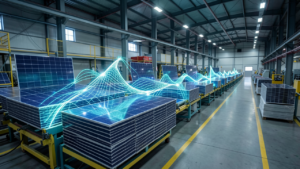
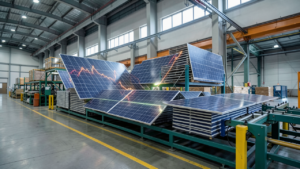
While perovskite solar cells have demonstrated remarkable efficiencies at the laboratory scale, their mass production into large-area modules at low cost and with high reliability requires the establishment of comprehensive and efficient manufacturing lines. Given their unique material properties and processing requirements, which differ from conventional solar cell manufacturing, meticulous planning and specialized expertise are essential. Lecheng Intelligence Technology outlines the key steps and considerations for building a complete perovskite module manufacturing line.
Key Steps in Manufacturing Line Construction
An efficient and robust perovskite module manufacturing line must seamlessly integrate the following primary production stages:
- Substrate Preparation: This foundational step involves cleaning and surface treatment of glass or flexible substrates, and the formation of conductive layers. Uniformity and cleanliness are critical for high-quality module production.
- Functional Layer Deposition: Techniques for uniformly depositing each functional layer, including the electron transport layer (ETL), perovskite active layer, and hole transport layer (HTL). Slot-die coating, blade coating, vacuum deposition, and printing technologies are applied. Challenges include large-area uniformity, precise film thickness control, and defect suppression.
- Electrode Formation: This stage involves the creation of transparent conductive electrodes and metal electrodes. High-precision laser patterning (scribing) for series connection of cells is also included here.
- Encapsulation: Perovskite materials are sensitive to moisture and oxygen, making robust encapsulation crucial for long-term stability. Selecting appropriate materials like glass, EVA, polyolefin resins, and barrier films, along with optimized processes, is vital.
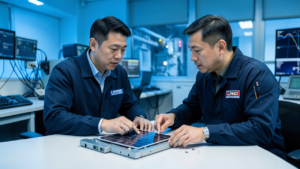
- Quality Control and Testing: In-line and off-line testing to ensure the quality of each manufacturing stage and the final product. This includes I-V characteristic measurements, EL/PL inspection, and long-term reliability tests (e.g., Damp-Heat, Thermal Cycling, UV irradiation).
- Module Assembly and Framing: The process of assembling completed cells into desired sizes and attaching frames. Special applications like Building-Integrated Photovoltaics (BIPV) require flexible assembly tailored to specific designs.
Importance of Process Integration and Supplier Selection
The success of a perovskite module manufacturing line hinges not just on the performance of individual equipment but on how efficiently they are integrated to function as a cohesive whole. Understanding the interactions between each process step and designing the workflow to minimize bottlenecks is crucial. Lecheng Intelligence Technology emphasizes the following points:
- Comprehensive Workflow Design: Designing the entire manufacturing process from the initial stage reduces future risks and enables smooth scale-up.
- Collaboration with Suppliers: Equipment vendors should ideally offer not only hardware but also deep knowledge in perovskite material science, process know-how, and integrated solutions. The supplier’s expertise is essential for process optimization and troubleshooting.
Future Outlook
Perovskite solar cells hold significant potential as a complement or alternative to silicon photovoltaics. The commercialization of this technology depends on the maturity of its manufacturing processes, specifically the ability to consistently supply high-quality modules at low cost. The establishment of appropriate manufacturing lines is a decisive step for this next-generation technology to secure a strong position in the energy market.
Source: https://www.le-laser.com/news





Comments