Key Findings
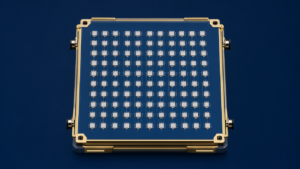
D-Wave Quantum has announced an ambitious gate-model roadmap aimed at accelerating the development of commercial fault-tolerant quantum computing. The roadmap sets a clear objective: to achieve a system with 100 logical qubits by 2032. This strategic shift signifies D-Wave’s serious entry into the general-purpose gate-model quantum computing arena, distinct from its established leadership in quantum annealing.
Technical / Clinical Details
- Logical Qubit Target: The primary goal is to reach 100 logical qubits by 2032. Logical qubits are stable computational units created by combining multiple physical qubits with error correction, essential for quantum computers to solve practical problems reliably.
- Integration of Core Technologies: The roadmap leverages D-Wave’s long-standing technological strengths:
- High-Coherence Dual-Rail Qubits: A qubit design that enables quantum information to be maintained stably for longer durations.
- Expertise in Quantum Error Correction (QEC): Applying existing knowledge and technology for detecting and correcting qubit errors.
- Proven Track Record in Superconducting Quantum Systems: Experience gained from developing and commercializing quantum annealing computers will be applied to the development of gate-model systems, including engineering, scaling, and commercialization.
- Leveraging Superconducting Technology: D-Wave plans to achieve fault tolerance by utilizing superconducting technology, which is deemed advantageous for providing faster error correction cycles. Superconducting qubits enable rapid gate operations, contributing significantly to efficient QEC.
Background & Context
The quantum computing industry primarily pursues two major approaches: quantum annealing and gate-model quantum computing. D-Wave has historically been a pioneer in quantum annealing. However, in response to the growing demand for gate-model quantum computers capable of implementing general-purpose quantum algorithms, the company has announced this new roadmap. Achieving fault-tolerant quantum computers is considered the ultimate goal for quantum computing to move beyond the NISQ (Noisy Intermediate-Scale Quantum) era and enable truly transformative applications. Major players like IBM, Google, and Quantinuum are also fiercely competing to achieve fault tolerance, underscoring the industry’s strategic direction.
Strategic Significance & Outlook
D-Wave’s gate-model roadmap demonstrates its ambition to diversify its position in the quantum computing market and become a leading provider of general-purpose fault-tolerant systems. The target of 100 logical qubits by 2032 is highly challenging, but D-Wave’s existing technical expertise and commercialization experience provide a strong foundation. The success of this roadmap would not only significantly enhance D-Wave’s market valuation but also dramatically expand the applicability of quantum computing across a wide range of fields, including drug discovery, materials science, financial modeling, and artificial intelligence. In an increasingly competitive landscape, D-Wave’s strategic pivot is set to introduce new dynamics into the industry.