Key Findings
Microsoft has significantly accelerated its quantum computing roadmap, announcing plans to complete a commercial-grade quantum computer by 2029, leveraging its newly developed Majorana 2 quantum chip. This breakthrough chip has achieved an unprecedented average qubit lifetime of 20 seconds, representing a 1000-fold improvement over previous benchmarks. This advancement, driven by topological qubit technology and AI-powered research and development, marks a critical step forward, though challenges persist in scaling the system from its current 12 qubits to millions and managing the associated compilation costs.
Technical / Clinical Details
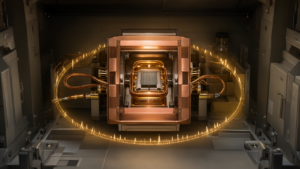
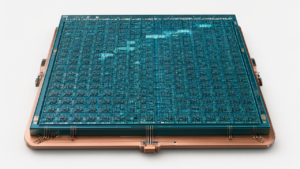
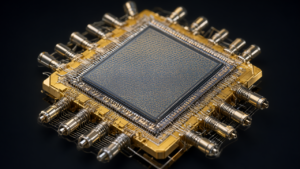
The Majorana 2 chip is engineered based on the principles of topological qubits, which utilize Majorana fermions—exotic quasiparticles—to encode quantum information. Topological qubits are inherently robust against external noise and decoherence, making them highly attractive for building fault-tolerant quantum computers. The reported 20-second average qubit lifetime is a monumental leap, as previous qubit lifetimes were typically in the millisecond range. This extended coherence time drastically reduces the overhead required for quantum error correction, enabling longer and more complex quantum computations. The AI-driven R&D process played a crucial role in optimizing material selection, device fabrication, and qubit control. However, the current Majorana 2 chip features only 12 qubits. Scaling this to the millions of qubits needed for truly practical quantum computers is a formidable engineering challenge, as is the development of efficient and cost-effective compilation methods for large-scale quantum programs.
Background & Context
The quantum computing industry is in a fierce global race to transition from noisy intermediate-scale quantum (NISQ) devices to fault-tolerant quantum computers. Topological quantum computing, with its intrinsic noise resilience, has been Microsoft’s long-term strategy in this pursuit. This announcement firmly demonstrates the tangible potential of their investment in Majorana fermions, setting a new benchmark for qubit stability. This progress positions Microsoft as a strong contender against other major players like Google, IBM, and Amazon, who are advancing different quantum modalities such as superconducting, trapped-ion, and neutral-atom systems. The pursuit of long-lived, stable qubits is a universal challenge across all quantum architectures, and Microsoft’s achievement represents a significant de-risking for their specific approach.
Strategic Significance & Outlook
Microsoft’s ambitious goal of delivering a commercial-grade quantum computer by 2029 gains substantial credibility with the Majorana 2 chip’s performance. This technology promises to unlock unprecedented computational power for applications in pharmaceuticals, materials science, financial modeling, and artificial intelligence, enabling breakthroughs previously deemed impossible. Future efforts will focus on achieving massive qubit scaling and developing robust, cost-effective quantum program compilation techniques. Microsoft’s strategy involves not only hardware innovation but also building a comprehensive software stack and developer ecosystem to ensure the usability and accessibility of its quantum solutions. For investors, this technological advancement represents a powerful catalyst for the commercialization of quantum computing, signaling significant potential for market disruption and new growth opportunities within the sector.
Source: https://www.htx.com/news/microsoft-announces-commercial-grade-quantum-computer-to-be-Dr4u00RC/
Get our weekly technology intelligence — free
Receive an infographic that lets you judge at a glance whether each field’s analysis report is worth reading.
Subscribe Free — Weekly Tech Intelligence
By subscribing, you’ll receive Troy-Technical’s weekly technology intelligence newsletter.
- Your email and selected fields are used only to deliver the newsletter.
- We never share your information with third parties.
- You can unsubscribe anytime via the link in each email.
See our Privacy Policy for details.
Takes about a minute · Unsubscribe anytime