Background
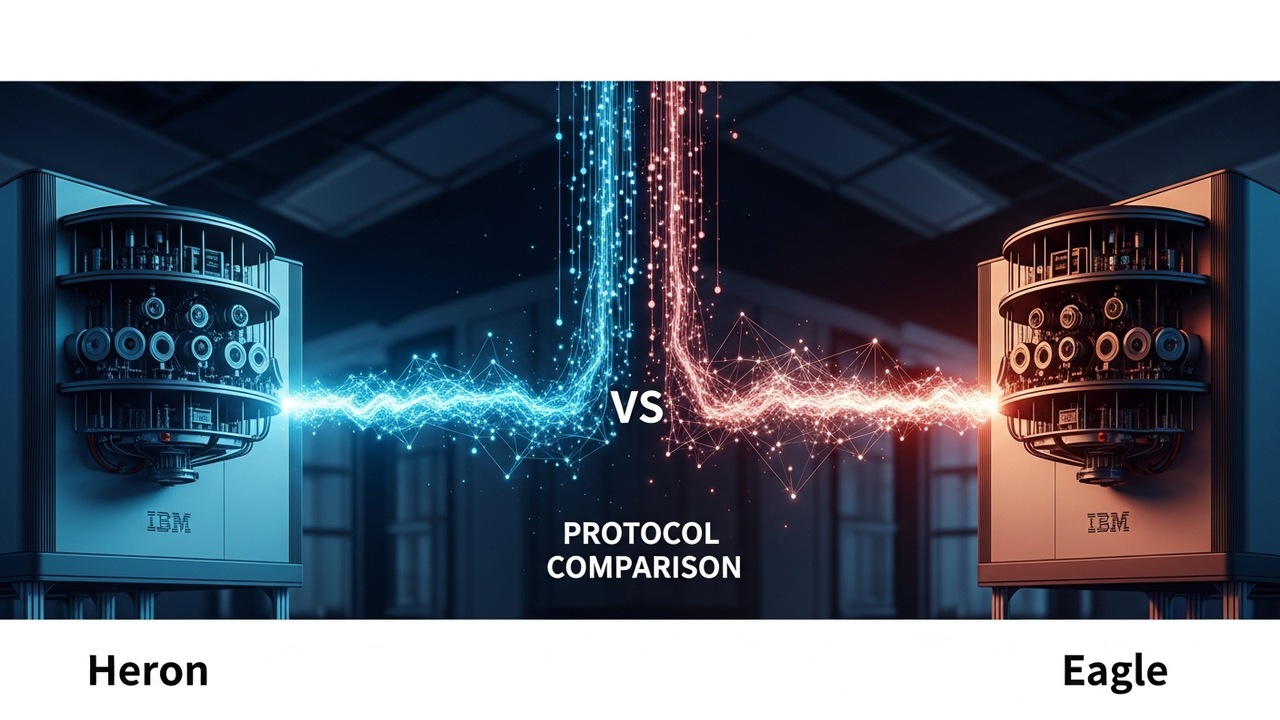
Benchmarking quantum computers is crucial for understanding their performance, capabilities, and progress towards achieving practical quantum advantage. Traditional benchmarking often focuses on low-level metrics like gate fidelity or coherence times. However, a more application-oriented approach, termed “protocol-based benchmarking,” assesses how well a quantum processor can execute specific quantum information protocols. A recent arXiv paper employs and extends this method to compare two generations of IBM’s quantum computers: Eagle and the newer Heron, aiming to provide a clearer picture of their practical utility.
Key Findings
- Application of Extended Protocol-Based Benchmarking: The researchers applied and extended a protocol-based benchmarking methodology. This approach moves beyond simple gate fidelity measurements to evaluate the performance of quantum computers on entire quantum protocols, offering a more holistic view of their functional capabilities.
- Comparison of IBM’s Heron and Eagle Processors: The study directly compared two distinct generations of IBM’s quantum processors, Eagle and Heron. This comparison is vital for tracking the technological evolution and performance improvements between successive hardware iterations.
- Explicit Assessment of Practical Quantum Advantage: A core objective was to explicitly evaluate whether specific quantum processors could demonstrate practical quantum advantage at the protocol level. This means assessing if the quantum system can perform certain quantum information tasks more efficiently or accurately than classical methods or previous quantum generations.
- Heron Demonstrates Quantum Advantage in Specific Tasks: The key finding was that the Heron architecture, IBM’s newer processor, demonstrably achieved quantum advantage in particular tasks. These include foundational quantum information protocols like quantum teleportation and superdense coding, where the Heron showed superior performance.
Significance & Outlook
This research provides valuable insights into the tangible progress of quantum hardware development. The demonstration of quantum advantage by the Heron architecture in specific, fundamental quantum information tasks, such as teleportation and superdense coding, is a significant validation of IBM’s advancements. This protocol-level benchmarking is crucial for guiding the development of more complex quantum algorithms and applications. It moves the field closer to realizing practical quantum computing by identifying specific areas where quantum processors can already offer a measurable advantage over classical systems or previous quantum hardware generations. This will accelerate the development of real-world quantum applications and further refine the design principles for future fault-tolerant quantum computers.
Source: https://arxiv.org/html/2603.04377v3
Get our weekly technology intelligence — free
Receive an infographic that lets you judge at a glance whether each field’s analysis report is worth reading.
Subscribe Free — Weekly Tech Intelligence
By subscribing, you’ll receive Troy-Technical’s weekly technology intelligence newsletter.
- Your email and selected fields are used only to deliver the newsletter.
- We never share your information with third parties.
- You can unsubscribe anytime via the link in each email.
See our Privacy Policy for details.
Takes about a minute · Unsubscribe anytime