Key Findings
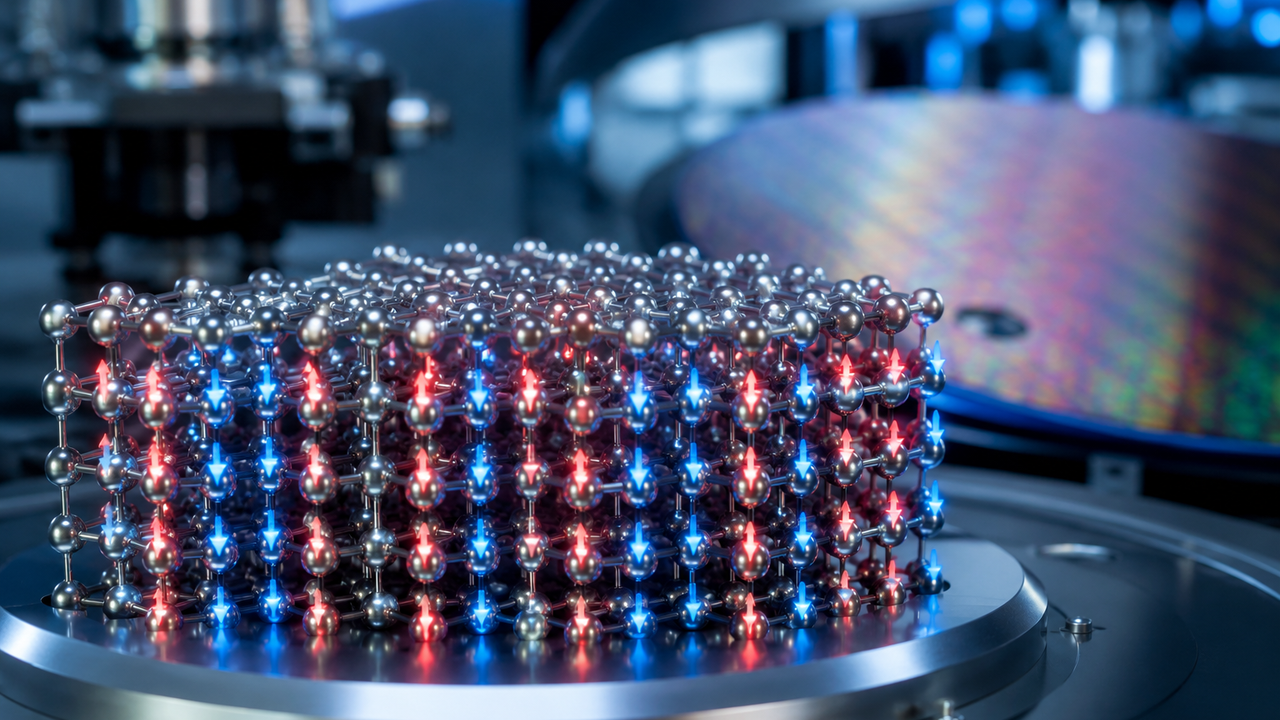
A novel symmetry-guided AI model, ‘SG-CDVAE’ (Symmetry-Guided Crystal Diffusion Variational Autoencoder), which directly incorporates crystallographic space group information into its learning process, has been developed. This model successfully identified four stable candidate antiferromagnets with promising applications in spintronics. This generative deep learning framework offers a significantly faster and more efficient route for inverse design in magnetic crystalline materials compared to conventional computational methods.
Technical / Clinical Details
SG-CDVAE functions by combining principles of diffusion models and variational autoencoders, types of generative AI, with the physical constraints of crystal symmetry. Specifically, it directly utilizes the inherent crystallographic space group information of materials as an input to the model, enabling the efficient generation of only physically plausible and stable crystal structures. This model possesses the capability to inversely design materials with specific magnetic properties required for spintronics (e.g., high Néel temperature or specific magnetic anisotropy). In this study, it discovered four novel antiferromagnet candidates whose stability was subsequently verified by Density Functional Theory (DFT) calculations. This approach substantially reduces the search space and computational cost, allowing for efficient identification of materials with targeted properties.
Background & Context
Spintronics, a next-generation electronics technology utilizing not only the charge but also the spin of electrons, is expected to bring about applications in faster, lower-power, and higher-density data storage devices, as well as quantum computing technologies. Antiferromagnets, due to their inherent magnetic order and insensitivity to external magnetic fields, are garnering attention as key components for spintronics devices. However, the discovery of promising antiferromagnets has been a significant challenge due to their complex magnetic structures and synthesis difficulties. Traditional materials discovery relies on extensive computations and experiments for vast numbers of candidate materials, consuming considerable time and resources. AI models like SG-CDVAE address this bottleneck, enabling more efficient and target-oriented materials design, thereby accelerating innovation in the spintronics field.
Strategic Significance & Outlook
Symmetry-guided generative AI models like SG-CDVAE hold the potential to revolutionize the discovery of magnetic materials. Moving forward, this framework is expected to be applied not only to antiferromagnets but also to the exploration of various functional crystalline materials, including ferromagnets, topological materials, and superconductors. By considering more complex property constraints, synthetic pathways, and integrating feedback loops with experimental results, AI will move closer to realizing ‘materials factories’ capable of autonomously discovering and optimizing new materials. This is anticipated to significantly accelerate the development of next-generation electronic devices, sensors, and energy storage technologies.
Source: https://www.azom.com/news.aspx?newsID=65528
Get our weekly technology intelligence — free
Receive an infographic that lets you judge at a glance whether each field’s analysis report is worth reading.
Subscribe Free — Weekly Tech Intelligence
By subscribing, you’ll receive Troy-Technical’s weekly technology intelligence newsletter.
- Your email and selected fields are used only to deliver the newsletter.
- We never share your information with third parties.
- You can unsubscribe anytime via the link in each email.
See our Privacy Policy for details.
Takes about a minute · Unsubscribe anytime