June 2026– date –
-

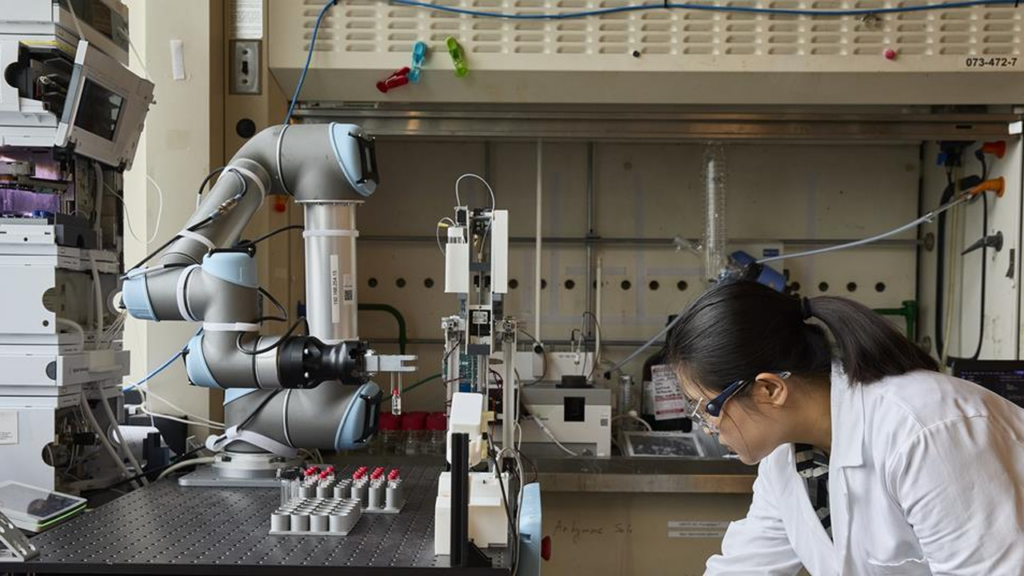
World Economic Forum Proposes AI-Driven Self-Driving Labs to Accelerate Materials Discovery from Years to Months for Climate Solutions
The World Economic Forum Switzerland Overview The World Economic Forum advocates for the adoption of AI-driven 'closed-loop learning systems' and 'self-driving labs' to drastically accelerate materials innovation for climate change solut... -
Quantum Computing Halves Qubit Needs for Crystalline Materials Simulation with Novel Symmetry-Adapted Encoding, Reducing Qubits by 4-8
Quantum Zeitgeist UK Overview Researchers at the London Centre for Nanotechnology have developed a periodic symmetry-adapted encoding framework that significantly reduces the number of qubits required for quantum simulations of crystalli... -
Hugging Face Papers Unveil Electronic Density Generative Framework Combining 3D Convolutional Autoencoders and Latent Diffusion Models
Hugging Face International Overview A generative framework for learning electronic density's latent space dynamics has been introduced in Hugging Face's paper collection. This framework combines 3D convolutional autoencoders with latent ... -
Chalmers University Leverages Physics-Informed AI to Drastically Accelerate Quantum Optical Component Development
SciTechDaily スウェーデン Overview Researchers at Chalmers University of Technology in Sweden have developed a novel "physics-informed AI" approach that directly embeds fundamental physical laws into neural networks, significantly boosti... -
UniFFBench Evaluates Universal Machine Learning Force Fields (UMLFFs) Against Experimental Measurements, Assessing Simulation Stability, Structural Fidelity, and Elastic Properties
arXiv International Overview A new benchmark framework, UniFFBench, has been released to evaluate Universal Machine Learning Force Fields (UMLFFs) against experimental measurements for diverse mineral systems. UniFFBench rigorously asses... -
Unconstrained MLIPs Scaled to Large Datasets Outperform Constrained Models in Static Simulations for Accuracy and Speed
ResearchGate International Overview Unconstrained Machine Learning Interatomic Potentials (MLIPs), scaled to large datasets, have demonstrated superior performance in both accuracy and speed for static simulation workflows like geometric... -
Chemistry World Reports AI Agents and MLIPs Accelerating Catalyst Discovery from Simulation to Scale-Up
Chemistry World UK Overview Chemistry World reported on the forefront of AI agents and Machine Learning Interatomic Potentials (MLIPs) accelerating the catalyst discovery process from simulation to scale-up. MLIPs replace computationally... -
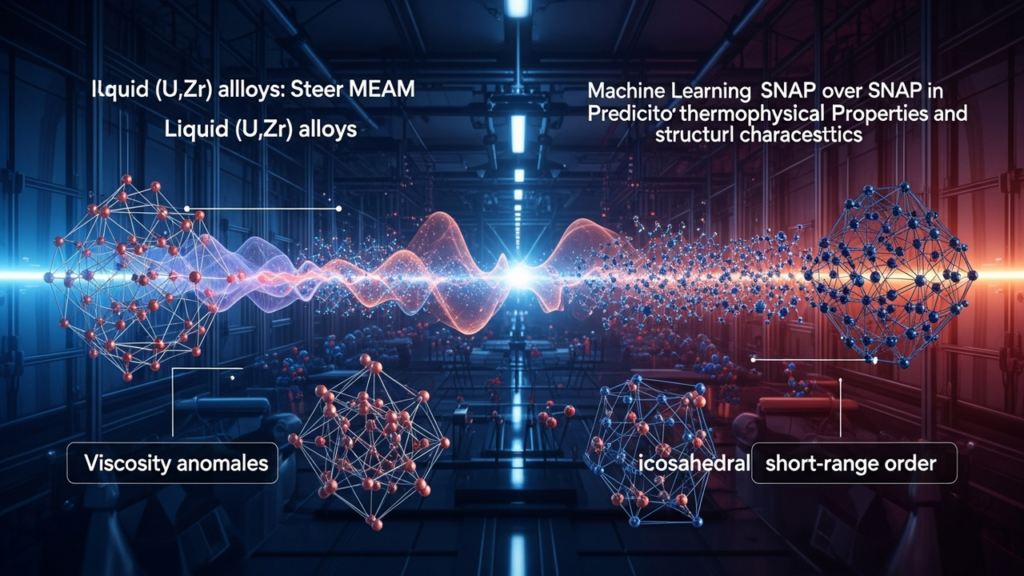
ML SNAP Outperforms MEAM in Liquid (U,Zr) Thermophysical and Structural Predictions, Unveiling Viscosity Anomalies and Icosahedral Short-Range Order
PubMed International Overview In predicting the thermophysical and structural properties of liquid Uranium-Zirconium (U,Zr) mixtures, the machine learning-based Spectral Neighbor Analysis Potential (SNAP) demonstrated superior predictive... -
Virial-Matching in ML Coarse-Grained Potential for Multilayer hBN Addresses Mesoscale Problems in 2D Materials
The Journal of Physical Chemistry C - ACS Publications International Overview A bottom-up virial-matching coarse-graining method, based on machine learning potentials, has been developed for multi-component 2D materials like multilayer h... -
MLIPs Tackle Electronic Entropy Challenge: Charge State Embedding Boosts Battery Material Prediction Accuracy
arXiv International Overview Traditional Machine Learning Interatomic Potentials (MLIPs) have struggled to capture electronic entropy in mixed-valence materials, leading to prediction inaccuracies. To address this, a new approach embeds ...