Key Findings
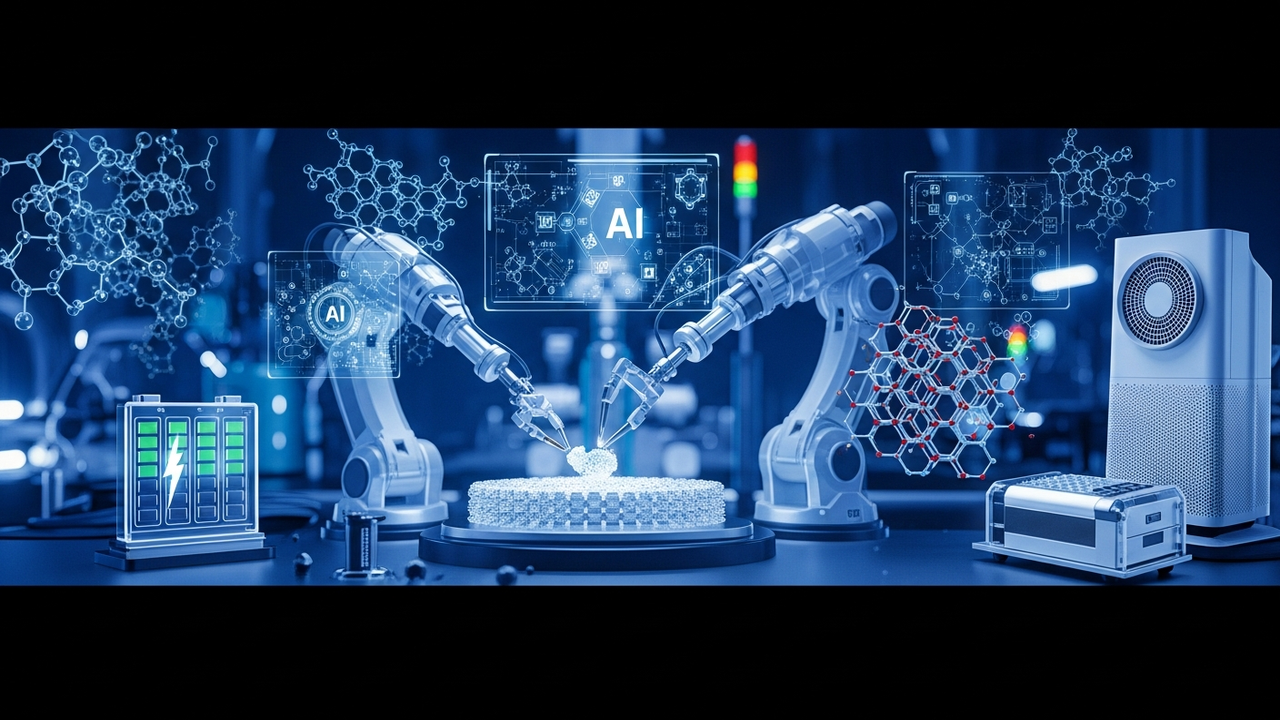
The integration of artificial intelligence (AI) into advanced materials manufacturing is reported to be driving unprecedented and transformative progress in the fields of energy storage, catalysis, and environmental applications. Specifically, machine learning (ML) technologies are dramatically accelerating the process of catalyst discovery and have successfully reduced the reliance on computationally intensive Density Functional Theory (DFT) simulations. This AI-driven approach enhances the optimization of critical electrocatalytic processes, such as hydrogen generation and CO2 conversion, thereby robustly advancing the development of clean energy technologies for a sustainable society.
Technical / Clinical Details
AI-integrated manufacturing is applied across the entire lifecycle of materials, from design to synthesis, characterization, and final optimization. Specifically, machine learning algorithms extract patterns from vast materials databases and quantum chemistry calculation results to predict novel material candidates likely to possess specific functionalities (e.g., high catalytic activity, durability, selectivity). This predictive capability allows researchers to identify promising material compositions and structures far more efficiently than traditional trial-and-error methods. For instance, in electrocatalyst development, AI explores the compositional space of multi-element alloys, proposing optimal active site structures for oxygen reduction reaction (ORR), hydrogen evolution reaction (HER), and CO2 reduction reaction (CO2RR). This accelerates the reduction of noble metal catalyst usage and the development of cheaper, higher-performance non-noble metal catalysts. Furthermore, AI plays a role in optimizing synthesis process conditions (e.g., temperature, pressure, reaction time) to improve the yield and quality of products with desired material properties.
Background & Context
Amidst rising global energy demand and growing concerns about climate change, the generation and storage of clean energy, as well as the reduction of environmental impact, are urgent challenges. High-performance advanced materials such as catalysts, batteries, and adsorbents are indispensable for addressing these issues. However, traditional materials development has faced significant constraints in terms of time, cost, and resources. Discovering catalysts that drive complex chemical reactions and designing new energy storage materials have been particularly challenging. Integrating AI into the material manufacturing process represents a paradigm shift that breaks through these bottlenecks, significantly shortens the R&D cycle, and enables more rapid technological commercialization. This delivers a crucial competitive advantage vital for achieving international energy security and environmental goals.
Strategic Significance & Outlook
AI-integrated manufacturing is poised to expand its applications further, potentially evolving into fully autonomous material discovery and synthesis systems in the future. Researchers aim to combine AI’s predictive capabilities with automated experimental robotics to construct closed-loop systems that explore and optimize new materials with minimal human intervention. The progression of this technology will enable more sustainable and efficient material development, accelerating innovation in next-generation clean energy technologies, environmental remediation solutions, and other advanced application fields. This is expected to contribute significantly to overall societal sustainability and economic growth.
Source: https://www.frontiersin.org/journals/chemistry/articles/10.3389/fchem.2026.1864044/full
Get our weekly technology intelligence — free
Receive an infographic that lets you judge at a glance whether each field’s analysis report is worth reading.
Subscribe Free — Weekly Tech Intelligence
By subscribing, you’ll receive Troy-Technical’s weekly technology intelligence newsletter.
- Your email and selected fields are used only to deliver the newsletter.
- We never share your information with third parties.
- You can unsubscribe anytime via the link in each email.
See our Privacy Policy for details.
Takes about a minute · Unsubscribe anytime









Comments