Background
Flexible perovskite solar cells hold immense potential for a wide range of emerging applications, including building-integrated photovoltaics (BIPV), wearable devices, and portable power sources. In these applications, lightweight, flexibility, and low-cost manufacturing are essential. The roll-to-roll (R2R) manufacturing process is an ideal method to meet these requirements, but the development of environmentally benign solvent systems has been a critical bottleneck. This research directly addresses this challenge, providing a manufacturing pathway for perovskite solar cells that can be safely deployed even in regions with stringent environmental regulations.
Technical Breakthrough
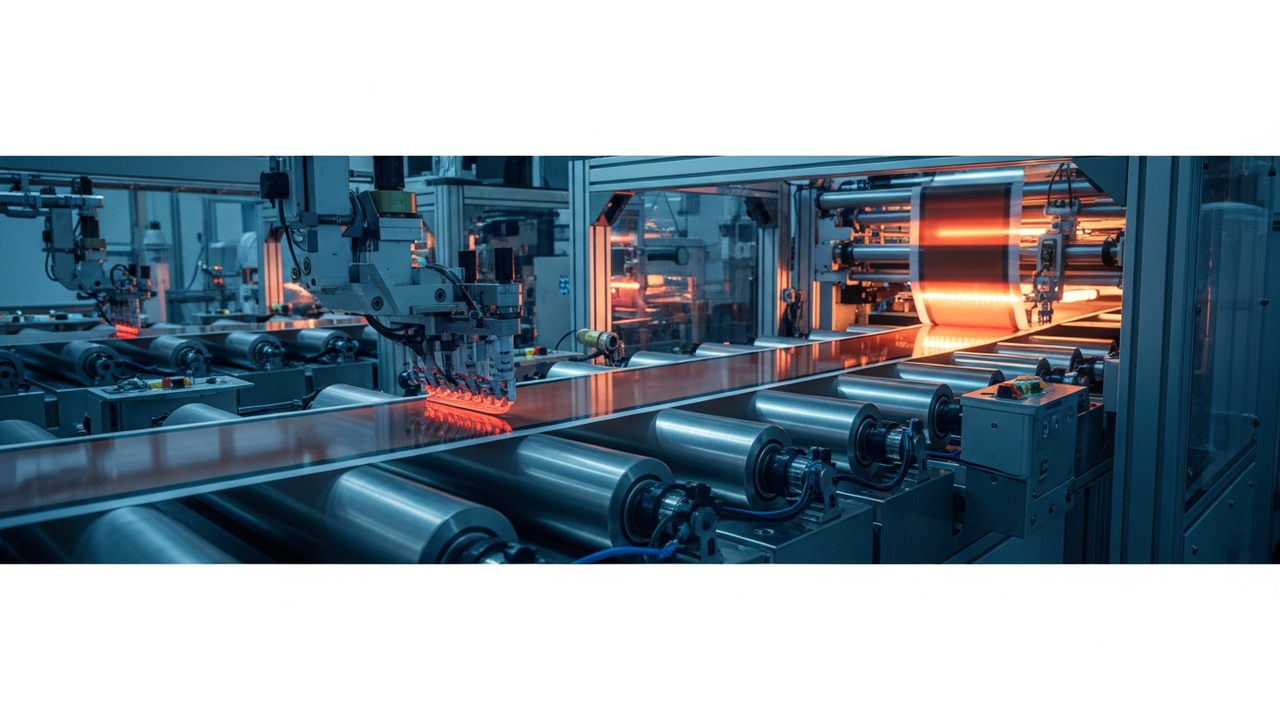
This study reports the successful development of an environmentally friendly roll-to-roll (R2R) manufacturing process for flexible perovskite solar cells, utilizing novel DMF-free cosolvent inks. This innovative process completely eliminates the use of N,N-dimethylformamide (DMF), a hazardous solvent, thereby offering a significantly more sustainable and commercially scalable method for solar cell production.
Historically, the fabrication of perovskite solar cells, particularly solution-based processes, has extensively relied on highly toxic organic solvents like DMF. However, escalating concerns regarding DMF’s environmental and human health impacts have made the development of alternative solvents an urgent priority. The research team successfully developed a DMF-free cosolvent ink system, specifically mixtures of dimethyl sulfoxide (DMSO) and acetonitrile (ACN), and integrated it into an R2R slot-die coating process. In this process, the morphology and crystallization characteristics of both the precursor lead iodide (PbI₂) films and the final perovskite films were meticulously evaluated and optimized across various DMSO:ACN ratios. Slot-die coating, renowned for its capability in large-area and high-speed deposition, when combined with R2R manufacturing, enables the low-cost mass production of flexible solar cells. This technology represents a significant milestone for the industrialization of perovskite solar cells, as it drastically reduces environmental impact while maintaining high efficiency.
Strategic Significance and Outlook
The development of a DMF-free R2R manufacturing process will significantly accelerate the commercialization of flexible perovskite solar cells. This technology not only promises to reduce manufacturing costs and improve production throughput but also enhances workplace safety and minimizes the overall environmental footprint. Moving forward, the research team is poised to further optimize the developed inks and processes, enhance device long-term stability and efficiency, and explore applicability to larger-scale production lines. This eco-friendly manufacturing technology is anticipated to promote the widespread adoption of perovskite solar cells, firmly establishing their position as an indispensable clean energy solution for achieving a sustainable society.
Get our weekly technology intelligence — free
Receive an infographic that lets you judge at a glance whether each field’s analysis report is worth reading.
Subscribe Free — Weekly Tech Intelligence
By subscribing, you’ll receive Troy-Technical’s weekly technology intelligence newsletter.
- Your email and selected fields are used only to deliver the newsletter.
- We never share your information with third parties.
- You can unsubscribe anytime via the link in each email.
See our Privacy Policy for details.
Takes about a minute · Unsubscribe anytime






Comments