Background
Perovskite/silicon tandem solar cells are gaining attention as the next frontier in photovoltaics because their theoretical efficiency significantly exceeds the current limits of commercial silicon solar cells. However, ensuring interfacial stability between the two materials has been one of the primary challenges for their commercialization. Specifically, long-term chemical stability and the suppression of ion diffusion between the perovskite layer and the charge transport layer are crucial for determining device lifetime. The all-ALD method, capable of atomic-level control over film thickness and composition, is an ideal technique for forming high-quality interface layers, and this research has maximized its potential.
Key Findings
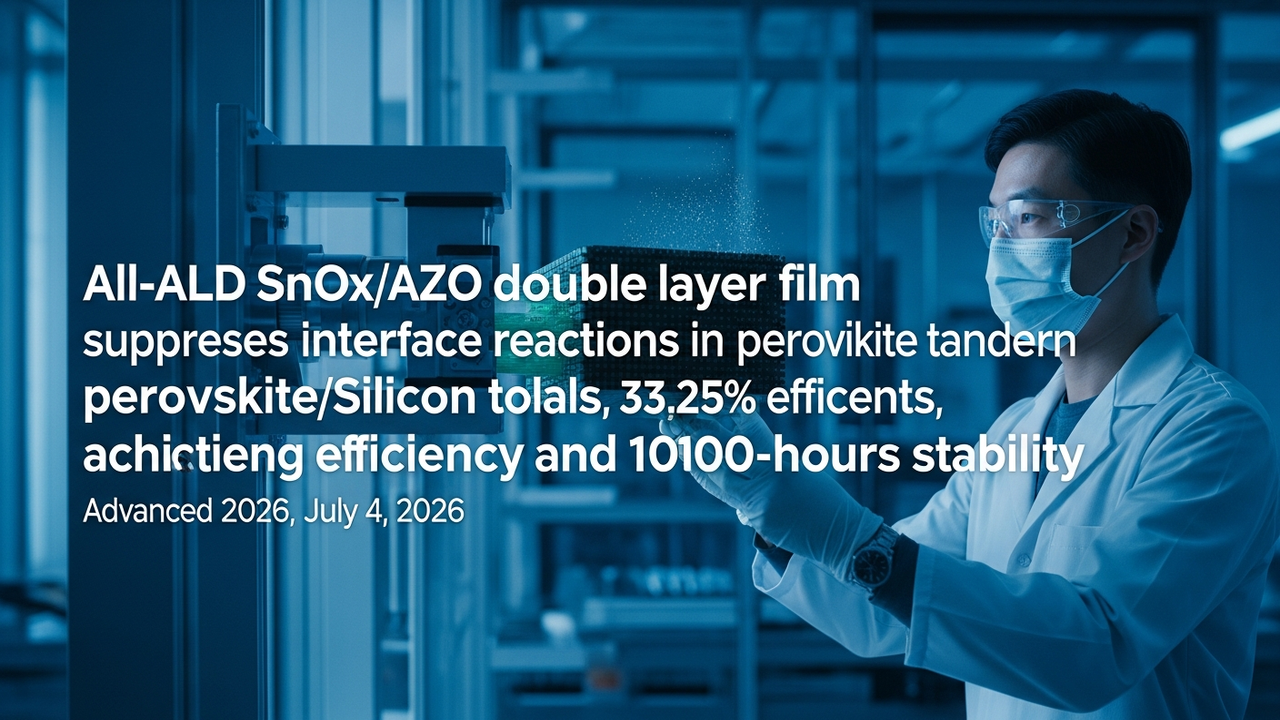
This research reports that an all-atomic layer deposition (ALD) SnOx/AZO bilayer effectively suppresses interfacial reactions in perovskite/silicon tandem solar cells, achieving an impressive power conversion efficiency of 33.25%. With this innovative interfacial design, devices also demonstrated excellent long-term stability, maintaining over 96% of their initial efficiency after 1000 hours of continuous illumination. This achievement represents a significant advancement towards the practical implementation of high-efficiency, highly stable tandem solar cells.
Technical Details
In perovskite/silicon tandem solar cells, the chemical and electrical interactions at the interface between the perovskite and silicon layers significantly impact device performance and stability. Interfacial reactions, in particular, can lead to defect generation and ion diffusion, causing efficiency degradation and device failure. The research team employed the precise thin-film deposition technique of all-ALD to develop a bilayer consisting of SnOx and AZO (aluminum-doped zinc oxide). This bilayer is functionally segregated and optimized as follows:
- SnOx Layer: Ensures good energy band alignment with the perovskite layer, promoting efficient charge carrier separation and transport.
- AZO Layer: Provides a robust barrier against ion diffusion due to its dense structure, while also offering a low-resistance electrical pathway to minimize charge losses.
The wide-bandgap perovskite top cell, incorporating this functionally segregated bilayer, achieved an efficiency of 23.47% on its own. When integrated into a monolithic perovskite/silicon tandem cell, the power conversion efficiency increased to 33.25%. Furthermore, this interface layer demonstrated remarkably high operational stability, maintaining over 96% efficiency after 1000 hours of continuous light illumination, thereby ensuring reliability under harsh environmental conditions.
Strategic Significance and Outlook
The achieved high efficiency of 33.25% and stability of over 96% after 1000 hours significantly enhance the prospects for perovskite/silicon tandem solar cells to be applied in commercial power generation. This all-ALD SnOx/AZO bilayer technology will substantially improve device reliability and lifetime, contributing to reduced construction costs for large-scale solar farms and increased long-term power generation. Moving forward, the research team is expected to further optimize this interface engineering approach, pursue large-area fabrication, scale up manufacturing processes, and conduct long-term field tests under various environmental conditions. This breakthrough is poised to accelerate the evolution of solar power technology and become a powerful component in driving the global clean energy transition.
Get our weekly technology intelligence — free
Receive an infographic that lets you judge at a glance whether each field’s analysis report is worth reading.
Subscribe Free — Weekly Tech Intelligence
By subscribing, you’ll receive Troy-Technical’s weekly technology intelligence newsletter.
- Your email and selected fields are used only to deliver the newsletter.
- We never share your information with third parties.
- You can unsubscribe anytime via the link in each email.
See our Privacy Policy for details.
Takes about a minute · Unsubscribe anytime









Comments