Key Findings
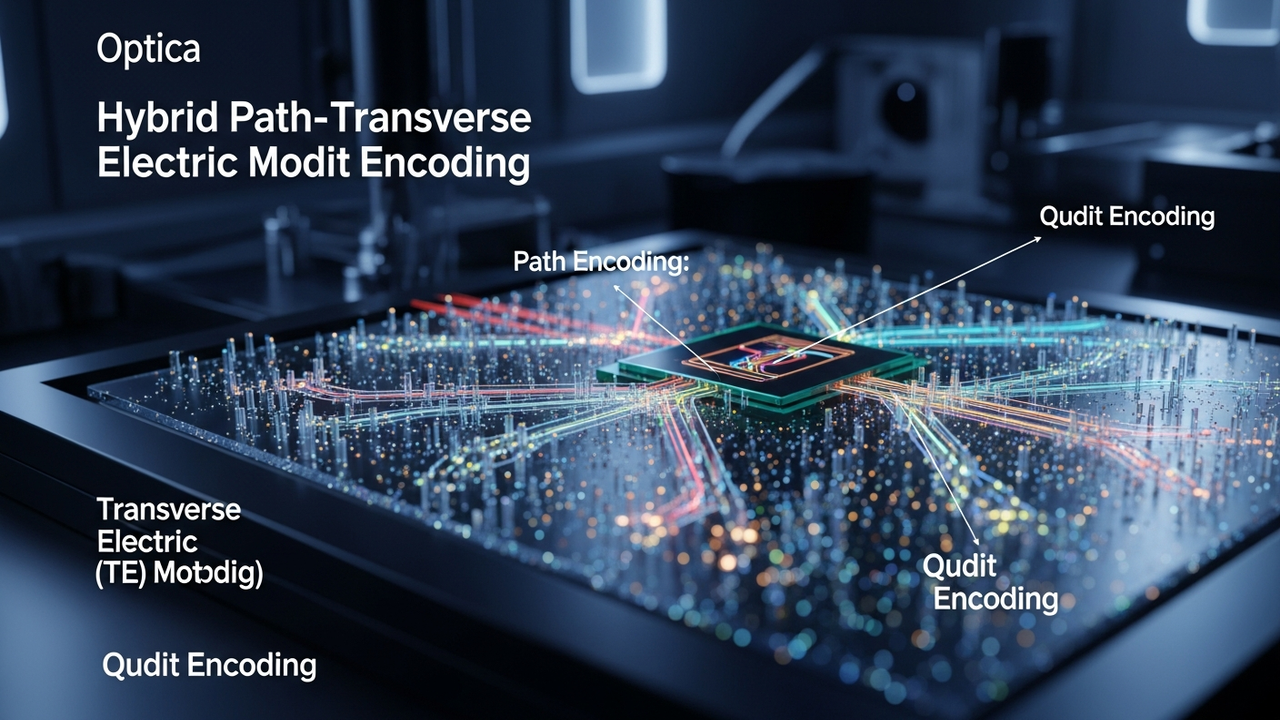
A groundbreaking paper published by Optica Publishing Group successfully demonstrated hybrid path-transverse electric mode qudit encoding on an integrated photonic chip. This achievement marks a significant step towards making quantum technology more scalable and underscores the inherent advantages of integrated photonics, which allows for the fabrication of quantum devices using existing CMOS foundry processes.
Technical Details
While traditional quantum computing primarily utilizes two-level qubits, qudits leverage three or more quantum levels to encode more information into a single quantum unit. The hybrid path-transverse electric mode qudit encoding demonstrated in this research represents multi-level quantum information by combining different physical degrees of freedom of a photon (its path and transverse electric mode). This approach is built on an integrated photonic chip, utilizing standard CMOS-compatible processes, such as the silicon-on-insulator (SOI) platform. Integrated photonics enables the high-density integration of optical components like waveguides, beam splitters, and phase shifters on a millimeter-scale chip, achieving system miniaturization, enhanced stability, and mass producibility. The success of this encoding method indicates that qudit states can be generated and manipulated with high fidelity using individual photons. This promises to deliver higher computational power with the same physical resources, offering a promising solution to quantum computer scalability challenges.
Background & Context
One of the biggest challenges towards the practical realization of quantum computing is the stable generation, manipulation, and interconnection of a large number of qubits. Specifically, ‘scaling’ the number of qubits remains a significant technological bottleneck. Integrated photonics, as a platform that uses photons as qubits, offers substantial advantages: operation in low-noise environments, potential for room-temperature operation, and compatibility with existing semiconductor manufacturing technologies. For these reasons, it is considered a leading candidate for building large-scale quantum processors. Qudit encoding, by increasing the amount of information per quantum unit, can potentially utilize quantum hardware resources more efficiently and reduce the number of physical qubits required for implementing complex quantum algorithms.
Strategic Significance & Outlook
The success of this hybrid qudit encoding holds significant implications for the advancement of integrated photonics-based quantum computing. Further increases in the number of qudits and refinement of interaction control technologies are expected to contribute to the realization of more powerful and versatile quantum processors. This technology has the potential to deliver high-performance enhancements in quantum communication, quantum sensing, and quantum machine learning that are unattainable with existing systems. Its manufacturability using CMOS-compatible processes provides a realistic pathway toward eventual commercialization and widespread adoption.
Source: https://opg.optica.org/opticaq/abstract.cfm?uri=opticaq-4-4-321
Get our weekly technology intelligence — free
Receive an infographic that lets you judge at a glance whether each field’s analysis report is worth reading.
Subscribe Free — Weekly Tech Intelligence
By subscribing, you’ll receive Troy-Technical’s weekly technology intelligence newsletter.
- Your email and selected fields are used only to deliver the newsletter.
- We never share your information with third parties.
- You can unsubscribe anytime via the link in each email.
See our Privacy Policy for details.
Takes about a minute · Unsubscribe anytime









Comments