Key Findings
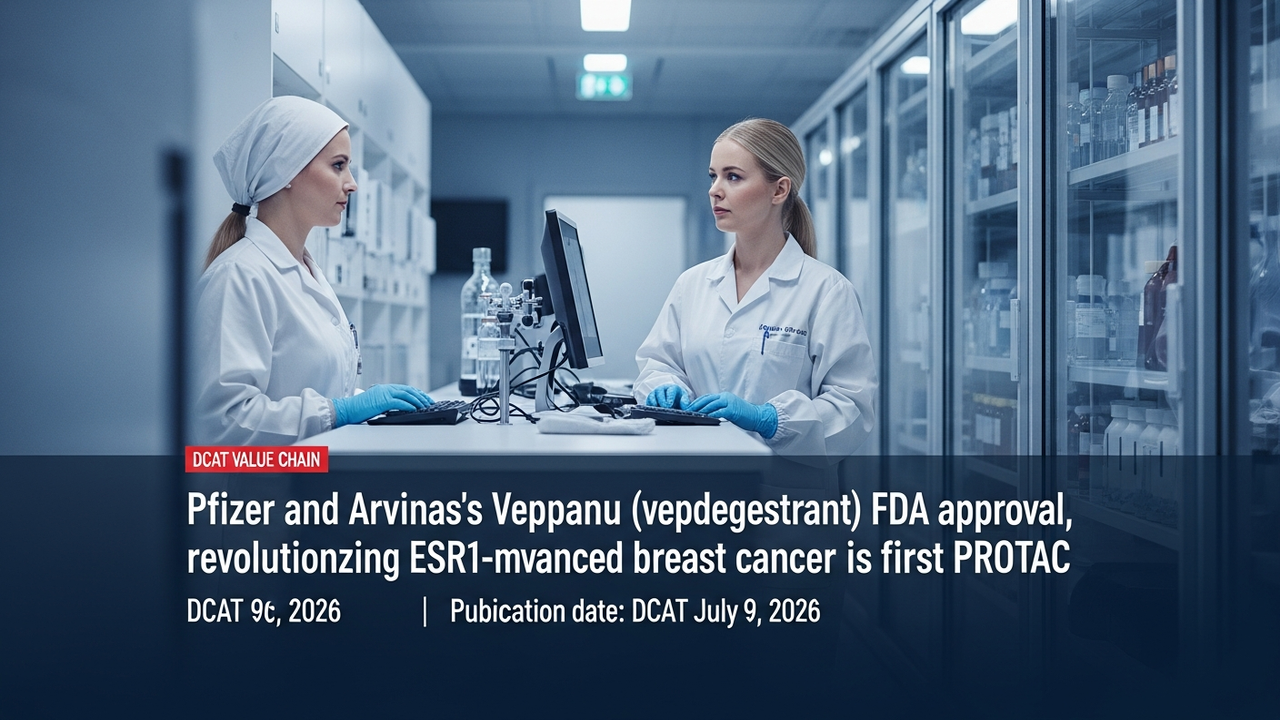
In 2026, Veppanu (vepdegestrant), co-developed by Pfizer and Arvinas, secured U.S. Food and Drug Administration (FDA) approval for the treatment of advanced breast cancer characterized by ESR1 mutations. This approval is profoundly significant as Veppanu is the first proteolysis-targeting chimera (PROTAC) drug to gain FDA clearance, introducing a novel mechanism of action for managing challenging breast cancers that have developed resistance to conventional treatments.
Technical & Clinical Details
Vepdegestrant is a PROTAC molecule engineered to induce the degradation of the estrogen receptor (ER). ESR1 gene mutations are a primary mechanism causing resistance to existing endocrine therapies. Vepdegestrant effectively overcomes this resistance by inducing the proteolytic degradation of both wild-type and mutated ER. PROTACs represent a new class of therapeutics that leverage the cell’s ubiquitin-proteasome system to specifically eliminate target proteins. Unlike traditional inhibitors that merely block protein function, PROTACs achieve potent and sustained pharmacological effects by completely removing the target protein. Clinical trials demonstrated improved objective response rates and progression-free survival in patients with ESR1-mutated advanced breast cancer who had developed resistance to prior treatments, alongside a manageable safety profile.
Background & Context
Patients with advanced breast cancer, particularly those with ESR1 mutations, often face limited treatment options due to high rates of resistance to hormone therapy. In this context, Veppanu’s approval unequivocally validates the ability of PROTAC technology to generate clinically effective drugs, signifying a major leap forward in pharmaceutical science. This not only demonstrates the commercial viability of PROTACs but also is expected to accelerate research and development efforts into TPD approaches for numerous other intractable diseases.
Strategic Significance & Outlook
The introduction of Veppanu is anticipated to significantly improve the quality of care for advanced breast cancer patients, especially those with ESR1 mutations. As the inaugural FDA-approved PROTAC, it is expected to have a positive ripple effect across the entire pipeline of targeted protein degraders, including other PROTACs and molecular glue degraders, potentially opening new therapeutic frontiers. In the future, this technology holds promise for broad application across various disease areas, including other cancers and neurodegenerative disorders, further expanding the boundaries of drug discovery.
Source: https://www.dcatvci.org/features/mid-year-review-whats-trending-in-new-drug-approvals/
Get our weekly technology intelligence — free
Receive an infographic that lets you judge at a glance whether each field’s analysis report is worth reading.
Subscribe Free — Weekly Tech Intelligence
By subscribing, you’ll receive Troy-Technical’s weekly technology intelligence newsletter.
- Your email and selected fields are used only to deliver the newsletter.
- We never share your information with third parties.
- You can unsubscribe anytime via the link in each email.
See our Privacy Policy for details.
Takes about a minute · Unsubscribe anytime








Comments