Key Findings
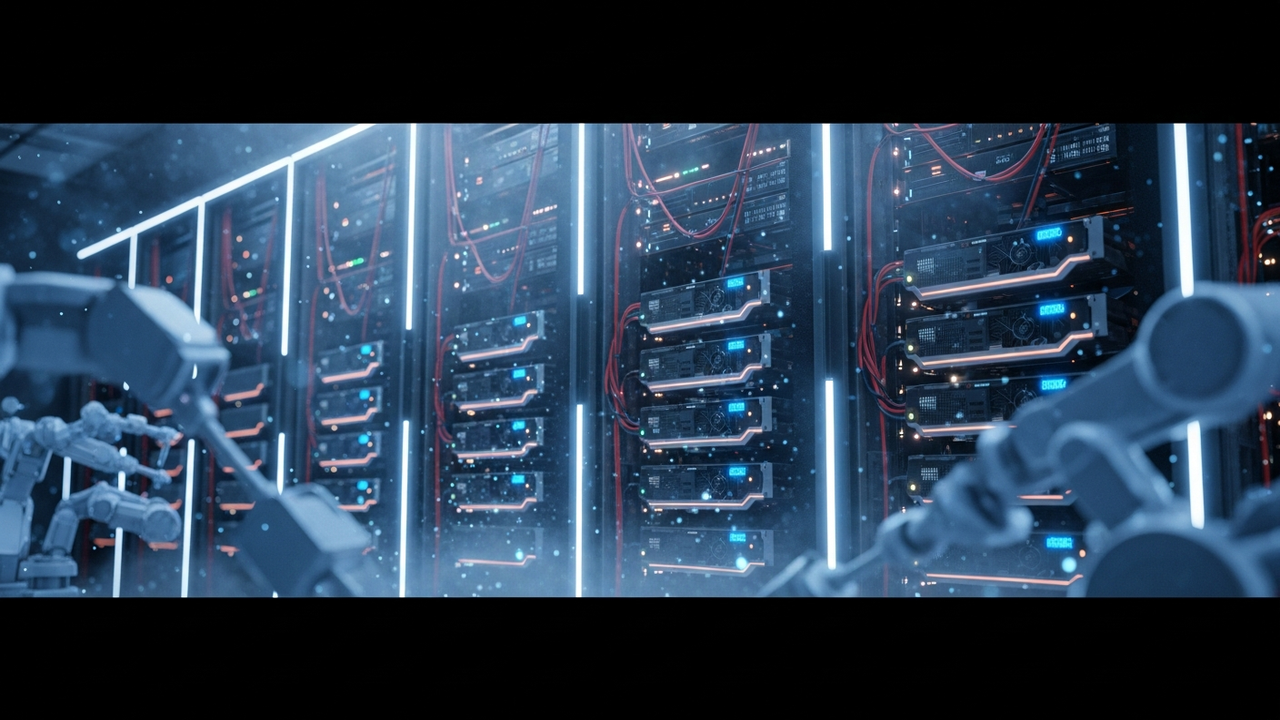
The computational costs associated with AI development for robotics are surpassing those of large language models (LLMs), presenting a significant challenge. Specifically, while world foundation models enable robots to learn from scenarios never physically encountered by adding a computational layer for synthetic trajectory generation on top of physical simulations, this process consumes immense GPU time and resources.
Technical Details
Physical AI computing, particularly the development of AI systems for robots operating in the physical world, is an extremely computationally intensive process. Key technical aspects and challenges include:
- High-Load Real-World Learning: Even basic actions like teaching a robot to walk on uneven terrain can take hours to days on a single compute node. This is due to the complexity of physical interactions and the time-consuming nature of trial-and-error processes.
- Computational Cost of World Foundation Models: While world foundation models offer robots the ability to learn safely in simulation without physical risks, this requires a second computational layer atop physical simulation to generate photorealistic synthetic trajectories. This layer demands computational resources comparable to, or even exceeding, those needed for LLM training and inference.
- Efficiency and Cost of Synthetic Data Generation: NVIDIA reported generating 780,000 synthetic trajectories in just 11 hours, an amount equivalent to approximately 6,500 hours or nine months of human demonstration data. While this generation speed is remarkable, it requires extensive GPU time, which constitutes the majority of the actual cost in robot development. Unlike LLM development, robotics incurs unique computational costs for building simulation environments and generating synthetic data.
- Physical Constraints: Robots operate under physical laws, and AI models must rigorously account for these laws. This introduces a fundamental complexity distinct from LLMs, which primarily learn from purely digital data.
Background & Context
The evolution of AI technology has been prominently showcased by the success of large language models (LLMs), but the field of robotics faces the distinct challenge of interaction with the physical world. For robots to autonomously perform complex tasks, they need the ability to understand their environment, plan actions, execute them, and learn from the outcomes. However, real-world robot data collection has been expensive, dangerous, and difficult to scale. World foundation models and synthetic data generation offer promising approaches to overcome these challenges and accelerate robot learning, but optimizing the associated computational costs remains a major bottleneck for the widespread adoption of robot AI.
Strategic Significance & Outlook
Reducing the computational costs of robot AI is an indispensable challenge for the widespread adoption of this technology. Going forward, key strategies will include developing more efficient simulation technologies, optimizing synthetic data generation algorithms, and advancing specialized AI hardware (such as NPUs). Improving the accuracy of sim-to-real transfer learning is also crucial for reducing real-world training time and costs. In the long term, the emergence of lower-cost, high-performance GPUs and robot-specific processors is expected to increase the accessibility of robot AI development, accelerating the deployment of robots in manufacturing, logistics, healthcare, and homes. Physical AI computing is the next frontier for AI, and solving its computational efficiency challenges will be the greatest step towards realizing truly general-purpose robots.
Source: https://axecompute.com/physical-ai-compute-stack/
Get our weekly technology intelligence — free
Receive an infographic that lets you judge at a glance whether each field’s analysis report is worth reading.
Subscribe Free — Weekly Tech Intelligence
By subscribing, you’ll receive Troy-Technical’s weekly technology intelligence newsletter.
- Your email and selected fields are used only to deliver the newsletter.
- We never share your information with third parties.
- You can unsubscribe anytime via the link in each email.
See our Privacy Policy for details.
Takes about a minute · Unsubscribe anytime







Comments