Key Findings
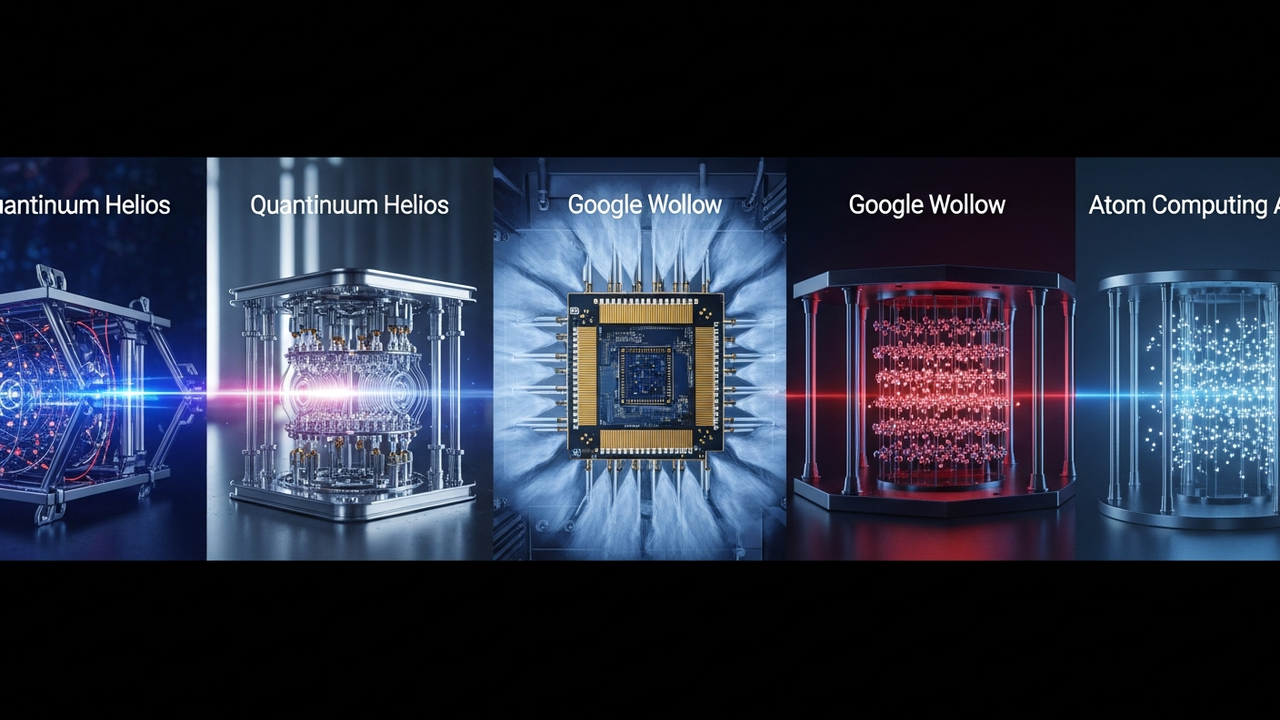
According to an analysis by New Market Pitch, the current landscape of quantum computing is dominated by several key players, each showcasing unique strengths. Quantinuum’s Helios stands out with 98 fully connected trapped barium-ion qubits, renowned for its extremely high average two-qubit fidelity, enabling precise quantum operations. Google’s Willow, a 105-qubit superconducting chip, is noted for its faster gates and its ability to execute verifiable beyond-classical algorithms. Meanwhile, Atom Computing’s AC1000, featuring over 1,200 programmable physical qubits, positions neutral-atom systems as offering a more straightforward path to implementing large-scale error-correcting codes.
Technical Details
- Quantinuum Helios (Trapped-Ion): Helios features 98 trapped barium-ion qubits with all-to-all connectivity and industry-leading gate fidelities, often exceeding 99.99%. This high precision allows for the execution of complex quantum algorithms with fewer errors, making it particularly effective for quantum chemistry simulations and optimization problems.
- Google Willow (Superconducting): The 105-qubit superconducting Willow chip has demonstrated fast gate operations and, crucially, operation below the quantum error correction threshold. This means that by adding physical qubits, the reliability of logical qubits can be enhanced, enabling tasks that exhibit “quantum advantage” beyond the capabilities of classical supercomputers.
- Atom Computing AC1000 (Neutral Atom): The AC1000 is a neutral-atom system equipped with over 1,200 programmable physical qubits. Neutral-atom platforms are characterized by long coherence times and optical control, which facilitates the creation of large qubit arrays and provides a promising route for efficiently implementing robust error correction codes.
Background & Context
The quantum computing development race is highly competitive, with various companies investing in different physical qubit technologies. Superconducting, trapped-ion, and neutral-atom qubits each possess distinct advantages and challenges, offering unique benefits for specific types of computations and future scaling paths. The industry’s focus has evolved from a pure competition of qubit counts to emphasizing error tolerance, gate fidelity, and the applicability to practical use cases. The advancements of these leading platforms serve as critical indicators for the commercial viability of quantum computing.
Strategic Significance & Outlook
Each quantum computer is leveraging its technological advantages to target specific industrial applications. Quantinuum focuses on high-precision calculations, Google on error correction and quantum advantage demonstrations, and Atom Computing on large-scale scalability. The competition among these platforms is expected to intensify, driven by further advancements in error correction techniques and the development of more efficient quantum algorithms. Ultimately, these breakthroughs will determine the value quantum computing can deliver across diverse sectors such as materials science, pharmaceuticals, finance, and AI, reshaping computational capabilities worldwide.
Source: https://newmarketpitch.com/blogs/news/quantum-computing-best-quantum-computer
Get our weekly technology intelligence — free
Receive an infographic that lets you judge at a glance whether each field’s analysis report is worth reading.
Subscribe Free — Weekly Tech Intelligence
By subscribing, you’ll receive Troy-Technical’s weekly technology intelligence newsletter.
- Your email and selected fields are used only to deliver the newsletter.
- We never share your information with third parties.
- You can unsubscribe anytime via the link in each email.
See our Privacy Policy for details.
Takes about a minute · Unsubscribe anytime









Comments