Key Findings
The 2026 Kavli Prize in Nanoscience has been bestowed upon Professor Eva Y. Andrei, Professor Pablo Jarillo-Herrero, and Professor Allan H. MacDonald for their groundbreaking research in ‘twistronics’—a phenomenon where slightly twisting graphene layers dramatically alters their electronic properties. Their pioneering discoveries have ushered in a new paradigm for understanding and designing quantum materials, opening avenues to engineer novel quantum states by precisely manipulating the twist angles between atomic layers.
Technical / Clinical Details
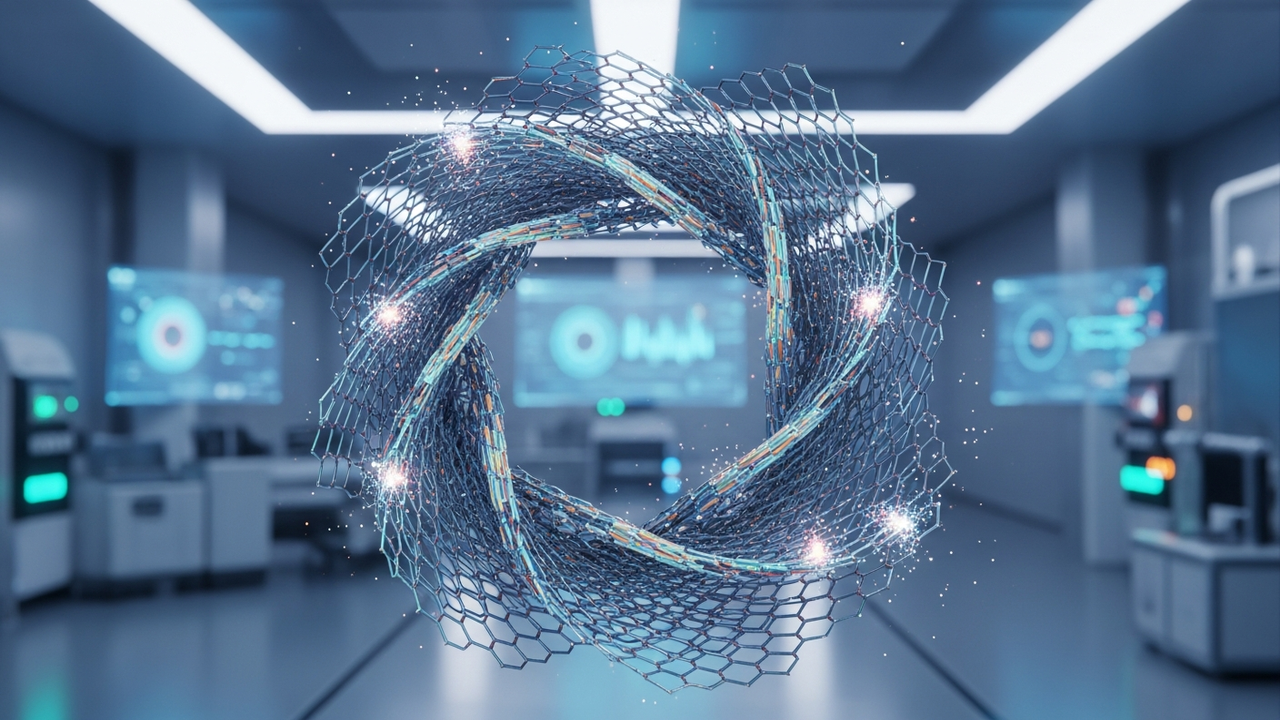
‘Twistronics’ refers to the phenomenon where the electronic properties of two or more atomically thin materials (particularly graphene) stacked at a slight twist angle relative to each other undergo dramatic changes depending on that twist angle. This field began with the discovery by Prof. Jarillo-Herrero and his team that twisting two layers of graphene at a specific ‘magic angle’ (approximately 1.1 degrees) could induce strongly correlated electron phenomena, such as superconductivity and Mott insulating states, near room temperature. This finding demonstrated that entirely new physical properties, unattainable through simple material stacking, could be harnessed, sending shockwaves through the materials science community.
Professor Andrei made crucial contributions by directly observing the electronic structure of twisted graphene layers using scanning tunneling microscopy (STM), experimentally confirming the theoretically predicted ‘moiré superlattice’ structure and electronic states. Professor MacDonald established the theoretical framework for the electronic structure and strongly correlated electron phenomena in twisted bilayer graphene, elucidating the mechanism of superconductivity emergence at the magic angle. Their research has also opened the path to extending the concept of twistronics to other two-dimensional materials, such as Transition Metal Dichalcogenides (TMDs).
The core of this technology lies in the ability to ‘engineer’ the quantum states of electrons by precisely controlling the atomic arrangement at the nanoscale. This makes it possible to artificially design and induce exotic quantum properties like superconductivity, ferromagnetism, and topological insulators, which were previously impossible through conventional material synthesis or structural modification. For instance, magic-angle graphene provides a new platform for exploring the possibility of room-temperature superconductivity through strong electron interactions.
Background & Context
Quantum materials science is one of the most active research areas in physics and materials science, holding the potential to form the basis of next-generation electronic devices, quantum computing, and energy technologies. Graphene has been lauded as a ‘wonder material’ due to its exceptional electrical and mechanical properties. However, the discovery of twistronics transcends the limitations of this simple two-dimensional material, offering a new design principle for creating novel functional materials. The development of this field has attracted significant investment and interest from research institutions and high-tech companies worldwide, serving as a classic example of how fundamental scientific breakthroughs can rapidly lead to technological innovation.
Strategic Significance & Outlook
The research by the Kavli Nanoscience Prize laureates has had an immeasurable impact on the field of twistronics, and its exploration is expected to deepen further. In the future, research will likely advance in elucidating twistronic effects in more complex multilayer structures and heterostructures combining different types of two-dimensional materials. This could solidify the path towards achieving room-temperature superconductors, highly efficient quantum devices, or new quantum computing architectures. Advances in precise atomic layer control technologies, such as Atomic Layer Deposition (ALD) and Molecular Beam Epitaxy (MBE), will also accelerate the high-quality fabrication and large-scale application of twistronic materials. The development of this field is expected to push the boundaries of fundamental science while simultaneously opening new frontiers for future technological innovation, serving as a powerful driving force for research and development over the coming decades.
Get our weekly technology intelligence — free
Receive an infographic that lets you judge at a glance whether each field’s analysis report is worth reading.
Subscribe Free — Weekly Tech Intelligence
By subscribing, you’ll receive Troy-Technical’s weekly technology intelligence newsletter.
- Your email and selected fields are used only to deliver the newsletter.
- We never share your information with third parties.
- You can unsubscribe anytime via the link in each email.
See our Privacy Policy for details.
Takes about a minute · Unsubscribe anytime