Key Findings
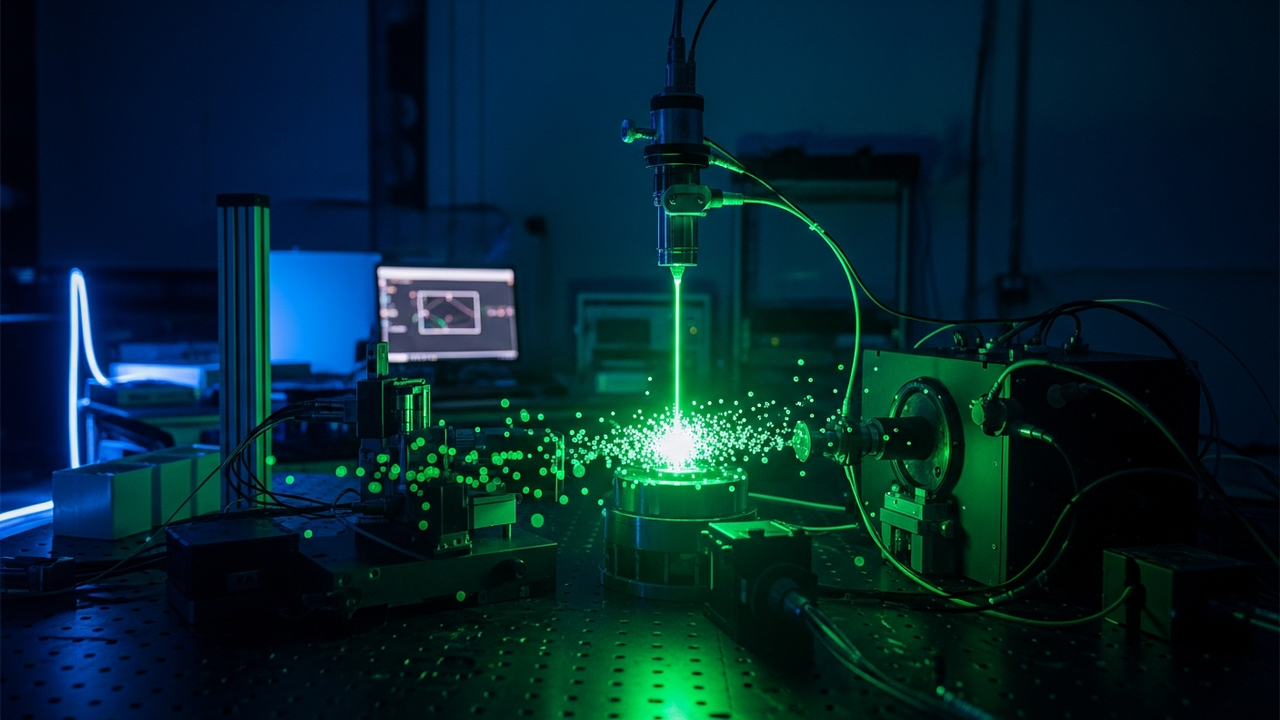
A groundbreaking study published in ‘Nano Letters’ reports the successful creation of high-performance pure-green spin-polarized light-emitting diodes (spin-LEDs) operating at room temperature, achieved through the precise manipulation of structural asymmetry in FAPbBr3 perovskite quantum dots (QDs). This innovative approach leverages chiral perovskite QDs, which integrate high photoluminescence quantum yield with the Chiral-Induced Spin Selectivity (CISS) effect, to efficiently generate spin-polarized carriers for the radiative recombination process.
Technical / Clinical Details
The core of this research lies in the technique for controlling the nanoscale structural asymmetry of FAPbBr3 quantum dots. FAPbBr3 (formamidinium lead bromide) is a type of perovskite material known for its excellent optical properties, and its quantum dot form allows for tunable emission spectra. The research team induced chiral structural asymmetry throughout the quantum dots by modifying their surfaces with chiral organic ligands. This chiral structure gives rise to the CISS effect, where electrons traversing the quantum dot exhibit different transmission rates depending on their spin orientation.
By combining this CISS effect with the high photoluminescence quantum yield (the ability to efficiently convert light energy into emitted light) of perovskite QDs, a spin-LED was realized that emits highly spin-polarized light during radiative recombination of spin-polarized electrons and holes. Conventional LEDs emit light irrespective of spin state, limiting their application in information processing. Spin-LEDs, however, hold the potential to apply the principles of ‘spintronics,’ which uses electron spin as an information medium, to optoelectronic devices through the polarization state of light.
This pure-green spin-LED has been demonstrated to operate stably at room temperature, which is a significant advancement towards practical application. While specific numerical values for spin polarization are not detailed, the ‘high-performance’ description suggests superior results compared to existing spin-LEDs. This breakthrough promises new advancements in energy-efficient displays, optical communication, and particularly in quantum information technologies utilizing quantum entanglement between qubits.
Background & Context
Spintronics is a next-generation electronics field that utilizes not only the charge but also the spin of electrons as information carriers. It is attracting significant attention for its potential to enable faster and lower-power information processing than conventional electronic devices. Spin-LEDs are one of the core technologies in ‘spin optoelectronics,’ which extends spintronics into the realm of light. Previous research on spin-LEDs has faced challenges, either operating only under extreme conditions like cryogenic temperatures and strong magnetic fields, or exhibiting insufficient performance at room temperature. Overcoming these challenges and achieving high performance at room temperature using FAPbBr3 perovskite QDs represents a crucial step towards realizing a long-standing goal in this field.
Strategic Significance & Outlook
The success of this FAPbBr3 quantum dot-based pure-green spin-LED significantly expands the possibilities for room-temperature spintronic applications. Moving forward, the research team will likely focus on developing spin-LEDs of different colors (red, blue), further improving spin polarization rates, ensuring long-term device stability, and establishing large-scale production techniques. These advancements are expected to accelerate applications in next-generation high-efficiency, high-color-purity displays, spin-based optical communication systems, and quantum information technologies that leverage entanglement between qubits. Ultimately, with dramatic improvements in information processing speed and reductions in energy consumption, this technology holds the potential to become indispensable for realizing a sustainable and intelligent society.
Source: https://pubs.acs.org/doi/10.1021/acs.nanolett.6c01923?goto=supporting-info
Get our weekly technology intelligence — free
Receive an infographic that lets you judge at a glance whether each field’s analysis report is worth reading.
Subscribe Free — Weekly Tech Intelligence
By subscribing, you’ll receive Troy-Technical’s weekly technology intelligence newsletter.
- Your email and selected fields are used only to deliver the newsletter.
- We never share your information with third parties.
- You can unsubscribe anytime via the link in each email.
See our Privacy Policy for details.
Takes about a minute · Unsubscribe anytime