Key Findings
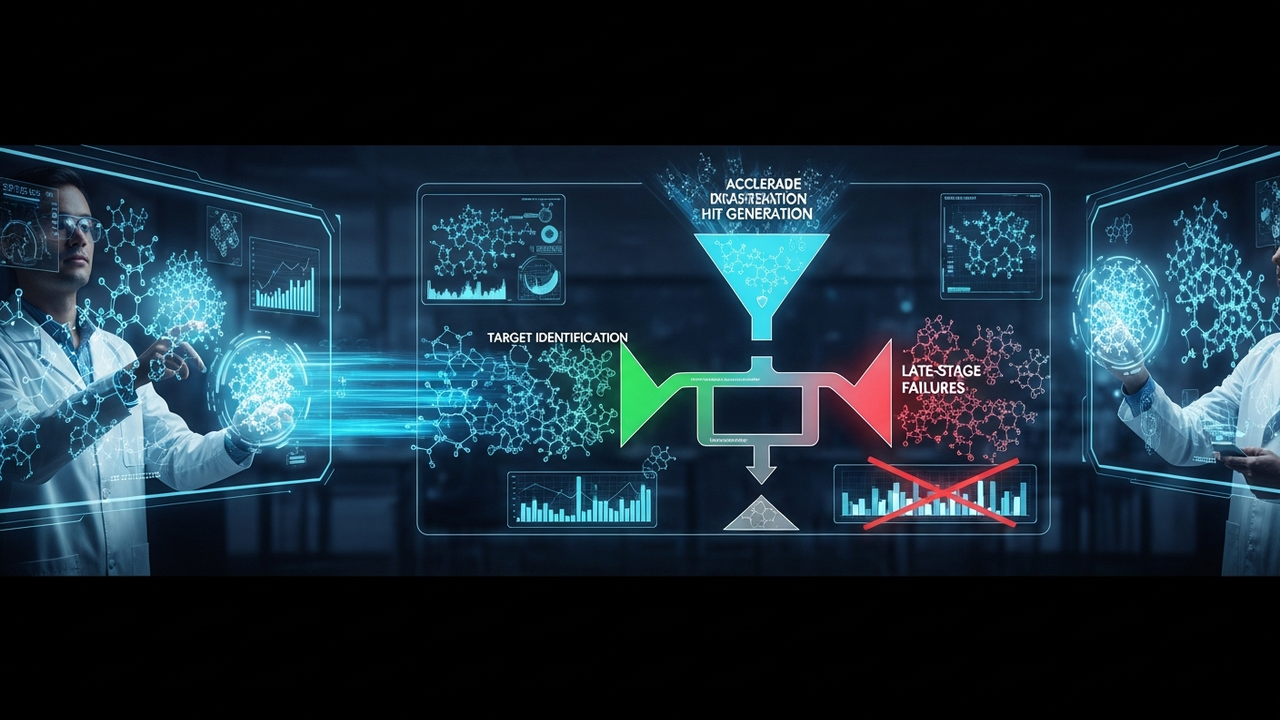
AI drug discovery is primarily transforming the early stages of the pharmaceutical pipeline, specifically accelerating target identification and hit generation processes. This streamlines tasks that traditionally demanded years of manual effort. The fundamental business rationale for AI in pharmaceuticals is its ability to identify and eliminate drug candidates likely to fail early in the development process, thereby preventing the significant financial burdens associated with late-stage clinical failures.
Technical / Clinical Details
AI excels at analyzing vast biological and chemical datasets to pinpoint novel target candidates and generate compounds with high affinity for these targets. For example, machine learning algorithms can extract patterns from existing drug databases and omics data to uncover new target pathways or mechanisms of action. Deep learning-based generative models propose more diverse molecular structures faster than human chemists and predict their pharmacological properties, dramatically accelerating hit compound discovery.
Conversely, later stages, including wet-lab validation, animal studies, and the most expensive human clinical trials, still require considerable time and resources and largely depend on traditional methodologies. AI’s role is concentrated on acting as a ‘gatekeeper’ before these high-cost phases, selecting only the most promising candidates to advance.
Background & Context
The pharmaceutical industry has long grappled with low success rates for new drug development and colossal R&D expenditures. A major contributing factor has been the high number of drugs that ultimately fail in clinical trials despite promising initial results, imposing significant financial strain on companies. The integration of AI is seen as a strategic solution to this challenge. By employing AI in early discovery, companies aim to feed higher-quality candidates into the pipeline, thus improving overall success rates and reducing costs.
Strategic Significance & Outlook
Moving forward, AI is expected to expand its influence across more stages of the drug discovery process through increasingly sophisticated algorithms and the integration of larger datasets. In the future, AI will not only contribute to early-stage screening but also to predicting preclinical outcomes, optimizing clinical trial designs, and identifying biomarkers, thereby further enhancing efficiency and success rates across the entire drug development lifecycle. This advancement promises to provide patients with faster access to more effective treatments globally, reinforcing the industry’s commitment to innovation and patient benefit.
Source: https://converge-bio.com/blog/how-ai-drug-discovery-is-reshaping-the-pharma-pipeline
Get our weekly technology intelligence — free
Receive an infographic that lets you judge at a glance whether each field’s analysis report is worth reading.
Subscribe Free — Weekly Tech Intelligence
By subscribing, you’ll receive Troy-Technical’s weekly technology intelligence newsletter.
- Your email and selected fields are used only to deliver the newsletter.
- We never share your information with third parties.
- You can unsubscribe anytime via the link in each email.
See our Privacy Policy for details.
Takes about a minute · Unsubscribe anytime