Key Findings
The California Institute of Technology (Caltech) and Sophia Space, an orbital space computing startup, have been granted a patent for an efficient passive cooling system designed for orbital data centers. This innovative technology addresses the long-standing challenge of thermal management for high-performance computing in space.
Technical Details
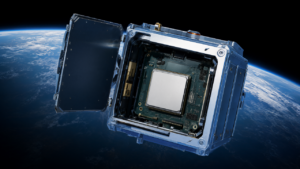
The patented cooling system features a tile-based modular architecture, where each tile possesses independent cooling capabilities, allowing for flexible scaling and configuration to suit various spacecraft designs. The core of the cooling mechanism relies on passive thermal radiation. Specifically, the system generates power from solar cells on the sun-facing side of the spacecraft, which is then used to operate the computing units. Simultaneously, any excess heat generated within the data center is efficiently radiated into deep space from the shaded side of the spacecraft, which is typically much colder and not directly exposed to solar radiation. This process is achieved by combining passive components such as heat pipes and radiating panels, significantly reducing power consumption and mechanical complexity compared to active cooling systems. Such passive cooling is essential for long-term reliability in the space environment and contributes to reducing failure risks.
Background & Context
In recent years, the demand for on-orbit data processing (edge computing) has rapidly increased across various space missions, including Earth observation, telecommunications, and scientific research. However, managing heat in space is exceptionally challenging due to the absence of convective heat transfer. Traditional satellites have limited computing capabilities, requiring vast amounts of data to be transmitted to Earth for processing. This often results in communication delays and bandwidth constraints. Orbital data centers aim to overcome these challenges by enabling real-time processing and AI inference directly in space, but their realization is contingent upon efficient and highly reliable cooling systems. The patent by Caltech and Sophia Space marks a significant step toward resolving this technological bottleneck in the field.
Strategic Significance & Outlook
Sophia Space plans to initiate sales of its “TILE” system and related components in 2028. Furthermore, around 2029-2030, the company intends to launch a constellation of four to six small satellites to conduct in-space validation of the cooling system and the overall orbital data center capabilities. If successful, this technology will dramatically enhance computing power in space, enabling the execution of more complex AI algorithms, real-time analysis of Earth observation data, and improved autonomy for deep space exploration. Ultimately, it holds the potential to establish space as a new data center hub, creating a novel infrastructure that complements the Earth’s digital economy. This initiative represents a glimpse into the future driven by the convergence of space technology and AI.
Get our weekly technology intelligence — free
Receive an infographic that lets you judge at a glance whether each field’s analysis report is worth reading.
Subscribe Free — Weekly Tech Intelligence
By subscribing, you’ll receive Troy-Technical’s weekly technology intelligence newsletter.
- Your email and selected fields are used only to deliver the newsletter.
- We never share your information with third parties.
- You can unsubscribe anytime via the link in each email.
See our Privacy Policy for details.
Takes about a minute · Unsubscribe anytime