Key Findings
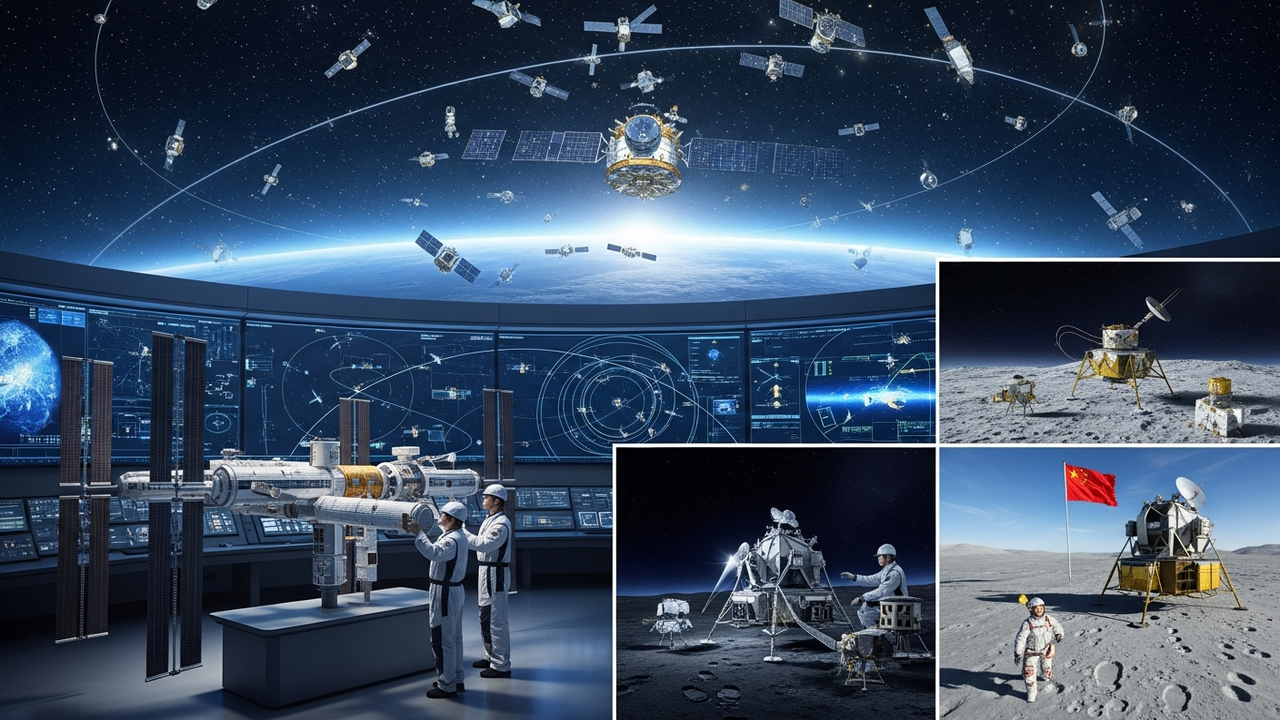
The China National Space Administration (CNSA) is aggressively advancing a wide range of space development initiatives, including the established operation of its independent, permanently crewed ‘Tiangong’ space station, and an ambitious lunar exploration program (Chang’e program) targeting a human lunar landing by 2030. Furthermore, China is pursuing a Mars sample return mission and multiple large-scale satellite internet constellations (‘Guowang’ and ‘Qianfan’) designed to compete with Starlink. Currently, China conducts over 60 orbital launches annually, surpassing any other nation in rocket launches.
Technical Details
The ‘Tiangong’ space station, comprised of indigenous modules, serves as a platform for long-term human scientific research and technology demonstration. The ‘Chang’e’ lunar exploration program is progressively escalating from robotic exploration to crewed landings, with an eye towards future lunar base construction. The Mars sample return mission aims to retrieve crucial scientific data for detecting signs of extraterrestrial life. The ‘Guowang’ and ‘Qianfan’ megaconstellation projects are designed to provide global broadband internet connectivity, challenging the U.S. Starlink, with thousands of low Earth orbit satellites planned for deployment. These plans are underpinned by China’s rapid advancements in rocket technology, space communication, and human spaceflight capabilities.
Background & Context
China’s space development has been a top national strategic priority for many years, enabling it to rapidly catch up with, and in some areas surpass, traditional space powers like the U.S. and Russia. The construction and operation of its own space station, coupled with a clear roadmap for human lunar exploration, signifies China’s establishment not merely as a follower in space technology but as a major new player in space development. Notably, the commercially oriented megaconstellations are expanding China’s influence in the international space economy.
Strategic Significance & Outlook
These CNSA plans are expected to dramatically enhance China’s space capabilities in the coming years, significantly altering the global space development landscape. A successful human lunar landing would not only showcase China’s scientific and technological prowess and national prestige but also potentially influence the formation of international rules regarding lunar resource utilization and deep-space exploration. Furthermore, the deployment of its megaconstellations will introduce new competition into the global internet connectivity market and contribute to bridging the digital divide. The acceleration of China’s space development is anticipated to have broad implications for the entire global space industry, in terms of both international cooperation and competition.
Source: https://orbitalradar.com/space-agencies/cnsa
Get our weekly technology intelligence — free
Receive an infographic that lets you judge at a glance whether each field’s analysis report is worth reading.
Subscribe Free — Weekly Tech Intelligence
By subscribing, you’ll receive Troy-Technical’s weekly technology intelligence newsletter.
- Your email and selected fields are used only to deliver the newsletter.
- We never share your information with third parties.
- You can unsubscribe anytime via the link in each email.
See our Privacy Policy for details.
Takes about a minute · Unsubscribe anytime