Background
Amid growing concerns over lithium resource constraints, escalating prices, and geopolitical risks, sodium-ion batteries (NIBs) are emerging as a compelling, sustainable energy storage solution, leveraging abundant and inexpensive sodium. However, NIBs still face challenges in matching the energy density, cycle life, and fast-charging capabilities of their lithium-ion counterparts. Bridging this performance gap demands significant breakthroughs in materials science, with the integration of computational science and artificial intelligence (AI) offering one of the most promising pathways forward. A recent review offers researchers and engineers a comprehensive foundation for understanding the key challenges and solutions in NIB development.
Key Findings
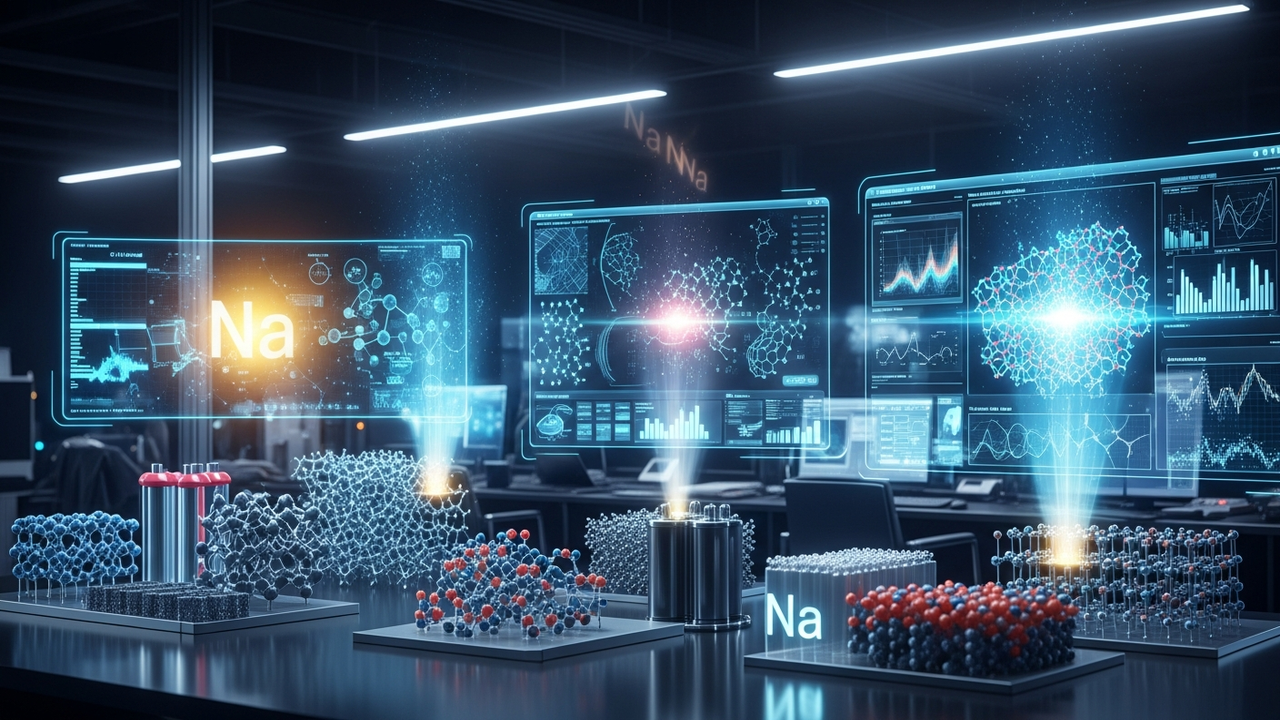
A recent review published in MDPI (Multidisciplinary Digital Publishing Institute) underscores the pivotal importance of innovation in electrolyte and electrode materials, alongside advanced interface construction strategies, for boosting the performance of next-generation sodium-ion batteries (NIBs). Crucially, the paper emphasizes that theoretical calculations—specifically Density Functional Theory (DFT) and Molecular Dynamics (MD)—combined with Machine Learning (ML) technologies, are indispensable for accelerating the discovery and optimization of these novel materials. This insight provides a clear technological roadmap for NIBs to mature into a viable alternative to lithium-ion batteries.
Technical Details
The review meticulously analyzes the properties, advantages, challenges, and optimization pathways for various NIB electrolyte compositions, including organic solvent-based systems, ionic liquids, and solid-state electrolytes. It specifically highlights how complex chemical reactions and structural changes at the electrode-electrolyte interface critically impact battery performance, safety, and cycle life. The paper details advanced design strategies for constructing robust and stable electrode/electrolyte interfaces, such as the solid-electrolyte interphase (SEI) layer. Here, theoretical calculations are shown to be essential for predicting ion transport mechanisms, interface reactions, and material stability at atomic and molecular levels, elucidating subtle behaviors often inaccessible through experimental methods alone. Furthermore, machine learning emerges as a powerful tool for analyzing vast material databases to predict and optimize novel electrolyte and electrode compositions or interface structures, thereby efficiently narrowing the experimental search space and dramatically shortening development cycles.
Outlook
Continued advancements in theoretical calculations and machine learning are poised to facilitate a paradigm shift towards AI-driven design for NIB electrolyte and electrode materials, significantly accelerating their commercialization. This trajectory is expected to result in the market introduction of higher-performance, safer, and more cost-effective NIBs. Looking ahead, the seamless integration of these computational and experimental methods could give rise to “self-driving laboratories,” dramatically accelerating the entire process from material discovery to optimization for NIBs and other next-generation battery technologies. Such technological innovation will play a crucial role in boosting the adoption of renewable energy and significantly contributing to a carbon-neutral society.
Source: https://www.mdpi.com/2079-6412/16/7/851
Get our weekly technology intelligence — free
Receive an infographic that lets you judge at a glance whether each field’s analysis report is worth reading.
Subscribe Free — Weekly Tech Intelligence
By subscribing, you’ll receive Troy-Technical’s weekly technology intelligence newsletter.
- Your email and selected fields are used only to deliver the newsletter.
- We never share your information with third parties.
- You can unsubscribe anytime via the link in each email.
See our Privacy Policy for details.
Takes about a minute · Unsubscribe anytime