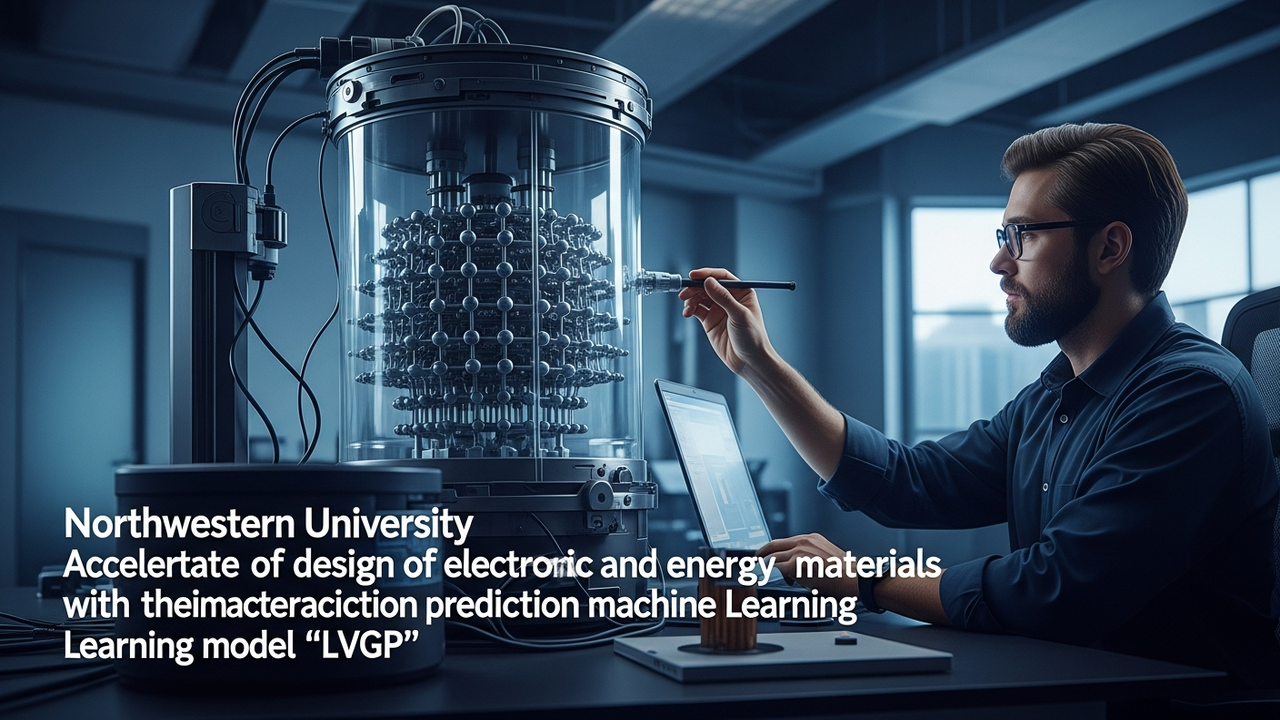
Key Findings: Northwestern University Accelerates Electronic and Energy Material Design with ‘LVGP’ Machine Learning Model
The research group of Professor Wei Chen at the Paula M. Trienens Institute for Sustainability and Energy at Northwestern University has developed a groundbreaking machine learning model, the ‘Latent Variable Gaussian Process (LVGP).’ This LVGP model possesses the capability to transform categorical material selections, such as elemental composition and crystal structure, into numerical representations to predict the performance of diverse materials. This innovative tool contributes to accelerating the discovery of new metal-insulator transition compounds in critical fields like electronics, energy storage, and thermal management, and is continuously being improved to handle large-scale material databases.
Technical & Clinical Details: Performance Prediction Through Integrated Categorical and Continuous Data
The defining feature of the LVGP model is its ability to predict material properties by associating categorical choices in material design (e.g., specific elemental combinations or types of crystal phases) with continuous physical properties. Traditional machine learning models often struggle with efficiently handling such mixed data types. LVGP uses latent variables to convert this categorical information into more meaningful numerical representations, which, when combined with Gaussian process regression, enables robust predictions even from a small number of data points. This allows researchers to efficiently identify materials with specific functionalities (e.g., high conductivity, specific bandgaps, superior thermal conductivity) within a vast material exploration space. New metal-insulator transition materials, in particular, are anticipated for applications in switching elements and smart devices, and LVGP serves as an indispensable tool for designing and optimizing these materials.
Background & Context: Challenges in Material Design and the Need for Data-Driven Approaches
The discovery of high-performance materials is the foundation of modern technological progress, yet the design process still relies on time-consuming and costly trial-and-error. Especially for materials with complex compositions or structures, finding optimal materials with desired properties has been challenging. Materials informatics aims to solve this problem by applying data science and machine learning to materials science. Models like LVGP bridge the gap between computation and experimentation, dramatically improving the efficiency of material development through data-driven approaches. This plays a crucial role in realizing sustainable energy technologies and advanced electronics.
Strategic Significance & Outlook: Automation of Material Design and Acceleration of Innovation
The LVGP model will become a powerful tool for accelerating material design automation and innovation by deepening its integration with large material databases (e.g., Materials Project) and further enhancing its predictive capabilities and versatility. In the future, this type of AI-driven platform is expected to autonomously design custom materials that meet specific application needs and even propose their synthesis processes. This will significantly shorten the material science research cycle, leading to the rapid market introduction of new products and technologies across diverse fields, including electronics, energy, environment, and medicine.
Get our weekly technology intelligence — free
Receive an infographic that lets you judge at a glance whether each field’s analysis report is worth reading.
Subscribe Free — Weekly Tech Intelligence
By subscribing, you’ll receive Troy-Technical’s weekly technology intelligence newsletter.
- Your email and selected fields are used only to deliver the newsletter.
- We never share your information with third parties.
- You can unsubscribe anytime via the link in each email.
See our Privacy Policy for details.
Takes about a minute · Unsubscribe anytime