Background
The rapid evolution of AI systems relies on vast amounts of sensitive data and complex computational processes, making their security a central concern for national security and economic stability. With the advent of ‘Q-Day,’ when quantum computers become practical, currently encrypted data faces an increased risk of ‘Harvest Now, Decrypt Later (HNDL)’ attacks. NIST’s PQC standards offer a unified framework for government agencies and private enterprises to implement quantum-resistant security measures to counter this impending threat. This establishes a foundation for protecting AI model training data, inference results, and communication channels far into the future.
Key Findings
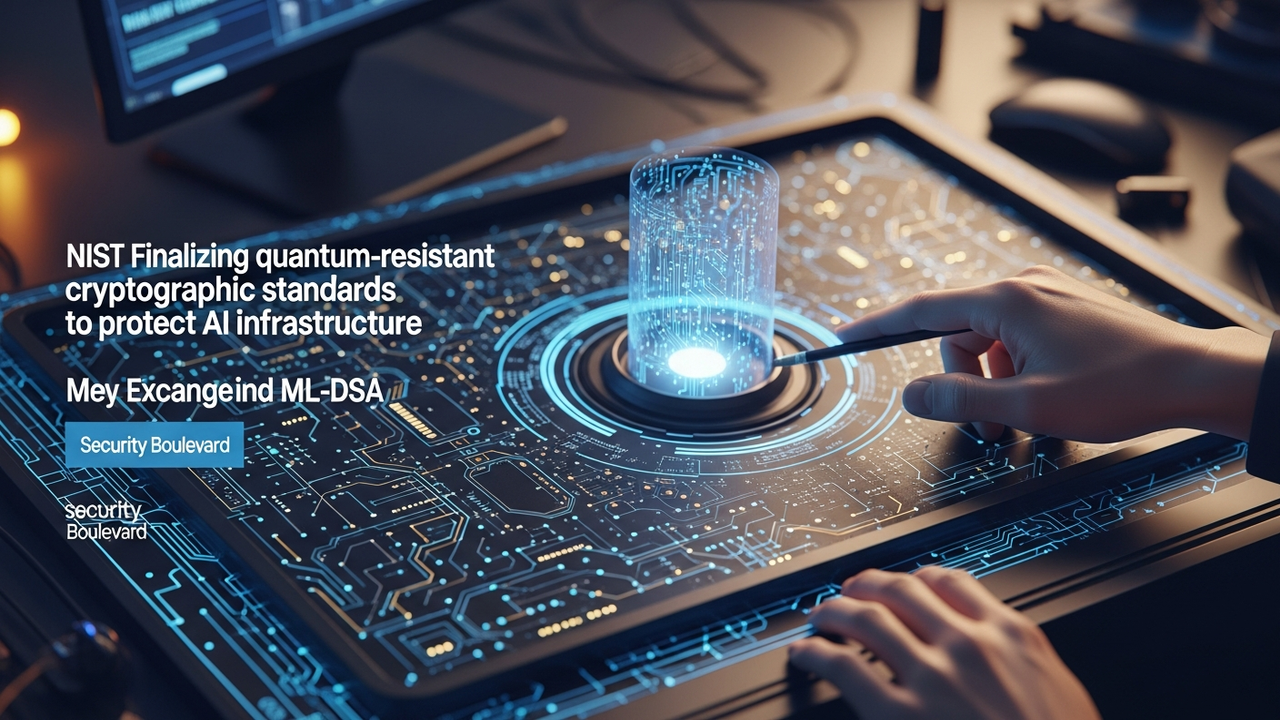
The finalization of Post-Quantum Cryptography (PQC) standards by the National Institute of Standards and Technology (NIST) marks a pivotal step in countering the cybersecurity threats posed by the advent of quantum computers. This initiative establishes new benchmarks for data protection, particularly within AI infrastructure, and provides a technical roadmap to effectively defend digital security against future quantum attacks. As key components, two robust algorithms have been specified: ML-KEM (FIPS 203) for key encapsulation and ML-DSA (FIPS 204) for digital signatures.
Technical & Implementation Details
ML-KEM (FIPS 203) functions as a Key Encapsulation Mechanism (KEM), enabling secure key exchange. Its purpose is to allow senders and receivers to securely establish a common secret key, resistant to quantum computer attacks, by leveraging public keys. ML-DSA (FIPS 204), on the other hand, provides data integrity and authentication as a digital signature algorithm. These algorithms are specifically designed to address the vulnerability of classical cryptosystems like RSA and Elliptic Curve Cryptography (ECC), which form the foundation of modern internet security, but could be easily broken by future quantum algorithms. Based on the computational difficulty of lattice-based mathematical problems, these PQC standards are considered resistant even to the most powerful quantum computers currently envisioned.
Future Outlook
The finalization of NIST’s PQC standards will accelerate global efforts towards building quantum-resistant AI infrastructure. Companies and research institutions must evaluate existing AI systems and data pipelines, then formulate strategies to integrate PQC algorithms. This will involve hardware upgrades, software redesign, and retraining for developers and security professionals. Quantum-resistant AI infrastructure is indispensable for sustaining innovation and trust across all sectors, including healthcare, finance, defense, and energy, making this standardization a crucial milestone towards its realization.
Get our weekly technology intelligence — free
Receive an infographic that lets you judge at a glance whether each field’s analysis report is worth reading.
Subscribe Free — Weekly Tech Intelligence
By subscribing, you’ll receive Troy-Technical’s weekly technology intelligence newsletter.
- Your email and selected fields are used only to deliver the newsletter.
- We never share your information with third parties.
- You can unsubscribe anytime via the link in each email.
See our Privacy Policy for details.
Takes about a minute · Unsubscribe anytime