Key Findings
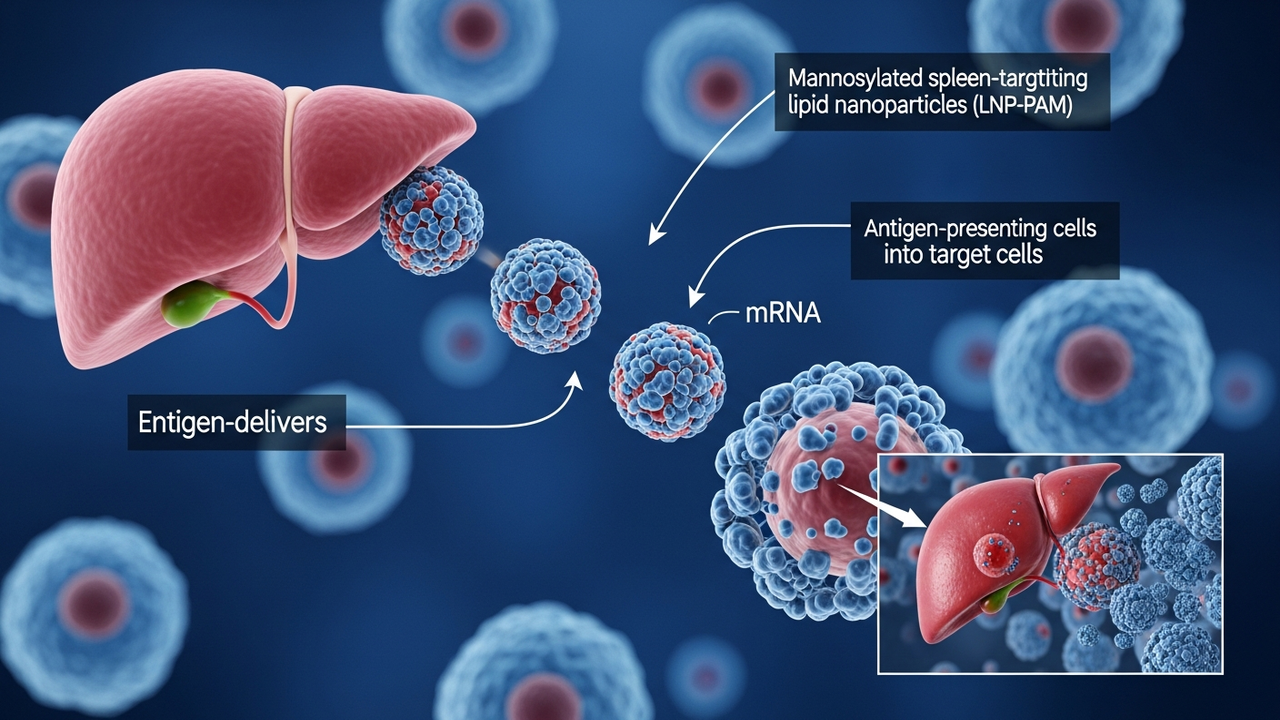
A significant breakthrough, published in ACS Publications, introduces a novel mannosylated spleen-targeted lipid nanoparticle (LNP-PAM) designed to dramatically enhance mRNA delivery to antigen-presenting cells. This innovative LNP-PAM system integrates both active and endogenous targeting mechanisms, successfully overcoming the primary challenge of predominant liver accumulation that has limited the broader application of existing LNP systems. This advancement is crucial for extending the reach of RNA therapeutics to vital immune organs beyond the liver, thereby opening new avenues for the development of immunotherapies and infectious disease vaccines.
Technical / Clinical Details
Traditional LNP systems primarily deliver their nucleic acid payload to the liver due to preferential uptake by hepatic cells, largely mediated by serum ApoE proteins. The LNP-PAM system addresses this by conjugating mannose sugar residues to the LNP surface. Mannose is known to specifically bind to mannose receptors found abundantly on the surface of immune cells, particularly macrophages and dendritic cells, which are critical antigen-presenting cells (APCs) in organs like the spleen. This ‘active targeting’ mechanism, combined with optimized physicochemical properties of the LNP that contribute to ‘endogenous targeting,’ enables LNP-PAM to significantly reduce hepatic uptake and efficiently enhance mRNA delivery to lymphatic organs such as the spleen, as demonstrated in in vivo studies. This precise targeting maximizes mRNA expression within APCs, thereby holding the potential to induce robust and specific immune responses. The research involved detailed analysis of how LNP particle size, surface charge, and lipid composition (especially ionizable lipid pKa and PEG-lipid ratio) influence organ-selective delivery.
Background & Context
mRNA-based therapeutics have gained immense recognition for their efficacy, particularly with the success of COVID-19 vaccines, and are now being explored for a wide array of applications in infectious diseases, cancer immunotherapy, and genetic disorders. However, the successful clinical translation of these therapies relies heavily on efficient and safe mRNA delivery to the intended cells and tissues. The challenge of effectively delivering mRNA to APCs in the spleen, which play a crucial role in initiating immune responses, has been significant due to the liver’s preferential uptake of most LNP formulations. Overcoming this hurdle is essential for developing more potent immune cell-targeted mRNA vaccines and cancer immunotherapies. This progress clearly signifies a paradigm shift in LNP design, moving from ‘endogenous passive enrichment’ to ‘programmed precise targeting.’
Strategic Significance & Outlook
The development of mannosylated spleen-targeted LNPs (LNP-PAM) represents a crucial step forward in the field of organ-selective delivery for RNA therapeutics. Moving forward, this technology is expected to find broad application in the development of next-generation vaccines and immunomodulatory therapies that specifically target immune cells in the spleen and lymph nodes. Further preclinical and clinical research will be essential to validate the efficacy and long-term safety profile of LNP-PAM. If successfully established, this technology could enable the induction of powerful therapeutic immune responses through specific immune cell engagement, leading to innovative treatment options for previously challenging diseases. Pharmaceutical and biotechnology companies are anticipated to show considerable interest in this type of precision-targeted LNP technology, accelerating the development of novel RNA therapeutics and ushering in an era of more sophisticated immunotherapies.
Get our weekly technology intelligence — free
Receive an infographic that lets you judge at a glance whether each field’s analysis report is worth reading.
Subscribe Free — Weekly Tech Intelligence
By subscribing, you’ll receive Troy-Technical’s weekly technology intelligence newsletter.
- Your email and selected fields are used only to deliver the newsletter.
- We never share your information with third parties.
- You can unsubscribe anytime via the link in each email.
See our Privacy Policy for details.
Takes about a minute · Unsubscribe anytime