Key Findings
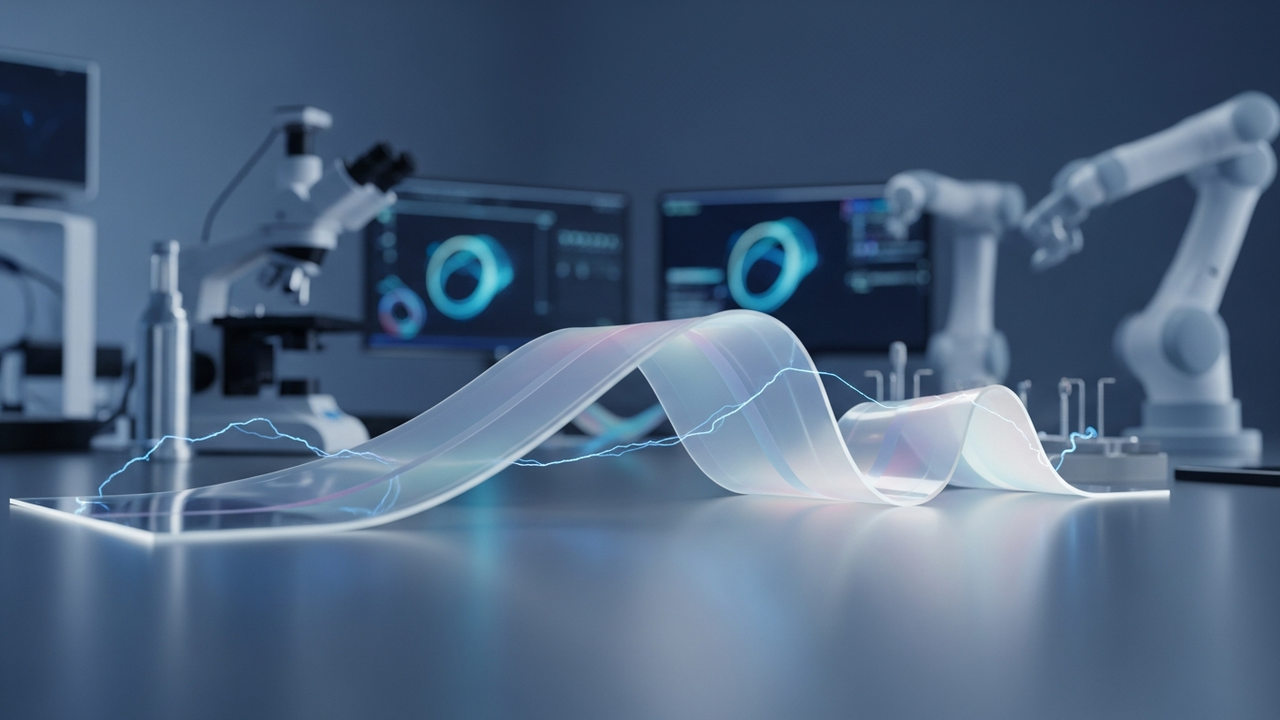
A recent study published in MDPI reports successful programming of electroactive bending morphologies in cantilevered dielectric liquid crystal elastomer (DLCE) sheets by precisely tuning the mesogen (liquid crystal molecule) alignments within the material. This discovery marks a significant step towards the practical application of liquid crystal elastomers (LCEs)—smart soft materials known for actively morphing their shape in response to various external stimuli—as electroactive actuators. It specifically accelerates LCE applications which have lagged behind existing electroactive materials like piezoelectric substances.
Technical / Clinical Details
Liquid Crystal Elastomers (LCEs) are polymer materials combining the ordered structure of liquid crystals with the flexibility of elastomers, exhibiting large and reversible shape changes in response to stimuli such as heat, light, or electric fields. Dielectric Liquid Crystal Elastomers (DLCEs) are a type of LCE that deforms when an electric field is applied, due to dielectrophoretic forces or electrostatic attraction. In this study, researchers demonstrated that by carefully designing and controlling the initial alignment of mesogen molecules within DLCE sheets (e.g., pre-stretch direction or alignment layer patterns), they could pre-program the bending direction, amount, and speed of cantilevered structures upon applying an electric field. For instance, by aligning mesogens at specific angles, complex bending motions—not just vertical, but also diagonal or twisting—become possible. This precise control over bending morphology is achieved by engineering the material’s microstructure, not just its composition, significantly expanding the capabilities of LCEs which were previously limited to unidirectional actuation. This technology is directly applicable to the design of simple, lightweight soft actuators that do not require external motors or gears.
Background & Context
Soft robotics has garnered significant attention in fields requiring human interaction, such as medicine, elder care, and wearable devices, due to its flexibility, safety, and adaptability to complex environments. These robots require actuators that convert external energy (electrical, thermal, optical, etc.) into mechanical motion. LCEs have been considered one of the most promising materials for artificial muscles in soft robots due to their high energy conversion efficiency and large deformation capabilities. However, LCE actuation via electric fields has been slower to develop for practical use compared to other electroactive materials like piezoceramics or shape-memory alloys, owing to challenges in responsiveness and control complexity. This research fills this technological gap by establishing a method to precisely program the electroactive response of LCEs, thereby accelerating the proliferation of electric-field-driven soft robots based on LCEs.
Strategic Significance & Outlook
The realization of programmable bending morphologies in electroactive DLCE sheets introduces revolutionary design freedom to the soft robotics field. This will accelerate the development of higher-performance, multifunctional soft robots capable of multi-directional movements, complex grasping, or delicate manipulations. Specific applications include minimally invasive surgical robots navigating inside the body, wearable assistive devices that adapt to user movements, or sensor robots autonomously exploring complex environments. Furthermore, by combining this technology with improvements in response speed and energy efficiency, applications in other fields such as smart fabrics, adaptive optical elements, and microfluidics devices are also anticipated. This research serves as a prime example of how advancements in smart materials and actuator technology can transform our daily lives and industries, driving innovation in human-robot interaction and adaptive systems.
Source: https://www.mdpi.com/2079-4991/16/8/204
Get our weekly technology intelligence — free
Receive an infographic that lets you judge at a glance whether each field’s analysis report is worth reading.
Subscribe Free — Weekly Tech Intelligence
By subscribing, you’ll receive Troy-Technical’s weekly technology intelligence newsletter.
- Your email and selected fields are used only to deliver the newsletter.
- We never share your information with third parties.
- You can unsubscribe anytime via the link in each email.
See our Privacy Policy for details.
Takes about a minute · Unsubscribe anytime