

Key Findings
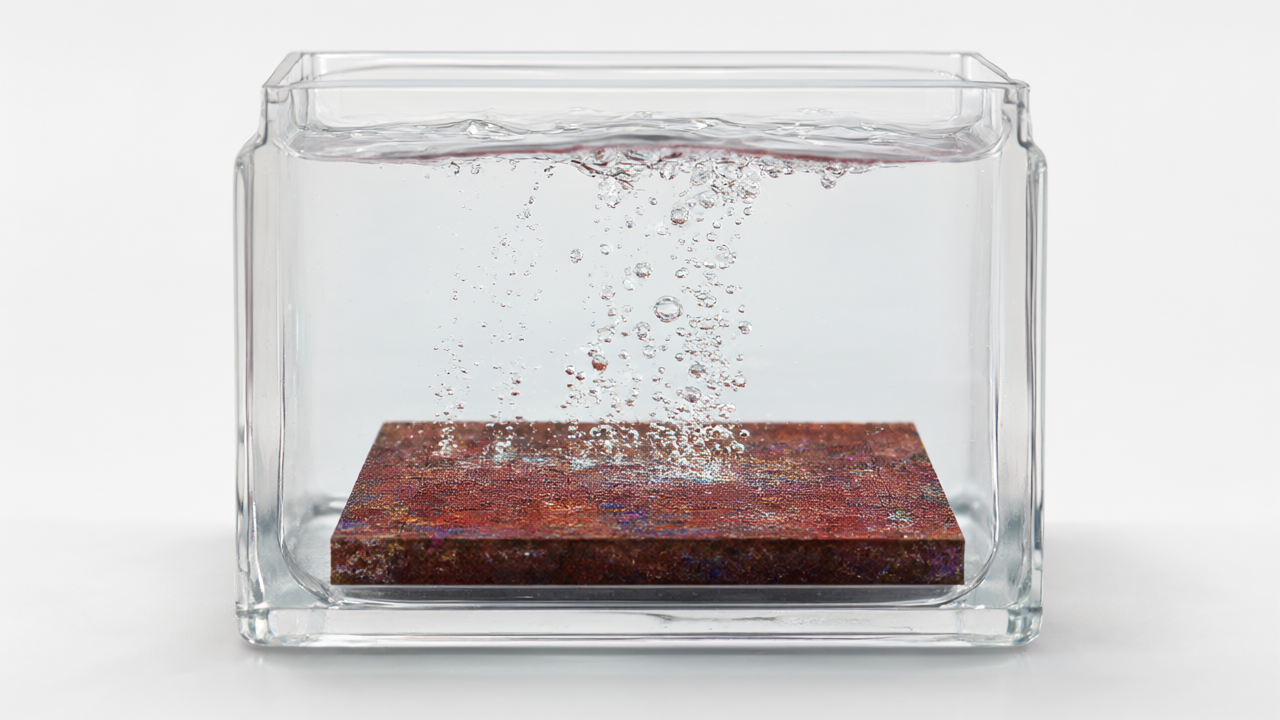
A research team at Shanghai Jiao Tong University has successfully developed a localized high-entropy oxide (LHEO) nanostructure catalyst that dramatically lowers the overpotential required for the oxygen evolution reaction (OER) in water splitting. Their novel α-Fe₂O₃@LHEO catalyst achieved an unprecedentedly low overpotential of 229 mV at a current density of 10 mA/cm² in alkaline water splitting, significantly outperforming benchmark commercial RuO₂ catalysts, which typically require 326 mV. This achievement represents a pivotal step towards highly efficient and cost-effective green hydrogen production.
Technical / Clinical Details
The breakthrough lies in the intentional introduction of lattice strain and phase separation within different metal oxides, leading to the formation of localized high-entropy oxide regions on the catalyst surface. This LHEO nanostructure, characterized by the atomic-level mixing of multiple metallic elements, provides a unique electronic structure and a multitude of active sites superior to conventional single-component oxides. The researchers demonstrated that this design effectively optimizes the adsorption energy of intermediates, which is the rate-determining step for OER, thereby lowering the reaction’s energy barrier. This mechanism results in a substantial enhancement of catalytic activity, enabling high current densities at significantly reduced overpotentials.
Background & Context
The global transition to clean energy heavily relies on efficient green hydrogen production through water electrolysis. However, the OER is a complex multi-electron transfer process that typically requires high overpotentials and depends on expensive noble metal catalysts like RuO₂ and IrO₂. The LHEO catalyst developed by Shanghai Jiao Tong University is groundbreaking because it achieves superior performance using a relatively inexpensive iron-based material. This innovation directly addresses the critical need for cost reduction and energy efficiency improvements in electrolyzers, which are essential for making green hydrogen commercially viable and globally scalable.
Strategic Significance & Outlook
Beyond hydrogen production, the LHEO catalyst holds promise for other electrochemical energy conversion systems, such as seawater-based zinc-air batteries. Seawater electrolysis, in particular, offers a pathway to overcome freshwater resource limitations for hydrogen generation. Further research into the catalyst’s long-term stability and scalability for industrial applications will be crucial. If these challenges are met, this functional material could become a cornerstone technology for sustainable energy solutions, profoundly impacting global energy security and environmental sustainability. Its performance surpasses current international benchmarks, positioning it as a leading candidate for next-generation OER catalysis.
Source: https://www.eurekalert.org/news-releases/1145328
Get our weekly technology intelligence — free
Receive an infographic that lets you judge at a glance whether each field’s analysis report is worth reading.
Subscribe Free — Weekly Tech Intelligence
By subscribing, you’ll receive Troy-Technical’s weekly technology intelligence newsletter.
- Your email and selected fields are used only to deliver the newsletter.
- We never share your information with third parties.
- You can unsubscribe anytime via the link in each email.
See our Privacy Policy for details.
Takes about a minute · Unsubscribe anytime