


Key Findings
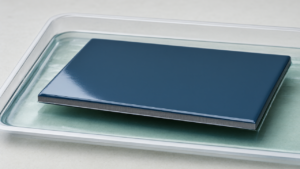
The developed transparent coating achieves a visible light transmittance above 83% while reaching a surface temperature of 86.5 °C under 1 sun illumination, representing an apparent photothermal conversion efficiency of 42.6%. In winter conditions, the coating demonstrates an ice adhesion strength of 56.8 kPa and an icing delay of 121 s at –20 °C without illumination. Under 1 kW/m² simulated solar irradiation, the ice-melting time on the CsₓWO₃-20/PSO coating is 46.4% shorter than on bare glass.
Technical Details
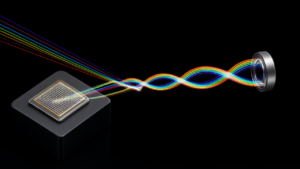
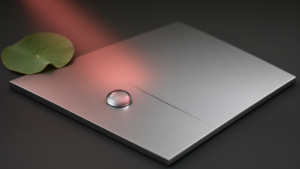
The coating is based on a phenyl/methylsiloxane cross-linked network combined with free polydimethylsiloxane (PDMS) segments. This structure creates a liquid-lubricant-free solid slippery surface with a sliding angle of 16°. To achieve spectral selectivity, cesium tungsten bronze (CsₓWO₃) nanoparticles are used as fillers, which provide strong absorption in the near-infrared region and relatively weak absorption in the visible range.
Regarding durability, the hybrid structure maintains stable performance after 1,000 abrasion cycles and prolonged chemical exposure.
Background & Context
Ice accumulation on outdoor optical windows is a critical challenge for UAV optoelectronic pods, automotive autonomous driving sensors, and building-integrated photovoltaic (BIPV) facades. Previous passive solutions, such as superhydrophobic surfaces and slippery liquid-infused porous surfaces (SLIPS), often suffer from lubricant depletion or wetting-state transitions. Conversely, active photothermal coatings using MXenes or carbon-based materials typically reduce optical clarity.
Significance & Outlook
Beyond winter de-icing, the near-infrared-selective absorption of CsₓWO₃ allows the coating to act as a solar heat shield. In tests using a model house, the coating reduced indoor temperatures by 19.9 °C. By combining liquid-lubricant-free solid slipperiness, low ice adhesion, and dual-season thermal management, this technology offers a durable, all-weather solution for transparent outdoor optical components.
Get our weekly technology intelligence — free
Receive an infographic that lets you judge at a glance whether each field’s analysis report is worth reading.
Subscribe Free — Weekly Tech Intelligence
By subscribing, you’ll receive Troy-Technical’s weekly technology intelligence newsletter.
- Your email and selected fields are used only to deliver the newsletter.
- We never share your information with third parties.
- You can unsubscribe anytime via the link in each email.
See our Privacy Policy for details.
Takes about a minute · Unsubscribe anytime