Key Findings
The battery energy storage system (BESS) industry is undergoing a significant paradigm shift driven by evolving safety standards and technical integration approaches. A critical development is the mandate for large-scale fire propagation testing under the 2026 edition of NFPA 855, which is making traditional building-based BESS installations increasingly difficult and expensive. This regulatory change is accelerating the transition towards modular, outdoor containerized BESS solutions, while projects like the Gemini solar-plus-storage facility showcase advanced DC-coupled system integration for enhanced efficiency.
Technical & Business Details
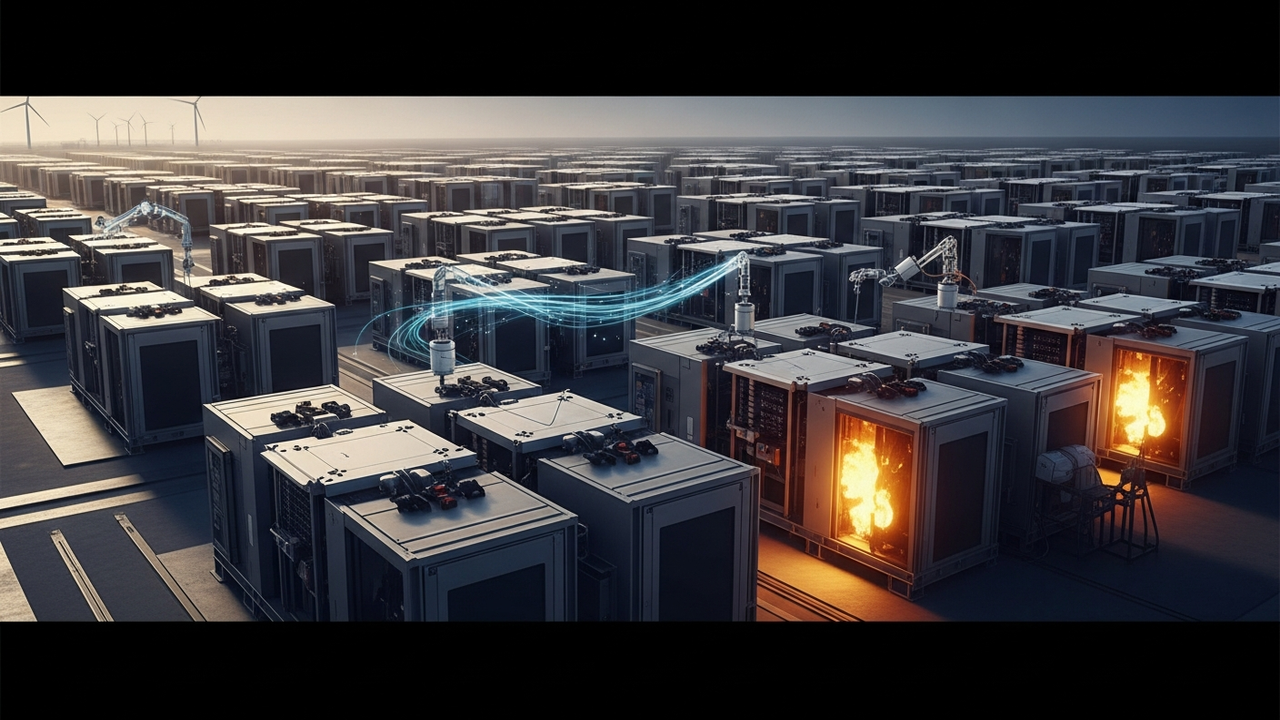
The 2026 NFPA 855 standard introduces rigorous testing and design requirements for BESS installations, particularly those within or adjacent to buildings, aimed at preventing thermal runaway and fire propagation. These stricter safety protocols significantly increase the complexity and cost of indoor deployments. Consequently, the industry is rapidly gravitating towards pre-engineered, factory-assembled outdoor container solutions, which offer better control over environmental conditions, simplified permitting, and inherent safety advantages by isolating potential hazards. Furthermore, the 2024 Gemini solar-plus-storage project in Nevada stands as a landmark example of advanced BESS integration. This gigawatt-scale facility employs a DC-coupled architecture, directly linking solar PV arrays to batteries. DC coupling minimizes conversion losses compared to traditional AC coupling, potentially boosting overall system efficiency and reducing balance-of-system costs, while simplifying the power electronics architecture. Beyond these, the article highlights trends such as diversified supply chains, increasing interest in long-duration storage, and AI-driven optimization.
Background & Context
The global push for clean energy necessitates reliable and safe energy storage. Previous incidents involving BESS fires have raised public and regulatory concerns, underscoring the need for robust safety standards. NFPA 855’s updated requirements are a direct response to these concerns, aiming to enhance the overall safety and public confidence in BESS technology. Concurrently, as renewable energy penetration grows, the efficient integration of generation and storage becomes paramount. Advanced integration techniques like DC coupling, exemplified by the Gemini project, are vital for maximizing the value of co-located solar and storage assets. These trends not only reflect technological maturation but also a fundamental rethinking of grid architecture and operational strategies, moving towards more resilient and secure energy systems.Strategic Significance & Outlook
The stringent requirements of NFPA 855 will fundamentally reshape the BESS deployment landscape, further fueling the growth of the outdoor modular container market. This emphasis on safety and standardization is expected to attract greater investment and accelerate BESS adoption worldwide. The success of large-scale integrated systems like Gemini sets a precedent for future renewable energy hubs, contributing to improved energy efficiency and grid stability. Collectively, these trends reinforce battery energy storage’s position as a core technology for the clean energy transition, guiding the future of power supply towards a safer, more robust, and sustainable paradigm. The industry is actively adapting, fostering innovation in both hardware and system integration to meet these evolving demands.
Source: https://www.energy-storage.news/seven-trends-reshaping-battery-energy-storage-in-2026-and-beyond/
Get our weekly technology intelligence — free
Receive an infographic that lets you judge at a glance whether each field’s analysis report is worth reading.
Subscribe Free — Weekly Tech Intelligence
By subscribing, you’ll receive Troy-Technical’s weekly technology intelligence newsletter.
- Your email and selected fields are used only to deliver the newsletter.
- We never share your information with third parties.
- You can unsubscribe anytime via the link in each email.
See our Privacy Policy for details.
Takes about a minute · Unsubscribe anytime