Key Findings
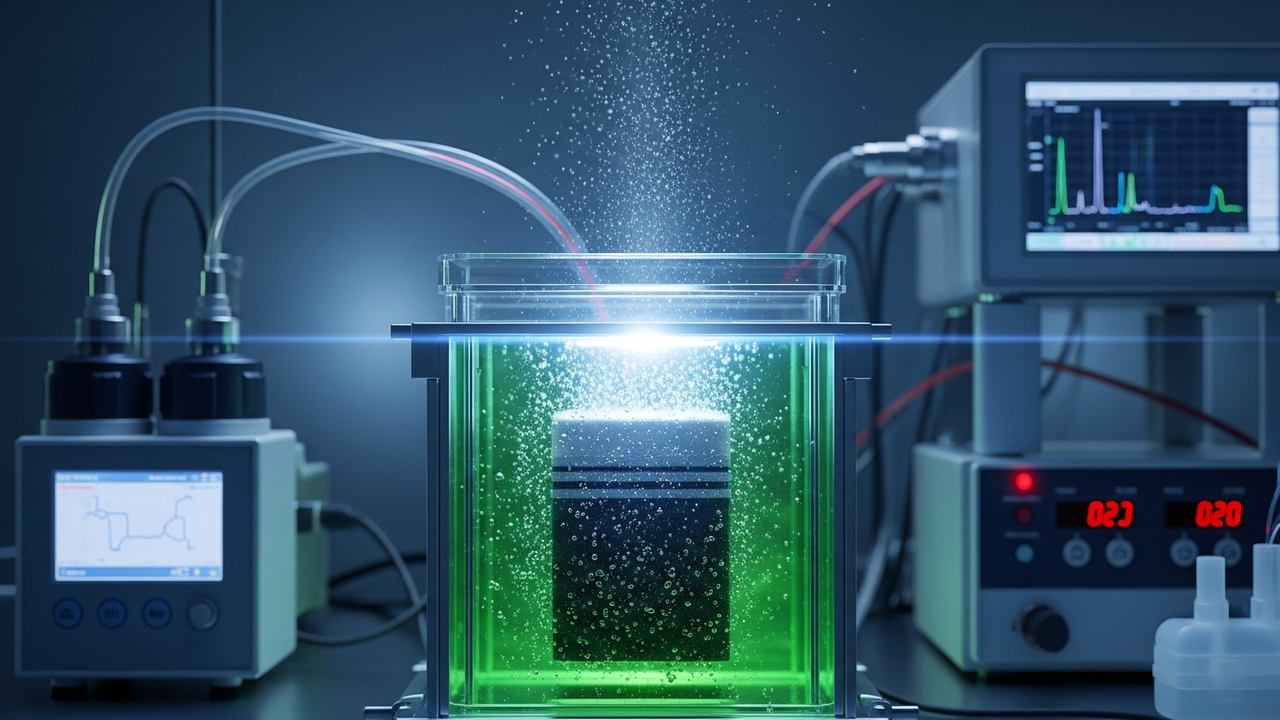
This research reports the development of ‘NiCo-LDH@Mo2CTx/NF,’ a hybrid electrode designed as a highly efficient non-precious metal anode for anion exchange membrane (AEM) water electrolysis. This innovative electrode combines conductive exfoliated Mo2CTx MXene with NiCo-LDH (nickel-cobalt layered double hydroxide) nanosheets. The electrode demonstrated outstanding oxygen evolution reaction (OER) performance in a 1.0 M KOH solution, achieving high current densities with overpotentials of just 324 mV at 10 mA cm–2 and 393 mV at 100 mA cm–2. This marks a significant step towards sustainable and efficient green hydrogen production without reliance on expensive noble metal catalysts.
Technical Details
The key to the electrode’s design lies in the utilization of exfoliated Mo2CTx MXene. By exfoliating MXene, its interlayer spacing is effectively expanded, providing an ideal conductive platform for the uniform growth of NiCo-LDH nanosheets. This intricate composite structure combines the high electrical conductivity of MXene with the abundant OER active sites of LDH, significantly enhancing electron transfer and charge transport at the catalytic interface. The high OER performance of the NiCo-LDH@Mo2CTx/NF electrode is attributed to the large surface area and porous structure provided by MXene, which allows for efficient diffusion of reactants and products, while maximizing the catalytic activity of NiCo-LDH. This improves the OER reaction rate and reduces overpotential. An overpotential of 393 mV at 100 mA cm–2 indicates excellent performance for practical application in large-scale electrolyzers.
Background and Industry Context
Water electrolysis for green hydrogen production is crucial for achieving a decarbonized society, but its cost and energy efficiency remain challenges. Specifically, the oxygen evolution reaction (OER) in water electrolysis is a major factor limiting the overall system energy efficiency due to its slow reaction kinetics and high overpotential requirements. Currently, highly active OER catalysts often include noble metals such as Ir (iridium) and Ru (ruthenium). However, these materials are scarce and expensive, making the development of non-precious metal catalysts an urgent priority. MXene, with its excellent conductivity and tunable surface chemistry, is a promising material to enhance the performance of non-precious metal catalysts. This research targets AEM water electrolysis, a more efficient and cost-competitive hydrogen production technology.
Strategic Significance and Outlook
The development of the NiCo-LDH@Mo2CTx/NF hybrid electrode significantly advances the commercialization of AEM water electrolysis technology using non-precious metal catalysts. The substantial improvement in OER performance will enhance the energy efficiency of hydrogen production and reduce operational costs. Future research will focus on the long-term stability, durability, and performance maintenance at even higher current densities for this catalyst. Additionally, this MXene-LDH compositing strategy is expected to find applications in other electrochemical reactions, such as the hydrogen evolution reaction (HER) and CO2 reduction reaction (CO2RR). If commercialized, this technology is anticipated to expand the supply of green hydrogen produced from renewable energy sources and reduce reliance on fossil fuels, thereby accelerating the transition to a sustainable energy system. This achievement serves as a concrete example of how nanomaterials are driving the energy revolution.
Source: https://pubs.rsc.org/fd/article/doi/10.1039/d6fd00075d/1223315
Get our weekly technology intelligence — free
Receive an infographic that lets you judge at a glance whether each field’s analysis report is worth reading.
Subscribe Free — Weekly Tech Intelligence
By subscribing, you’ll receive Troy-Technical’s weekly technology intelligence newsletter.
- Your email and selected fields are used only to deliver the newsletter.
- We never share your information with third parties.
- You can unsubscribe anytime via the link in each email.
See our Privacy Policy for details.
Takes about a minute · Unsubscribe anytime