Background
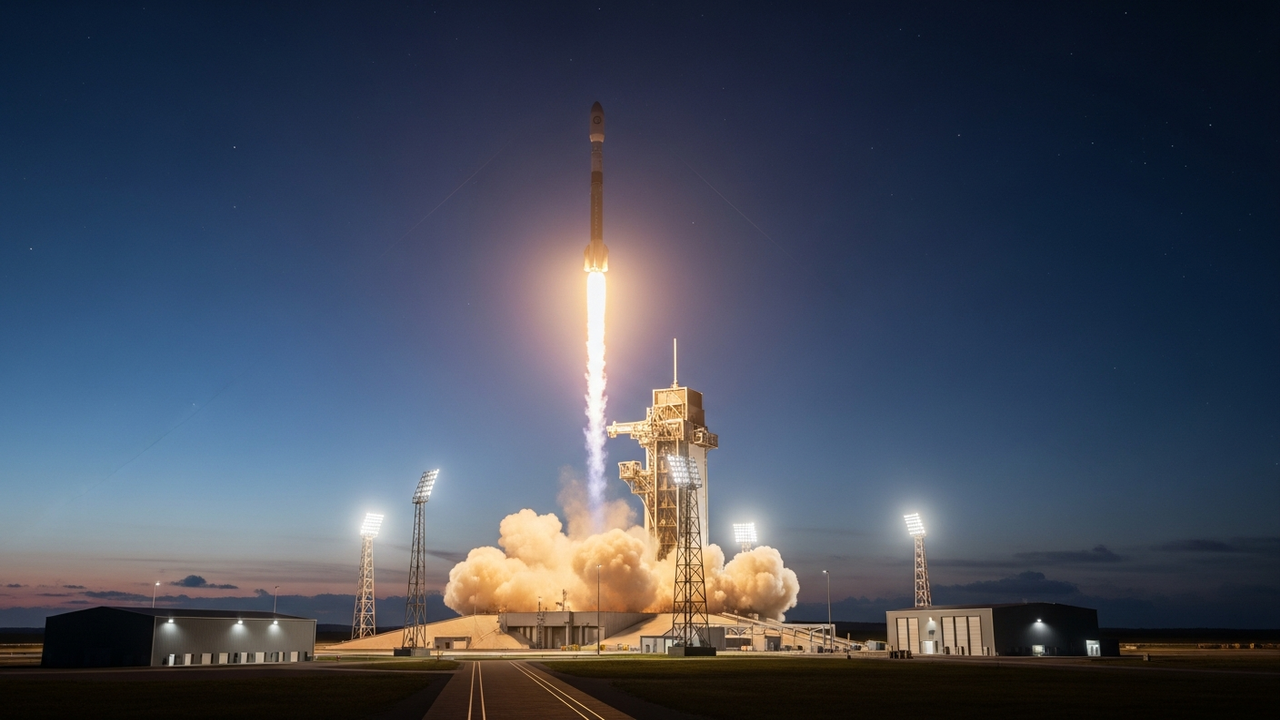
On August 6, 2026, Rocket Lab successfully executed its ‘The Grain Goddess Provides’ mission, deploying the QPS-SAR-13 satellite into low Earth orbit. Utilizing its Electron/Curie launch vehicle, the mission lifted off from Launch Complex 1A on New Zealand’s Mahia Peninsula. This flight marked the 13th Electron mission for Rocket Lab within the calendar year, a testament to the company’s high operational tempo and its reinforcing role in the burgeoning small satellite launch market.
Payload and Earth Observation Capabilities
The ‘The Grain Goddess Provides’ mission specifically carried the QPS-SAR-13 ‘Mai-I’ satellite, a compact Synthetic Aperture Radar (SAR) satellite developed by Japan’s QPS Institute. This advanced SAR satellite is engineered to provide high-resolution Earth observation data, with critical applications anticipated across various sectors. These include precision disaster monitoring, detailed infrastructure surveillance, and enhanced geospatial intelligence gathering. The Electron rocket’s precision injection capabilities for small payloads into specific orbital parameters make it an optimal platform for the rapid deployment of Earth observation satellites like QPS-SAR-13, enabling timely data acquisition for global stakeholders.
Operational Tempo and Market Strategy
Having completed 13 successful Electron missions already in 2026, Rocket Lab continues to demonstrate exceptional operational tempo and reliability within the competitive small satellite launch services market. The company’s strategic focus remains on providing dedicated, flexible, and cost-effective launch services for small and medium-sized satellites. This approach offers a compelling alternative to larger, often less frequent, launch options, enabling CubeSat and microsatellite developers to deploy their payloads promptly and predictably. This contributes significantly to the dynamism and accessibility of the commercial space industry. Furthermore, Rocket Lab is actively advancing the development of its Neutron rocket, a move designed to address larger payload requirements and strategically expand its market share beyond the small satellite niche.
Strategic Vision and Future Impact
Rocket Lab’s consistent launch success not only highlights its technical prowess but also epitomizes the rapid growth and increasing maturity of the commercial space sector, particularly within the small satellite segment. Its high-frequency launch capability is instrumental in accelerating data collection and the provision of critical services across diverse fields, including advanced Earth observation, global communication networks, and cutting-edge scientific research. The company’s foundational technology underpins its ambitious vision to become an ‘end-to-end’ space services provider, seamlessly integrating satellite manufacturing, dedicated launch services, and comprehensive in-orbit operations. This holistic strategy positions Rocket Lab as a pivotal player in building future space infrastructure and driving the ongoing expansion and innovation within the global space economy.
Get our weekly technology intelligence — free
Receive an infographic that lets you judge at a glance whether each field’s analysis report is worth reading.
Subscribe Free — Weekly Tech Intelligence
By subscribing, you’ll receive Troy-Technical’s weekly technology intelligence newsletter.
- Your email and selected fields are used only to deliver the newsletter.
- We never share your information with third parties.
- You can unsubscribe anytime via the link in each email.
See our Privacy Policy for details.
Takes about a minute · Unsubscribe anytime