Key Findings
Researchers have developed a groundbreaking technique to convert centrifugally-spun polyvinyl alcohol (PVA) based nanofibers into nitrogen (N) and sulfur (S) co-doped carbon nanofibers (CNFs). These CNFs demonstrate a high specific surface area, tunable porosity, and excellent mechanical and chemical stability, proving exceptionally promising as electrode materials for high-performance sodium-ion storage. This achievement marks a significant step towards realizing next-generation energy storage devices that are both efficient and sustainable.
Technical / Clinical Details
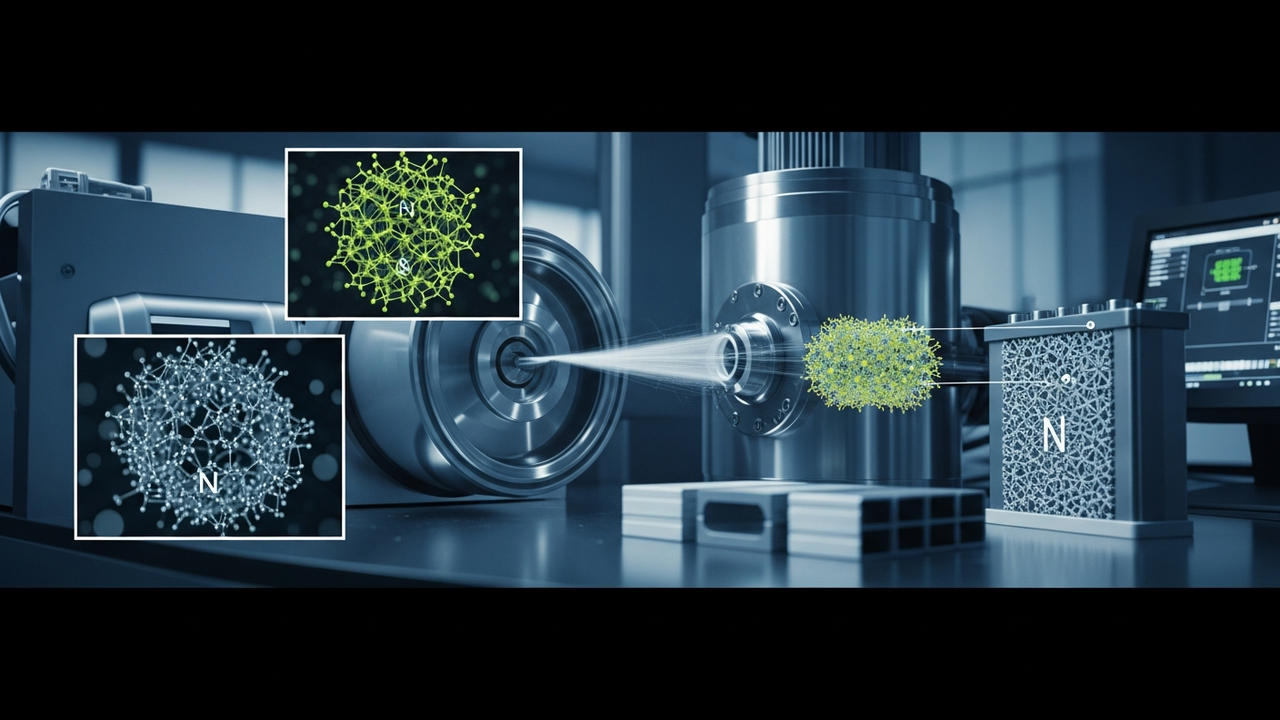
Centrifugal spinning is a simple and scalable process, offering the advantage of efficiently producing uniform nanofibers. By thermally treating PVA nanofibers manufactured using this technique, carbon nanofibers with N and S integrated into their backbone are formed. The heteroatom doping with N and S modifies the electronic structure within the carbon matrix, creating numerous active sites that facilitate the adsorption and desorption of sodium ions. Furthermore, the one-dimensional (1D) structure of the CNFs provides short pathways for rapid sodium ion diffusion within the electrode material, leading to high-rate capability and excellent cycle stability. Experimental results unequivocally showed that these CNFs exhibit significantly superior specific capacity and cycle life in sodium-ion batteries compared to conventional carbon materials.
Background & Context
Lithium-ion batteries are widely adopted as the primary energy storage technology for portable electronics and electric vehicles. However, they face challenges related to lithium resource scarcity, uneven geographical distribution, and high costs. In contrast, sodium-ion batteries (SIBs), which utilize abundant sodium, are garnering attention as a promising alternative. Nevertheless, the commercialization of SIBs requires the development of high-performance electrode materials to improve energy density, cycle life, and rate capability. This research addresses a critical challenge in material development, accelerating the practical implementation of SIBs.
Strategic Significance & Outlook
The development of N, S co-doped carbon nanofibers as electrode materials has the potential to significantly enhance the performance of sodium-ion batteries and accelerate their commercialization. Realizing cheaper and more sustainable energy storage technology could contribute to large-scale power storage, grid-scale applications, and cost reductions in electric vehicles. Researchers, engineers, and investors should pay close attention to the role sodium-ion batteries will play in a future constrained by lithium resources. This technology is expected to be a key driver enabling the construction of sustainable energy infrastructure and addressing diverse energy storage needs.
Get our weekly technology intelligence — free
Receive an infographic that lets you judge at a glance whether each field’s analysis report is worth reading.
Subscribe Free — Weekly Tech Intelligence
By subscribing, you’ll receive Troy-Technical’s weekly technology intelligence newsletter.
- Your email and selected fields are used only to deliver the newsletter.
- We never share your information with third parties.
- You can unsubscribe anytime via the link in each email.
See our Privacy Policy for details.
Takes about a minute · Unsubscribe anytime