Key Findings
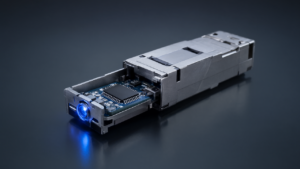
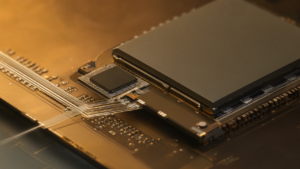
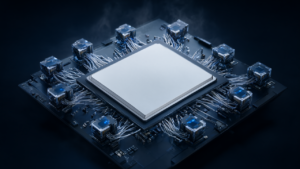
An article in Optica by Alexander Gaeta highlights significant advancements towards the commercialization of frequency comb technology for integrated photonics. This innovation enables the creation of low-power, compact, and lightweight microcombs that are compatible with existing photonic foundry materials, suggesting a clear path to large-scale adoption. The most pivotal breakthrough is the ability to generate multiple wavelengths from a single laser source, which can then be integrated as Co-Packaged Optics (CPO) on a chip. This is expected to fundamentally transform high-bandwidth communication within AI clusters, specifically between GPUs and CPUs.
Technical Details
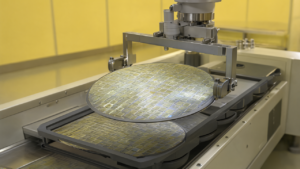
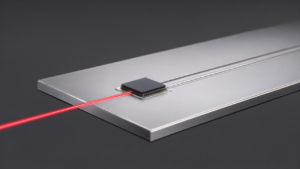
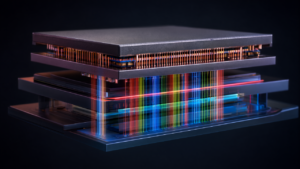
Frequency combs are specialized lasers that emit a spectrum of light comprising many discrete, equally spaced frequency components, often referred to as ‘teeth.’ Unlike traditional systems that require multiple lasers for various wavelengths, frequency combs achieve this from a single, compact laser chip. Microcombs, fabricated using standard silicon-on-insulator (SOI) or other photonic foundry materials, are particularly notable for their miniaturization and low power consumption. Gaeta describes this technology as a ‘miniature rainbow,’ emphasizing its potential to drastically simplify complex optical systems by integrating them onto a chip. This capability is crucial for meeting the demands of AI clusters for ultra-high-bandwidth data transfer, potentially exceeding hundreds of terabits per second, by providing high-density and energy-efficient optical I/O solutions.
Background & Context
The relentless progression of AI and high-performance computing (HPC) has led to an exponential increase in data movement within data centers, pushing the limits of conventional electrical interconnects. Co-Packaged Optics (CPO) and other optical interconnect solutions are seen as key to overcoming this bottleneck, but their realization hinges on the availability of compact, power-efficient, and mass-producible optical components. Frequency comb technology holds immense promise in meeting these requirements, particularly in enhancing the density and reducing the cost of optical modules. Its compatibility with existing semiconductor manufacturing processes streamlines the path to industrial-scale deployment. This technology directly contributes to scaling AI training models and accelerating inference speeds, making it a foundational technology for future digital infrastructure.
Strategic Significance & Outlook
The commercialization of frequency combs in integrated photonics is poised to have a transformative impact across diverse fields, including data communication, sensing, metrology, and quantum computing, extending beyond just AI clusters. Low-power, compact microcombs are expected to dramatically boost optical I/O performance, becoming a critical determinant of power efficiency and scalability in future computing architectures. As Gaeta notes, the ability to leverage existing foundry technologies will expedite time-to-market and accelerate widespread adoption. The evolution of this technology not only shapes the future of optical communication but also fosters the creation of entirely new applications, further solidifying its role as a cornerstone of next-generation technological innovation.
Get our weekly technology intelligence — free
Receive an infographic that lets you judge at a glance whether each field’s analysis report is worth reading.
Subscribe Free — Weekly Tech Intelligence
By subscribing, you’ll receive Troy-Technical’s weekly technology intelligence newsletter.
- Your email and selected fields are used only to deliver the newsletter.
- We never share your information with third parties.
- You can unsubscribe anytime via the link in each email.
See our Privacy Policy for details.
Takes about a minute · Unsubscribe anytime